
Devangshu Dutta
October 23, 2009
Trade, of course, has been global for millennia, so it seemed hardly unusual for retailers in the US, and in Europe to begin sourcing from distant countries in Asia where certain items were more readily available or significantly cheaper. Imports have also been encouraged as a political and developmental vehicle to aid friendly countries.
So, on the sourcing-end, large retailers have been comfortably operating beyond international borders for several decades even while the stores-end of their business was entirely domestic.
For most large modern retailers however, after the post-Second World War economic boom their core markets have grown relatively slowly (and rather predictably). While the sheer size of the US market kept American retailers busy domestically, planning and legal restrictions in terms of store size, locations, market share etc. limited manoeuvrability for retailers in Europe.
Among the current major retailers, the early retail explorer, Carrefour set out into neighbouring Spain in 1973 and then into distant Brazil in 1975. Soon after, Dutch retailer Ahold landed in the USA in 1977.
However, it took the opening up of East European economies in the 1990s to really prime the pump for growth of international retail. Suddenly, many more millions of consumers became available to European retailers close to their existing markets – both geographically and culturally – and western European retailers jumped at the opportunity.
At the same time, China seemed to have become steadily more open over the previous decade and in the early-1990s India looked accessible again. Some of the Latin American markets were also steaming up.
And, obviously, the prospect of 3-4 billion new consumers in emerging or developing markets was clearly not going to be ignored. In 2001, post dot-com, another inspiring idea hit the business world that was desperately looking for hope – the golden BRICs – the four countries focussed upon by Goldman Sachs as the biggest economies of the future: Brazil, Russia, India and China.
As incomes grew in these “developing” or “emerging markets”, the hypothesis was that consumer would want products and services similar to those in the more developed markets, creating the opportunity for retailers to cross borders. In the last 15 years or so, retail internationalization (and gradually “globalization”) has become an increasingly acceptable theme – in conceptual thinking, in retail boardrooms, in white papers, and finally in trade and mainstream media. The world has witnessed a network of retail subsidiaries, joint-ventures, franchise and other relationships spreading across continents.
Certainly, through the 1990s and 2000s, growing tele-connectivity, fashion, portable TV programming concepts, movies and print media seemed to give the impression that consumers around the world are becoming more similar, and can be reached by common formats and brands. Led by the FMCG companies on the one hand and fashion brands on the other, insights, concepts, products, formats, advertising campaigns are routinely extended across countries. (Unilever’s TV commercial for Close-Up in West Asia is a great example of this – an Anglo-Dutch company’s international brand of toothpaste, Indian models in Thailand, an Arabic voiceover and a Hindi song (“Paas Aao” – “Come Closer”) by Sona Mohapatra – surely you don’t get more global than that?)
But wait! Is the picture really as clear as that?
In 2006 Wal-Mart pulled the plug on its €2 billion German business that was a combination of German chains that it had acquired. In Russia it still has only a development presence since 2005, though it is reported to be looking at opening 10-15 stores in the following three years. According to Newsweek, Wal-Mart’s 13 year old Chinese business – even after an acquisition that is still to be approved – will have fewer stores than it would have opened in the US just in 2009. In the past it has struggled in Japan and Brazil.
In June 2009, Carrefour opened its first 86,000 sq. ft. hypermarket in Moscow, and a second one soon after that. In September, the company affirmed that the BRIC markets were its highest priority for international growth. However, in October it announced that it was pulling out of Russia. Within 4 months of the first store, Russia has gone from a market with “outstanding long term potential” to being a market to exit. In previous years the company has moved out of Japan, South Korea and Mexico. The Economist reports that significant Carrefour’s shareholders are forcing it to look at selling its Chinese business as well – obviously a move that would be politically very sensitive in China. The same shareholders are also reported to be urging a sale of its Latin American business. For now, the official statement from the company maintains an ongoing interest in all these markets.
Ikea has decided to freeze further investments in Russia, and has decided not to enter India until the Indian government allows 100 per cent foreign ownership of retail operations. It entered China in 1998, and has only 7 stores so far.
Even as Carrefour and Ikea announce plans to pull out of Russia, Russian retailers have pulled out from Ukraine, while Metro is cautious in its outlook about that country. French retailer Auchan has opened three stores in Ukraine since 2007, while the German retailer Rewe has opened all of nine since 2000.
Could the juggernaut of global retail be slowing, stopping or even – shock! – reversing? Are the BRICs and emerging markets falling out of favour?
Before we jump to conclusions, as they say in the television world: please don’t adjust your sets. As the French author Karr wrote: “plus ça change, plus c’est la même chose” (the more things change, the more they are the same).
It is a fact that, no matter how international or global a company becomes, when it gets to the business of retail, it needs to be intensely local. While elements of the business – concepts, products, people, money – can travel across borders, it is extremely difficult to take across an intact retail mix and expect to address a significant portion of the population in the new country. And given how important scale is to mass retailers, lack of localization would be a significant hurdle.
A company sourcing products from a developing country can fully expect his suppliers to adapt to his practices and customs. On the other hand, the same company entering that country as a retailer needs to do exactly that – adapt to the customers – rather than expecting them to fall in line because the “best practice” manual dictates certain processes or because central merchandising found some deals that were great for the home market which are totally irrelevant in the new market.
However, there are encouraging signs that retailers looking to grow internationally understand this more and more. Tesco, for one, has been following a localized approach in Thailand and South Korea, while Carrefour, Ikea, Wal-Mart have all steadily modified their approach in China and other markets. Wal-Mart’s cautious steps in India, including the stores opened by its joint-venture partner Bharti, are a complete contrast to the aggressive “plans” that were being reported in the press 2006-onwards. Recently Wal-Mart’s international chief C. Douglas McMillon was quoted by BusinessWeek as saying “we know you can’t run the world from one place”.
For the larger international retailers this means that, the benefits from international scale would be limited by the amount of localization that they carry out in their operations. For smaller and local competitors that are based in an emerging market this means a fighting chance to remain in business and even remain market leaders.
Lastly, as far as all the dark clouds gathered over international retailing and all the retreats being announced – stay tuned – this weather will change, too.
admin
May 9, 2009
By Devangshu Dutta, Tarang Gautam Saxena
While the Indian consumers have aspired to own international fashion brands, India’s large population base in turn has been an aspirational market for the international companies.
To remote observers, the Indian market may appear to be a virgin territory as far as international apparel and footwear brands are concerned. But India has seen the presence of international brands for almost a century, including mass brands such as Bata and luxury brands such as Louis Vuitton. However, as the colonial government systematically repressed local textile production, the local resistance to foreign products grew as well. Therefore, until the 1980s, the presence of international fashion brands was negligible.
In the early 1990s, as the Indian economy opened up again, a few international fashion brands entered the Indian market. The pioneering companies during this stage were Benetton, Coats Viyella and VF Corporation.
At this time the Indian apparel market was still fragmented, with multiple local and regional labels and very few national brands. Ready-to-wear apparel was prevalent primarily for the menswear segment which was thus a target for many international fashion brands (such as Louis Philippe, Arrow, Allen Solly, Lacoste, Adidas and Nike).

In the midst of this the media industry was also witnessing a high growth which aided the international brands in gaining visibility and establishing brand equity in the Indian market.
The late-1990s marked a significant milestone in the growth of modern retail in India. Higher disposable incomes and the availability of credit significantly enhanced the consumers’ buying power. A growing supply of good-quality retail real estate in the form of shopping centers and large format department stores also allowed companies to create a more complete brand experience through exclusive brand stores and shops-in-shop.
The number of international brands continued to grow each year at a steady pace until the early 2000s, and took off exponentially thereafter. By 2005 the number of international fashion brands present in India was over three times compared to that in the mid 1990s. The last few years (since 2005) have continued the significant growth of international fashion brands, including luxury brands such as LVMH, Aigner, Tommy Hilfiger and Chanel.
The Popular Entry Strategies
Many of the international companies entering India in the late 1980s and 1990s chose licensing as the entry route to India to gain a quick access to the Indian market at a minimal investment.
A few companies such as Levi Strauss set up wholly owned subsidiaries while others such as Adidas and Reebok entered into majority-owned joint ventures. This helped them to gain a greater control over their Indian operations, sourcing and supply chain, and brand.
In the subsequent years import duties for fashion products successively came down making imports a less expensive sourcing option and the realty boom brought investors in retail real estate that were ideal franchisees for the international brands. By 2003, franchising became the preferred launch vehicle for an increasing number of international companies, while only a few chose to enter through licensing.
In 2006 the Government of India reopened retail to foreign investment (allowing up to 51 per cent foreign direct investment in “Single Brand” retail). Using this route, many brands have entered India by setting up majority owned joint ventures, or transitioned their existing franchise arrangements into a joint venture structure.
The Entry Structure for Some International Brands
| Entry Strategy | Time Period | ||
| 1980s or Earlier | 1990s | Post-1999 | |
| Licensed | Louis Philippe, United Colors of Benetton and 012, Wrangler | Allen Solly, Arrow, Jockey, Lacoste, Lee, Nike, Van Heusen, Vanity Fair | Puma |
| Wholly Owned Subsidiary | Bata, Pepe Jeans | Levi’s® | Hanes, Triumph |
| Joint Venture (Majority) | Adidas, Reebok | Diesel, Nautica, Sixty Group | |
| Franchise or Distribution | Aldo, Burberry, Canali, Versace, Debenhams, Esprit, Gucci, Guess, Hugo Boss, Mango, Marks & Spencer, Mothercare, Tommy Hilfiger | ||
| Joint Venture (incl. Minority Stake) | Celio, Etam, Giordano | ||
Source: “Global Fashion Brands: Tryst with India” (A Report by Third Eyesight) © Third Eyesight, 2009
Note: The above table shows the structure used during entry, and not the structure that exists currently.
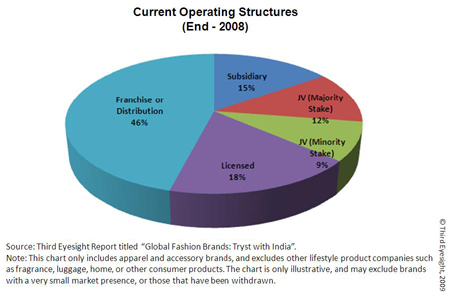
By the end of 2008, just under half of the brands were present through a franchise or distribution relationship, while over a quarter had either a wholly-owned or majority-owned subsidiary. These structures allowed the brands to have greater control of operations, particularly of product.
Shifting Strategies
Many international companies have evolved their presence in India into structures different from those at the time they entered the market.
A good example depicting the shift in business strategy is that of VF Corporation which entered India in 1980s by assigning the Wrangler license to Dupont Sportswear. Since then it has launched a variety of brands in different product categories with number of Indian partners and finally formed a joint venture, VF Arvind Brands Pvt. Ltd., with Arvind Brands.
Another example of a company that has evolved its presence is Benetton, which first entered India through a licensee (Dalmia). Benetton then transitioned in 1991 into 50:50 joint-venture and finally in 2004 took over the Indian business completely. However, it adopted the franchising route in 2006 for its premium fashion brand, Sisley, appointing Trent (a Tata Group company) as the national retail franchisee.
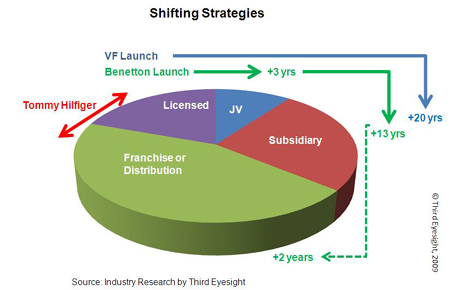
Many other companies such as Nike, Tommy Hilfiger, Marks & Spencer and Pierre Cardin (as described in our report “Global Fashion Brands: Tryst with India”) have changed their approach as the original structures did not perform as well as they had expected.
Obviously, each such change has cost the brands time, management effort, money and, sometimes, market share.
We believe that these shifts and the pain related to it could have been reduced, had the brands ruthlessly questioned the motivation for considering this market and their expectations from the market in determining an appropriate strategy.
What’s Ahead?
In the midst of economic upheaval around the world, how does India look as a market for international fashion brands?
Well, it is difficult to generalize even in the best of times. In the current global turmoil there is certainly a lot more unpredictability about international expansion for most companies.
Although India’s position as a target market for international brands has been improving, as is evident from the number of launches in the last 6-7 years, some companies considering international expansion may prefer entering other markets that may seem more “familiar”, developed and safe (such as Europe, Japan, South Korea or Taiwan). Against such comparisons, India’s growing but fragmented market can seem chaotic and difficult to deal with.
However, the fact remains that there are very few markets globally that can provide the sustained size of mid-term and long-term opportunity that India does. We are already seeing the more far-sighted and committed brands consolidating their position and presence in the market by continuing to look at expansion, even while examining how they can make their existing points of sale perform better. We also constantly come across new companies carrying out investigations into the market.
In the current environment we expect to see a shift in the nature of launch vehicle. While franchising seems to be a safe option for risk-averse brands in the current times, we will probably see more brands with a long term strategy, who would establish a controlled presence either through joint-ventures or through wholly-owned subsidiaries, since they can lay the foundation of the business today at much lower costs today than in the past few years.
India’s foreign direct investment (FDI) policy, allowing FDI only up to 51% in retail trading of “Single Brand” may have held back some fashion brands as they are still managed by owner founder with a conservative outlook on “control”. However, in the last couple of years, we have found companies not being deterred by the barriers to FDI.
As their comfort and familiarity with India has grown, international companies are more willing today to create corporate structures that allow them a presence in the market today and a step-through to a more controlling stake as and when government regulations allow.
All in all, we feel that international brands are in India not only to stay, but also to expand. There is yet a lot of potential untapped in the market, and as the integration of the Indian consumer with global trends continues, international brands can expect to find India an increasingly fertile ground for growth.
(c) 2009, Third Eyesight
Devangshu Dutta
May 5, 2006
With the possibility of 51% foreign direct investment (FDI) in India opened up to foreign retailers, one of the questions arising frequently is whether this means the death (or at least a slow-down) of franchising in India.
After all franchising, in most people’s mind, has these alternate images of unscrupulous franchisers ripping-off the life-savings of the small retailer on the one hand, and shady landlords in the guise of retail franchisees gouging at the pockets honest businessmen who are trying to build national brands. There also haven’t been too many sustained success models in India where both franchiser and franchisees have consistently won.
Surely, with FDI opening up gradually, foreign retailers would want to set up joint ventures in which they have control, rather than go through the franchise route, where their brand is “at the mercy of another company”? So it is a legitimate question, whether FDI sounds the death knell for franchising.
However, jumping to that conclusion would be to ignore the fundamentals of franchising as a business. If the barrier to FDI was the only factor in the growth of franchising, there would be no franchise businesses in countries such as the USA (the largest retail market) or Australia (again one of the most dynamic albeit small markets for franchising in the world), which have negligible barriers against foreign retailers or service providers setting up their own outlets.
At its most basic, a franchise is an authorisation, granted to an individual or company by another company, to sell its goods or services in a specific territory. The motivations for entering such a relationship are as varied as the individuals involved in the business, but typically cover some common points.
For the franchiser, franchising offers increase in the business footprint and scale that can help to reduce costs per unit of sales, improve business visibility and the brand, and make the business a more likely candidate for investment or listing. Franchisees become a source of finance and additional management to grow the business, which otherwise would need to be provided by the franchiser himself. Franchisers also gain from the franchisee’s local market knowledge, existing infrastructure and real estate, which they would otherwise take time, money and effort to build. What’s more, each franchisee is an entrepreneur and “business partner” who directly gains from helping the franchiser grow, unlike employee managers – thus, potentially there is more energy and enthusiasm available to drive the business.
The big trade-offs for the franchisee are that the local (or regional) business ownership, topline (sales) and a chunk of the margin, are passed on to the franchisee.
The biggest motivator from the franchisee’s point of view is that, despite operating under another company’s brand and selling another company’s products, he is not an employee but an independent business owner. This is as important to an individual store franchisee as to a regional or national master franchisee. The franchise relationship also offers the umbrella of a brand under which to operate his own outlet(s) – the time, efforts and investment put into the brand across the various territories all converge to the benefit of the individual franchisee when the customer walks in with a prior knowledge and confidence in the brand. The franchisee also benefits from previously defined processes and systems, as well as structured training and business coaching.
However, if I were to identify two major hurdles in the path of growth of franchising, they would be the immaturity of the business model on the franchiser’s part, and lack of compliance on the franchisee’s.
The franchiser must approach the market with a well-structured model that makes money and can be replicated across locations, and with a system of training and transferring knowledge to the franchisees.
The franchiser must also have a clear control on the product stream, intellectual property or other key success factors without which the franchise reduces to a generic outlet. Given the overloaded courts in the country, litigation to stop a franchisee from misusing the Brand’s rights is only a very very remote last resort!
There are no hard and fast rules that can be generalised about whether franchising, joint-venture or direct investment is the correct model to follow – each situation is unique to the specific companies involved, and it comes down to previous experience with franchising, the feasibility of franchising in that specific product or service mix, and the business attractiveness (risk and investment versus the return). Franchising offers an attractive model of business growth, certainly a more collaborative one which is in keeping with the changing and entrepreneurial environment. Now that both models, direct investment and franchise, are available, companies can actually make decisions based on a balanced analysis.
India has literally millions of individuals who would prefer to be their own boss and run a business, rather than being an employee. There are joint-families, where resources may be available in the form of some real-estate and family members who can be part of the business. Personal loans are available from family and friends, in the close social fabric of our communities. Ideal ground for franchising to grow.
To close, I must quote a conversation with an international Brand about 30 months ago. I put across the premise that given India’s potential size and strategic importance as a market, surely the brand would consider setting up its own company rather than a franchise relationship. The Brand’s head of internationalisation looked ambivalent because at that time FDI in retail was nowhere on the horizon, but thought that they might consider it if government regulations changed. Well, the government allowed FDI earlier this year. And yet, this brand recently launched in India through a franchise relationship, for many of the reasons listed above.
Franchising lives!
(Guest Column in The Financial Express on 5 May 2006)
Devangshu Dutta
March 3, 2006
In February, just before the mega-blitz of “India Everywhere” at the World Economic Forum, the Indian government took a step forward. Amidst shrill outcries from its coalition partners and domestic anti-FDI lobbies, it finally decided to bell the cat, and let foreigners invest in retail again!
About a month has passed since the cabinet announcement, the dust has settled, and it is a good time to consider what has happened.
Since the initial euphoria of the early-to-mid 1990s when international retailers entered the market including companies such as Benetton (50% JV) and Littlewoods (100% subsidiary), this revised policy provides the first opportunity for large global companies to participate in the Indian market’s growth.
The key questions being raised are:
What Is Allowed, and Who Might Enter?
Let’s first deal with what the government has actually allowed. In a nutshell, a foreign retailer can set up a company in India in which it holds 51% equity, the balance being held by an Indian partner. This subsidiary can operate retail stores in India under one brand name. All products in the store must also carry the same brand name, and this branding must have been applied during the process of manufacturing.
This means that, as yet, a foreign department store selling multiple national and international brands cannot set up its own 51% owned operation in India. Nor can a supermarket or hypermarket chain like Wal-Mart, Carrefour or Tesco, sell their wide range of products under any name but their own, if they decided to take a majority stake in a retail operation.
In theory, you could have a Wal-Mart store selling Wal-Mart cola (not Pepsi), Wal-Mart butter (not Amul or Mother Dairy), Wal-Mart chocolates (not Cadbury’s), Wal-Mart cookies (not Britannia or Sunfeast), Wal-Mart T-shirts (not USI or Duke). You could have Tesco jeans (not Levi’s or Numero Uno) or Carrefour luggage (not Samsonite or VIP). This obviously dilutes the consumer proposition of the store, which may then have to primarily focus on a single-point agenda – such as low prices – to draw consumer footfall.
On the one hand, the cabinet decision clearly allows companies such as Starbucks and The Body Shop to step in with a majority stake, provided the branding is clearly by the primary name (store name) – thus, you may not be sold the famous “Tazo Tea” in Starbucks, but get “Starbucks Tea” instead.
However, to a brand such as Starbucks, this policy change is significant as its international expansion is largely through owned operations, especially in potentially large and strategic markets such as India. Starbucks would now have the option of not only controlling the retail operation through a 51% ownership, but also the raw material sourcing, storage and wholesale operation.
On the one hand, this may mean nothing to a retailer such as The Body Shop, whose international strategy in Asia has been largely driven through franchise relationships. This is true now of India as well, as The Body Shop announced its master franchise arrangement with Planet Sports in India.
A retailer such as Gap would need to set up separate retail operations for Gap, Old Navy, Banana Republic and Forth & Towne. There obviously are ways to consolidate operations even with the diverse retail corporate structure, but it does mean that the foreign retailer will be operating several corporate entities in India.
An existing company such as Benetton does not benefit from this change in regulation. In 2005 Benetton actually increased its stake in its joint-venture to 100%, but in the bargain had to forego the stores it was running. Its current network comprises entirely of franchise stores, and will have to remain so, unless Benetton reduces its stake to 51% in order to be able to run stores in India, which is highly unlikely.
Other existing international brands such as Levi Strauss, Adidas and Nike are not retailers in themselves, and are not dramatically affected by the change in policy at all. All of them operate subsidiaries in which they have complete or majority ownership. Brands such as Tommy Hilfiger, Wrangler and Lee are also present through licence or franchise relationships, and unlikely to change their strategy.
Will Global Retailers Come?
All of this obviously raises the question whether government regulations preventing foreign investment in retail were or are actually keeping foreign companies out of the Indian retail market.
The answer to that is both “No” and “Yes”. The reason is that companies that are looking at international expansion apply criteria that are specific to their own business needs which can lead to very different evaluations by each company.
Laws allowing or preventing FDI in retail are only one of the several factors that any global retailer would look at, when considering a market.
Other factors, such as various market options possible at the time, the state of development in the market, existing sourcing and other relationships, scale and scope of investment required vs. the rate of return expected, the risk factors involved, and the retailer’s own business strategy, all play a part in their decision-making process.
Thus, in one company’s case India may be the hottest market in which it would like to open a store at the earliest possible date this year, while for another company India may be of interest only after 5-7 years.
Opening single-brand retail to foreign direct investment, therefore, is at best an encouraging signal that the government has provided. It is unlikely to prompt international retailers to look at India any sooner than they might otherwise have.
The second key issue is whether FDI itself is of any consequence to whether the retailers enter India. This again is related to the individual retailer’s own strategy and business context, as well as how they perceive the risk-return ratio.
Thus, while China may not have any restrictions on foreign investment in retail, western retailers may still prefer to go with a local partner due to the differences in cultural and market nuances. Even in other unrestricted markets international retailers may prefer to enter through licensees or franchisees because the effort and investment in setting up their own company may not be compensated by the size of the opportunity, or their own investment strategy may not be in line with setting up international subsidiaries.
Some companies such as Wal-Mart, Tesco, Gap and Starbucks prefer to invest in international operations themselves, as ownership gives them a higher degree of control over the business. Of course, both Tesco and Wal-Mart have set up joint ventures in markets that are starkly different in cultural and business norms from their home markets but, by and large, where feasible these companies prefer majority or 100% stake in the business.
Other companies, such as Mothercare, Debenhams and The Body Shop, have expanded their international presence through franchises. Their premise is proprietary product and an enormously powerful brand that translates well across cultures. These companies have taken the less intensive route of franchise. In India, too, they have signed master franchises. Mothercare has assigned master franchise rights to the Rahejas’ Shoppers Stop. Debenhams and The Body Shop have both signed up with Planet Sports (soon to be renamed Plant Retail), which is also the franchisee for Marks & Spencer.
Thus, while allowing FDI may help some companies, it is unlikely to have investors beating down the door in a rush to enter.
What Does FDI in Retail Mean for India?
Permission for foreigners to invest in retail businesses in India obviously mean different things to different stakeholders in India.
For real estate owners, especially shopping centre developers, new entrants are always welcome, since it provides a wider basket of brands to present to the consumer, and the opportunity to differentiate one shopping centre from another.
To existing retailers, it does mean potentially more clutter in the market, possible higher marketing expenditure for them to maintain their position. However, it also means that more players can encourage the growth of the market, which otherwise can end up looking stale and in-bred. Brands that are entering the market for the first time can also bring fresh ideas in terms of merchandise, store planning and display, advertising etc.
To the question of whether Indian retailers are prepared to handle the competition, I would say that, while global best practices help, retail is a uniquely local business. Indian retailers who bother to listen to the consumer and constantly upgrade their own business are possibly in a stronger competitive position than a foreign brand that wants to impose its own alien sensibility on the market.
For suppliers, new brands bring in new avenues for business growth. Many of the international brands will look to increasing their sourcing from India, to take advantage of local labour costs and skills, or to down-play the disadvantage of duties on imported merchandise. Thus, especially for suppliers of fashion goods this is definitely a growth opportunity. Retailers might even prefer to work with the supply base from which they already source for their operations in other markets. Thus, the growth opportunity exists for exporters – the question is how many of them are willing and able to make the transition to begin supplying locally.
Not only do new retailers bring the prospect of increased business, but also the possibility of better systems and skills, improved product development, and in all, an opportunity for the supply base to upgrade itself. This will certainly have a positive fall-out for exporters, since their business is likely to become overall more competitive globally, too.
Let’s consider another stakeholder, who we tend to miss – the government itself. Organised retailers, including global companies, tend to be more constrained by law than a retailer from the unorganised segment. Based on that assumption, a large international retailer (and his Indian counterpart) will set up a local company that will carry out business by the book, recording all sales and purchase transactions. All local sales and purchases will be subject to VAT and sales taxes, while all imports would be documented and therefore subjected to import duties. All of this means more revenue for the government.
On the other hand, do foreign retailers pose a threat at all?
Well, there is certainly a threat to those retailers who insist that the market needs to remain structured the same way that it has been for years, and who refuse to upgrade their own business. There may even be a threat to the large Indian corporate retailers who are competing on the basis of their scale relative to the rest of the market. With the presence of global retailers with deeper pockets, these large Indian retailers will no longer be the big boys on the block. But the positive outcome for the many seems to outweigh the negative outcome for the few.
What I would certainly like to see is how quickly the government translates the promise of opening into a concrete plan that can benefit the Indian consumer, the Indian supplier, the Indian real estate market and the government itself.
