
admin
April 13, 2023

Economic Times / ETRetail
April 13, 2023
There will be blood!
An all-out war has started in India’s FMCG space. At one end are the behemoths – HUL, P&G, Dabur, Marico, Tata Consumer, ITC, and others – and on the other side is the master disruptor, Reliance.
Known to change the market dynamics by venturing into new segments, Mukesh Ambani-owned Reliance Retail Ventures, a part of Reliance Retail, has now set its eyes on India’s over USD500 billion grocery retail market, as estimated by Euromonitor International. And the company is depending on its distribution channel and kirana partners to conquer this feat.
The strategy
In the last couple of years, Reliance Retail has been slowly and steadily developing a distributor ecosystem to take on the FMCG giants. However, its strategy is different from the incumbents.
Helmed by Isha Ambani, Reliance Retail has announced its plans to go big on FMCG with the help of local brands and manufacturers. During its AGM last year, the company mentioned that it intends on launching affordable products.
To carve a niche in the sector, it is using four primary moves:

What can we expect from each of these moves taken by Reliance to take over the FMCG market?
Reliance Retail has been a few years behind in entering the retail space. It entered the e-commerce market as well in 2016. But the delayed entry did not stop it from giving a tough competition to its competitors. Reliance is perhaps planning to repeat the success with its delayed foray into FMCG business as well.
Out of the INR50,000 crore grocery retail market of India, more than 75% is still dominated by kirana stores. And Reliance is not just eyeing the 25%, it is working with kiranas, and hence, targeting the whole market and not just the organised sector.
Let’s deep dive.
Reliance’s ‘selling ecosystem’
The grocery retail market of India constitutes nearly 67% of the country’s total retail market, according to Euromonitor International. Within the grocery retail, the channels are further divided by modern and traditional retailers. The former covers hypermarkets, supermarkets, and convenience stores, while the latter consists of kirana stores.


Kirana stores are the lifeline of grocery retail in India — 75% of all grocery sales happen via this channel. A presence across this channel is imperative for any FMCG brand.
The biggest FMCG conglomerates are available pan-India across majority of kirana stores with their cheapest SKUs as well – this could be the smallest SKU, for example sachets for shampoos, or the largest to make it cost efficient and allow consumers to buy in bulk; read products like detergents.
In India, the grocery retailing is always driven by value and availability, and not just cost.
Reliance Retail Ventures started interacting with the kiranas during the pandemic the way no one had done before. The company decided to become distributors. It sold both its own products, and competitive brands.

Conquering distribution
Distributors form the backbone of FMCG sales in India. While manufacturers sell with no credit timeline to distributors, the latter allows discounts to wholesalers, who then extend a 30-day period of credit line to retailers. Retailers then finally sell the product to consumers.
Reliance is now on its way to becoming one of the most aggressive distributors in the country.
Abhijit Kundu, senior vice-president-research, Antique Stock Broking Ltd, says, “Reliance’s focus on the FMCG industry started with the distribution business. They are essentially creating an entire ecosystem of their own. They are now distributors of their own brands, their acquired brands, and competitor brands, all. And here’s the best part, they are providing one of the deepest discounts to wholesalers as well.”
Almost three years ago Reliance started its distribution business. The company is now developing that and calls it the “selling ecosystem” in its annual report.

According to Reliance Retail’s FY22 annual report, “The company has expanded its physical footprint into tier-II and tier-III markets, bringing the benefits of modern trade to consumers in smaller towns.”
“Extending its reach even further to reach India’s 200 million households, the company is building one of the world’s largest distribution platforms under its ‘new commerce’ initiative by leveraging its extensive supply chain and sourcing capabilities, as well as New Age technologies, to support and enable millions of kirana and merchant partners across the country, assisting them to modernise, provide easy access to a diverse product portfolio, become more efficient and generate revenue,” the report states.
The MCA filing of Reliance Retail Venture’s FY21 report says, “In the lockdown period, Reliance Retail established itself as the ‘preferred’ partner to kiranas by ensuring uninterrupted supply of essential items. JioMart kirana service, now active in 33 cities, launched self-onboarding application, aiding rapid merchant additions.”
Speaking of the developing distribution network of its own by Reliance, Devangshu Dutta, founder, Third Eyesight, says, “Disintermediation, that is removal of middlemen, is a natural outcome of consolidation of the market. However, even in the most developed and some of the most consolidated consumer markets, intermediaries continue to exist because they provide value in terms of aggregation of demand from smaller markets or segments, as well as providing some financial buffer for both buyers and sellers.”
Working with kiranas
What is interesting is how Reliance Retail is engaging with the kirana stores and using their strength to its advantage. The company launched JioMart in December 2019, in phases.
“Reliance is working very smartly as a distributor. Instead of giving deep discounts on all brands, across SKUs, the company is providing deep discounts on the fastest-moving SKUs. Imagine you run a kirana store, technically no one has loyalty only to one distributor or wholesaler. Now, if as a kirana store owner you know you need 10 packets of let’s say Surf Excel, 1 Kg SKU, chances are that kirana will order the same from Reliance, as RRL knows that is the fastest-moving SKU, and hence will give the deepest discount on that. The discounts offered by RRL are almost 15%-20% higher than what any other distributor is providing right now,” says Kundu.
“The same kirana store owner will probably order other things from other distributors, depending on discounts again. What Reliance is doing is focusing on the volume game, and on the fastest-moving SKUs and brands, cause as a distributor they know these will move, no matter what,” he adds.
According to a Kotak Securities report in March 2021, the average number of distributors that a retailer works with is 10-15. And foods, which include staples, dairy, packaged foods, beverages and such contribute 75% of average daily sales.
The same report surveyed at the time of freshly launched JioMart selling ecosystem kirana partners in Mumbai, the count of which was 60, and majority of these kirana store retailers surveyed mentioned that JioMart has lower pricing than other distributors and offers better profit margins. Around 37% respondents also mentioned that Reliance pushed its own private labels while having all brands in stock.
Isha Ambani during the 45th Annual General Meeting of Reliance Industries Ltd mentioned that the company now has a merchant partner base of 20 lakh partners and is adding 150,000 partners every month. The company has five-year plans to cover 7,500 towns and 3 lakh villages.
“JioMart, delivering in over 260 towns, was rated India’s No. 1 trusted brand for online grocery. JioMart works on a hyperlocal delivery model and is India’s largest deployment of omni-channel capabilities,” she said.
“The FMCG and grocery business of Reliance, back in 2021-2022, was nearly INR55,000 crore – INR60,000 crore already. And this was even before the company was involved in brand sales of its own. This was primarily driven by its distributor business,” says Kundu of Antique Stock Broking.
Acquisitions and private labels
Dutta of Third Eyesight says, “Regarding the FMCG and food/beverage brand acquisitions by Reliance Retail, while they are relatively small, they feed into a strategy that side-steps the need to create brands from scratch – both, as private labels for its retail formats and other acquisitions for its broader expansion into other retail channels.”
“Creating new brands takes time and success is not guaranteed, no matter who is behind the brand. Riding on the goodwill and awareness of existing brands provides a shortcut, and further growth can be fuelled by additional resources,” adds Dutta.
Clearly, something Reliance Retail seems to believe as well. Or maybe it just wants to shorten the process of establishing its retail brands’ presence amongst consumers.
One of the biggest acquisitions of the company was Metro Cash & Carry, the German B2B wholesale company. Reliance acquired the latter in a 100% stake sale for INR2,850 crore. This would give a huge leg-up to Reliance’s already burgeoning “selling ecosystem” business.
Speaking about this acquisition Isha Ambani said in the press release, “We believe that Metro India’s healthy assets combined with our deep understanding of Indian merchant / kirana ecosystem will help offer a differentiated value proposition to small businesses in India.”
Metro India, which entered in 2003, was operating 31 stores across 21 cities. The company was servicing nearly 3 million customers via its B2B channel, of whom 1 million (customers) were frequent buyers. As of FY22, Metro Cash & Carry generated revenues worth INR7,000 crore and losses of INR49.7 crore, as reported by Tofler.
In 2021, Reliance Retail also acquired online milk and dairy products delivery platform, Milkbasket. As per its FY22 annual report, the company integrated Milkbasket with JioMart, and there were double the number of subscriptions on the Milkbasket platform. The company seems to have dairy leadership plans as well. Reliance Retail has recently got RS Sodhi, ex-managing director of Gujarat Cooperative Milk Marketing Federation (GCMMF), the parent company of Amul, onboard. Sodhi was associated with GCMMF for 40 years, out of which 12 years he held the position of managing director.
Besides, the company is also targeting the FMCG market with the help of private labels and acquiring brands. Over the last few years, Reliance Retail has spent nearly USD1.1 billion on brand acquisitions – this is across grocery and non-grocery segments.
Reliance Retail acquired Chaudhary brothers’-owned Campa Cola for INR22 crore, and relaunched the brand in March 2023. Moreover, the company has also announced its plans to acquire 50% of the 100-year-old Gujarat-based beverage company, Sosyo Hajoori Beverages.
Prior to that, it acquired 51% stake in Lotus Chocolate Company for INR74 crore and plans to take over an additional 26% of the latter eventually.
In the non-grocery FMCG category, the company has acquired lingerie brand Zivame for INR1,200 crore in 2020, 89% stake in Clovia — another more affordable brand compared to Zivame — for INR950 crore, offline lingerie brand Amante (owned by MAS Holdings) for an undisclosed amount, British toy retailer Hamleys for INR620 crore in an all-cash deal, majority stake in online furniture company Urban Ladder for INR182 crore, majority stake in online pharmacy retailer Nedmed for INR620 crore, and 26% stake of task-runner and quick-commerce app Dunzo for INR1,488 crore.
While not fast moving, but consumer goods nonetheless, Reliance Retail acquired couture fashion brands namely, 52% of Ritu Kumar for an undisclosed amount, 51% of Abu Jani and Sandeep Khosla, 40% of Manish Malhotra’s couture brand, and the company has joint ventures with Anamika Khanna and Rahul Mishra.
In terms of private label, the company recently launched Independence, which will have an array of staples such as edible oil, packaged atta, and packaged pulses, under its umbrella, along with biscuits. Reliance Retail also has private label brands such as Good Life, Snac Tac, Pure It, and Enzo. These brands cut across almost all grocery FMCG categories such as packaged foods inclusive of noodles, home cleaning, beauty and personal care including hand wash brands, dishwash, and floor cleaners.
The company is not limiting itself to only Indian brands – national or regional when it comes to its acquisition strategy. Reliance Retail in February 2023 acquired Sri Lanka-based Maliban biscuits, and plans to bring the brand to India, and clearly will now be targeting the biscuits category as well. Biscuits in India is nearly INR38,000 crore market, with leaders such as Parle Products, Britannia, and ITC.
The bottom line
Reliance Retail is targeting the FMCG market of India from all angles namely retail outlets, national and regional brands, private labels, and distribution.
However, it doesn’t end there. The company is also providing financial services with the help of Jio PoS terminals, which is used by kiranas for both transactions and supply chain management. Jio Financial Services is expected to become the fifth-largest fintech company in the country soon.
The company is not just foraying into the FMCG market, it is on its way to create an entire ecosystem in the FMCG market. While acquiring a consumer is obviously the end goal, it is targeting the spine of the FMCG retail of the country first – the kiranas.
The company has added 2,500 stores in FY22, taking the total count of retail stores to 15,000, covering 42 million square feet. It has also doubled its warehousing fulfilment area to 670 million cubic feet. Warehousing and distribution are at the core of its retail plans, clearly.
“Most retailers in India are small, family-run operations that operate at a subsistence level, and that receive the financial and operational support of the distributors and wholesalers. So, removing intermediaries from the distribution chain in India will take time, unless deep-pocketed players like Reliance decide to explicitly price them out of the market while also providing credit to retailers,” concludes Dutta.
(Published in Economic Times)
admin
February 23, 2023

India’s economy is in focus globally, and is also at an inflection point.
Join Devangshu Dutta at the Asia-Pacific conference of UFI, The Global Association of the Exhibition Industry. Registration Link: https://lnkd.in/dq89_rY3
See you at UFI Asia-Pacific Conference in Kuala Lumpur!
admin
January 18, 2023

Faizan Haidar, ET Bureau
Jan 18, 2023
Tension has built up between retailers and malls across India, with leading malls planning to increase rentals every year instead of the current arrangement of every three years.
Industry insiders said large retailers are opposing the move given the number of stores they operate. Malls usually sign nine-year agreements with the retailers with a 15% increase in rentals every three years. If rents increase 5% each year, retailers will have to shell out about 17% in three years.
“It does not make any sense because we sign our properties for a long term, which is generally 12-15 years. An annual escalation in rent will not be viable and we would want to not go ahead with such short-term demands,” said a chief executive at a departmental store chain, who did not wish to be identified.
Rajendra Kalkar, president-west at Phoenix Mills, which operates more than half-dozen malls in Mumbai, Pune and Bengaluru, and in some tier-2 cities, said rentals are revised as per the originally agreed terms of the agreement. But in new agreements, the issue of annual rent revision is being negotiated on a case-by-case basis.
Another retailer said on condition of anonymity that brands invest a lot in fit-outs and annual rental hikes will make the business unviable. “A brand has to manage so many stores that annual hikes will lead to a chaotic situation where every month brands will have to keep rental hikes in mind,” said the retailer.
Other malls such as those of DLF, Nexus and Oberoi, Select City Walk and Vegas are also mulling over the issue, said industry executives.
“We have started something like staggered rental so that we can hike the rental every year. However, in the first year. we don’t put much pressure because the brand is trying to settle in. But once they start doing well, we push for a rental hike,” said the director of a leading mall, who did not wish to be identified.
Single-brand retailers said the demand is strong and they may be able to absorb rent inflation, if at all it goes through.
Mall developers said they will push for a 20% rental hike in three years given the inflation and cost of raw materials.
“The cost of everything has gone up and we will have to put it in a fresh condition to sustain. Retailers are doing good and they should not be hesitant in absorbing the hike,” said another mall developer.
India’s top ten listed retailers, including Aditya Birla Fashion & Retail, Shoppers Stop, Jubilant Foodworks and Tata Trent, have together saved more than Rs 1,500 crore in rents over the past two financial years, after negotiating discounts with malls and other landlords for the lockdown period.
“Covid impacted both mall developers and retailers, and mall developers may possibly be trying to recover from those lockdown losses,” said Devangshu Dutta, founder of retail consulting firm Third Eyesight. “Where there’s a dearth of quality retail spaces, well-managed malls may be able to negotiate more strongly for a frequent hike. But both retailers and malls need to come together for a symbiotic solution that works for both.”
Rentals have now returned to pre-Covid levels, as malls have returned to normal business and their tenants are seeing healthy footfall. According to ICRA, rental income reached 80% of pre-Covid levels during 2021-22 and is expected to surpass 2019-20 levels by 4-6% in the current fiscal.
“We have seen double-digit growth and understand that it was an unfavourable time for mall operators during Covid. So during renewal, we may accept rent escalation if we are not able to hold it. However, we don’t expect any adverse impact on our financials,” said Satyen Momaya, CEO of Celio, a French apparel brand.
Rental incomes have improved at a faster pace after the second wave of the pandemic, with recovery at 74% during the second quarter of 2021-22, as against 34% a year ago, and reaching 102% of pre-Covid levels in the second half of the current fiscal, said ICRA.
“Malls are investing heavily in events and every month there are two-three events to ensure footfall. With these initiatives, the mall expects sales to increase and the retailer to pay higher rent,” said a Kolkata-based mall developer, who did not wish to be identified.
admin
December 20, 2022
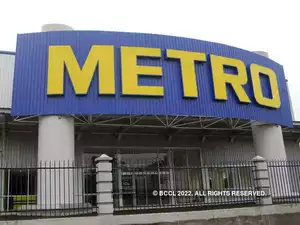
Metro AG global chief executive officer Steffen Greubel said the company is at a “very advanced” level of discussions on its India business, suggesting for the first time that it could be looking at an exit from the country soon.
“We are very advanced in the process regarding India and are at a certain maturity level in the process. It’s too early to share any information, but we have discussed it greatly,” Greubel told analysts when asked if he is looking at a possible withdrawal from India and the status of talks. “We are very deep in the (sale) process in India,” he said last week while announcing annual earnings.
The German wholesaler grew its Indian business by 21% to $982 million during the year ended September, as per its latest annual report.
Last month, ET reported that Reliance had agreed in principle to buy Metro AG’s cash-and-carry wholesale India business for ₹4,000-4,500 crore.
Its unit Reliance Retail is already the biggest grocery retailer in the country with over 2,400 stores across formats while Metro operates 31 wholesale stores in India with seven of them on company owned land in prime locations. The company hasn’t publicly stated that it’s looking to leave India. Metro would be the second big international wholesaler retailer to exit India, if this happens. French retailer Carrefour wound up its India business in 2014 after struggling with sales for four years.
Globally, Metro is the world’s fourth-largest retailer by revenue. In India, it doesn’t sell directly to consumers and is an organised wholesaler or cash-and-carry operator that sells merchandise to local kirana stores, hotels and catering firms.
It decided to put the India business on the block as part of a global decision to exit the country due to heightened competition, a tougher regulatory environment and the lack of a level playing field between local and foreign retail companies, industry executives said.
Experts said the difficult European and global economic environment, regulatory restrictions in India, tough competition from domestic Indian groups and thin margins in the B2B business in India may have led Metro to focus on growing its core markets in Europe.
“Though India is, indeed, a long-term strategic market for companies looking at global growth, whether retail or B2B, not every business model from other geographies can be successfully transplanted or rapidly scaled in India, and Metro’s business footprint in India may be far smaller than they may have expected in the two decades of presence here,” said Devangshu Dutta, founder of retail consulting firm Third Eyesight. The choice to be present in different countries is always a dynamic one for global retailers and entry or withdrawal is driven by individual strategies, rather than solely on the merit of the market itself, he said.
“In September, the management board reported on the current status of the audit of strategic options for Metro India,” according to the annual report.
Overseas investment in offline trade has been a tricky issue, despite India allowing 100% foreign direct investment (FDI) in wholesale trade on a cash-and-carry basis. Metro was one of the first companies to enter the segment in India in 2003. Lobby groups representing small Indian retailers have accused overseas retailers of violating FDI rules, which the foreign companies have consistently denied. Some trade lobbies have complained to the government that a few global wholesalers have been flouting FDI rules by selling to consumers directly, which is not allowed as per current regulations.
(Published in The Economic Times)
admin
December 5, 2022
Faizan Haider, The Economic Times
New Delhi, 5 December 2022
Shoppers Stop is planning to open a value format to attract consumers opting for lower priced brands such as Tata Zudio and Landmark Group’s Max, two officials privy to the launch said.
The idea is to open stores on ty to sustain and the lines of Zudio and Max and capture a larger market especially in smaller towns,” one of them said. “The first store, sizes anywhere between 7,000 8,000 square feet could open in the next three months.”
Shoppers Stop is foraying in to the mass-priced segment after three decades of selling premium apparel and lifestyle merchandise. Experts said India’s consumption structure has been skewed in the past over a narrow base of richer consumers accounting for a large chunk of the overall market. However, as the economy is broadening across many more cities and the impact is reaching further down the income ladder, the opportunity for value-formats and value-brands is expanding.
“Shoppers Stop’s competitors have demonstrated mixed success in the mass segment. and servicing this segment needs merchandising agility to respond to varying customer preferences across markets, as well as the financial ability to sustain and scale,” said Devangshu Dutta, founder of retail consulting firm Third Eyesight. “In the diversity of India’s market, scale alone isn’t enough to guarantee success.”
Shoppers Stop may open first few of its value format stores in tier 2 cities before taking them to metroci ties, people cited above said.
The company did not respond to the email query till press time on Sunday.
“The value format segment is growing and during Covid 19 we have seen consumption increasing in Tier-2 cities,” said Shriram PM Monga, cofounder at retail consultancy firm SRED.
“These cities also have grade A malls now, offering retailers quality space.” Tata Group firm Trent had earlier indicated that Westside accounts for 70% of its standalone business but Zudio, an affordable fast-fashion brand, has the potential to outpace the department chain due to the size of the opportunity in the value segment.
For Lifestyle International, its value brands Max and Easy Buy have already outpaced the department stores by sales – back in 2019 – indicating that consumers are increasingly seeking either lower-priced merchandise or opting for global brands such as Zara and H&M for fashion apparel instead of department stores.
Shoppers Stop has 296 stores spread across 3.8 million square feet, which include 91 department stores, 11 HomeStop home furnishing shops, 139 beauty stores, and 25 airport doors. It is on track to add 12 department stores and 15 beauty stores during this fiscal year.
According to Retailers Association of India (RAI), overall retail sales in October 2002 grew 15% year on year and by 19% when compared to pre- pandemic sales level (October 2019).
(Published in The Economic Times)
