
admin
January 8, 2024
Yash Bhatia, Afaqs
8 January 2024
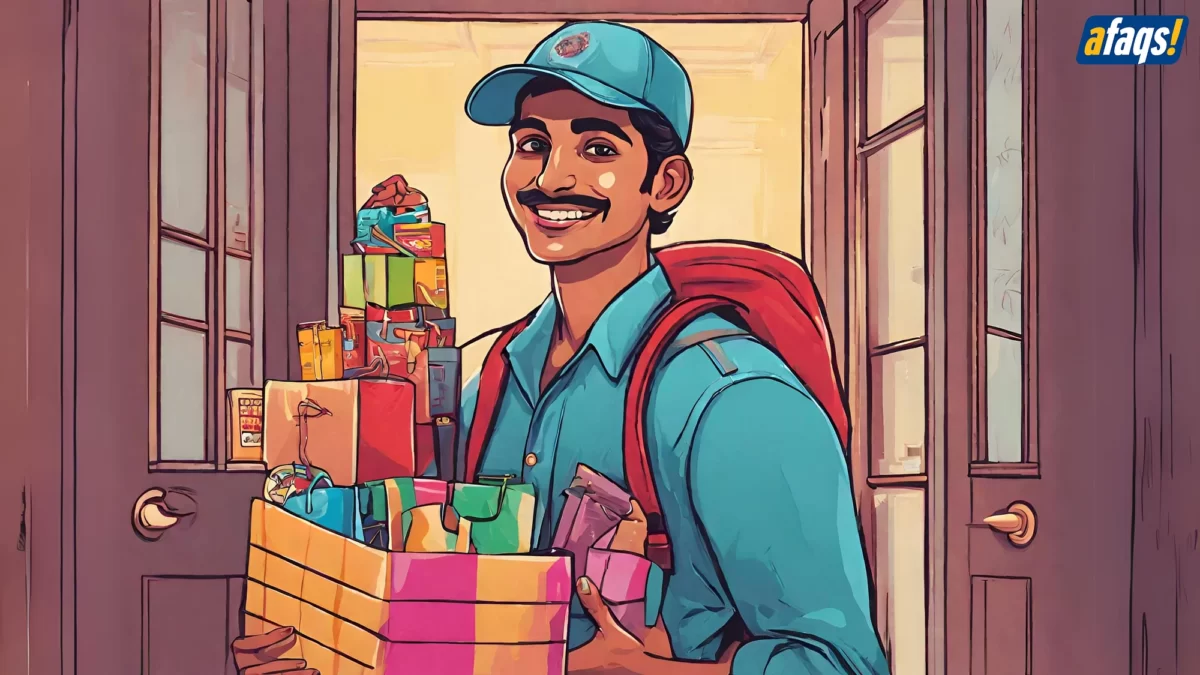
In the 10th episode of Zerodha co-founder Nikhil Kamath’s YouTube podcast series, WTF, Aadit Palicha, co-founder, Zepto, says that consumer goods are the fastest-growing category for its quick commerce business. Initially, quick commerce brands just focussed on serving impulse grocery needs, but now they have changed their way to serve regular planned purchases too.
Major players like Zepto, Blinkit, Swiggy Instamart, and BBNow are expanding their offerings in gifting, makeup, ready-to-eat, baby care, pet care, meat, poultry and more to cater to a wider range of consumer needs and preferences.
Through our interviews with brands like Bombay Shaving Company, Bevzilla and Plum, it is evident that Q-comm business contributes approximately 10-25% of online revenue for different brands.
Also, according to a report by Redseer, the Q-comm market is expected to reach almost $5.5 billion by 2025. The report highlights, that these platforms can up their game by going beyond just grocery and extend their offerings to other consumables, electronics, newspapers and more.
It shows that quick commerce players would focus on other categories to reach this milestone. But, are brands ready for it? If yes, how is their strategy different for this model?
Aditi Handa, co-founder of The Baker’s Dozen, an artisanal bakery, states, “In our category, once the customers figure out a product in the physical store, then they tend to buy again on the quick commerce platforms rather than visiting a store. It works well in our category, as there is no need to touch and feel the product.”
Baker’s Dozen makes 60-65% of its online sales on Q-comm platforms.
Devangshu Dutta, founder of Third Eyesight says that quick commerce has spread across various product categories and he believes, “It is driven more by buzz than customer needs. Unless we meet a core demand with a large consumer market, there’s no sustained road to profit.”
Deepti Karthik, fractional CMO, SuperBottoms, says, “In the diaper category, there are a lot of unplanned purchases. We target customers who’re buying other products, and eventually get trails from them.”
She points out that a lot of gifting happens in the quick commerce segment. “Gift packs can be a great solution our brand can leverage.”
She predicts that for the baby-care brand, quick commerce will contribute 3-5% of overall revenue, led by gifting as a category.
Apart from the reduced delivery time, is there a reason that customers are opting to shop on quick commerce platforms?
Handa answers that two factors work in favour of Q-comm platforms: discounts and convenience. “As these players are expanding their portfolio, customers will find more reasons to go on these apps.”
Is the quick commerce business driven by celebrations?
India is renowned for its diverse festivities. Quick commerce platforms capitalise on this by selling event-related or topical assortments. For instance, they offer flutes for Krishna Jayanti, Ganesha idols for Ganesh Chaturthi, Christmas decorations for the holiday, decorative items for Diwali, and gold and silver coins for Dhanteras.
These platforms are also curating special web and app pages for such occasions, even for regional festivals like Chauth Puja. In 2023, Blinkit curated a specific page dedicated to the wedding season.
Karthik states, “The major business of this sector is driven by consumables and FMCG products. On special occasions, e-commerce brands used to curate specific products, which Q-commerce is now doing. The market share of the other modes is now being taken by the quick commerce players on festivals. That’s why every e-commerce is looking to launch its version of Q-commerce, like Amazon Fresh by Amazon, and BBnow by Big Basket.”
Handa believes differently and states that quick commerce is not taking up the market share of any other modes. “Currently we’re buying more than what we need. Quick commerce is creating some new markets, and people are spending more money as it is easy to spend now.”
Will Q-commerce take over e-commerce?
As the country embraces digital commerce, the battle between e-commerce and Q-commerce is intensifying. While e-commerce has a well-established presence with a vast user base, Q-commerce offers unmatched speed and efficiency. As Q-commerce players foray into other categories, will they take over e-commerce?
Ritesh Ghosal, former chief of marketing at Croma believes that Q-comm will not replace e-commerce. He says that Q-commerce will only be a successful mode for urgently needed products like trimmers, headphones etc.
Handa predicts, “In our category, Q-commerce will replace e-commerce purely based on better service. The only advantage that e-commerce holds is a variety of stock keeping units (SKUs). Like, some products will have a presence in e-commerce only like English Cheddar cheese, it will not be there in Q-comm, a customer can only get it through e-commerce.”
She says that quick commerce also provides a fast way to experiment with new products.
Kartik, says e-commerce will always be at the main stage for the brand and believes Q-commerce will be an incremental business for them.
She has observed that in quick commerce if a product gets listed, it starts to sell faster and gets a quick start as compared to the e-commerce route.
Challenges
While the benefits of quick commerce are evident for customers, these players in the backend face a lot of challenges including warehousing, labour expenses, and, most importantly, the orders are low-value, therefore the margins are less.
Balasubramanian Narayanan, vice president, of Teamlease services points out that the consumer preferences and buying patterns in the quick commerce segment evolve rapidly, making data collection and analysis a crucial aspect.
“Balancing data collection with user privacy is a key challenge. The data insights can help to create personalised experiences, predict demands, and improve operational efficiency. But this can be a challenge in this mode.”
Handa says in quick commerce, the biggest challenge is the stock keeping unit (SKU) mix, SKU selection is critical.
“Brands like Amazon, and Flipkart allow a plethora of SKUs, while quick commerce just allows a limited number, due to limitation of warehouse space and delivery time. The SKU selection by the brand becomes a critical aspect.”
In the physical realm, shelf presence plays an important role in reaching customers, in the online world, optimising the online presence is crucial to get the customers’ attention. She highlights that in quick commerce, the fight is to be at the top of the search bar.
“To be at the top, the brand should generate organic sales, secondly it’s about keyword bidding. A keyword that would search customers to find the product from the brand. The brand pays quick commerce players for this.”
Ghosal also agrees with this and states, “In the Q-commerce arena, most searches are by category rather than by brand. The brands have to tick more boxes in terms of categories/searches so that customers tend to look at them.”
(With additional inputs: Ruchika Jha)
(Published in Afaqs)
admin
October 13, 2023

Anand JC, Economic Times
13 October 2023
Once the butt of jokes in Dalal Street circles, 113-year-old ITC has turned a new leaf in recent years, as its strategy to derive higher revenue from its consumer business is bearing fruit, bit by bit.
Registered in Calcutta as the Imperial Tobacco Company, the FMCG major has always relied on its cigarettes and leaf tobacco business for a major chunk of its revenues. ITC’s true diversification move might have begun with the launch of its hotel in Chennai in 1975, including a failed attempt at the financial services business, but it wasn’t until August 2001 that the tale of the FMCG behemoth came to be.
Having relied on its cigarette business since 1910, ITC has increasingly sought to earn more from its ‘cleaner’ consumer goods products. In a 2018 interview, CEO Sanjiv Puri admitted that while the journey to diversify the company started a long time ago, it only got traction around 2008. Under Puri’s first term as the ITC chairman, the company embarked on the ‘ITC Next’ strategy. The first decade was focused on preparing the company for the transition, he said. ITC now can innovate products, create brands and allow “pro-neurs” or professional entrepreneurs to build businesses in FMCG.
The plan has worked
ITC, a darling of dividend-led investing lovers, has always been a long-term growth story in the making. Nearly two decades after entering the food business, the company holds a leadership position across categories.
As per the company’s latest annual report, it holds the leadership spot in the branded Atta market through Aashirvaad, cream biscuits segment via Sunfeast, bridges segment of snack foods via Bingo!, notebooks via Classmate and dhoop segment via Mangaldeep. Its Yippee noodles trails Nestle’s Maggi, as the latter continues to lead in a highly consolidated market. However, Yippee has managed to gobble up Maggi’s share at an enviable pace. Capturing these positions, this quickly is no easy feat either.
One of the things that worked for ITC is their understanding of the distribution of products, stemming from their strength in the tobacco business. ITC started exploring aggressively diversifying away from the tobacco business around the 90s, says Devangshu Dutta, head of retail consultancy Third Eyesight.
ITC’s foray into the food business was supported by its presence in the hotel business. “Some of the marquee products that used to be served in their hotel restaurants, packaged dal and so on, they packaged and sold but it was not a humungous success. It was marginal at best.”
“But they started understanding the distribution aspect because those were sold through traditional distribution channels,” Dutta says.
ITC also put in a lot of financial muscle behind the brand building, given no dearth of resources, Dutta says. This helped them grow rapidly in product categories in which they didn’t have a presence earlier on.

“Starting from scratch, particularly on the foods side, ITC has been one of the most successful companies in the last 15-20 years. Their overall revenue this year has been roughly Rs 19,000 crore, out of which Rs 15,000-16,000 is purely from foods segment,” Amnish Aggarwal, Head of Research, Prabhudas Lilladher told ET Online.
“For a company which started this business, maybe, say, two decades back, this is a very big achievement,” he says.
Unlike its commanding position in its cigarette business, ITC’s ‘other-FMCG’ ambitions faced stiff competition from local and national companies in categories including soaps, shampoos, atta, snacks, biscuits, noodles and confectioneries.
Supporting ITC’s ‘other-FMCG’ ambitions is its core competency, the cigarette business. ITC’s consumer business’ growth has weathered storms, in part, thanks to the cash flows generated by its cigarette business which has helped it create stronger brands, an essential part of any consumer-centric business. Through its cigarette business, ITC also gets unparalleled access to a network of brick-and-mortar stores that have a diverse presence across India.
Also complimenting its growth is ITC’s agri-business, a segment which has also grown in strength over the years. From 10 per cent in FY14, the agri-business in FY23 contributed around 24 per cent to the company’s revenue from operations, as per ET Online’s calculations. ITC over the years has invested in building a competitive agri-commodity sourcing expertise. Some of these structural advantages have facilitated the company’s sourcing of agri raw materials for ITC’s branded packaged foods businesses, be it towards its atta, dairy or spices.
Like its peers, ITC too has given a fair deal of importance to its digital push, with more and more companies launching their D2C platforms. These platforms help customers buy products directly from the company website without the hassle of dealing with channel partners, and at the same time, the companies get their hands on first-party data. Such access can help the company market its offerings better. ITC, like some of its other peers, has also been investing in start-ups to diversify its product portfolio. It recently invested in Yoga Bar and Mother Sparsh.
The numbers behind ITC’s consumer business behemoth
Built to engage in the tobacco business, ITC got into cigarette packaging nearly 100 years ago. Another intent in recent decades has been to focus more on the non-cigarette business.
Puri saw it coming.
Upon being asked about the FMCG business overtaking cigarettes, Puri had said “We do not give guidance. But it will certainly happen because the other businesses are growing faster.”

After contributing nearly 62 per cent to the overall revenue in FY14, the cigarettes business in FY23 contributed only around 37 per cent.
ET Online calculations show that the other-FMCG business contributed 17 per cent to the overall revenue in FY14, which grew to 25 per cent in FY23.
Data confirms the claims made in the above segment. ITC’s non-cigarettes businesses have grown over 31-fold and currently form over two-thirds of its net segmental revenues. The company’s other-FMCG business didn’t start turning consistent profits up until FY14. Since then, it has gone from strength to strength.
ITC’s Other FMCG segment (the second largest contributor to sales) is also witnessing strong earnings and growth momentum, unlike most consumer staples peers.
The segment clocked a revenue of 19 per cent YoY while Nestle and Britannia saw 21 and 11 per cent growth each. FMCG EBITDA performance was even better, with the margin expanding by 430 bps YoY to 13.3 per cent & EBITDA growing 2.1x YoY.

Laughing stock no more
For years, the cigarette business has funded the growth of ITC’s other businesses like non-cigarette FMCG products, sometimes to the ire of shareholders who weren’t happy with the slow growth in financials and scrip value.
A slower growth in scrip value meant that for years ITC was also the laughing stock among social media circles. The stock often remained elusive during market rallies in the previous decade, offering poor returns in comparison to FMCG peers. Between 2014 and July 2022, ITC rose with dividends rose 53 per cent while Nifty50 rose 200 per cent, as per moneydhan.com, a SEBI RIA. ITC’s shares trailed the Sensex for five out of eight years through 2020.
“In the last ten years, HUL has done far, far better than ITC. And if you look at other companies in the same universe, say Dabur, it has also given superior performance. ITC has actually underperformed many of the large consumer names,” Aggarwal said.
But fast forward to 2023, not only is it among the best performers within the benchmark index, ITC has even trumped it. While Nifty50 has gained around 17 per cent in the last year, ITC has grown nearly 40 per cent. The ITC scrip in July crossed a market capitalization of Rs 6 lakh crore, beating HUL to become the largest FMCG company.
Sin stock
Prompting a move away to other segments is the nature of the cigarettes business. Tobacco is toxic, and investors are increasingly recognising it as such. Sin stocks are shares of companies engaged in a business or industry that is considered unethical or immoral.
While Environment, Social, and Governance (ESG) investing may be at a nascent stage in India, it is a serious parameter for global investors. Asia’s largest cigarette maker ITC cannot ignore it.
“The company sustained its ‘AA’ rating by MSCI-ESG –the highest amongst global tobacco companies– and was also included in the Dow Jones Sustainability Emerging Markets Index,” Puri noted in the company’s 2022 sustainability report.

Cigarettes, a bitter but essential overhang
For all the accolades for its gains in its other-FMCG business, ITC is nowhere close to ending its love for cigarettes, not that we are claiming it wants to. The Gold Flake-maker currently controls nearly 80% of the cigarette market.
The numbers in recent years suggest that the segment is flourishing more than ever before.
On an annualized basis, the return on depreciated cigarette assets is approaching a staggering 240%, three times the level two decades ago, as per a Bloomberg report. The entire legal cigarette industry was bleeding in the recent past due to punitive and discriminatory taxation on cigarettes. Taxes on cigarettes in India are multiple times higher than in developed countries viz. 17x of USA, 10x of Japan, 7x of Germany and so on, data shows.
But, companies are now recovering due to stable taxation. ITC’s three four-year cigarette sales CAGR are at their best levels since FY15 despite the company not taking material price increases over the last 13-14 months, as per a Motilal Oswal report.
ITC, which accounts for three out of every four cigarettes sold in the white market in the country, is currently seeing its best growth levels in over a decade, and is far superior to the flattish volumes of the past ten and twenty years.
(Published in Economic Times)
admin
September 25, 2023

Akanksha Nagar, Financial Express
September 25, 2023
Adding to the fizz in the energy drink market, NourishCo, a division of Tata Consumer Products (TCP), has unveiled Say Never — a caffeine-based energy drink priced at Rs 10 for a 200 ml cup — in two variants of red (berries) and blue (tropical flavours). In its initial phase of launch, the brand will be available largely through general trade outlets in Karnataka and some key markets of the north, including Delhi, NCR, Uttar Pradesh and Bihar. Vikram Grover, MD, NourishCo Beverages, TCP, says, “With Say Never we are celebrating the heroes who carve their own path.”
As a functional beverage, the energy drinks segment has grown by leaps and bounds in recent years to stand at Rs 3,500 crore in 2022. Experts reckon the market will touch Rs 10,000 crore by 2027. Red Bull is the category leader with a 61% market share of the market.
PepsiCo’s debut of Sting a few years ago at an inviting Rs 50 for 250 ml (as opposed to Red Bull’s Rs 125 for 250 ml can) had shaken up the category. With a 7% market share Sting has surpassed PepsiCo’s older products like Mountain Dew to become the company’s fastest-growing brand. Charged by Thums Up kept up the buzz for Coca-Cola during the 2023 edition of the Indian Premier League on Star Sports. Grover says Say Never will stand out for two reasons — the attractive price point and the cup delivery format, which the company has used with Gluco+. “The rapid growth in this energy segment in the recent past has come on the back of price disruption, and we feel that we can take that disruption forward,” he adds.
As energy drinks still operate in a niche segment with a premium play, an affordable price point can be a game-changer, say experts. “Affordability is a significant driver in India, especially for pre-teens, teens and college students,” says Devangshu Dutta, CEO, Third Eyesight. For many years energy drinks were treated as a niche premium opportunity, but the availability of lower price options has opened up the mass market as demonstrated by PepsiCo’s Sting in PET bottles with a much lower price point.
While the cola giants have an obvious advantage in terms of shelf space accessibility, given the market’s trajectory even smaller players stand a good chance to create a space for themselves. “Clarity in positioning, techniques to make the brand stand out, and ensuring availability with strong distribution and replenishment is imperative to get ahead,” Dutta suggests.
TCP plays in the energy space with Tata Gluco+, a glucose-based energy drink targeting a young consumer set; for Say Never the target is the youth between the ages of 18 and 35.
Besides pricing, what will be make or break is marketing muscle and a differentiated appeal, says Samit Sinha, managing partner, Alchemist Brand Consulting. “Say Never can position itself as a party-drink — akin to how Red Bull is equated with active lifestyles. There are enough opportunities to create nuanced differences in attributes, functional benefits and most of all, emotional benefits.”
NourishCo contributes 4% to the TCP overall business and in Q1 of FY23, its recorded a strong revenue growth of 60%. TCP’s flagship drink Tata Gluco+ registered a growth of 61% in the same period.
(Published in Financial Express)
admin
August 11, 2023

Christina Moniz, Financial Express
August 11, 2023
Pizza chain Domino’s recently unveiled a Rs. 49 pizza, its cheapest anywhere in the world. At $0.60, the pizza chain’s seven-inch cheese pizza is priced far lower than Domino’s in China (where $3.80 is the cheapest option). As per media reports, the rising inflation has caused Jubilant FoodWorks, which runs Domino’s outlets in India, to see a 70% slide in profits in the first quarter of CY23.
Competitor Pizza Hut has launched its Flavour Fun range, offering 12 new pizzas in five different sauce flavours, starting at a price of Rs. 79, which is easy on the pocket, especially targeted at young consumers. “We further stabilise costs by rolling out value deals from time to time such as 1 Plus 1 (two personal pizzas at Rs. 299 each), a Hut Treat Box for four starting at Rs. 799 and My Box deals starting at Rs. 229 for solo consumption. While food inflation is projected to persist, QSR brands must demonstrate agility and innovation in their offerings to effectively engage with customers,” says Merrill Pereyra, managing director, Pizza Hut India Subcontinent. Despite the competitive nature of the QSR market, he remarks that the rising purchasing power of consumers opens up promising opportunities for brands to expand.
Get the drift?
Crisil says the cost of a vegetarian thali rose 28% in July on the back of high tomato, onion and other raw material prices. With consumers also cutting back on eating out and discretionary spends, brands are bending over backwards to serve offerings at attractive prices to drive up footfalls .
Other fast food chains in the country too are rolling out value meals and snacks to appeal to price-conscious consumers. Burger King India announced its latest value range of ‘Tasty Meals’ starting at Rs. 99 to encourage dine-in consumers, while KFC too has unveiled its snacker range, featuring its most popular offerings like the classic chicken roll and chicken popcorn, at Rs. 99. McDonald’s India (West and South) also recently unveiled a campaign showcasing its easy-on-the-pocket McSaver meals at Rs. 179. McDonald’s India (North and East) made headlines with its decision to temporarily drop tomatoes from their products due to quality concerns and supply shortage.
This is just the second quarter of the current fiscal, but Devangshu Dutta, CEO, Third Eyesight, observes that the trend among QSR brands is to absorb costs or reduce expenses rather than raise prices and risk a drop in footfalls. Most brands are hoping to keep consumer demand up and make up for the loss in margins in the second half of the financial year.
That would be a 1% hit on margins on account of inflation, say experts.
Pramod Damodaran, CEO, Wagh Bakri Tea Lounge, has a slightly different take. Noting that food input cost is just one cost item for a QSR brand, he says that most companies make gross margins of over 60% on each order. These margins are without taking into account costs of labour, rent, etc. “The new price points are designed to drive more walk-ins and new customers. The menu is vast enough to get consumers to eventually spend more after they walk in. Customers often buy a small burger but that is not a substantial meal and so they need to buy fries or other sides, which have higher margins. Most QSR chains find a way to pass on the inflation-added cost to the customer,” says Damodaran. For example, he says, if the inflation rate is at 5% this year, restaurants may increase the price of certain items on the menu by 3% for the first six months and by another 3-4% in the next six months, thus covering the additional input cost.
Focus on efficiency
The fact that brands have launched affordable, lower-priced offerings may have landed them in a slightly tricky situation, says Rajat Tuli, partner, Kearney. “The value offerings at lower prices have encouraged trials and new customer walk-ins, but existing customers are also opting for these. That has resulted in a lower average ticket size, while the cost to serve stays the same. Order volumes have grown but average order values have stayed the same or reduced, which could be a challenge if the trend continues,” he points out, though he adds that gross margins in the current quarter have shown improvement over the last quarter. Fast food chains need to bring in more efficiencies in cost, streamline processes and introduce more digitalisation.
It is also something that McDonald’s India (West & South) is working towards, says MD Saurabh Kalra. Noting that inflation is not new to the company in India, Kalra explains, “Recognising that food inflation is a domestic truth, over the years, we have developed tools and strategies to manage it effectively. This is attributed to our strategic management of our supply chain and product mix, as well as our cost initiatives. We have been successful in managing our costs and in maintaining healthy margins.” Further, with the reality of global warming, there will be pressures on agricultural output.
Kalra argues that enhancing efficiency and adoption of new technology are the only ways to create long-term solutions, something that McDonald’s has been doing globally too.
(Published in Financial Express)
admin
July 28, 2023

Manu Balachandran, Forbes India
July 28, 2023
Revant Himatsingka doesn’t despise junk food.
The 31-year-old firmly believes that those who consume it also know the perils and long-term risks associated with it. From obesity to heart disease and diabetes, junk food is often counted as a more serious threat to life than even smoking according to some studies. “Most people who consume Coke and cigarettes know they are bad for you and consume them,” Himatsingka says.
Himatsingka, however, has a problem with junk food masquerading as healthy. That’s why over the past few months he has been busy calling out its makers, and in the process taking on some of the world’s biggest FMCG behemoths.
Since April this year, Himatsingka, through his social media profile, Foodpharmer, claims to have taken on almost all the FMCG companies in India, whose products he has reviewed, and in the process has been swamped with lawsuits. Himatsingka has a following of half a million followers on Instagram.
“Food is probably 60-70 percent of what shapes our health,” Himatsingka told Forbes India over a telephone call. “And what is shaping our food today is packaged food, which is very different from what our grandparents grew up eating. Most packaged food is just selling junk and they’re marketing it as healthy. This happens even more in relatively poorer countries.”
Himatsingka began his war against fake claims with a video about Bournvita, made by confectionary maker Mondelez. That video, critiquing the children’s drink for its excessive use of sugar, was shared across social media and on WhatsApp. Himatsingka poked fun at Bournvita’s tagline Tayyari Jeet Ki (preparing for victory), instead suggesting that Bournvita was preparing children for diabetes.
He listed out all the ingredients in Bournvita, debunked claims that the drink is healthy, and remarked that half of a package of Bournvita is sugar, and [it] even contains cancer-causing ingredients.
Trouble soon followed. Mondelez sent Himatsingka a legal notice asking him to take down the video within 24 hours. Coincidentally, the notice came to him on the last day of his notice period at McKinsey where he had been working as a consultant. Unfortunately for Mondelez, the video continues to be in circulation, more so across WhatsApp. Himatsingka took down the video and even issued a statement saying that he had no interest or resources to take on the company in any court cases.
“Most people have Coke once a week,” Himatsingka says. “But people have Bournvita twice a day. So you end up having 14 [servings of] Bournvita in a week. So, the net impact of Bournvita is probably worse than that of Coke.”
“As a growing market, India is potentially a natural “dumping ground” for poor products and processes that have been used by prominent brands in other markets,” Devangshu Dutta, the founder and CEO of management consultancy firm Third Eyesight says. “It is incumbent upon Indian customers to be diligent, picking up cues not only from Indian consumer-activists and but also their counterparts in the developed economies.”
From Kolkata to New York and back
Himatsingka grew up in an upper-middle-class household, with a homemaker mother and a father running his own business in Kolkata.
After his schooling, Himatsingka went to New York to study finance at the New York University’s NYU Stern School of Business where he graduated in finance. For a year after that he worked with a bank in the US. At 22, he ventured out into writing a book, Selfienomics, a self-help comedy book focusing on managing finances, health, religion, death, starting a business, and even completing projects on time.
“I wrote one chapter on how to read a food label even then,” Himatsingka says. “Back then, and even now I believe that it is the most important skill in the 21st century.” While he did secure admission into the illustrious IIM Bangalore, Himatsingka turned it down, instead focussing on his book.
By 2018, Himatsingka went to do an MBA at Wharton and followed it up with a course in nutrition, while also starting work at McKinsey as a consultant. “As a consultant, you work to solve business problems and you try to structure solutions,” Himatsingka says. “We focus on our career when it comes to structuring solutions and being data driven. But I try to extrapolate that into life. In life, one of our most important aspects is health.”
Himatsingka was also concerned by the growing link between cancer and heart diseases to packaged and processed food. In 2019, a study published in the British Medical Journal (BMJ) suggested a possible link between “ultra-processed” foods and cancer. The study defined ultra-processed foods as those lacking vitamins and fibre, which also contain high levels of sugar, fat, and salt. Such ultra-processed food, the study noted, represents as much as half of the daily energy intake in several developed countries.
“This is such a big problem and no one is talking about it,” Himatsingka says. “No one is trying to solve it. So, I thought, I wanted to do something in this space.”
That meant, Himatsingka, who by his own account was making very good money in the US, decided it was time to come back home, and try and do something around awareness. “I’m very social impact driven,” Himatsingka says. “April 1st is when I made the Bournvita video. I made a video showcasing how Bournvita was falsely labelling itself. Their label showed that you get stronger bones and muscles. Then I got a legal notice from Bournvita asking me to take down the video in 24 hours.”
The idea for the Bournvita video, Himatsingka says, came from his concern that a product like Coke had become the face of obesity and junk food, while many others were marketing themselves as healthy, without it being so.
Mondelez, the makers of Bournvita soon retorted that the drink contains nutrients such as Vitamin A, C, D, iron, zinc and copper that help build immunity and have been part of its formulation for 70 years. It also said that every serve of Bournvita has 7.5 grams of added sugar, much less than the recommended limit for children.
imatsingka though found support from unexpected quarters. The Nutrition Advocacy in Public Interest India (NAPi) a think tank comprising independent experts in epidemiology, human nutrition, community nutrition and paediatrics, medical education, administration, and management, issued a statement supporting Himatsingka.
“The food product Bournvita falls under the ultra-processed food (UPF) category based on its ingredients list,” NAPi said in a statement. “This industrial formulation is inherently harmful. There is enough scientific evidence present in the public domain pertaining to the negative impact of increasing consumption of UPFs on human health, which include several chronic diseases such as obesity, diabetes, cardiovascular disease, cancer, and depression (Non-Communicable Diseases-NCDs).”
The National Commission for Protection of Child Rights (NCPCR) also issued a notice to Mondelez asking the company to review and withdraw all misleading advertisements, packaging, and labels. The NCPCR is a statutory body to protect child rights.
Fighting it out now
Personally, for Himatsingka, the pushback from Mondelez couldn’t have come at a worse time. “I had just quit my job. And my family was asking me what I was trying to do with my life. They said ‘you had such a good job, you left all of that, now you are getting into a legal fight’,” Himatsingka says. “So I removed the video as they asked me to. And that got even more attention.”
Since then, Himatsingka has been actively taking on FMCG companies and their products in the country, ranging from ketchup, and chyawanprash to juices and bread among others. Himatsingka recounts having received legal notices from Dabur and even been asked to remove a video by Sting Energy, owned by PepsiCo.
He says his strength, however, comes from many parents who have reached out to him and are thanking his efforts for making them aware of the importance of reading labels. “People are reading labels for the first time and have now started figuring that many of the products are not that healthy,” Himatsingka says.
However, the pressure of the job continues to be heavy. “There is a lot of pressure,” the 31-year-old says. “These companies send legal notices and I have no idea how to deal with it. These are very technical and very dense documents, where they analyse each line and write a paragraph on each line. I once got a 300-page document from one company and they were asking me for a few crores. It’s strenuous.”
What lies ahead?
For now, the 31-year-old says his focus remains steadfast on raising awareness around food.
“Because of the Bournvita controversy, the rollover impact is that all the other companies are also going to get scared now to falsely market themselves,” Himatsingka says. “I cannot think of a human problem that is relatively easy to solve than nutrition labels and it creates massive impact.”
A few weeks ago, Himatsingka raised awareness about the growing consumption of bread in India and how most makers of bread who sell whole wheat or brown bread use more maida, which has less fiber, and is unhealthy. He had also called out juice makers for their use of sugar by comparing various mango juices available in the country.
“When a movie comes out, there are reviews and I can openly say whether I liked a movie or not,” Himatsingka says. “So why can’t I say the same about a food product? I’m just unboxing a product and saying what is there inside it. So I don’t think I’m legally wrong. They can ask me for whatever money they want. But I don’t think they can win on that.”
Along the way, he says he has also seen positive changes in companies. For instance, Himatsingka made a video on ketchup and explained how Maggi Rich Tomato Ketchup has more sugar than tomato in its ingredients. “Last month, they (Nestle) announced that they’re changing the recipe,” Himatsingka says. “They’re reducing their sugar content and they are going to have more tomatoes than sugar. One tiny change like that has such a major impact on the large scale.”
Experts agree that the growing scrutiny about ingredients is certain to give FMCG majors sleepless nights. “Given that food has a disproportionate share in our spend, an enormous impact on our health as well as a tremendous ecological footprint, it is only natural for consumers to question the composition, the origins, and the overall impact of the food that is being sold by leading brands,” says Dutta of Third Eyesight. “Over the last several decades, packaged food has become laden with synthetic flavouring, colouring, and shelf-life-extending chemicals, which are being called into question by activists through blogs and social media. On several occasions, prominent companies are forced to change their product composition or, at the very least, admit to the health-negative implications of their ingredients.”
Meanwhile, over the past three or four weeks, Himatsingka says he hasn’t been flooded with lawsuits. That’s partly because he has become quite careful about how he words his statements, instead focusing only on the merits of his argument.
“There are millions of problems in the world. But most of the problems are very hard to solve, like air pollution. But teaching people how to read a food label is easy. I feel learning how to read a food label is more important than coding in the 21st century, where most of what we’re eating is processed or packaged.”
Indeed, the fight is long. And Himatsingka is only gearing up for more.
(Published in Forbes India)
