
Devangshu Dutta
February 24, 2013

Luxury is an ill-defined concept. There is no specific line or limit of price, quality or availability that separates the luxurious from all that is not.
However, like other similarly intangible attributes such as power or grace, we all immediately recognise luxury when we experience it.
In fact, experience — vague as that may sound — is key to differentiating luxury, more than the tangible product being consumed. It’s not just the person’s own direct sensory experience, but also the prestige and status granted by others around her or him that creates the luxury experience.
Surely, with such intangible notions of experience, power and prestige, luxury brands should be among the most influential in the market. They should be pioneers that set the tone for change in improving retail management practices, upping customer service standards, driving quantum leaps in quality.
But is it so? The response from the rest of the retail sector may not quite be “meh”, but I suspect that it would not be far off.
There are strong reasons why luxury brands would have a lower influence as benchmarks in India and why, in fact, they may draw in more influence from the market themselves.
Market presence and location
As an example, in physical presence, luxury brands seem to demonstrate a delayed response to changes in the market, both in terms of market entry and location selection.
Prior to the entry of global brands, luxury products and services in India were naturally defined by niche, largely owner-managed businesses. Business scale was curtailed by internal limitations, and due to the small size, its market reach was also limited. While there were some designer brands that would occasionally get copied by mid-priced retailers, by and large luxury brands lived in their own separate bubble, with little or no influence on the heaving mass of the market.
In contrast, in the Western economies, from where many of today’s luxury brands originate, they are looked up to for inspiration. So, it is natural to expect Western luxury brands to lead the charge into the newly emerging modern retail economy of India. However, according to Third Eyesight’s research of international fashion and accessory brands in India, in the last 25 years it is mid-priced and premium brands that have opened the market. It is only in the last 10 years, well after the economic and retail growth was underway, that luxury brands stepped up their presence.

Sure, during the so-called “retail boom” from 2004, luxury brands went up to one-quarter of all international fashion and accessory brands present in the market. Then, when practically the whole world was in a recessionary mood, and mid-priced and premium brands took a call to defer their India launch plans, luxury brands pushed ahead. In 2009, luxury fashion brand launches accounted for two-third of all foreign fashion brands launched in India. Maybe the brand principals felt that this market could take on the burden of slowing growth elsewhere, or perhaps it was their Indian counterparts who were the source of optimism. Either way, the optimism took a hit in 2010 and 2011 when it was luxury brands that became cautious.
In terms of store openings and location selection too, luxury brands seem to have waited for the overall market to upgrade itself, and have then latched on to that growth. Previously luxury brand stores, such as there were, largely restricted their presence to five-star hotel shopping arcades, while a few took up non-descript sites as they were confident of being destinations in their own right or clustered together to create a precious few bohemian locations in surroundings that were far from luxurious. As modern shopping centres emerged in recent years, these presented an environment where rich consumers — especially the ‘new’ rich — could flock to buy globally benchmarked lifestyle statements. While these were mainly targeted at mid-market to premium brands, some of them are now even attracting designer brands such as Canali at Mumbai’s Palladium mall rubbing shoulders with Zara. These new luxury stores in mid-market or premium locations are performing better than the original “luxury” sites.
Thus, in terms of expressing confidence in the market, luxury brands seem to be following market trends rather than leading them. And far from being the anchors to create demand, they seem to be following where the demand goes.
Design and product development
The most important impact that luxury brands could have on the market is by influencing product design. This fashion trickle-down is supposed to work in two ways: one, through “inspiring” knock-offs by cheaper brands; two, making luxury customers act as opinion leaders and trend-setters for other consumers.
However, various factors dilute the luxury brands’ product and design influence in India: the preponderance of domestic (“ethnic”) style and colour, especially in womenswear, the existing domestic variety in products, the flood of premium (non-luxury) international brands and a customer base that is oblivious to the difference between the premium and luxury segments. In spite of their small size, Indian luxury and designer brands possibly have a larger direct impact, not to mention the massive Bollywood machine that drives mainstream fashion trends on a day-to-day basis. The international luxury giants are conspicuous by their small influence.
In fact, increasingly the influence is flowing the other way. A few luxury brands have attempted to create India-specific items to give the customer what they might want. Some of these may be indulging in superficial pandering such as putting an Indian image on a global product, but others have created Indian products that genuinely reflect what the brand stands for. While some use India as a production sweatshop to minimise the cost of high-skills jobs, others are now beginning to use Indian crafts to design products that are relevant to other global markets. A few examples, without passing judgement on which category they fit into, include: Lladro’s Spirit of India collection, the Hermès sari, the Jimmy Choo “Chandra” clutch bag, Louis Vuitton’s Diwali collection and Canali’s nawab jacket.
Slow, but not yet steady
Another issue with India is the sheer numbers, or the lack thereof!
China’s GDP is about four times the size of India’s but its luxury market size is estimated to be six times that of India. There are 1.7 million households in China that meet the high net-worth criteria, as compared to 125,000 in India. What’s more, according to industry estimates, only about 30 per cent of luxury consumers in China are actually wealthy, while the overwhelming majority are people with mid-market incomes who are given to conspicuous consumption, whether buying luxury goods for themselves or as gifts.
Indian consumers also have a penchant for buying overseas rather than shopping from the same brands’ stores in India. This is not just due to higher costs and import duties in India, but because of wider and more current selections of merchandise in stores overseas. Indians’ luxury shopping destinations include the usual suspects: London, New York, Paris, Milan, Singapore and Dubai. This has meant that while luxury brands recognise Indians as a large, emerging base of customers, for most brands India itself remains an operating market for the future.
Having said that, when compared to any other sector of business, luxury brands in India probably get the most media coverage for every rupee of sales earned. Although they are a small fraction of the sales, luxury brands rule in terms of column centimetres or telecast seconds. The coverage is not restricted to consumer-oriented media such as lifestyle magazines or mainstream newspapers, individual luxury brands are also extensively covered in business media.
One may argue that such is the nature of luxury: this disproportionate visibility and share of mind happen because luxury is not just aspirational, but inspirational. However, that inspiration and influence is yet to become apparent in the business at large. Until we see significantly larger numbers of upper-middle-income customers in India, luxury brands will find it difficult to expand their reach beyond the small base of ultra-rich consumers. The aspiration and price gap is just too wide for the Indian middle class, and there are very few who will emulate their Chinese counterparts and save up a year’s salary for a single luxury item.
And so…
One thing is beyond doubt: the luxury sector in India is undergoing significant change. We could even say it is in active ferment. There has never been so much interest among so many people, or so many brands so widely promoted, as now.
The question is still open on whether it is a good ferment such as the one that produces wine from raw grape juice and fine cheese from plain curds, or the unguided rot that results in a putrid, smelly mess unfit for consumption.
My bet is on the first possibility. In the short term, the luxury business appears to be a mess, littered with fractured partnerships and bleeding financial statements. But the brew needs time to mature. Gradually, as the luxury segment matures along with the rest of the market, we will see the influence trickling down into other segments. But remember, the finest brews do not only impart their flavour to the cask, but imbibe the cask’s characteristics into themselves. So it is with luxury and the Indian market. The message that we have given many other international businesses seems to hold doubly true for the global purveyors of influence, the luxury brands: “As much as you think you would change India, India will change you.”
admin
January 21, 2013
By Tarang Gautam Saxena & Devangshu Dutta
Since the onset of reopening of India’s economy in the late 1980s, fashion is one consumer sector that has drawn the largest number of global brands and retailers. Notwithstanding the country’s own rich heritage in textiles the market has looked up to the West for inspiration. This may be partly attributable to colonial linkages from earlier times, as well as to the pre-liberalisation years when it was fashionable to have friends and relatives overseas bring back desirable international brands when there were no equivalent Indian counterparts. Even today international fashion brands, particularly those from the USA, Europe or another Western economy, are perceived to be superior in terms of design, product quality and variety.
International brands that have been drawn to India by its large “willing and able to spend” consumer base and the rapidly growing economy have benefitted in attaining quick acceptance in the Indian market and given their high desirability meter, most international brands have positioned themselves at the premium-end of the market, even if that is not the case in the home markets. In addition, Indian companies – manufacturers or retailers – have been more than ready to act as platforms for launching these brands in the market and today there are over 200 international fashion brands in the Indian market for clothing, footwear and accessories alone, and their numbers are still growing.
Global Fashion Brands – Destination India
Europe’s luxury brands have had a long history with India’s princely past, but modern India tickled the interest of international fashion brands in the 1980s when it set on the path of liberalisation. The pioneering companies during this stage were Coats Viyella, Benetton and VF Corporation. At the time the Indian apparel market was still fragmented, with multiple local and regional labels and very few national brands. Ready-to-wear apparel was prevalent primarily for the menswear segment and was the logical target for many international fashion brands (such as Louis Philippe, Arrow, Allen Solly, Lacoste, Adidas and Nike). (Addendum: The rights to Louis Philippe, Van Heusen and Allen Solly in India and a few other markets were sold after several years to the Indian conglomerate, Aditya Birla Group, as part of the Madura Garments business.)
The rapidly growing media sector also helped the international brands in gaining visibility and establishing brand equity in the Indian market more quickly. However, this period did not see a huge rush of international brands into India. West Asia and East Asia (countries such as Japan, South Korea, Taiwan and even Thailand) were seen as more attractive due to higher incomes and better infrastructure. In the mid-1990s there was a brief upward bump in international fashion brands entering the Indian market, but by and large it was a slow and steady upward trend.
The late-1990s marked a significant milestone in the growth of modern retail in India. Higher disposable incomes and the availability of credit significantly enhanced the consumers’ buying power. Growth in good-quality retail real estate and large format department stores also allowed companies to create a more complete brand experience through exclusive brand stores in shopping centres and shop-in-shops in department stores.
By the mid-2000s, however, a very distinct shift became visible. By this time India had demonstrated itself to be an economy that showed a very large, long-term potential and, at least for some brands, the short to mid-term prospects had also begun to look good.
While India was a promising market to many international brands, it was not completely immune to the global economic flu. More than its primary impact on the economy, it sobered the mood in the consumer market. Even the core target group for international brands tightened the purse strings and either down-traded or postponed their purchases.
In 2008, in the midst of economic downturn, scepticism and uncertainty, international fashion brands continued to enter India at nearly the same momentum as the previous year. Many international brands such as Cartier, Giorgio Armani, Kenzo and Prada entered India in 2008, targeting the luxury or premium segment. However, given the high import duties and high real estate costs, the products ended up being priced significantly higher than in other markets. Many brands ended up discounting the goods heavily to promote sales, while a few gave up and closed shop.
The year 2009 saw the true impact of the slowdown as fewer international brands were launched during the year. The brands that launched in 2009 included Beverly Hills Polo Club, Fruit of the Loom, Izod, Polo U.S., Mustang, Tie Rack, Donna Karan/DKNY and Timberland amongst others. Some of these had already been in the pipeline for quite some time and had invested considerable time and effort in understanding the dynamics of the Indian retail market, scouting for appropriate partners, building distribution relationships and tying up for retail space, setting up the supply chain and, most importantly, getting their operational team in place.
2010 was better in comparison: although initially slow, the growth of new international brands entering the Indian market in 2010 bounced back later during the year, and some brands that had exited the Indian market earlier also made a comeback. Amongst the new launches, a highlight of the year was the launch of the most awaited and discussed-about Spanish brand Zara. The first store was launched in Delhi to an absolutely phenomenal response, followed by a store in Mumbai, and a third again in Delhi. The Italian value fashion brand, OVS Industry, was launched in 2010 by Oviesse through a joint-venture with Brandhouse Retail from the SKNL group. While in its first year products were imported from Italy, the company had mentioned that it intended to bring in the merchandise directly from the supply source for speed and cost effectiveness, to achieve aggressive growth over the following five years.
2010 indicated a fresh round of optimism as the pace of new brands entering the market picked up, and those already present in the market showing signs that they were adapting their strategies to grow their India business, including lowering prices and entering new segments.
Though the number of new brands entering the Indian shores in 2011 and 2012 may not have matched the numbers in the peak years, both years have been healthy and the list of new brands ready to enter in 2013 already seems promising.
Amongst others, 2011 saw the entry of Australian brands such as Roxy and Quiksilver having tied up with Reliance Brands for distribution. The largest British football club and lifestyle brand Manchester United, signed up with Indus-League Clothing Ltd. to bring the fashion products to India, after having launched café bars in India in 2010 through a franchisee.
2012 brought in luxury brands such as Christian Louboutin, Roberto Cavalli and Thomas Pink, womenswear brands such as Elle, Monsoon and fashion accessories brands such as Claire’s.
Routes to Market – The Evolution
The choice for entry strategy for the fashion brands has evolved over the years. During the initial years licensing was the preferable route for international brands that were testing the market. This shifted to franchising as import duties dropped and brands looked at exerting more control on the product and the supply chain. More recently, brands seem to be opting for some degree of ownership, as they begin to take a long-term view of the market.
In the 1980s and the early 1990s, licensing was a popular entry strategy amongst the global fashion brands, with minimal involvement in the Indian business.

In the mid-1990s a few companies such as Levi Strauss set up wholly owned subsidiaries while others such as Adidas and Reebok entered into majority-owned joint ventures. This helped them to gain a greater control over their Indian operations, sourcing and supply chain, and brand. In the subsequent years import duties for fashion products successively came down making imports a less expensive sourcing option and the realty boom brought in many investors in retail real estate who became franchisees for the international brands. By 2003, franchising became the preferred launch vehicle for an increasing number of international companies, while only a few chose to enter through licensing.
In 2006 the Government of India reopened retail to foreign investment (allowing up to 51 per cent foreign direct investment in single-brand retail). Using this route, many brands have entered India by setting up majority-owned joint ventures, or moving their existing franchise relationships into a joint venture structure. By the end of 2008, more than 40 per cent of the international brands were present through a franchise or distribution relationship, while more than 25 per cent had either a wholly-owned or majority-owned subsidiary. All these structures allowed the brands to have greater control of operations, particularly of the product.
Amongst the international brands that entered the Indian market, a few were on their second or even third attempt at the market. For instance, Diesel BV initially signed a joint venture agreement in 2007 with Arvind Mills. However, by the middle of 2008, the relationship ended with mutual consent, as Arvind reduced its emphasis at the time on retailing international brands within the country. Within a few months of ending this relationship, Diesel signed a joint venture with Reliance Brands as the iconic denim brand wanted to take on the Indian market full throttle and the Indian counterpart had indicated that it wanted to rapidly build its portfolio of Indian and foreign brands in the premium to luxury segments across apparel, footwear and lifestyle segments.
Similarly, Miss Sixty entered India in 2007 through a franchisee agreement with Indus Clothing. It switched to a joint venture with Reliance Brands in the same year but the partnership was called off in 2008. Miss Sixty finally entered India through a franchisee agreement with a manufacturer of women’s footwear and accessories.
During the turbulence of 2008 and 2009, a few brands also moved out of the market. Some of them were possibly due to misplaced expectations initially about the size of the market or about the pace of change in consumer buying habits. Others were due to a failure either on the part of the brand or its Indian partners (or both), to fully understand what needed to be done to be successful in the Indian market. Whatever the reason, the principals or their partners in the country decided that the business was under-performing against expectations for the amount of effort and money being invested, and that it was better to pull the plug. Amongst the brands that exited the market during 2008 and 2009 were Gas, Springfield and VNC (Vincci).
In the last few years as the foreign direct investment rules are being softened in particular with regard to the more flexibility in the 30% domestic sourcing and clarification on brand ownership norm there is an increasing preference for international companies to enter the India market with some form of ownership while those that are already in the market are looking to increase their stakes in the business.
Several brands have taken the plunge into investing in the Indian operations and moved more aggressively into the market. Since the year 2009, international brands increasingly opted for joint-ventures as the choice for entry into the market. Even the brands already present started looking to modify the nature of their presence in India in order to exert more control over the retail operations, products, supply chain and marketing. Brands that changed their operating structures and, in some cases partners, include VF (Wrangler, Lee etc.), Lee Cooper, Lee, Louis Vuitton, Gucci, Burberry amongst others. Mothercare, the baby product retailer, which was initially present through a franchise agreement with Shoppers Stop, formed a joint venture with DLF Brands Ltd to enable the expansion through stand-alone stores.
During 2011, Promod changed its franchise arrangement with Major Brands into a joint-venture that is majority-owned by Promod. From its launch in 2005, the brand has opened 9 stores so far. However with the new joint venture in place, the international brand is reported to be looking at opening 40 stores in the next four years with the hope of increasing the contribution of India business to its global revenue to the extent of 15-20% from a mere 3% at present.
After its partnership with Raymond fell through in 2007 and all of its standalone stores were shut down, Gas (Grotto SpA) scouted around for an appropriate partner for India business. Eventually, the brand set up a wholly owned subsidiary in 2010 for wholesale operation while retail stores were franchised. In 2012 the company formed an equal joint venture partnership with Reliance Brands with plans to ramp up India retail presence.
2012 was a defining year marking the government’s decision to allow 100% foreign direct investment in single brand retail business and permitting multi-brand retail in India. Not only has this encouraged new brands to consider the Indian market but many existing brands have started reviewing their existing operating structures and alliances, and have initiated moves towards greater ownership and a stronger foothold in the Indian market. Some of the brands have taken the decision to step into an ownership position in India as they felt that India was too strategic a market to be “delegated” entirely to a partner (whether licensee or franchisee), or that an Indian partner alone might not be able to do justice to the brand in terms of management effort and financial capital.
S. Oliver restructured its India operations in 2012 by exiting its prior relationship with the apparel exporter Orient Craft and tied up with a new partner through a majority joint venture. To gain a larger share in the Indian market the company has repositioning the brand, changed its sourcing strategy, reduced the entry-level prices by 40% while reducing the store size (from 5,000 sq. ft. to 1,200-2,400 sq. ft.). It has also put in place an aggressive expansion strategy for tier II towns. The change in FDI norms towards the end of last year may cause it to review its position further.
Canali has entered into a majority-owned joint-venture with its existing partner Genesis Luxury. The brand had entered in India in 2004 through a distribution agreement. Through this change the international brand plans to grow its presence in India multi-fold by opening 10-15 stores over the next three-four years.
Pavers England is the first international brand to have applied for and been granted the permission to own and operate its retail business in India through a 100 per cent subsidiary owned by a UK based company. Newcomers such as H&M and Loro Piana are reportedly considering the joint venture route.
As we have already mentioned in one of our earlier papers (“Tapping into the India Gold Rush”) we do not expect a dramatic short-term growth in the number of international brands following the retail FDI relaxation in September 2012. However, at that time we did foresee some changes in the operating structures for the single brand ventures already active in the market, as well as entry of new brands that have been holding back so far as they wanted greater control in their India retail business and this seems to be happening already.
In the luxury sector, 51 percent FDI and distribution relationships are likely to continue to be a norm, since it is virtually impossible for most luxury companies to meet the 30 percent domestic sourcing requirement in its true spirit. In many cases, the local partner in a joint venture is a mere placeholder until FDI rules are liberalised further and, unless the business grows significantly, most brands will be content to keep the existing structures in place.
In the other segments some more relationships could be reconstituted during 2013, taking the international brand at least a step closer to gaining greater control, even if their partners remain the same.
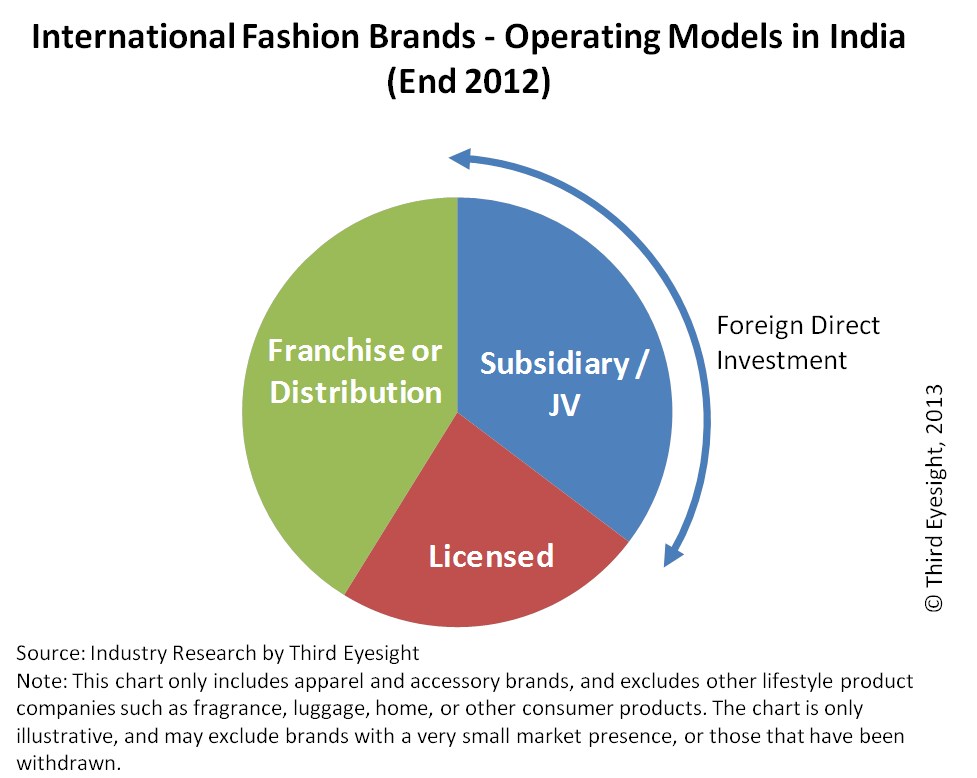
Franchising is still the more common form of route to market for most single brand retail companies although for many international companies an eventual ownership in India business may be desirable. However, licensing should not be excluded from the choice set, especially for companies that are multi-brand retail concepts such as Sephora or those that manage to find a suitable Indian partner that can provide end-to-end support from product sourcing to distribution and retail (for example, the relationship between Elle and Arvind).
Today two thirds of the international fashion brands come from three countries the U.S.A., Italy and the U.K. with nearly 30 per cent originating from the U.S.A. alone.

Is This A Lucky 13?
The theme for the year 2013 is positive for most brands, although still cautious.
Amongst the international brands that one can look forward to shopping in 2013 are “Uniqlo” of Fast Retailing, Japan’s largest apparel retailer, Sweden’s H&M, Emilio Pucci and Billabong. But India is not merely a destination anymore for the international brands to grow their business. The country is also increasingly becoming the innovation-platform or testing ground for new concepts and trends. World Co. a Japanese retailer with more than 3,000 stores in Japan and 200 stores in other parts of Asia is also test-marketing women’s apparel and accessories brands such as Couture Brooch, Opaque.clip, zoc, Tk Mixpie and Hot Beat to gain insights into consumers’ psyche. Italian brand United Colors of Benetton has recently introduced a global retail interior design concept which is present in major European cities but is the first-of-its-kind store in Asia and may well set the trend for the rest of Asia.
Gucci recently opened its largest store in India recently Delhi-NCR after two failed joint ventures. All of its five stores are now run directly by the company and the Indian business also reported to have turned profitable this year.
Brands such as Mango who have chosen the franchise route are tying up with additional partners (e.g. DLF) in the hope of making the Indian business contribute significantly to the overall revenue of the company.
UK-based apparel chain Marks & Spencer is accelerating its expansion in India with plans to add ten stores in the next six to eight months in the country. The company has identified India as one of the key markets to become the world’s most sustainable retailer by 2015. It plans to increase the number of stores in India from 24 currently to over 30 through the 51:49 joint venture with Reliance Retail.
Puma SE, the global sports lifestyle company for athletic shoes, footwear, and other sports-wear aggressively set out to gain 30 per cent of the Indian organised retail sportswear market within a year, from a share of 18-20 per cent in the top four branded sportswear segments in 2011. To this end the company targeted opening nearly 100 more stores during 2012. While the actual numbers are reportedly short of target, the brand has been opening amongst the largest stores during the year.
The confidence in the India opportunity is rising again, with existing global brands expecting the contribution from India business to grow multi-fold in a few years. However, the approach is of careful consideration and brands realise that India is a unique market, different not only from the West but also from other Asian economies such as China. Rather than adopting a “cut-and-paste” approach one needs to seriously consider the appropriate business model for India. Many of the global players have had to create a different positioning from their home markets. Some have significantly corrected pricing and fine-tuned the product offering since they first launched; these include The Body Shop and Marks & Spencer. Others are unearthing new segments to grow into; for instance, Puma and Lacoste are now seriously targeting womenswear as a growth market.
It is not only international brands that are more optimistic. Indian partners are also reviewing their approach. For instance, the Arvind Group that had looked at reducing its emphasis on international fashion brands in 2007-08 has recently acquired the business operations of Planet Retail which operated the franchises of British fashion retailers Debenhams and Next, and American lifestyle brand Nautica in India. The company termed Debenhams’ franchise as a significant acquisition as it provided an entry into the department store segment. Arvind plans to increase the India presence of Debenhams from 2 stores to 8 over the next three years. It also plants to grow the network of Next, the large-format speciality stores, from 3 to 12 in the same period.
As customer footfall and conversions pick up, international brands are also shoring up their foundations for future expansion in terms of better processes and systems, closer understanding of the market, and nurturing talent within their team. Third Eyesight’s study of the market highlights international brands’ concerns with ensuring a consistent brand message, improved organisational capabilities right down to front-line staff, and focussing on unit productivity (per store and per employee).
India shows signs of a healthier business outlook for International brands but the game has just begun and with competition getting tougher, we can expect interesting times ahead.
Tarang Gautam Saxena
May 1, 2012
India’s economic growth may seem to have taken a dip last year with India’s GDP growth falling to 6.9% for 2011-12 from 8.4% the previous year. But that has not translated into a slower entry of international brands entering the market. There already exist over 200 international fashion brands in India with more than a quarter of these operating predominantly in the footwear and accessories category. Bata may be an exception, having been present in India for over eighty years, but since the 1980s international brands have been trickling in, and the numbers really picked up in the 2000s.
Since 2006, the number of international shoes and accessories brands entering the market has increased 4-fold. The year 2012 has already ushered in international brands such as Claire’s (jewellery), Christian Louboutin (shoes) and Kelme (sports shoes and apparel) within the first three months, while more brands are there on the anvil. While India is expected to grow at 7.6% this year, the pace of growth of international brands may just as well surpass this relatively slow growth rate.

Business Environment & Choice of Operating Structure at Entry
The choice of entry strategy is a key decision for brands entering new markets. This decision hinges on internal and external business factors including the degree of control that a brand wants to exercise on the brand, the product and the supply chain, the market potential, the internal capabilities and strategies of the international brand in their home market or other overseas markets and the government policy pertaining to foreign investment in that particular market.
In the late 1980s and 1990s the Indian retail market was largely unorganized with few national Indian brands and an under developed modern retail network. Import duties were high and there were many investment barriers for foreign brands. The early players entering the market in the shoes and accessories segment were primarily sports footwear and equipment brands targeting the Indian men. Bata was perhaps a lone brand that offered footwear for the entire family.
The international brands that entered the Indian market at that time largely opted to license the brand to an Indian partner that allowed the international brands to gain quick access to the Indian market with a minimal investment. Brands such as Lotto, Hush Puppies and Puma chose to license the brand to a partner based in India. The Indian partner invested in sourcing or manufacturing, merchandising, branding, marketing, distribution, and even retail while the international brand received royalties and other fees for lending its brand to the market. However, this left the brands with very little control on their growth path in the market. A few formed joint ventures (Reebok, Adidas) or entered into licensing and distribution tie-ups (Nike, Umbro) with Indian partners to leverage the partners’ manufacturing or distribution strengths.
Over time, certain brands decided to move their existing entities (licensed, franchised or joint venture) into wholly owned subsidiaries. These brands may have invested a disproportionate amount of management time and effort initially but the investment has paid off well. Reebok is today the largest international sports goods brand in India with a reported turnover of Rs 600 crores last year, followed by Adidas, Puma and Nike.
The 2000s saw a rising interest of women’s footwear and accessories brands in the Indian market as the market further evolved. Many of these players operated in the luxury segment appealing to a limited few. There was a distinct shift in the choice of entry strategy and franchising emerged as the preferred entry route for the brands stepping afoot in the Indian market testing the waters. The successive lowering of import duties for fashion products resulted in imports being a less expensive sourcing option and the realty boom brought investors in retail real estate that were ideal franchisees for the international brands.
At the same time the count of sports footwear and accessories brands also continued to grow. This product category was primarily distributed through agents, regional distributors and through a combination of exclusive branded outlets, multi-branded outlets and large department chains at the retail end. By 2003, franchising became the preferred launch vehicle for an increasing number of international companies, including Accessorize, Aldo, New Balance and Nine West, while only a few chose to enter through licensing.
In 2006 the Government of India reopened retail to foreign investment (allowing up to 51 per cent foreign direct investment in “Single Brand” retail). Later the Indian government also announced the possibility of gradually increasing the FDI limit in single brand retail from 51% to 100%. The possibility of having part or an eventual complete ownership encouraged brands, seeking a more controlled business in India, to use joint venture as the launch vehicle. International footwear and accessories brands such as Clarks, Fendi, Kipling, Pavers England either entered India by forming joint ventures or shifted their existing structures to joint ventures.
Thus the last decade saw the international brands largely using the franchising route or forming joint ventures to create a presence in the Indian market. While franchising became the choice for risk-averse brands, those that were convinced about the longer-term value of India took the more committed ownership route.

While the government has recently allowed 100% foreign direct investment in single brand retail, it has placed the rider that 30% of the sourcing would happen from small and medium enterprises in India. The lack of clarity as to what this actually means, as well as the need to set up an adequate sourcing presence in India has meant that most brands have not pushed their Indian presence into a 100 per cent ownership structure.
Of course, for a few brands India may be the key source for their entire range and given our government’s manufacturing policy they may already have an existing small and medium enterprise vendor base. These brands may go for complete ownership if India is a strategic and important enough market and sourcing base in their global portfolio.
One such international company is Pavers England, a premium leather footwear brand from UK, which has recently approached the Indian government to allow the retailer 100% foreign direct investment in single brand retail. The group has been present in India since 2008 through a joint venture and currently sells the brands, Pavers England and Staccato in India.
At the moment, 35% of the international brands are present through an ownership business model, either through a wholly owned subsidiary or a joint venture with majority stake which reflects the growth of confidence level of international brands in the Indian market.
Changeovers, Exits & Re-launches
The road to success in the Indian market has not been an entirely smooth ride even for the large brands that are successful globally. Brands that have invested in understanding the psyche of the Indian consumer, adopted flexibility in market approach and displayed persistence, have been paid off handsomely and some of these have even exceeded domestic brands in size and reach. Some others have had to reconcile to being niche operators.
Some brands have shifted their strategy and changed their operating structures and even partners in response to the dynamic market conditions and the increasing importance of India’s contribution in their global business. Some brands that may not have achieved success in their initial stint and have exited the market, only to return with renewed strategy, energy and rigour and more suitable business models and or partners. There are plenty of examples of international brands that have changed over their operating structure, partners, exited the market and yet re-launched again.
Puma, for instance, had first entered the Indian market through a licensing arrangement with Carona in the early 90s to sell sports footwear, but the agreement was revoked in 1998. The brand entered the market again in 2002, this time with a licensing / distribution tie up with Planet Sports. The company positioned itself as a lifestyle brand this time with a wider product range. While the Indian partner was responsible for sourcing of apparel and accessories, distribution and retail, Puma ensured that the quality of footwear being sourced from India was upto mark and also ensured brand consistency throughout all marketing, product and retail efforts. To the international company, India occupied an important position in Puma’s global as well as Asian business. With an aim to strengthen the brand’s position further in the country through greater control over its India operations, Puma set up a wholly owned subsidiary in 2006 subsequent to the end of its licensing tie-up.
Another early entrant, Lotto Italia, re-entered the market in 2005 through a license deal after a gap of ten years. More recently, in an effort to move to the higher growth trajectory, the brand has changed its partner last year and the brand is looking for aggressive growth by planning to grow its network of exclusive stores across India from 50 at the moment to 200 in the next three years. The brand is also undertaking various marketing activities to gain high visibility and connect with the consumers. Recently, the brand has been reported to be working on launching cricket equipment in India in the next six months, which will be a pilot run for the global launch of the product as well.
The renowned Italian brand Gucci was brought into India through a franchise agreement with Murjani Retail in 2006. However, the global economic crisis and its resultant impact on the Indian market, led a shift in the Indian partner’s focus from luxury to premium brands. The franchise agreement with Murjani Retail was terminated and replaced with a new franchisee, Luxury Goods Retail, in 2009. Simultaneously, the international brand Gucci, converted this new franchise agreement into a majority owned joint venture for more control over the Indian operations.
Clarks, a British footwear brand, first entered India in 2005 through a distribution agreement with an India partner and also set up a few exclusive stores across India. It withdrew from the market due to below-par performance. However, after researching and understanding the Indian consumer further it re-entered the market 2011 through a joint venture with Future Group. Now Clarks is offering differentiated products across segments (men, women and kids) with lower price points and is focusing on high brand visibility through exclusive branded stores to break through the clutter. India is an important sourcing base for this company and it is also drawing synergy for its global product range from the products being developed as per the tastes and preferences of Indian consumers. From the new partner the brand hopes to leverage their experience in real estate and their understanding of the Indian consumer.
The Italian fashion brand Miss Sixty exited the market and their partnership with Reliance Brands in 2007. The brand re-launched shoes and accessories in 2009 through another franchise agreement and currently the brand has three stores across Delhi, Mumbai and Chennai.
The German lifestyle brand, Aigner that entered India in 2004 is perhaps a lone brand that has not yet re-entered the market since its exit in 2010, but it will be no surprise if it returns to India again at an appropriate time.

The strategies of international brands have changed due to various factors. Many of the changes in strategy and structure have been due to the actual performance in the market falling well short of expectations and projections. Perhaps, the changes in partnership could have been moderated had the companies been more careful in questioning the criteria and motivations for choosing partners. (This is discussed further in detail in our earlier articles, relating to the International Fashion Brands in India). In choosing their partners, the international brands need to carefully identify what role they wish to play in the market, and what capability and capacity they need operationally to create the success that can truly root a brand into the rich Indian soil.
International Brands: Here to Stay
India is at the early stage of consumer growth and is emerging to be a strategic market to many international brands with a promising market potential. The market conditions are much better and the barriers to entry much lower for the international brands as compared to even the last decade. The overall confidence of the international brands in the potential of the Indian market is highly positive.
So far, the shoes and accessories market has been led by international sports and outdoors brands. Though there are already over a dozen international brands present in this category, we can expect to see more entering this category. The recently announced joint venture between Wolverine and Tata International to strengthen the presence of CAT and Merrell brands in the Indian market and to possibly introduce other brands from the portfolio shows that this segment is far from saturation.
Indian women are emerging as another important segment, drawing more footwear and accessories brands into the market and expansion of the existing brands through stand alone stores for women. There is still open ground available in the premium and value segment of women’s accessories for the growth of both international and national brands.
Over the last decade, the pace of growth of a brand has accelerated; the time needed for a brand to scale up has shortened. The modern retail network has expanded and there are an increasing number of distribution channels today, even as existing players such as Bata and new ones such as Reliance Footprint offer growing platforms for international accessory brands to plug into.
The online channel is further emerging as an important route to reaching the consumers especially in the tier II and III cities where demand exists but there is low accessibility due to inadequate distribution network. Vans Shoes, an international footwear brand from USA, has tied with online portal myntra.com to widen its consumer reach having entered India last year through a joint venture with Arvind Brands. The online channel also offers the possibility of “pilot runs” and test marketing for brands at the early stage.
Going further, not only do we see more brands customizing their product range for Indian tastes, but India also becoming the testing ground and an inspirational source for global product range.
International brands clearly are here to stay. The more successful brands will be the ones that take pragmatic view of what is achievable and make course-corrections to their India business model as often as required.
Devangshu Dutta
March 13, 2012
Among consumer sectors, very few can match up to fashion in terms of its global nature. Despite food having led the way in global trade through spices, it is the fashion sector that led the global march of brands. As the economies in Europe and Asia recovered and grew, historical colonial linkages as well as modern culture-vehicles such as movies carried images of what was cool in the benchmark culture. Fashion brands were the most identifiable representation of cool.
India itself has known international fashion and luxury brands for several decades. From the mass footwear brand Bata to the top-notch luxury of LVMH, some of whose most important global customers included the rulers of Indian princely states, international fashion brands have an age-old connection with India.
In spite of these old links, the absolute base of consumers for fashion brands was small, and for them, prior to the 1980s , India was a relatively low potential market with low attractiveness and low probability of success.

A transition began in the 1980s, as India moved emphasis from central planning and a restrictive economy to a more liberal business regime, and brands and modern retailers started growing in presence gradually. During this transition period, other than the notable exception of Bata, it was mainly Indian brands that were at the forefront of modernisation of retail in India, with the first retail chains being set up for textiles, footwear and clothing. Though the seeds were laid earlier – Liberty is credited with the launch of the first ready-to-wear shirt brand in the 1950s, Raymond with the first ready-to-wear trouser brand in the 1960s – the growth started in real earnest only in the 1980s when apparel exporters such as Intercraft (with brands like “FU’s”), Gokaldas Exports (“Wearhouse”), and Gokaldas Images (“Weekender”) also tried their hand at modern retail, as did corporate groups (“Little Kingdom” for kids and “Ms” stores for womenswear).
Yet, even in the early to mid-1990s, when western companies looked at the Asian economies for international growth, West Asia and East Asia (countries such as Japan, South Korea, Taiwan and even Thailand) were seen as more attractive due to higher incomes and better infrastructure. In the mid-1990s there was a brief upward bump in international fashion brands entering the Indian market, but by and large it was a slow, steady process of increase.
By the mid-2000s, however, a very distinct shift became visible. By this time India had demonstrated itself to be an economy that showed a very large, long-term potential and, at least for some brands, the short to mid-term prospects had also begun looking good. In a few years, from 2005 onwards, the number of international fashion brands entering the market has increased 4-fold.

Market Still Evolving, but Brands are Confident
The sheer number of brands that are now present in India and the new ones that are entering every year is a clear sign of strengthening confidence among international brands that India is now one of the most important markets that they cannot ignore for long.
There is a visible acceleration of growth in absolute revenues, too, being achieved by individual brands. Brands such as Levi Strauss, Reebok, Louis Philippe (a British brand formerly owned by Coats Viyella, now by Aditya Birla Group for India and other territories) and its sister brands took perhaps 12-15 years to break through the threshold of Rs. 500 crores (Rs. 5 billion) in sales turnover, but industry opinion is that the “0 to 500” trajectories today are faster and that younger brands are likely to take less time – under a decade – to cross the threshold. While modern apparel retail currently contributes less than 20 per cent of the total apparel market, with growing incomes and increased availability of modern retail environments, consumers are spending more on branded fashion than ever before. In the year closing March 2012, at least 2-3 additional brands (including Indian ones) are expected to cross the Rs. 500 crores threshold.
Clearly, there are few markets globally that can support potential growth from zero to US$100 million in a decade, with the potential to even reach a billion-dollar mark within the next couple of decades. However, some of these markets are already hugely competitive, and also going through painful economic churns. India, on the other hand, is a market that is at the earliest stages of consumer growth – it is, in the words of the managing director of a European brand, a market where “a brand can enter now and live out its whole lifecycle”.
In fact, it is tempting to compare the emerging golden bird of India to the golden dragon of China where western brands seem to have rapidly established as products of choice for the newly affluent Chinese consumer during the last 15 years or so.
In our work with brands and marketers from around the world, we have to constantly remind them that not all emerging markets are the same. The explosion of luxury and premium brands in China during the last decade or so has happened on the back of explosive economic growth that came after a long cultural and economic vacuum. When the new money wanted links with the old and when uniform grey-blue suits needed to give way to something more expressive, well-established western premium and luxury brands provided the most convenient bridge.
On the other hand, in India “discernment” may be a new experience to the newly-rich Indians for whom brands can be a valuable guide and “secure” purchase, but discernment and taste are not new to India as a whole. More importantly, differentiation and self-expression never disappeared even during India’s darkest years of “socialistic” economics. Therefore, the Indian market has a more “layered” approach to the premium fashion market and will continue to grow in a more fragmented, more organic manner than the Chinese market. There would be multiple tiers of growth available for international as well as Indian brands. For international brands customisation and Indianisation will be important. This is already visible in bespoke products by Louis Vuitton and Indian products by brands such as Canali (jackets) on the one hand, and significant re-thinking on product mix and pricing by brands such as Marks & Spencer. That brands are willing to rethink their position in the context of the Indian market demonstrates that they see India as a strategic market, worth investing in for the long term.
Another sign of the growing confidence amongst international brands in the Indian market is the number of companies that are looking at directly investing in joint ventures, or even going further to set up wholly-owned subsidiaries in the country.
It is worth keeping in mind that setting up a subsidiary is a decision that is not taken lightly, regardless of the size of the business and the amount of investment, since it involves a disproportionate amount of management time and effort from the headquarters during the launch and early growth phase where revenues are small and profits non-existent.
Among our clients, brands have taken the decision to step into an ownership structure in India when they feel that India is too strategic a market to be “delegated” entirely to a partner (whether licensee or franchisee), or that an Indian partner alone may not be able to do justice to the brand in terms of management effort and financial capital.
In the last few years we have seen several brands take the plunge into investing in the Indian business, among them S. Oliver (Germany), Marks & Spencer (UK) and Mothercare (UK).
During 2011 specifically, Promod changed its franchise arrangement with Major Brands into a joint-venture that is majority-owned by Promod. From its launch in 2005, the brand has opened 9 stores so far. However with the new JV in place, the venture is reported to be looking at opening 40 stores in the next five years.
Most recently, Canali was one of the brands that moved into a majority-owned joint-venture. The brand entered in India in 2004 through a distribution agreement with Genesis Luxury. This has recently given way to a joint venture between the two companies that is owned 51 per cent by Canali. The brand currently operates five exclusive stores in India has plans to accelerate the brands growth in India by opening 10-15 stores over the next three-four years.

The Impact of FDI Regulations
If a “theme of the year” has to be picked for the Indian retail sector in 2011, it must be ‘Foreign Direct Investment’. The debate during the year was hardly a clean and clear “pro vs. con” exchange of ideas. It was a motley mix of extreme lobbying for and against FDI, some balanced reasoning on why FDI should be allowed, and also moderate voices calling for governing the speed at which and the conditions under which foreign investment could be allowed. In many cases there seemed to be dissenting voices emerging from within the government. One possible impact of this uncertainty through the year was that several brands postponed their decisions regarding the potential entry and the strategy that they would follow in India with regard to partnership or investment.
In November 2011, the Indian government announced that 100 per cent foreign investment in single brand retail and 51 per cent foreign ownership of multi-brand retail operations, but was forced to back-track due to vociferous opposition from several quarters. At the very end of the year, the government finally reopened 100 per cent foreign ownership retail operations, albeit limiting it to single brand retail businesses. However, it allowed this under the condition that the Indian retail operation would source at least 30 per cent of its needs from Indian small and mid-sized suppliers.
The condition of 30 per cent domestic sourcing from SMEs is well-intentioned – aiming to provide a growth platform for India’s manufacturing enterprises – but unachievable for brands that do not currently source any serious volumes from India. In fact, for most international fashion brands India contributes less than 10 per cent of their total sourcing, in many cases well under 5 per cent.
Under these circumstances, we shouldn’t expect any dramatic changes, though we do expect the growth in joint-ventures and subsidiaries to continue in the coming months and years.
If an international brand perceives India to be at the right stage of development, and it wishes to exert significant or complete control over its Indian presence, then a majority or completely owned subsidiary seems the most logical step, and the brand will find a way to structure its involvement in India appropriately.
However, many brands that today have a 51 per cent ownership in India are stopping short of climbing to 100 per cent until they can sort out how to meet the SME sourcing conditions.
Getting Over the Sourcing Hurdle
The problem with the 30 per cent sourcing rider is simple. When a brand launches in India, it would like to present the consumer with the most complete product offering that showcases its capabilities and positioning as relevant to the target consumer in India. In most instances, the brand would not be sourcing the full range of its merchandise from India.
This is not a problem if the brand approaches the market through a wholesale or franchise structure, or even with a retail business that is not owned by it 100 per cent.
But for a retailer that wants to own the Indian business completely, complying with the 30 per cent domestic sourcing restriction means developing a new set of suppliers in India from scratch, pulling in the design and product development staff to work with them, and to develop ranges that suit not only the Indian market, but also other markets around the world. Simply putting together an India-specific sourcing team to replicate the entire range to buy small volumes for the Indian business is neither practical nor feasible for most of these brands. This means that the product development and sourcing team must be willing to see India as a strategic supply base for the future, just as their selling-side colleagues may be seeing it as a strategic market.
In this context it is worth repeating something that I have said before: retail managers are generally risk averse, and like to move in packs – where there are some brands, more come in and create a mutually reinforcing business environment. The presence of other international brands – especially from their own country – helps in creating a familiar context at first sight and encourages further exploration of the market. At least for the executives handling international retail expansion, India presents a more ‘familiar’ and ‘developed’ face today than ten years ago.
However, the explosive growth that we have witnessed in terms of the number of brands present in India is not mirrored by the growth of fashion sourcing out of India. In fact, even when compared to what has happened in the global textile, apparel and footwear sourcing environment since quotas were removed in 2005, the India’s export growth looks dispiritingly low, even stagnant. China still remains the largest source for fashion products, while countries such as Bangladesh, Indonesia and Viet Nam have grown their share aggressively. India’s share of clothing exports is a lowly one-tenth that of China.
In our work related to global sourcing strategies for western retailers, on an objective measurement matrix of sourcing competitiveness India rates highly. In several cases, sourcing from India as a hub (and, for European retailers, Turkey as a hub) has been seen as a logical counterweight to balance out the high concentration of current sourcing in China.
However, product development and sourcing is not entirely an objective process – in fact, sourcing habits are sometimes the hardest to change. The buyer’s subjective experiences – sometimes buried deeply in the past career – have a significant role to play. A conversation from 2001 with the sourcing head of a European brand sticks in my mind, when he said, “I don’t really want to buy anything from India – Indian suppliers can do a very limited product range, quality isn’t always good and the shipments are always late.” On probing further, I discovered that his last transaction was in 1992, after which he never set foot in India again. Much as we might present statistics and facts about the developments in the Indian textile and apparel industry, a personal injury early in his career has left a deep scar that obviously influenced this gentleman’s buying decisions worth over €300 million in global apparel sourcing, or about €700-800 million worth of sales.
There is clearly much to be done in terms of encouraging modernisation and better organisation amongst apparel suppliers, and making those changes visible to buyers. Even brands that are well-engaged with the Indian supply base have between 40-70% of their people here focussed on in-line and post-production quality issues. We are today at a stage where larger and better-equipped apparel exporters would be best placed to address the needs of international brands within India, but find the volumes too small to bother with setting up entirely different documentation and accounting processes.
Health & Safety and Labour compliances are also areas in which the brands will not forego their corporate standards. Can we imagine a brand saying that its European customers do not want their products made in sweatshops, but for the Indian consumers of the brand this is not (yet) an issue? While this may be a fact, would a high profile brand risk its global reputation to source competitively for its small Indian business?
So a government dictat to international brands’ fully-owned subsidiaries to ensure that they source 30 per cent of their needs is not enough. At best it will encourage some of the brands to start looking at India more seriously, but a more likely scenario for most brands is that they will carry on business as usual until the supply base in India pulls up its socks, or until the business in India becomes large enough to be interesting to their existing Indian suppliers who are currently focussed on exports.
Certainly the government itself needs to do much for more manufacturing-friendly policies, as well as focussed investment in infrastructure that can provide rapid, efficient and cost-effective transportation from the country and within the country.
It is time to bridge the gap between “textile exports” and “fashion retail” in the country. Remember, the explosive growth of brands in China followed the manufacturing explosion, not the other way round. Until the Indian apparel, textile and footwear manufacturing sector grows strongly, the actual volume growth of modern fashion retail will remain hobbled, regardless of the number of brands that enter the market.
To me this statement by a senior professional from one of Hong Kong’s largest apparel companies says it all: “The Indian industry looks like a formidable competitor, the day it decides to wake up.”
Drawing the Full Circle of Confidence
In closing I would like to mention the least acknowledged, but a very important part of the growth of international brands in India: the acquisition of brands overseas by Indian companies. The Aditya Birla group laid an early foundation when it bought out, for India and several other territories, the perpetual rights for Coats Viyella’s brands including Louis Philippe, Van Heusen and Allen Solly. Lerros was a slightly different example – being a brand that was set up by the House of Pearl in Germany – but that also circled back to India. More recently (2010) we have the example of the Swiss company Switcher Holdings, whose with brands including Switcher, Respect and Whale, was bought by PGC Industries.
In markets such as the EU, there are today brands that may be available because they are finding difficult to survive in harsh trading environments and that do not have the financial or management bandwidth to take on initiatives in growing markets like India. These offer a legitimate growth platform for Indian companies that are strong in manufacturing those product categories and want to move higher up the value chain from being a generic commodity “supplier”.
Although exporters may initially approach these brands for franchise or license relationships, to some it soon becomes clear that if they are in a position to make an incremental investment they could well own the perpetual rights and perhaps the whole business, rather than investing in building up someone else’s brand, especially in the business in India is likely to grow very rapidly. Obviously, this new-found confidence needs to be backed with solid management capability, but as other consumer goods companies such as Tata (beverages, automotive), Mahindra (automotive) and Dabur (personal care) have shown, it is entirely feasible to look at growth in India as well as internationally by using an existing international brand as a stepping stone.
It also presents a challenge of classifying such brands as international or Indian. Bata was founded in the Czech Republic and went global from there – however, today it is legitimate to treat it as a Canadian brand since its headquarters moved there in the 1960s. Among other products, Gloria Jean’s Coffee was founded in the USA, but is now completely Australian-owned. In that sense, today would that not make Louis Philippe, Allen Solly, Switcher Indian brands?
I think this puzzle is a challenge that many people in the industry in India would look forward to contributing to.
—–
Additional comment after reading the following blog post on Forbes on Single Brand Retailing (March 12, 2012):
Policies restricting foreign investment are not the biggest barrier to entering the Indian market. Brands and retailers that are clear that India is a strategic market with which they wish to engage will find a way. Even the largest global retailers have created structures that allow them a toehold in the market, awaiting a larger opening, despite the current ban on FDI in multi-brand retail.
The biggest barrier to entering India is actually the comfort zone within which the management team of an international retailer or brand may be operating. For some, the business environment of India needs at least a small step outside that comfort zone, for others it needs a big leap of faith.
There are encouraging signs of this happening already. Research carried out by Third Eyesight shows that the number of foreign brands operating in India in the fashion segment alone have quadrupled since 2005-2006, and a significant chunk of these are operating with direct investment in the Indian operations, whether as 100 per cent owned subsidiaries or as joint-ventures, indicating their growing comfort and confidence in the market.
One last word of advice: assess the opportunity pragmatically; don’t come looking for “a small percentage of the 1.3 billion population” in the short term – it takes time and patience to develop a meaningful share in the market.
Devangshu Dutta
February 27, 2012
Luxury is dichotomous, conflicted and conflict-creating by its very nature. “Luxuria” is Latin for “Lust”, the first in the list of the Seven Deadly Sins. The British poet Edith Sitwell is quoted as saying, “Good taste is the worst vice ever invented.” Luxuries are not a basic fundamental need to start with, yet to seek them out is innate in our nature.
For the most part, the term luxury has been and continues to be applied to tangible goods whether found naturally, hunted or manufactured, rather than to intangible services. Yet, it is the intangible that differentiates what is luxurious from what is not.
Certainly, the definition of luxury changes with time. There was a time, in today’s advanced markets, when hot water baths were a luxury and available frequently to only a few people. Indian pepper was once more expensive than gold. In fact, a significant part of European exploration of the world during the last millennium was driven by the craze for spices from “the Indies” before morphing into empire-building. Today, most modern Europeans would call neither a hot bath nor spices as a luxury, and many would gladly delegate to someone else their share of global travel.
If we want to understand the shifts in the luxury market and how the emerging markets of luxury such as India and China might evolve in future, we must understand the two most fundamental drivers of price premium: the social esteem achieved and the possessor’s own experience of the product or service.
When viewed together in the Experience-Esteem Price Premium Model (see graphic), we see the relationship of price premium and these two factors zig-zagging in an N-shape for immature or rapidly evolving markets (“New”), whereas in more mature markets the premium would follow more of an S-curve (“Stable”). The term “market” here refers to not just geography but consumer segments, including segments defined by need/use rather than by demographics such as income or age.
In rapidly evolving markets there is a significant premium available on products and services that are conspicuously expensive, whose price (or at least the apparent price level) is known in the buyer’s social circle. It’s a positive feedback loop: high social recognition keeps the price up, which in turn improves the social esteem of the buyer. Expensive cars and gadgets, designer brand apparel and accessories, holidays that would be the envy of others, Big Fat Indian Weddings (for and by Indians) all fit into this category. Beyond social recognition, however, the buyer’s own experience and satisfaction also plays a role in driving the price premium: the better the buyer’s own experience is for a given amount of social recognition, the higher the price premium is likely to be. This gives rise to the familiar pyramid for the luxury market, where the highest price is available for products and services that deliver both high social status and a superlative personal experience. In “New” or evolving markets, more of the premium is attributable to social status; the buyer’s thought process is: “if you’ve spent a million Rupees or Yuan on something and no one knows about it, it’s not that valuable”. In more evolved or “Stable” markets, on the other hand, where tastes have had longer to evolve, personal experience becomes important in driving premium for at least some products: for example, high-fidelity unbranded speakers bought by music aficionados or a vacation in an unknown destination fit the bill. The satisfaction, and the premium, is driven more from the personal high-quality experience, not from receiving recognition or respect from someone else.
Developing taste needs time both at the personal level and for the society. On the other hand, status difference is a factor in all societies, at any given time. The pull between conspicuous and inconspicuous consumption at the higher price end plays out between indulgence and luxury versus opulence. Opulence may or may not enhance the buyer’s experience, but its main function is to make a status-statement, including instances such as millions being spent on “public” spaces to enhance a political leader’s own standing.
The thing with status is this: If others see you as worse off than them it is their problem; if you think you’re worse off than others, it is yours. By and large, the luxury industry, as it has evolved over the last 30-40 years, feeds on this status insecurity that is multiplied and amplified by media.
Luxury used to mean something that was expensive because it was highly desirable but also scarce. Today ubiquity seems to be the driving force of luxury not scarcity. As economic growth has created nouveau riche worldwide, brands (especially logo-bearing ones) have emerged to deliver instant gratification and legitimacy. Distinct, recognisably expensive brands are the accepted currency in the world of cachet. In the final price, the share of marketing spend is often higher than the cost of the core product. In a consumer society that is more conscious of the status that the product offers rather than its utility, it is the recognition and identification that matters most.
This has led to the trickle-down effect with luxury brands becoming increasingly more accessible, not just in terms of physical availability but also in terms of price units through bridge, diffusion and prêt lines, and licensing. A particular consumer may not be able to buy a Chanel dress or Dior gown, but she can surely scrounge enough to buy a perfume that promises at least a whiff of celebrity status!
The vintage of the product or service is an important component of the status or recognition premium, especially when the buyer has newly come into money. This is why the market is dominated by European luxury brands that can claim ancestry of at least a few decades, if not centuries, while there are barely any brands of note from other geographies. This is not conclusive evidence of European tastes being better or more acceptable, just the economic cycles through which societies around the world have been.
So where does India stand for luxury marketers? The Indian operations of most brands that have been launched in the last few years are bleeding, and seem unsustainable. And yet, it is tempting to compare the emerging golden bird of India to the golden dragon of China.
In our work with brands and marketers from around the world, we have to constantly remind people that not all emerging markets are the same. The explosion of luxury and premium brands in China during the last decade or so has been aided by sudden economic growth that came after a long cultural and economic vacuum. When the new money wanted links with the old and when uniform grey-blue suits needed to give way to something more expressive, well-established western premium and luxury brands provided the most convenient bridge. As China evolves further and consumer become more discerning, I believe we will see the emergence of Chinese and smaller new international brands that differentiate themselves on the core product, rather than relying on a long foreign history.
India’s case is slightly different. Discernment may be a new experience to some Indians who have come into money recently, for whom brands can be a valuable guide and “secure” purchase. Globally well-known premium and luxury brands or products that are endorsed by “people in the know” (including works of art) are the first to benefit from this spending.
However, discernment and taste are not new to India and, more importantly, differentiation and self-expression never disappeared even during the darkest years of “socialistic” economics. Therefore, India will see a layered approach to the luxury market and grow in a more fragmented manner, with slower expansion of individual brands. There would be multiple tiers of growth for international as well as Indian luxury products. For international brands customisation and Indianisation will be important, as is already visible in bespoke products by Louis Vuitton and Indian products by brands such as Canali (jackets) and Lladro. And there is a real prospect of luxury Indian brands emerging to respectable size, if they can stay the course and travel the distance.
As the market matures spending by Indian consumers on indulgences will also grow, driven by the need to satisfy themselves rather than for the status they could gain. In fact, another market to watch out for is India itself is a source of indulgences for foreigners – luxurious Indian experiences in which price is not the object but the experience – Big Fat Indian Weddings, ayurvedic treatments and meditation holidays for non-Indians are a case in point.
While on indulgences, in closing, I refer back to the ExEs Price Premium Model. For a limited number of people the price premium curve follows a clockwise-D, starting from Indulgences. For them invisible or inconspicuous products whose only function is to enhance the owner’s or buyer’s own experience are the most prized. In many cases, the fewer people that know about it, the better and more premium it would be.
In fact, perhaps invisibility could be the greatest indulgence of all in a world of hyper-information, self-promotion and instant celebrity. Increasingly we will find that anonymity and invisibility will be treated as luxuries, and service providers will charge a huge premium for taking you down below the radar, making you invisible. We don’t really need to wait to see that emerge. That world of luxurious anonymity is already here, and its most valuable service providers are banks in offshore tax havens!
(Edit: This article appeared in a special issue of the Strategist on March 26, 2012.)
(View PDF or download from Slideshare >> )
