
admin
May 20, 2011
 Suneera
Tandon
Suneera
Tandon
Businessworld,
May 20, 2011
The buzz at Dabur is Real this summer. It has just roped in Zlata Creative Design, a brand consultancy from Down Under, and spent close to Rs 18 crore to give a booster shot to its two fruit-juice brands — Real and Real Active. Krishna Kumar Chutani, vice-president for marketing at Dabur, says fatigue was the trigger: “Consumers have been looking at the same juice packs for over 10 years now.” It has also added Real Fibre for that nutritious zing.
Now, there’s nothing to beat nimboo-paani (lemon juice) when it comes to matters of thirst. But Real’s market share is juicier than its rivals. Elara Capital puts it at 52 per cent. Right behind Dabur is PepsiCo’s Tropicana at 35 per cent. The remaining is shared by others such as Coca-Cola’s newly launched Minute Maid juice, Parle’s Saint Juices and some local brands that are still warming up. (This market share is for the juices/nectar category only — beverages with 25-85 per cent pulp concentrate.)
On The Shelf
Sure, the thirsty swig more cola. It packs more than a fruit-punch
in the annual Rs 10,500-crore beverages mart. The fruit-based
beverages market is much smaller at about Rs 2,000 crore. Fruit
juice sales come in at a shade over a third of this at Rs 750
crore. But fruit beverage is seen as the next big squeeze. It
is growing at a healthy clip of 25 per cent year-on-year as against
carbonated beverages that is growing at 22 per cent per annum.
The bet is on the growing pool of the health-conscious that believes fruit drinks are the real big chill. Godrej’s Nature Basket, which caters to the higher end of the market through its 13 retail outlets, has witnessed a 4:1 sales ratio between fruit and aerated drinks. It also vends high-end imported juice brands from the US and South Africa such as Ceres, Pfanner and Florida, priced anywhere between Rs 125 and Rs 250 for a litre as against Real and Tropicana, which fall in the range of Rs 85-Rs 90. “Consumers are more than willing to pay for these brands. Juices have constantly outdone other drinks. It is an obvious market preference where our health-conscious consumers opt for juices,” says Mohit Khattar, managing director at Godrej’s Nature Basket.

Homi Batiwalla, director-juice and juice drinks at PepsiCo, would like some of that business come his way. “Fruit drinks are the next big thing and we are constantly investing in better technology to get the best out of this market.” PepsiCo might have held back from repricing Tropicana this year, but it has tweaked the way it hawks its mango drink Slice, which will now be sold — the only one at that — at three price points. You still get to gulp down from the 200 ml tetra-pack; there’s also a bigger-gulp 350-ml Slice priced at Rs 22. PepsiCo has also upped the price of its 500 ml bottle by Rs 3 to Rs 28.
For Spar, a chain of 14 hyper-markets run by Max Hypermarket India, a consumer tilt towards fruit beverages is the trend. “The sale of fruit juices and fruit-based drinks market is twice that of carbonated drinks. The demand for fruit drinks category has been growing steadily at say around 10-12 per cent annually,” says Viney Singh, managing director of Max Hypermarket India that also sells mango juice under a private label. “We also house a few regional brands such as Cocojal, a range of flavoured coconut drinks, and Sip On, local mango and apple drink that is sold only in Mangalore.”
It also helps that a sipper is born every minute. For most consumers, the lines are fuzzy. Juice, fruit nectar or fruit beverage, it is the pulp that matters. If what you drink contains a generous 85 per cent or more fruit pulp, it can be called juice. It is fruit nectar if there’s 25 per cent to 85 per cent pulp; and it is just a fruit-based drink if the pulp is at 25 per cent. To most consumers, it does not seem to matter though — as many just want to have a ‘healthier’ or more ‘natural’ option than carbonated, synthetic drinks. “The concentration of pulp does drive up the price. You get the sense that it is a more wholesome product. But I think the perceived benefits of having a ‘natural product’ remain attached to products all along the price curve,” says Devangshu Dutta, CEO, Third Eyesight.
Mother Dairy, too, wants to get a few more sweet drops out of its Safal brand. It will now come in 200 ml plastic bottles with a new look. Pradipta Sahoo, head of horticulture business at Mother Dairy Fruits & Vegetables, says the company will look at how consumers reach out to the shelves. “We will tailor our range to future market trends.” Safal’s range is distributed and sold through 1,000 exclusive outlets in the Delhi National Capital Region and Bangalore.
Then you have Unilever’s Kissan. It has farmed out Kissan Soya Juices in three new flavours — apple, mango and orange. Safal makes it clear that it is not juice; its nectar. You will be forgiven though if you mistake Pepsico’s Slice to be pure mango juice!
Points out Dutta: “Package graphics or point-of-sale collateral does not make the distinctions any clearer for consumers.”
If it is true, it is a great way to juice your way to the bank.
(This article originally appeared in Businessworld.)
admin
March 29, 2011
We didn’t get an award, but got the chance to give one away — the Coca Cola Golden Spoon Award 2011 for the “Most Admired Foodservice Retailer of the Year: Cafés & Juice Bars” to Costa Coffee (Devyani International). Congratulations also to the other nominees: Café Coffee Day, Jus Booster Juice, Mad Over Donuts, Baker Street, and Coffee Bean & Tea Leaf.
Eric Oving (Larive), Virag Joshi (Devyani International), Devangshu Dutta (Third Eyesight)
PHOTO CREDIT: IMAGES MULTIMEDIA

Devangshu Dutta
March 24, 2011
During its history, the Indian subcontinent has been known as the “Golden Bird” for its natural and manufactured riches. In fact, long before the United States of America, India was the Land of Promise. (The irony, of course, is that Columbus also set foot on North America when he was actually trying to discover an alternative route to India.)
However, in the more recent centuries, India became an exploited golden goose which not only stopped laying golden eggs, but also almost appeared starved at different points in time.
The government’s thrust on infrastructure and industrialisation in the 1950s would have been a great base for economic growth, but the country had to wait another 4 decades to see a true boom, which only happened after the government began stepping back from excessive controls. Similarly, while the Green Revolution took India to self-sufficiency in grain and White Revolution made India the largest producer of milk, we are very far from the place where we can celebrate a boom in agriculture.
If anything, the recent economic boom is much more an urban and upper-income phenomenon, and that is creating some serious socio-economic fault-lines, about which I have expressed concern earlier. The growth of income inequality looks slower in the case of India than in the case of China, but that is only because India still has far too many poor people weighing down the decile averages.
My concern today is of a different nature: about the need to secure food and nutrition supplies for the burgeoning economy.
Over the decades, farm-holdings have steadily fragmented. With shrinking parcels, a farming family finds it increasingly difficult to create enough surplus produce to trade effectively. As farming becomes unattractive, the family looks at alternative, primarily urban opportunities to generate income, reducing the hands available to farm.
At the same time, economic shifts are causing increasing urbanisation, as concrete and glass takes over what used to be active farming land. Large cities such as Delhi (Gurgaon) and Bengaluru are prime examples, but the phenomenon is affecting smaller cities as well.
The demographic dividend to which we should otherwise look forward could, therefore, turn out to be a triple time-bomb, with:
The employment issue needs to be addressed by placing adequate emphasis on manufacturing (especially labour intensive products) and entrepreneurship, but without addressing agriculture, even this growth would unsustainable.
Also, India is at the inflexion point similar to where China was in the 1990s. The increasing income is leading to changes in food consumption. Not only is the overall consumption growing, the diet is broader and more balanced, as people are able to afford a greater variety of food. There is a growing consumption of milk, meat and poultry products, as well as processed foods (per capita of processed foods quadrupled from the late 1980s to the early-2000s). All of these require more inputs (land, feed, water, and fertiliser) per unit of food produced.
We may be tired of hearing this, but Indian farm productivity continues to be among the lowest in the world. For instance, India as the largest milk producing country is still only at about half the level of milk production per head of cattle, when compared to the global best. Similar comparisons can be made across the food supply chain.
There are three legs to create a change: technology, dissemination of information, and market demand.
There is an urgent for technology infusion across the chain, from seed to shelf. Technology doesn’t only mean tinkering with the genetic code (about which there are significant sensitivities). Traditional technologies that are centuries-old can be as effective, sometimes even more so, as technologies that come out of modern labs. If we can avoid taking a “fundamentalist” approach between modern and traditional, we will probably achieve much more, and faster in cultivating and harvesting more efficiently.
Information dissemination is vastly superior today, and with the convergence of internet and mobile technologies, not only is it possible to compile ever more information, but also spread it in regional languages very cost-effectively.
But these two alone will not be quick enough. The last, but possibly the most important leg, is market demand.
For obvious reasons, manufacturers and retailers are focussed on growing their brands, sales and driving per capita consumption. I would argue they also need to look equally critically and perhaps more urgently at the supply chain.
Without seeing the farmer and the processors as true partners in the supply chain, and ensuring them a productive existence, any victory on the market or brand-side will only be hollow.
As customers, retailers and brand manufacturers not only have the weight, but the sophistication to encourage development. Retailers and brands have the power to drive change. They must also assume the responsibility. A few of them have begun showing the way, but need support from many more. Urgently.
admin
March 16, 2011
China
Daily , Mumbai, March 16, 2011
Xinhua
The fledging retail sector in India will enter an expansion period and witness large-scale consolidation with increasing competition especially from international players, said a report by retail consultancy firm Technopak Advisors on Wednesday.
Technopak Advisors forecasts that there will be more movements of retailers to smaller cities and rural area and over 25 to 30 retail companies in India will post one billion U.S. dollars of revenues.
Speaking at Consumer Investment Summit 2011, Saloni Nangia, the senior vice president of Technopak Advisors said there could be some concrete steps by the government to lift the ban on foreign investment in Indian multi-brand retail businesses within 2011.
Saloni Nangia said there could be some consolidation of local retailers by foreign rivals after five to eight years of the opening-up of Indian multi-brand retail sector.
Now, India doesn’t allow foreign companies to open or hold share of multi-brand retail stores with single-brand retail business accessible so as to protect domestic employment. "We definitely will invest in retail sector once the ban on foreign investment is lifted," said Shankar Prasad, senior vice president with private equity company Everstone Investment Advisors.
Still, local retail companies also have big plans to grow and they have the advantage of knowing their customers better in the diverse Indian market, said Devangshu Dutta with Third Eyesight, retail consultants.
The most promising retail formats will be super-markets, specialty stores for large Indian cities and hypermarkets, cash and carry stores as well as category killer shops for the rest of India with more spacious settings, according to the report.
Convenience will be key for modern consumers who prefer "all-under-one-roof" malls and non-store shopping via the Internet, TV and others, the report said.
Retailers should not only pay attention to price, but also fashion, quality, convenience, service, experience, innovation and other elements to offer right "value" to customers.
Tarang Gautam Saxena
February 7, 2011
It has been almost two decades since the government in India re-opened the economy to international investors and brands. During the first dozen years or so, apart from a single visible bump in 1995, every year had a steady dribble of fashion brands coming into the country. It was not until 2005 that this rate accelerated to over 20 international fashion brands entering the Indian market annually, even as the existing brands grew their own retail footprint in the market.
2008 and 2009 were both slightly damp by comparison, reflecting the global economic sentiment, but we were optimistic as we laid out our expectations for 2010. While writing the previous version of our research report released a year ago, we felt that 2010 was going to be promising and it could well be a “curtain-raiser for a new decade of growth for international fashion brands in India”.
The increased bustle in the market has endorsed our forecast. Though initially slow, the growth of new international brands entering the Indian market in 2010 bounced back with the same vigour as before the downturn. Some brands that had exited the Indian market earlier also made a comeback as in the earlier years.
The Entry Strategies In 2010
The most preferred entry route for the international fashion brands entering India in 2010 has been franchise or distribution, with more than half the brands selecting this strategy that allows high control over the product and the supply chain with less intensity of involvement at the front-end. There are two discernible categories of brands that are picking this route: firstly, brands that are usually distributed through department stores and multi-brand independent stores in their home market and other markets, but also those brands that are as yet unsure of their capability to engage intensively with the Indian market. Franchising remained a popular choice in 2010 particularly for the brands looking to test the market or operating in niche or luxury segments.
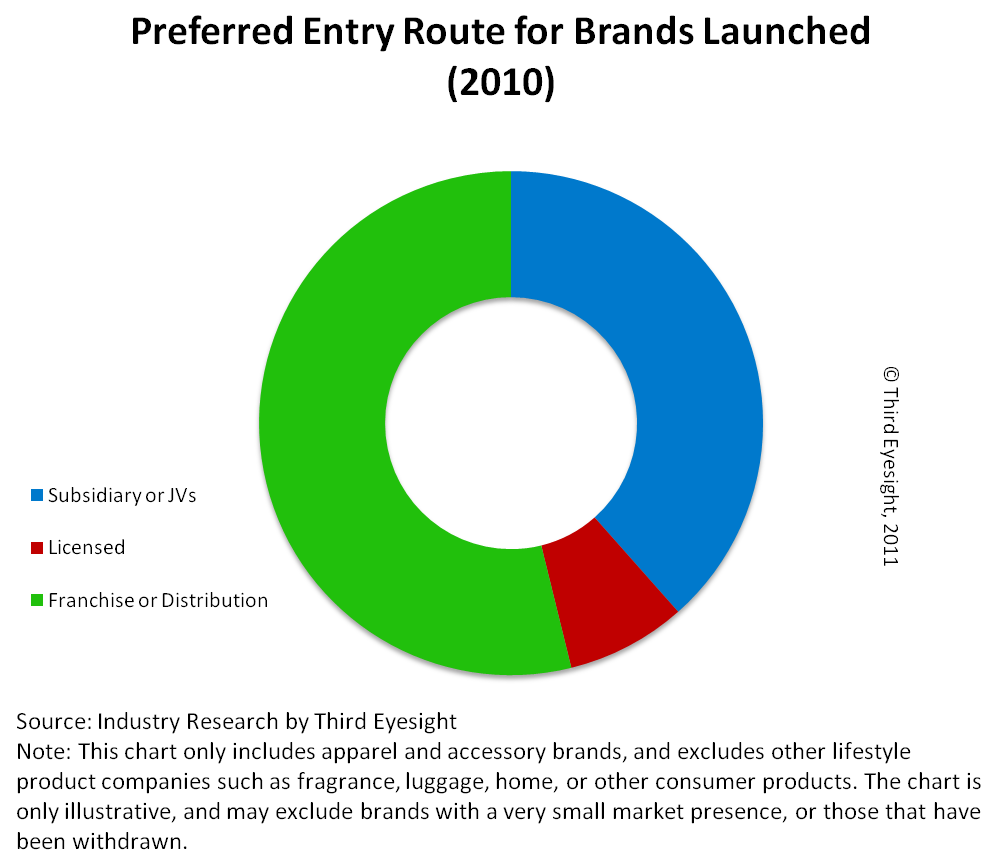
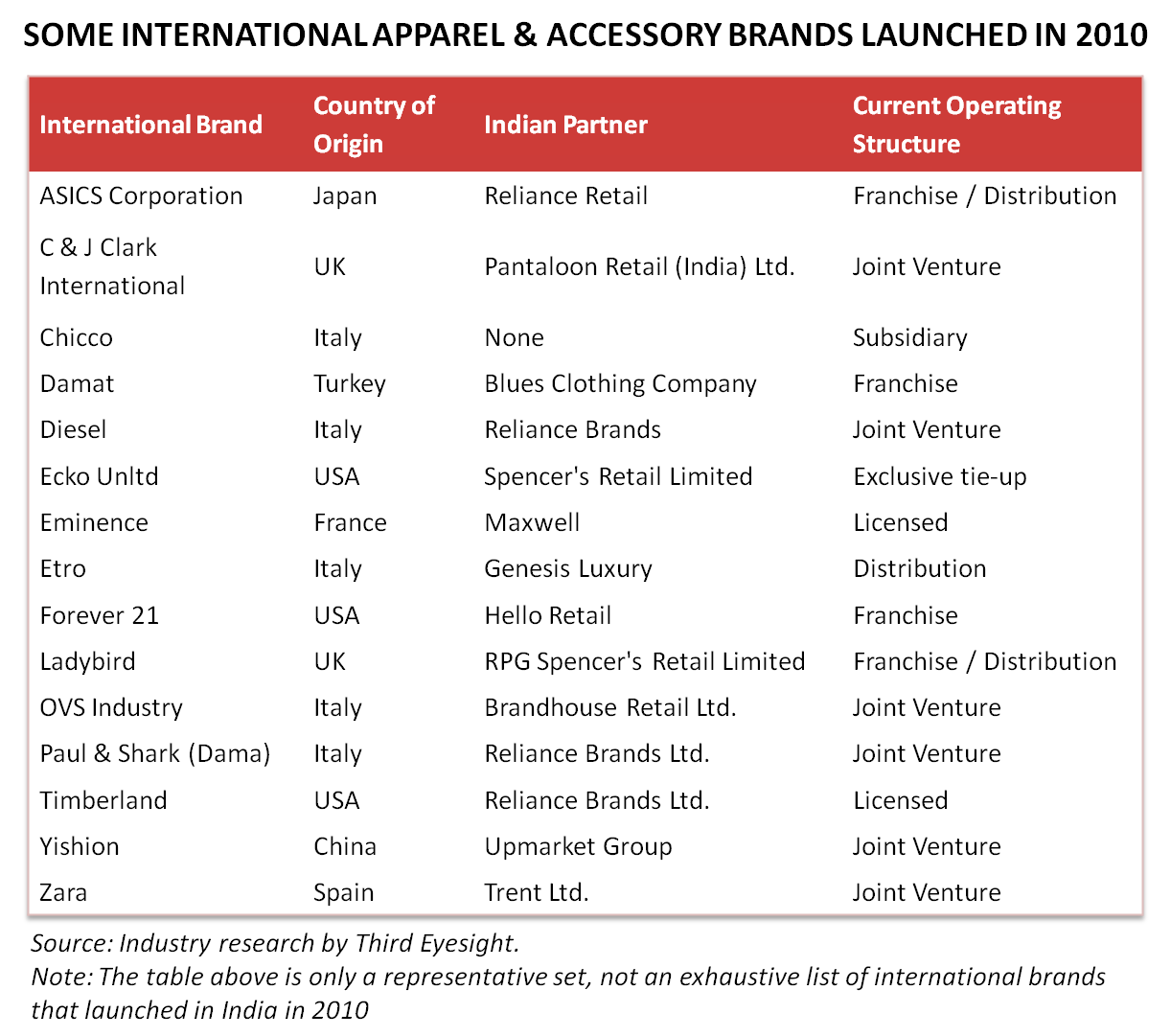
Some brands taking this route for entering the Indian market include Forever 21, Etro, Tom Ford, and Ladybird, amongst others. However, a number of brands that entered in 2010 (nearly 40% for the new entrants) also showed that they wanted a piece of the action through some degree of ownership (whether through a majority or minority stake in a joint venture or through a wholly owned subsidiary). Some – such as S. Oliver – also switched to joint-ventures from their earlier franchise structure.
Under the current regulations governing foreign investment into retail, several companies that typically want control operate either through 100% subsidiaries that sell to independent retail franchisees , or through 51:49 joint-ventures that operate the stores as well.
We are finding increasing signs among companies of a confidence in the market, a growing comfort with the operating environment, and a desire to own and control the direction their brand takes in a strategic market like India. it is likely that if the government decides to allow 100% FDI in single brand retail, several brands will opt to set up wholly-owned subsidiaries that control the entire chain of activities, source-to-store.
International brands opting for the ownership in the Indian venture included OVS (Italy’s Gruppo Coin), Yishion (China) and Chicco (Italy).
Fast Fashion for the Family
Amongst the new launches, a highlight of the year was the launch of the most awaited and discussed-about brand Zara. The first store was launched in Delhi with menswear, womenswear and childrenswear, followed by a store in Mumbai, and a third again in Delhi. While almost every other brand launches with an advertising blitz, Zara – in its usual fashion – needed none. The news buzz it generated created enough traffic to provide record sales during the first few weekends. It was also instrumental in generating 30-40% more footfall in the malls where it opened.
Inditex was certainly one of the brands looking for control, and has formed a 51:49 joint venture with the Tata Group’s retail business, Trent. For now the company has adopted its global supply chain for the Indian market as well which clearly adds cost and time to the supply chain. The merchandise is imported from the central distribution centre in Spain, and includes products manufactured in the Indian subcontinent. Competing brands in the industry have raised questions about Zara being able to build a successful and sustainable business in India just on the back of rapid fashion changes, at prices that are not quite “competitive”. However, the brand is reportedly aware of the struggle in building a successful business around import-led sourcing model and is seen to have planned growth conservatively.
Another southern European value fashion brand, OVS Industry, was launched last year by Oviesse through a joint-venture with Brandhouse Retail from the SKNL group. OVS Industry also offers a range for men, women and kids. While in the first year products have been imported from Italy, the company says it intends to bring in the merchandise directly from the supply source for speed and cost effectiveness, to achieve aggressive growth over the next five years.
Multi-Brand Platforms, Larger Stores
International brands have been drawn to India by its large “willing and able to spend” consumer base and the rapidly growing economy, but so also are Indian companies – manufacturers or retailers – who are ready to act as platforms for their launch.
Given the current restrictions on investment into retail operations, Indian companies are increasingly setting up large multi-brand outlets for an array of international brands under one roof. This allows the Indian franchisee to share overheads among many brands, and also negotiate harder for shopping centre space that is increasingly unaffordable. However, the idea is not only to gain from the operational efficiencies and cost efficiencies, but also to capture a higher share of the wallet of the consumers walking into the stores.
Even those Indian companies that are already retailing their own brands in a particular category are seeking franchise or distribution relationships with international brands, in order to capture a complementary segment of consumers or to offer a larger choice-set to their existing consumers.
For instance, Reliance Brands has partnered with some well known premium to luxury fashion and lifestyle brands. In 2010 alone, it brought Diesel, Paul & Shark and Timberland to the Indian market. On the other hand Maxwell Industries’ relationship with Eminence, a French innerwear brand, has allowed it to address the premium segment in which it was not present, and to compete with other international players such as Jockey, Triumph, Hanes, Fruit of the Loom and others.
RPG Group’s Spencer’s Retail, one of the pioneers of modern retail in the last two decades is looking at increasing the share of its apparel business. Apart from its private labels, Spencer’s is also actively seeking to grow its international brand portfolio quickly. Following up on its launch of Beverly Hills Polo Club in 2008, Spencer’s introduced Ecko Unltd (a youth fashion brand) in 2010. It has also become the platform for the British childrenswear brand Ladybird in its second coming to India.
While the emergence of large multi-brand franchise outlets is driven by Indian franchisees looking to optimise their businesses, the brands themselves are also looking at larger store sizes that are gradually becoming comparable to their stores elsewhere. For instance, the American brand Forever 21 launched with 10,000 square feet for only women’s western clothing and accessories. Similarly, Zara launched its business with a 14,000 square feet store. Larger stores are allowing brands to increase the efficiency of their operations, maximise the visual impact, and increase the speed at which they can achieve critical mass in the country.
Beyond Europe and the US
While European and American brands clearly dominate, 2010 also saw brands from China, Japan and Turkey making inroads to the Indian market.
China’s apparel retailer Yishion launched a 51:49 joint venture with a distribution company, Upmarket Group. Yishion is aiming at rapid growth in the mid price segment in India through own stores and multi-brand outlets (MBOs).
Turkish brands Tween, ADV and Damat from the Orka Group have been brought to the market by Blues Clothing Company, a mid-sized retailer of fashion apparel that also distributes brands such as Versace, Corneliani and Cadini.
The Strategy Shifts & Changing Structures
In the past the international brands have undergone changes in their strategy and operating structures to suit their current context and changing environment. Last year was not an exception to the correction and some brands did undergo a change in their approach and strategy for the Indian market.
Italian denim brand Energie exited the market and their partnership with Reliance Brands in 2007. However, in 2010, the Miss Sixty group entered into a licensing agreement with Arvind Limited which relaunched Energie as part of its portfolio of international denim brands. Arvind already had international brands catering to the mass and the middle segments of the denim market, and with the launch of Energie, it has achieved brand presence in the super-premium category as well.
Another notable denim brand that re-entered the market in 2010 was GAS, also from Italy. After it fell out with Raymond, the brand investigated other relationships, and finally decided to set up a fully-owned subsidiary. The brand was re-launched with one flagship store and through various shop-in-shop counters at Shoppers Stop, the department store chain.
The second attempt of the Germany-based casualwear apparel brand Lerros owned by the House of Pearl was ill-timed in 2008. With business coming up below expectations, the company decided exit the business in India. But instead of exiting the market, it granted the license to manufacture, retail and distribute Lerros to the maker of the Indian denim brand Numero Uno. With a complementary product mix, the principal and the licensee are looking to achieve greater success together.
Another brand that has undergone a shift in its strategy and the operating structure is the Italian brand Zegna, a world leader in luxury menswear. It was first introduced in the Indian market early on in the decade through a franchise arrangement. In 2005 with 51% FDI being allowed the Zegna Group invested in taking a majority stake in its Indian operations. Last year the brand entered into a joint venture with Reliance Brands Limited with the objective of ramping up its India operations and capturing a larger share in the Indian luxury market. For Reliance, it was a great addition to its international brand portfolio.
Compared to 2009, 2010 witnessed hardly any exits, Aigner being one.
Strategies for Growth and Prospects For 2011
Overall the year 2010 has been very positive and the pace of new brands entering the market is picking up. Those already present in the market, have been adapting their strategies to grow their India business. The growth strategy for international brands has revolved around lowering the prices and entering new segments.
The brands that have rationalised their pricing last year to attract more customers include Adams Kidswear. Previously priced significantly higher than the market leaders in that segment, Adams is looking to change its sourcing strategy and source a part of its product range locally. Similarly, having tasted success in the previous year, The Body Shop not only rationalised prices for more products in 2010, but also introduced new products at lower price points.
Another notable trend last year was the focus of international brands on Tier 2 and 3 cities. Marks & Spencer unveiled its plans to enter Tier 2 cities such as Jaipur and Chandigarh and grow its national footprint. Reebok, Adidas, Ed Hardy, Tommy Hilfiger, The Bodyshop and Puma are amongst those that have stated their intent to further expand to such cities. The success of adopting these strategies is bearing results already and the momentum is likely to build further as others follow.
For international brands, as for Indian brands, significant challenges remain in the path of growing their business.
At the base level is drumming up adequate demand. While India is often compared with China because of similar size of population, the fact is that urban discretionary incomes and the concentration of spend are far higher in China. This reflects in the speed with which brands have been able to ramp up in the two countries. For instance, Mango entered the two markets around the same time. However, a the end of 2010, the network of stores in India was only a tenth the size of the store network in China (100-plus), with over 200 more stores projected to open in 2011.
In scaling up, the lack of affordable good retail locations is one of the other biggest hurdles. With the slow growth in 2008 and 2009, brands are significantly more cautious in signing up space at high rentals.
Future challenges also remain more at the internal operational level. Retaining adequately trained front-line staff is an issue. Not only does the increasing number of international brands increase the competition for the employee pool, so also does growth in other segments of the economy and it is tough to sell retail as an employment option of first-choice.
We expect prices to become more realistic, but also operational efficiency to be a driver. Clustering of stores for efficient management, a concerted drive towards lower cost locations and variable (revenue-linked) payments to landlords are likely to be critical in driving better performance. We also expect many brands to seriously consider scaling up the network to provide critical mass to their business, which can also drive local sourcing of merchandise or direct shipments to the Indian business from Indian and other Asian sources.
If the Indian Government announces further relaxation in the foreign ownership norms, we would expect more brands to take equity stakes in the business in India, including the entry of those that wish to operate fully-owned subsidiaries. However, with many different signals from various arms of the government it is best not to try and read the crystal ball too closely on that issue.
Despite challenges and barriers, the market is far from being saturated right now as newer product segments and product lines create ever-newer needs. With India being one of the few large economies showing consistently strong performance, many more are considering the Indian market seriously. Among the ones reported to be interested in launching are GAP, Uniqlo and Polo by Ralph Lauren.
The market may become more segmented and even fragmented with a plethora of international brands being available.
The largest brands currently include Levi Strauss and Reebok which are both reportedly well past the US$ 100 million mark in India, but the race for market leadership is still well and truly on. No matter which brand comes out ahead the winner, without a doubt, will be the consumer.
