
admin
May 27, 2026
Writankar Mukherjee and Aanya Thakur, Economic Times
Kolkata/Mumbai, 27 May 2026
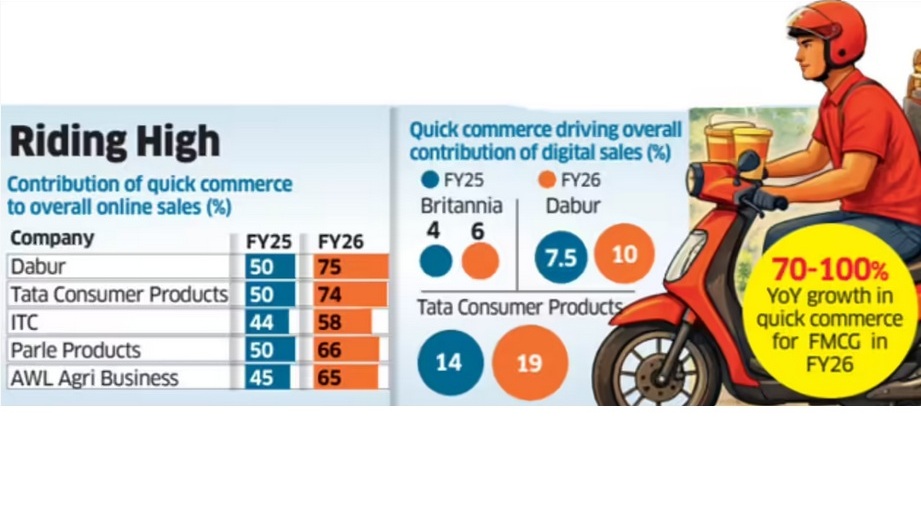
Quick commerce has become the dominant online sales channel for India’s top fast-moving consumer goods (FMCG) companies, with Dabur India and Britannia Industries among others now deriving up to 75% of their digital sales from 10-minute delivery platforms.
Industry executives said quick commerce is reshaping consumer buying habits and increasingly cannibalising sales from all other channels, including ecommerce platforms, modern trade and kirana stores, even as large online marketplaces and retailers expand into the segment.
Latest data from companies including ITC Ltd, AWL Agri Business, Tata Consumer Products and Parle Products showed quick commerce accounted for 60-75% of their total online sales in FY26, rising sharply from less than half a year earlier.
For Britannia and Tata Consumer Products, quick commerce now contributes more than 70% of online sales, while the share climbed to 75% for Dabur in the fourth quarter ended March from 50% in the December quarter.
Executives said expanding assortments and demand for instant replenishment are accelerating the shift. “Quick commerce has been gaining ground with several ecommerce companies such as BigBasket, Amazon and Flipkart, as well as retail chains like Reliance Retail, entering the space,” said Mayank Shah, vice-president at leading biscuits maker Parle Products. “Given consumers’ demand for convenience and immediate replenishment, quick commerce has emerged as a strong growth opportunity for them.”
Quick commerce accounted for 65% of online sales of Parle Products and AWL Agri Business last fiscal, compared with 50% and 45%, respectively, in FY25. ITC derived 58% of its online sales from this channel in FY26.
Frequent Purchases
Grocery-shopping are now centred around frequent top-up purchases through the week.
“Quick commerce has facilitated a grocery shopping habit which already existed – more frequent purchases. These companies are now also looking to improve profitability by expanding into higher-margin and impulse-driven categories,” said Devangshu Dutta, founder and CEO of Third Eyesight, a consultancy in consumer space.
While the channel is already significant for FMCG companies in the top 8-10 cities, it is expanding rapidly into smaller towns as operators such as Blinkit, Zepto and Swiggy Instamart widen their footprint.
Premium Push
The channel has also allowed companies to push premium products, executives said.
“While on marketplaces and traditional e-commerce platforms we were heavily skewed towards staples, the shift to q-commerce is helping us premiumise our assortment and sell far more indulgent categories,” Britannia Industries chief commercial officer Vipin Kataria told analysts earlier this month.
The transition has led to a threefold increase in sales of adjacency categories for the biscuits and dairy products maker, he said.
Kataria expects quick commerce’s contribution to the company’s total online sales to rise to 85% from 70% currently.
Most FMCG companies reported 70-100% year-on-year growth in quick commerce sales in FY26, making it the fastest-growing channel for the industry for the past two to three years. Executives expect the trend to continue.
Dabur India global chief executive officer Mohit Malhotra said beverages, foods, personal care and home care are currently the strongest-performing categories in this channel.
Saugata Gupta, managing director of Marico, said quick commerce is likely to be especially dominant in foods, while specialised ecommerce players such as Myntra and Nykaa remain strong in personal care.
The maker of Parachute, Saffola and Livon brands is strengthening its quick commerce supply chain through digitisation, automation and AI-based forecasting, Gupta said.
(Published in Economic Times)
admin
September 15, 2025

Shabori Das & Sagar Malviya, Economic Times
15 September 2025
ITC Foods is making a strategic entry into fresh packaged foods including short shelf-life cookies, cakes, and chapatis, among others, part of its broader aim to ride the surge in quick commerce demand, said Hemant Malik, chief executive of the food division of ITC.
The move is also prompted by the cigarette-to-snack maker’s aim to capture India’s growing appetite for convenience-led, freshly-made food with shelf life of a few days, instead of 12-24 months for other food products, with quicker fulfilment systems.
“There is a growing consumer demand for fresh packaged food products, powered by enhanced accessibility and convenience provided by the surge in quick commerce platforms,” Malik told ET, adding that the company has extended its Sunfeast and and Aashirvaad brands into these categories.
ITC has created a hyper-local production and distribution ecosystem to enable next-day delivery from oven to doorstep in a country where supply chains are often fragmented and 75% of the sales are through local kiranas. The company said its small-batch model, scaled across urban micro-markets, will help maintain freshness while sidestepping the usual constraints of long-haul logistics and warehouse storage.
“We are leveraging tech-enabled capabilities, supply chain efficiencies including hyper-local agile production and rapid fulfilment together with focus on fresh sourcing,” Malik added.
Analysts however noted that relying solely on quick commerce won’t ensure scale while limited shelf life could require bigger retail channels including modern and general trade.
“These products will need to move fast. So inventory management in terms of space for quick commerce will be challenging,” said Devangshu Dutta, founder of retail consulting firm Third Eyesight. “And in case of quick commerce, it will need to have catchment focus as not every micromarket in a city will have demand for such products.”
“In the case of large FMCG companies, scalability is always what is needed, and quick commerce alone will not help with that. Eventually modern trade and general trade for these shorter shelf life products will be considered,” he said.
ITC’s packaged food business clocked ₹18,270 crore in gross sales during FY25, up 6% on-year.
Quick commerce platforms such as Blinkit, Swiggy Instamart, and Zepto have made it easier than ever to deliver ultra-fresh products within hours–and they have been tapped by local bakeries and direct-to-consumer companies including Theobroma, Baker’s Dozen, and Id Fresh.
Over the past few months, mainstream companies including Hindustan Unilever, Marico, Adani Wilmar and Parle have carved out separate sales and distribution teams for quick commerce, responding to the need for a faster turnaround in stocking as well as a distinct portfolio for the segment.
(Published in Economic Times)
