
admin
May 17, 2013
Organised by the Retailers Association of India the Delhi Retail Summit this year (10 May 2013) focussed on multi-fold growth for retailers utilising multiple channels to the consumer, with panel discussions and presentations by industry leaders who shared their experiences in exploiting the opportunities and dealing with the strategic and operational challenges of their varied businesses. Some snippets from the first panel discussion, comprising of the following panelists:
1. Devangshu Dutta, Chief Executive, Third Eyesight (Session Moderator)
2. Atul Ahuja, Vice President – Retail, Apollo Pharmacy
3. Lalit Agarwal, CMD, V-Mart Retail Ltd.
4. Atul Chand, Chief Executive, ITC Lifestyle
5. Rahul Chadha, Executive Director & CEO, Religare Wellness Ltd.
Devangshu Dutta
February 24, 2013

Luxury is an ill-defined concept. There is no specific line or limit of price, quality or availability that separates the luxurious from all that is not.
However, like other similarly intangible attributes such as power or grace, we all immediately recognise luxury when we experience it.
In fact, experience — vague as that may sound — is key to differentiating luxury, more than the tangible product being consumed. It’s not just the person’s own direct sensory experience, but also the prestige and status granted by others around her or him that creates the luxury experience.
Surely, with such intangible notions of experience, power and prestige, luxury brands should be among the most influential in the market. They should be pioneers that set the tone for change in improving retail management practices, upping customer service standards, driving quantum leaps in quality.
But is it so? The response from the rest of the retail sector may not quite be “meh”, but I suspect that it would not be far off.
There are strong reasons why luxury brands would have a lower influence as benchmarks in India and why, in fact, they may draw in more influence from the market themselves.
Market presence and location
As an example, in physical presence, luxury brands seem to demonstrate a delayed response to changes in the market, both in terms of market entry and location selection.
Prior to the entry of global brands, luxury products and services in India were naturally defined by niche, largely owner-managed businesses. Business scale was curtailed by internal limitations, and due to the small size, its market reach was also limited. While there were some designer brands that would occasionally get copied by mid-priced retailers, by and large luxury brands lived in their own separate bubble, with little or no influence on the heaving mass of the market.
In contrast, in the Western economies, from where many of today’s luxury brands originate, they are looked up to for inspiration. So, it is natural to expect Western luxury brands to lead the charge into the newly emerging modern retail economy of India. However, according to Third Eyesight’s research of international fashion and accessory brands in India, in the last 25 years it is mid-priced and premium brands that have opened the market. It is only in the last 10 years, well after the economic and retail growth was underway, that luxury brands stepped up their presence.

Sure, during the so-called “retail boom” from 2004, luxury brands went up to one-quarter of all international fashion and accessory brands present in the market. Then, when practically the whole world was in a recessionary mood, and mid-priced and premium brands took a call to defer their India launch plans, luxury brands pushed ahead. In 2009, luxury fashion brand launches accounted for two-third of all foreign fashion brands launched in India. Maybe the brand principals felt that this market could take on the burden of slowing growth elsewhere, or perhaps it was their Indian counterparts who were the source of optimism. Either way, the optimism took a hit in 2010 and 2011 when it was luxury brands that became cautious.
In terms of store openings and location selection too, luxury brands seem to have waited for the overall market to upgrade itself, and have then latched on to that growth. Previously luxury brand stores, such as there were, largely restricted their presence to five-star hotel shopping arcades, while a few took up non-descript sites as they were confident of being destinations in their own right or clustered together to create a precious few bohemian locations in surroundings that were far from luxurious. As modern shopping centres emerged in recent years, these presented an environment where rich consumers — especially the ‘new’ rich — could flock to buy globally benchmarked lifestyle statements. While these were mainly targeted at mid-market to premium brands, some of them are now even attracting designer brands such as Canali at Mumbai’s Palladium mall rubbing shoulders with Zara. These new luxury stores in mid-market or premium locations are performing better than the original “luxury” sites.
Thus, in terms of expressing confidence in the market, luxury brands seem to be following market trends rather than leading them. And far from being the anchors to create demand, they seem to be following where the demand goes.
Design and product development
The most important impact that luxury brands could have on the market is by influencing product design. This fashion trickle-down is supposed to work in two ways: one, through “inspiring” knock-offs by cheaper brands; two, making luxury customers act as opinion leaders and trend-setters for other consumers.
However, various factors dilute the luxury brands’ product and design influence in India: the preponderance of domestic (“ethnic”) style and colour, especially in womenswear, the existing domestic variety in products, the flood of premium (non-luxury) international brands and a customer base that is oblivious to the difference between the premium and luxury segments. In spite of their small size, Indian luxury and designer brands possibly have a larger direct impact, not to mention the massive Bollywood machine that drives mainstream fashion trends on a day-to-day basis. The international luxury giants are conspicuous by their small influence.
In fact, increasingly the influence is flowing the other way. A few luxury brands have attempted to create India-specific items to give the customer what they might want. Some of these may be indulging in superficial pandering such as putting an Indian image on a global product, but others have created Indian products that genuinely reflect what the brand stands for. While some use India as a production sweatshop to minimise the cost of high-skills jobs, others are now beginning to use Indian crafts to design products that are relevant to other global markets. A few examples, without passing judgement on which category they fit into, include: Lladro’s Spirit of India collection, the Hermès sari, the Jimmy Choo “Chandra” clutch bag, Louis Vuitton’s Diwali collection and Canali’s nawab jacket.
Slow, but not yet steady
Another issue with India is the sheer numbers, or the lack thereof!
China’s GDP is about four times the size of India’s but its luxury market size is estimated to be six times that of India. There are 1.7 million households in China that meet the high net-worth criteria, as compared to 125,000 in India. What’s more, according to industry estimates, only about 30 per cent of luxury consumers in China are actually wealthy, while the overwhelming majority are people with mid-market incomes who are given to conspicuous consumption, whether buying luxury goods for themselves or as gifts.
Indian consumers also have a penchant for buying overseas rather than shopping from the same brands’ stores in India. This is not just due to higher costs and import duties in India, but because of wider and more current selections of merchandise in stores overseas. Indians’ luxury shopping destinations include the usual suspects: London, New York, Paris, Milan, Singapore and Dubai. This has meant that while luxury brands recognise Indians as a large, emerging base of customers, for most brands India itself remains an operating market for the future.
Having said that, when compared to any other sector of business, luxury brands in India probably get the most media coverage for every rupee of sales earned. Although they are a small fraction of the sales, luxury brands rule in terms of column centimetres or telecast seconds. The coverage is not restricted to consumer-oriented media such as lifestyle magazines or mainstream newspapers, individual luxury brands are also extensively covered in business media.
One may argue that such is the nature of luxury: this disproportionate visibility and share of mind happen because luxury is not just aspirational, but inspirational. However, that inspiration and influence is yet to become apparent in the business at large. Until we see significantly larger numbers of upper-middle-income customers in India, luxury brands will find it difficult to expand their reach beyond the small base of ultra-rich consumers. The aspiration and price gap is just too wide for the Indian middle class, and there are very few who will emulate their Chinese counterparts and save up a year’s salary for a single luxury item.
And so…
One thing is beyond doubt: the luxury sector in India is undergoing significant change. We could even say it is in active ferment. There has never been so much interest among so many people, or so many brands so widely promoted, as now.
The question is still open on whether it is a good ferment such as the one that produces wine from raw grape juice and fine cheese from plain curds, or the unguided rot that results in a putrid, smelly mess unfit for consumption.
My bet is on the first possibility. In the short term, the luxury business appears to be a mess, littered with fractured partnerships and bleeding financial statements. But the brew needs time to mature. Gradually, as the luxury segment matures along with the rest of the market, we will see the influence trickling down into other segments. But remember, the finest brews do not only impart their flavour to the cask, but imbibe the cask’s characteristics into themselves. So it is with luxury and the Indian market. The message that we have given many other international businesses seems to hold doubly true for the global purveyors of influence, the luxury brands: “As much as you think you would change India, India will change you.”
admin
January 21, 2013
By Tarang Gautam Saxena & Devangshu Dutta
Since the onset of reopening of India’s economy in the late 1980s, fashion is one consumer sector that has drawn the largest number of global brands and retailers. Notwithstanding the country’s own rich heritage in textiles the market has looked up to the West for inspiration. This may be partly attributable to colonial linkages from earlier times, as well as to the pre-liberalisation years when it was fashionable to have friends and relatives overseas bring back desirable international brands when there were no equivalent Indian counterparts. Even today international fashion brands, particularly those from the USA, Europe or another Western economy, are perceived to be superior in terms of design, product quality and variety.
International brands that have been drawn to India by its large “willing and able to spend” consumer base and the rapidly growing economy have benefitted in attaining quick acceptance in the Indian market and given their high desirability meter, most international brands have positioned themselves at the premium-end of the market, even if that is not the case in the home markets. In addition, Indian companies – manufacturers or retailers – have been more than ready to act as platforms for launching these brands in the market and today there are over 200 international fashion brands in the Indian market for clothing, footwear and accessories alone, and their numbers are still growing.
Global Fashion Brands – Destination India
Europe’s luxury brands have had a long history with India’s princely past, but modern India tickled the interest of international fashion brands in the 1980s when it set on the path of liberalisation. The pioneering companies during this stage were Coats Viyella, Benetton and VF Corporation. At the time the Indian apparel market was still fragmented, with multiple local and regional labels and very few national brands. Ready-to-wear apparel was prevalent primarily for the menswear segment and was the logical target for many international fashion brands (such as Louis Philippe, Arrow, Allen Solly, Lacoste, Adidas and Nike). (Addendum: The rights to Louis Philippe, Van Heusen and Allen Solly in India and a few other markets were sold after several years to the Indian conglomerate, Aditya Birla Group, as part of the Madura Garments business.)
The rapidly growing media sector also helped the international brands in gaining visibility and establishing brand equity in the Indian market more quickly. However, this period did not see a huge rush of international brands into India. West Asia and East Asia (countries such as Japan, South Korea, Taiwan and even Thailand) were seen as more attractive due to higher incomes and better infrastructure. In the mid-1990s there was a brief upward bump in international fashion brands entering the Indian market, but by and large it was a slow and steady upward trend.
The late-1990s marked a significant milestone in the growth of modern retail in India. Higher disposable incomes and the availability of credit significantly enhanced the consumers’ buying power. Growth in good-quality retail real estate and large format department stores also allowed companies to create a more complete brand experience through exclusive brand stores in shopping centres and shop-in-shops in department stores.
By the mid-2000s, however, a very distinct shift became visible. By this time India had demonstrated itself to be an economy that showed a very large, long-term potential and, at least for some brands, the short to mid-term prospects had also begun to look good.
While India was a promising market to many international brands, it was not completely immune to the global economic flu. More than its primary impact on the economy, it sobered the mood in the consumer market. Even the core target group for international brands tightened the purse strings and either down-traded or postponed their purchases.
In 2008, in the midst of economic downturn, scepticism and uncertainty, international fashion brands continued to enter India at nearly the same momentum as the previous year. Many international brands such as Cartier, Giorgio Armani, Kenzo and Prada entered India in 2008, targeting the luxury or premium segment. However, given the high import duties and high real estate costs, the products ended up being priced significantly higher than in other markets. Many brands ended up discounting the goods heavily to promote sales, while a few gave up and closed shop.
The year 2009 saw the true impact of the slowdown as fewer international brands were launched during the year. The brands that launched in 2009 included Beverly Hills Polo Club, Fruit of the Loom, Izod, Polo U.S., Mustang, Tie Rack, Donna Karan/DKNY and Timberland amongst others. Some of these had already been in the pipeline for quite some time and had invested considerable time and effort in understanding the dynamics of the Indian retail market, scouting for appropriate partners, building distribution relationships and tying up for retail space, setting up the supply chain and, most importantly, getting their operational team in place.
2010 was better in comparison: although initially slow, the growth of new international brands entering the Indian market in 2010 bounced back later during the year, and some brands that had exited the Indian market earlier also made a comeback. Amongst the new launches, a highlight of the year was the launch of the most awaited and discussed-about Spanish brand Zara. The first store was launched in Delhi to an absolutely phenomenal response, followed by a store in Mumbai, and a third again in Delhi. The Italian value fashion brand, OVS Industry, was launched in 2010 by Oviesse through a joint-venture with Brandhouse Retail from the SKNL group. While in its first year products were imported from Italy, the company had mentioned that it intended to bring in the merchandise directly from the supply source for speed and cost effectiveness, to achieve aggressive growth over the following five years.
2010 indicated a fresh round of optimism as the pace of new brands entering the market picked up, and those already present in the market showing signs that they were adapting their strategies to grow their India business, including lowering prices and entering new segments.
Though the number of new brands entering the Indian shores in 2011 and 2012 may not have matched the numbers in the peak years, both years have been healthy and the list of new brands ready to enter in 2013 already seems promising.
Amongst others, 2011 saw the entry of Australian brands such as Roxy and Quiksilver having tied up with Reliance Brands for distribution. The largest British football club and lifestyle brand Manchester United, signed up with Indus-League Clothing Ltd. to bring the fashion products to India, after having launched café bars in India in 2010 through a franchisee.
2012 brought in luxury brands such as Christian Louboutin, Roberto Cavalli and Thomas Pink, womenswear brands such as Elle, Monsoon and fashion accessories brands such as Claire’s.
Routes to Market – The Evolution
The choice for entry strategy for the fashion brands has evolved over the years. During the initial years licensing was the preferable route for international brands that were testing the market. This shifted to franchising as import duties dropped and brands looked at exerting more control on the product and the supply chain. More recently, brands seem to be opting for some degree of ownership, as they begin to take a long-term view of the market.
In the 1980s and the early 1990s, licensing was a popular entry strategy amongst the global fashion brands, with minimal involvement in the Indian business.

In the mid-1990s a few companies such as Levi Strauss set up wholly owned subsidiaries while others such as Adidas and Reebok entered into majority-owned joint ventures. This helped them to gain a greater control over their Indian operations, sourcing and supply chain, and brand. In the subsequent years import duties for fashion products successively came down making imports a less expensive sourcing option and the realty boom brought in many investors in retail real estate who became franchisees for the international brands. By 2003, franchising became the preferred launch vehicle for an increasing number of international companies, while only a few chose to enter through licensing.
In 2006 the Government of India reopened retail to foreign investment (allowing up to 51 per cent foreign direct investment in single-brand retail). Using this route, many brands have entered India by setting up majority-owned joint ventures, or moving their existing franchise relationships into a joint venture structure. By the end of 2008, more than 40 per cent of the international brands were present through a franchise or distribution relationship, while more than 25 per cent had either a wholly-owned or majority-owned subsidiary. All these structures allowed the brands to have greater control of operations, particularly of the product.
Amongst the international brands that entered the Indian market, a few were on their second or even third attempt at the market. For instance, Diesel BV initially signed a joint venture agreement in 2007 with Arvind Mills. However, by the middle of 2008, the relationship ended with mutual consent, as Arvind reduced its emphasis at the time on retailing international brands within the country. Within a few months of ending this relationship, Diesel signed a joint venture with Reliance Brands as the iconic denim brand wanted to take on the Indian market full throttle and the Indian counterpart had indicated that it wanted to rapidly build its portfolio of Indian and foreign brands in the premium to luxury segments across apparel, footwear and lifestyle segments.
Similarly, Miss Sixty entered India in 2007 through a franchisee agreement with Indus Clothing. It switched to a joint venture with Reliance Brands in the same year but the partnership was called off in 2008. Miss Sixty finally entered India through a franchisee agreement with a manufacturer of women’s footwear and accessories.
During the turbulence of 2008 and 2009, a few brands also moved out of the market. Some of them were possibly due to misplaced expectations initially about the size of the market or about the pace of change in consumer buying habits. Others were due to a failure either on the part of the brand or its Indian partners (or both), to fully understand what needed to be done to be successful in the Indian market. Whatever the reason, the principals or their partners in the country decided that the business was under-performing against expectations for the amount of effort and money being invested, and that it was better to pull the plug. Amongst the brands that exited the market during 2008 and 2009 were Gas, Springfield and VNC (Vincci).
In the last few years as the foreign direct investment rules are being softened in particular with regard to the more flexibility in the 30% domestic sourcing and clarification on brand ownership norm there is an increasing preference for international companies to enter the India market with some form of ownership while those that are already in the market are looking to increase their stakes in the business.
Several brands have taken the plunge into investing in the Indian operations and moved more aggressively into the market. Since the year 2009, international brands increasingly opted for joint-ventures as the choice for entry into the market. Even the brands already present started looking to modify the nature of their presence in India in order to exert more control over the retail operations, products, supply chain and marketing. Brands that changed their operating structures and, in some cases partners, include VF (Wrangler, Lee etc.), Lee Cooper, Lee, Louis Vuitton, Gucci, Burberry amongst others. Mothercare, the baby product retailer, which was initially present through a franchise agreement with Shoppers Stop, formed a joint venture with DLF Brands Ltd to enable the expansion through stand-alone stores.
During 2011, Promod changed its franchise arrangement with Major Brands into a joint-venture that is majority-owned by Promod. From its launch in 2005, the brand has opened 9 stores so far. However with the new joint venture in place, the international brand is reported to be looking at opening 40 stores in the next four years with the hope of increasing the contribution of India business to its global revenue to the extent of 15-20% from a mere 3% at present.
After its partnership with Raymond fell through in 2007 and all of its standalone stores were shut down, Gas (Grotto SpA) scouted around for an appropriate partner for India business. Eventually, the brand set up a wholly owned subsidiary in 2010 for wholesale operation while retail stores were franchised. In 2012 the company formed an equal joint venture partnership with Reliance Brands with plans to ramp up India retail presence.
2012 was a defining year marking the government’s decision to allow 100% foreign direct investment in single brand retail business and permitting multi-brand retail in India. Not only has this encouraged new brands to consider the Indian market but many existing brands have started reviewing their existing operating structures and alliances, and have initiated moves towards greater ownership and a stronger foothold in the Indian market. Some of the brands have taken the decision to step into an ownership position in India as they felt that India was too strategic a market to be “delegated” entirely to a partner (whether licensee or franchisee), or that an Indian partner alone might not be able to do justice to the brand in terms of management effort and financial capital.
S. Oliver restructured its India operations in 2012 by exiting its prior relationship with the apparel exporter Orient Craft and tied up with a new partner through a majority joint venture. To gain a larger share in the Indian market the company has repositioning the brand, changed its sourcing strategy, reduced the entry-level prices by 40% while reducing the store size (from 5,000 sq. ft. to 1,200-2,400 sq. ft.). It has also put in place an aggressive expansion strategy for tier II towns. The change in FDI norms towards the end of last year may cause it to review its position further.
Canali has entered into a majority-owned joint-venture with its existing partner Genesis Luxury. The brand had entered in India in 2004 through a distribution agreement. Through this change the international brand plans to grow its presence in India multi-fold by opening 10-15 stores over the next three-four years.
Pavers England is the first international brand to have applied for and been granted the permission to own and operate its retail business in India through a 100 per cent subsidiary owned by a UK based company. Newcomers such as H&M and Loro Piana are reportedly considering the joint venture route.
As we have already mentioned in one of our earlier papers (“Tapping into the India Gold Rush”) we do not expect a dramatic short-term growth in the number of international brands following the retail FDI relaxation in September 2012. However, at that time we did foresee some changes in the operating structures for the single brand ventures already active in the market, as well as entry of new brands that have been holding back so far as they wanted greater control in their India retail business and this seems to be happening already.
In the luxury sector, 51 percent FDI and distribution relationships are likely to continue to be a norm, since it is virtually impossible for most luxury companies to meet the 30 percent domestic sourcing requirement in its true spirit. In many cases, the local partner in a joint venture is a mere placeholder until FDI rules are liberalised further and, unless the business grows significantly, most brands will be content to keep the existing structures in place.
In the other segments some more relationships could be reconstituted during 2013, taking the international brand at least a step closer to gaining greater control, even if their partners remain the same.
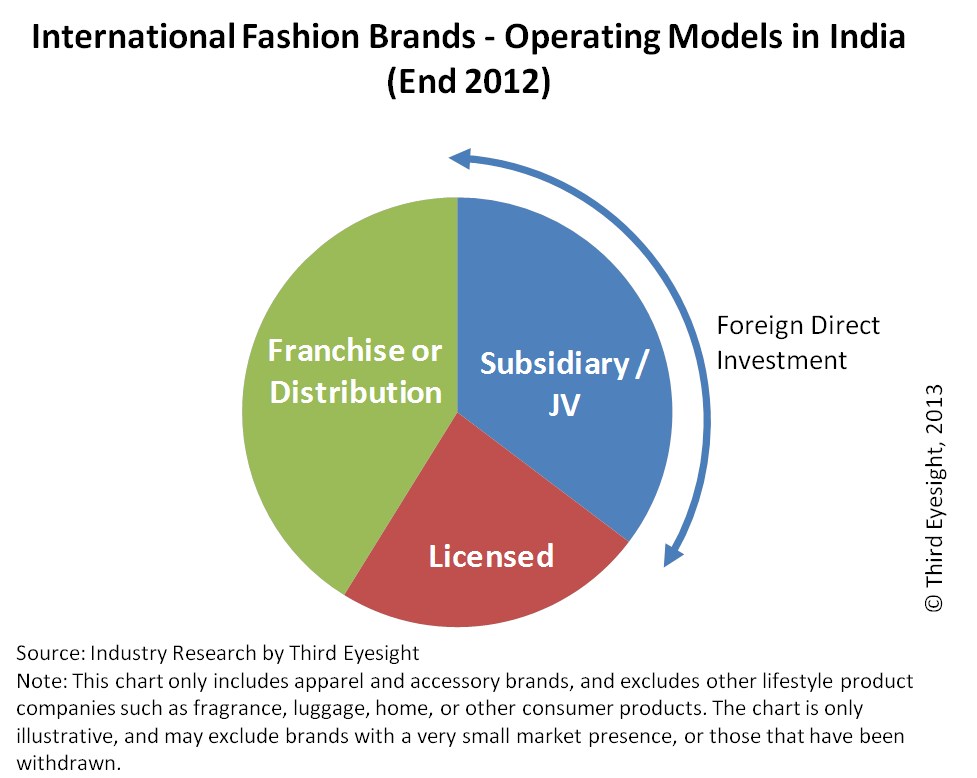
Franchising is still the more common form of route to market for most single brand retail companies although for many international companies an eventual ownership in India business may be desirable. However, licensing should not be excluded from the choice set, especially for companies that are multi-brand retail concepts such as Sephora or those that manage to find a suitable Indian partner that can provide end-to-end support from product sourcing to distribution and retail (for example, the relationship between Elle and Arvind).
Today two thirds of the international fashion brands come from three countries the U.S.A., Italy and the U.K. with nearly 30 per cent originating from the U.S.A. alone.

Is This A Lucky 13?
The theme for the year 2013 is positive for most brands, although still cautious.
Amongst the international brands that one can look forward to shopping in 2013 are “Uniqlo” of Fast Retailing, Japan’s largest apparel retailer, Sweden’s H&M, Emilio Pucci and Billabong. But India is not merely a destination anymore for the international brands to grow their business. The country is also increasingly becoming the innovation-platform or testing ground for new concepts and trends. World Co. a Japanese retailer with more than 3,000 stores in Japan and 200 stores in other parts of Asia is also test-marketing women’s apparel and accessories brands such as Couture Brooch, Opaque.clip, zoc, Tk Mixpie and Hot Beat to gain insights into consumers’ psyche. Italian brand United Colors of Benetton has recently introduced a global retail interior design concept which is present in major European cities but is the first-of-its-kind store in Asia and may well set the trend for the rest of Asia.
Gucci recently opened its largest store in India recently Delhi-NCR after two failed joint ventures. All of its five stores are now run directly by the company and the Indian business also reported to have turned profitable this year.
Brands such as Mango who have chosen the franchise route are tying up with additional partners (e.g. DLF) in the hope of making the Indian business contribute significantly to the overall revenue of the company.
UK-based apparel chain Marks & Spencer is accelerating its expansion in India with plans to add ten stores in the next six to eight months in the country. The company has identified India as one of the key markets to become the world’s most sustainable retailer by 2015. It plans to increase the number of stores in India from 24 currently to over 30 through the 51:49 joint venture with Reliance Retail.
Puma SE, the global sports lifestyle company for athletic shoes, footwear, and other sports-wear aggressively set out to gain 30 per cent of the Indian organised retail sportswear market within a year, from a share of 18-20 per cent in the top four branded sportswear segments in 2011. To this end the company targeted opening nearly 100 more stores during 2012. While the actual numbers are reportedly short of target, the brand has been opening amongst the largest stores during the year.
The confidence in the India opportunity is rising again, with existing global brands expecting the contribution from India business to grow multi-fold in a few years. However, the approach is of careful consideration and brands realise that India is a unique market, different not only from the West but also from other Asian economies such as China. Rather than adopting a “cut-and-paste” approach one needs to seriously consider the appropriate business model for India. Many of the global players have had to create a different positioning from their home markets. Some have significantly corrected pricing and fine-tuned the product offering since they first launched; these include The Body Shop and Marks & Spencer. Others are unearthing new segments to grow into; for instance, Puma and Lacoste are now seriously targeting womenswear as a growth market.
It is not only international brands that are more optimistic. Indian partners are also reviewing their approach. For instance, the Arvind Group that had looked at reducing its emphasis on international fashion brands in 2007-08 has recently acquired the business operations of Planet Retail which operated the franchises of British fashion retailers Debenhams and Next, and American lifestyle brand Nautica in India. The company termed Debenhams’ franchise as a significant acquisition as it provided an entry into the department store segment. Arvind plans to increase the India presence of Debenhams from 2 stores to 8 over the next three years. It also plants to grow the network of Next, the large-format speciality stores, from 3 to 12 in the same period.
As customer footfall and conversions pick up, international brands are also shoring up their foundations for future expansion in terms of better processes and systems, closer understanding of the market, and nurturing talent within their team. Third Eyesight’s study of the market highlights international brands’ concerns with ensuring a consistent brand message, improved organisational capabilities right down to front-line staff, and focussing on unit productivity (per store and per employee).
India shows signs of a healthier business outlook for International brands but the game has just begun and with competition getting tougher, we can expect interesting times ahead.
Devangshu Dutta
February 3, 2012
 Amazon has beta-launched a consumer-facing business in India with its comparison shopping site Junglee.com.
The company has been engaged with India as a support and development centre for several years now, and its traffic and business from India has also grown steadily ever since it started shipping products to the country.
Given the critical mass that is now becoming visible in the Indian e-commerce market, it is logical for Amazon to look at a more direct customer-facing presence here. Its recent moves to set up a fulfillment centre and now the Junglee.com launch certainly look like precursors to a retail launch, whenever the government allows foreign investment multi-brand retail businesses.
Junglee’s current business model is technically not a retail business since the actual transaction would happen on Amazon and websites of other retailers whose product listings it is aggregating.
In the short term, Junglee could be a beneficial partner to existing e-commerce retailers, since Amazon’s robust technology and know-how would become available as a platform, and it would also provide an additional channel for customer traffic. However, with time, Junglee could well become a sizeable competitor for primary traffic which otherwise would have landed directly on the retailers’ own websites. Smaller e-tailers who sign up with Junglee may also find it harder to break away into an independent presence.
The benefit to Amazon, of course, is developing the customer base for a future Amazon-India site, and achieving much deeper insights on customer shopping behavior in India than it possibly gets from the Indian customers transacting on Amazon’s non-Indian websites.
With time, and as Amazon takes a deeper plunge into the market, Indian customers who have enjoyed the Amazon experience remotely can certainly look forward to a wider choice of products at lower costs and with quicker deliveries.
Tarang Gautam Saxena
February 7, 2011
It has been almost two decades since the government in India re-opened the economy to international investors and brands. During the first dozen years or so, apart from a single visible bump in 1995, every year had a steady dribble of fashion brands coming into the country. It was not until 2005 that this rate accelerated to over 20 international fashion brands entering the Indian market annually, even as the existing brands grew their own retail footprint in the market.
2008 and 2009 were both slightly damp by comparison, reflecting the global economic sentiment, but we were optimistic as we laid out our expectations for 2010. While writing the previous version of our research report released a year ago, we felt that 2010 was going to be promising and it could well be a “curtain-raiser for a new decade of growth for international fashion brands in India”.
The increased bustle in the market has endorsed our forecast. Though initially slow, the growth of new international brands entering the Indian market in 2010 bounced back with the same vigour as before the downturn. Some brands that had exited the Indian market earlier also made a comeback as in the earlier years.
The Entry Strategies In 2010
The most preferred entry route for the international fashion brands entering India in 2010 has been franchise or distribution, with more than half the brands selecting this strategy that allows high control over the product and the supply chain with less intensity of involvement at the front-end. There are two discernible categories of brands that are picking this route: firstly, brands that are usually distributed through department stores and multi-brand independent stores in their home market and other markets, but also those brands that are as yet unsure of their capability to engage intensively with the Indian market. Franchising remained a popular choice in 2010 particularly for the brands looking to test the market or operating in niche or luxury segments.
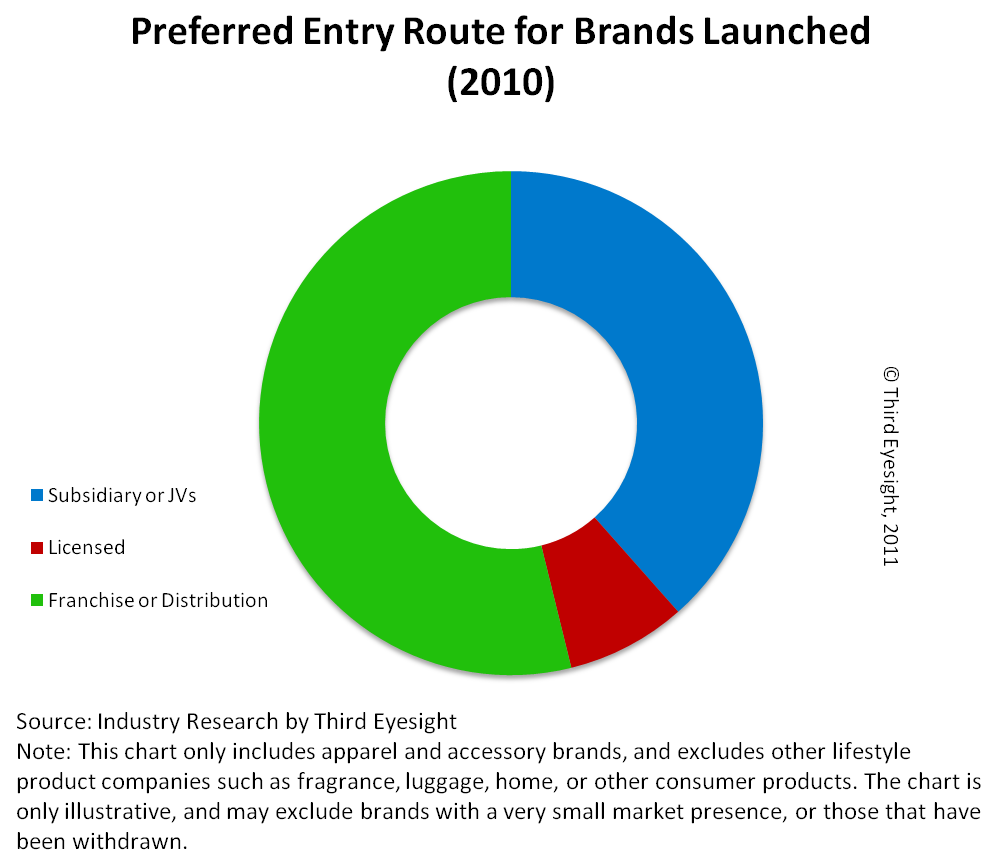
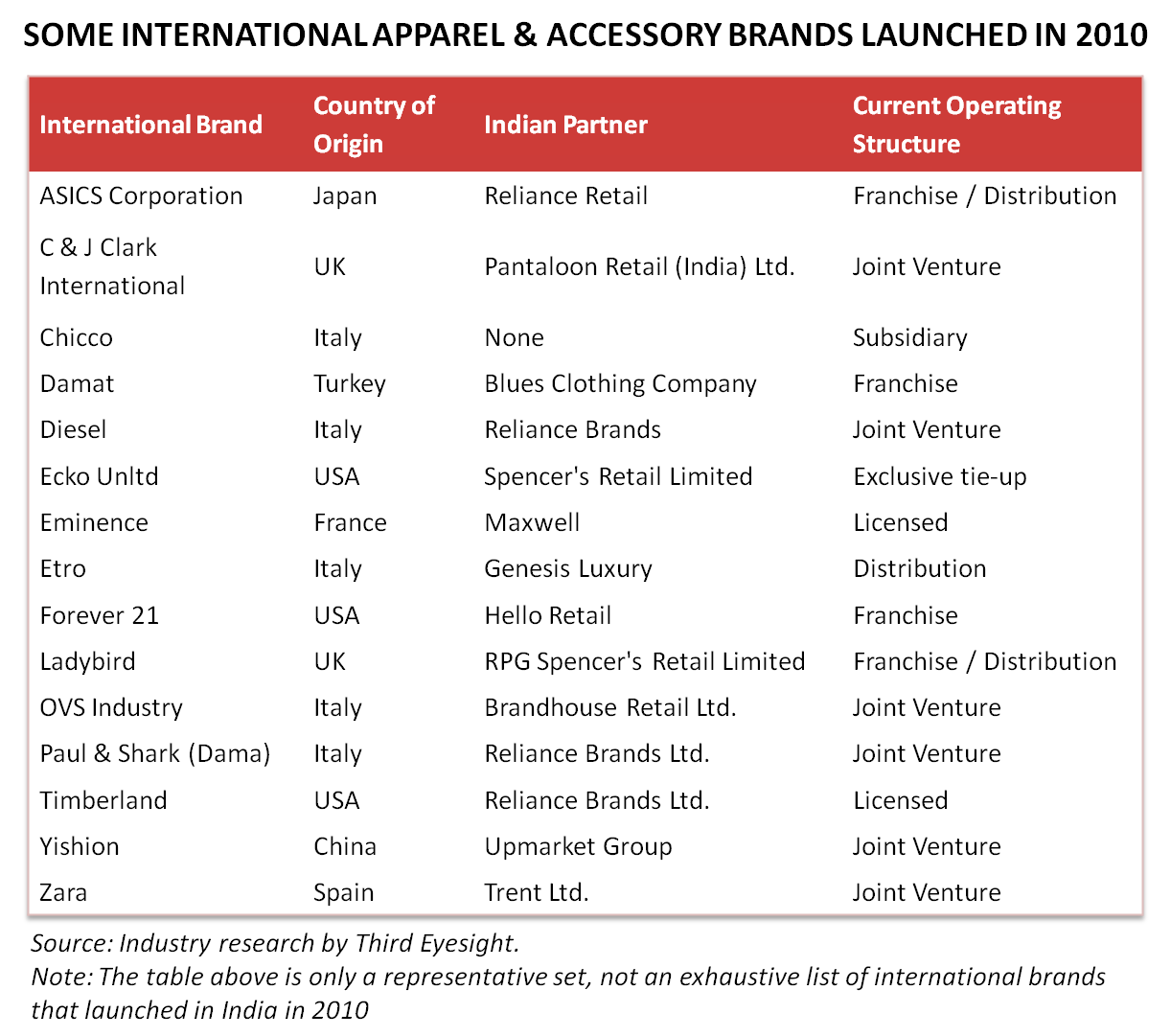
Some brands taking this route for entering the Indian market include Forever 21, Etro, Tom Ford, and Ladybird, amongst others. However, a number of brands that entered in 2010 (nearly 40% for the new entrants) also showed that they wanted a piece of the action through some degree of ownership (whether through a majority or minority stake in a joint venture or through a wholly owned subsidiary). Some – such as S. Oliver – also switched to joint-ventures from their earlier franchise structure.
Under the current regulations governing foreign investment into retail, several companies that typically want control operate either through 100% subsidiaries that sell to independent retail franchisees , or through 51:49 joint-ventures that operate the stores as well.
We are finding increasing signs among companies of a confidence in the market, a growing comfort with the operating environment, and a desire to own and control the direction their brand takes in a strategic market like India. it is likely that if the government decides to allow 100% FDI in single brand retail, several brands will opt to set up wholly-owned subsidiaries that control the entire chain of activities, source-to-store.
International brands opting for the ownership in the Indian venture included OVS (Italy’s Gruppo Coin), Yishion (China) and Chicco (Italy).
Fast Fashion for the Family
Amongst the new launches, a highlight of the year was the launch of the most awaited and discussed-about brand Zara. The first store was launched in Delhi with menswear, womenswear and childrenswear, followed by a store in Mumbai, and a third again in Delhi. While almost every other brand launches with an advertising blitz, Zara – in its usual fashion – needed none. The news buzz it generated created enough traffic to provide record sales during the first few weekends. It was also instrumental in generating 30-40% more footfall in the malls where it opened.
Inditex was certainly one of the brands looking for control, and has formed a 51:49 joint venture with the Tata Group’s retail business, Trent. For now the company has adopted its global supply chain for the Indian market as well which clearly adds cost and time to the supply chain. The merchandise is imported from the central distribution centre in Spain, and includes products manufactured in the Indian subcontinent. Competing brands in the industry have raised questions about Zara being able to build a successful and sustainable business in India just on the back of rapid fashion changes, at prices that are not quite “competitive”. However, the brand is reportedly aware of the struggle in building a successful business around import-led sourcing model and is seen to have planned growth conservatively.
Another southern European value fashion brand, OVS Industry, was launched last year by Oviesse through a joint-venture with Brandhouse Retail from the SKNL group. OVS Industry also offers a range for men, women and kids. While in the first year products have been imported from Italy, the company says it intends to bring in the merchandise directly from the supply source for speed and cost effectiveness, to achieve aggressive growth over the next five years.
Multi-Brand Platforms, Larger Stores
International brands have been drawn to India by its large “willing and able to spend” consumer base and the rapidly growing economy, but so also are Indian companies – manufacturers or retailers – who are ready to act as platforms for their launch.
Given the current restrictions on investment into retail operations, Indian companies are increasingly setting up large multi-brand outlets for an array of international brands under one roof. This allows the Indian franchisee to share overheads among many brands, and also negotiate harder for shopping centre space that is increasingly unaffordable. However, the idea is not only to gain from the operational efficiencies and cost efficiencies, but also to capture a higher share of the wallet of the consumers walking into the stores.
Even those Indian companies that are already retailing their own brands in a particular category are seeking franchise or distribution relationships with international brands, in order to capture a complementary segment of consumers or to offer a larger choice-set to their existing consumers.
For instance, Reliance Brands has partnered with some well known premium to luxury fashion and lifestyle brands. In 2010 alone, it brought Diesel, Paul & Shark and Timberland to the Indian market. On the other hand Maxwell Industries’ relationship with Eminence, a French innerwear brand, has allowed it to address the premium segment in which it was not present, and to compete with other international players such as Jockey, Triumph, Hanes, Fruit of the Loom and others.
RPG Group’s Spencer’s Retail, one of the pioneers of modern retail in the last two decades is looking at increasing the share of its apparel business. Apart from its private labels, Spencer’s is also actively seeking to grow its international brand portfolio quickly. Following up on its launch of Beverly Hills Polo Club in 2008, Spencer’s introduced Ecko Unltd (a youth fashion brand) in 2010. It has also become the platform for the British childrenswear brand Ladybird in its second coming to India.
While the emergence of large multi-brand franchise outlets is driven by Indian franchisees looking to optimise their businesses, the brands themselves are also looking at larger store sizes that are gradually becoming comparable to their stores elsewhere. For instance, the American brand Forever 21 launched with 10,000 square feet for only women’s western clothing and accessories. Similarly, Zara launched its business with a 14,000 square feet store. Larger stores are allowing brands to increase the efficiency of their operations, maximise the visual impact, and increase the speed at which they can achieve critical mass in the country.
Beyond Europe and the US
While European and American brands clearly dominate, 2010 also saw brands from China, Japan and Turkey making inroads to the Indian market.
China’s apparel retailer Yishion launched a 51:49 joint venture with a distribution company, Upmarket Group. Yishion is aiming at rapid growth in the mid price segment in India through own stores and multi-brand outlets (MBOs).
Turkish brands Tween, ADV and Damat from the Orka Group have been brought to the market by Blues Clothing Company, a mid-sized retailer of fashion apparel that also distributes brands such as Versace, Corneliani and Cadini.
The Strategy Shifts & Changing Structures
In the past the international brands have undergone changes in their strategy and operating structures to suit their current context and changing environment. Last year was not an exception to the correction and some brands did undergo a change in their approach and strategy for the Indian market.
Italian denim brand Energie exited the market and their partnership with Reliance Brands in 2007. However, in 2010, the Miss Sixty group entered into a licensing agreement with Arvind Limited which relaunched Energie as part of its portfolio of international denim brands. Arvind already had international brands catering to the mass and the middle segments of the denim market, and with the launch of Energie, it has achieved brand presence in the super-premium category as well.
Another notable denim brand that re-entered the market in 2010 was GAS, also from Italy. After it fell out with Raymond, the brand investigated other relationships, and finally decided to set up a fully-owned subsidiary. The brand was re-launched with one flagship store and through various shop-in-shop counters at Shoppers Stop, the department store chain.
The second attempt of the Germany-based casualwear apparel brand Lerros owned by the House of Pearl was ill-timed in 2008. With business coming up below expectations, the company decided exit the business in India. But instead of exiting the market, it granted the license to manufacture, retail and distribute Lerros to the maker of the Indian denim brand Numero Uno. With a complementary product mix, the principal and the licensee are looking to achieve greater success together.
Another brand that has undergone a shift in its strategy and the operating structure is the Italian brand Zegna, a world leader in luxury menswear. It was first introduced in the Indian market early on in the decade through a franchise arrangement. In 2005 with 51% FDI being allowed the Zegna Group invested in taking a majority stake in its Indian operations. Last year the brand entered into a joint venture with Reliance Brands Limited with the objective of ramping up its India operations and capturing a larger share in the Indian luxury market. For Reliance, it was a great addition to its international brand portfolio.
Compared to 2009, 2010 witnessed hardly any exits, Aigner being one.
Strategies for Growth and Prospects For 2011
Overall the year 2010 has been very positive and the pace of new brands entering the market is picking up. Those already present in the market, have been adapting their strategies to grow their India business. The growth strategy for international brands has revolved around lowering the prices and entering new segments.
The brands that have rationalised their pricing last year to attract more customers include Adams Kidswear. Previously priced significantly higher than the market leaders in that segment, Adams is looking to change its sourcing strategy and source a part of its product range locally. Similarly, having tasted success in the previous year, The Body Shop not only rationalised prices for more products in 2010, but also introduced new products at lower price points.
Another notable trend last year was the focus of international brands on Tier 2 and 3 cities. Marks & Spencer unveiled its plans to enter Tier 2 cities such as Jaipur and Chandigarh and grow its national footprint. Reebok, Adidas, Ed Hardy, Tommy Hilfiger, The Bodyshop and Puma are amongst those that have stated their intent to further expand to such cities. The success of adopting these strategies is bearing results already and the momentum is likely to build further as others follow.
For international brands, as for Indian brands, significant challenges remain in the path of growing their business.
At the base level is drumming up adequate demand. While India is often compared with China because of similar size of population, the fact is that urban discretionary incomes and the concentration of spend are far higher in China. This reflects in the speed with which brands have been able to ramp up in the two countries. For instance, Mango entered the two markets around the same time. However, a the end of 2010, the network of stores in India was only a tenth the size of the store network in China (100-plus), with over 200 more stores projected to open in 2011.
In scaling up, the lack of affordable good retail locations is one of the other biggest hurdles. With the slow growth in 2008 and 2009, brands are significantly more cautious in signing up space at high rentals.
Future challenges also remain more at the internal operational level. Retaining adequately trained front-line staff is an issue. Not only does the increasing number of international brands increase the competition for the employee pool, so also does growth in other segments of the economy and it is tough to sell retail as an employment option of first-choice.
We expect prices to become more realistic, but also operational efficiency to be a driver. Clustering of stores for efficient management, a concerted drive towards lower cost locations and variable (revenue-linked) payments to landlords are likely to be critical in driving better performance. We also expect many brands to seriously consider scaling up the network to provide critical mass to their business, which can also drive local sourcing of merchandise or direct shipments to the Indian business from Indian and other Asian sources.
If the Indian Government announces further relaxation in the foreign ownership norms, we would expect more brands to take equity stakes in the business in India, including the entry of those that wish to operate fully-owned subsidiaries. However, with many different signals from various arms of the government it is best not to try and read the crystal ball too closely on that issue.
Despite challenges and barriers, the market is far from being saturated right now as newer product segments and product lines create ever-newer needs. With India being one of the few large economies showing consistently strong performance, many more are considering the Indian market seriously. Among the ones reported to be interested in launching are GAP, Uniqlo and Polo by Ralph Lauren.
The market may become more segmented and even fragmented with a plethora of international brands being available.
The largest brands currently include Levi Strauss and Reebok which are both reportedly well past the US$ 100 million mark in India, but the race for market leadership is still well and truly on. No matter which brand comes out ahead the winner, without a doubt, will be the consumer.
