
Devangshu Dutta
November 23, 2009
Just after noon, on a weekday, I bumped into a family acquaintance at one of the more successful shopping malls in the city.
The question, “What are you doing here?” was underlined by a mildly accusatory look and the subtext, “Why are you spending a week-day shopping?”
My response that I was “working” wasn’t enough; the further explanation that I was doing “research” received a dismissive smirk and ended the conversation. The fact is that I was repeating the time-honoured ritual of RBWA (research by walking around), with its seemingly aimless strolling, sidelong glances, and possibly turning over a hundred items in a dozen shops without reaching for the wallet even once. This is a ritual that is not taught in our temples of management learning. In fact, it is one of the many tens of methodologies that seem to be missed out during the course of our formal education. And very often, what we do get taught is so remote and opaque to most people that they will promptly forget it the moment they walk out of the examination hall.
I was reminded of this walk-about incident during a conversation with two members of the faculty of a professional institute on the subject of research. Most of their students, I had observed, had a narrow interpretation of research – focussed only on consumers being interrogated through a questionnaire. The students were working from the guidance they had received during the previous semesters at the institute.
Unfortunately, the students are not alone – this is also how too many people identify research, including many executives in decision-making positions. I have been frequently puzzled by the confident (brash?) statement I have heard many times: “We don’t need research.” It is only when I probe further do I, and they, discover that while they perhaps don’t need consumer surveys, there are large gaps in their decision making toolkit which can only be filled by inputs from various other kinds of research.
Sometimes the roots of that statement lie in the perception of research as an impenetrable jungle in which it is easy to get lost but difficult to find something immediately useful. Researchers, like all other vocations, have their own professional shorthand (also known as “jargon”) which they sometimes use to identify their own kind, and perhaps sometimes to exclude people who are not from the trade. Very often this jungle is created by “research-as-a-foreign-language”, which many executives are just too apprehensive or too busy to tackle.
But before you pick up the axe and start cutting away at the creepers of bi-variate analysis, quota samples, correlation and projective techniques, let me give you my very simple definition of research which I like to keep in mind when I am asked the question: “Do we need research?”
To me, research is the discovery and collation of diverse pieces of information from various sources, so that it can be analysed using multiple tools, to discover relationships, patterns and directions that can be used to draw conclusions and take decisions.
There is a purpose for which we would discover or collate that information. There may be a set of questions that we need to answer. We need to understand what are the various places where that information may lie, the different forms it might take or the different ways in which we might need to look at the information before anything useful emerges.
And, in the business context (as in many other situations), research is meant to come up with something that is applicable and directly beneficial to the business. So once we’ve got most of the answers we were looking for, it is certainly useful to stop and apply the newly gained knowledge rather than try to refine and perfect it to the infinite degree.
If this definition of research frames the context well enough for you, then you’re on the way to doing and using research well.
Despite the wealth of information available today, far too many bad business decisions are being made in the absence of good information, either because the executives have not bothered to carry out research, or have not had the capability or the time to question the research which is being presented to them.
Worse – perhaps because of the abundant data and the ease of access to it – today many business decisions that turn bad are taken on the basis of information that is presented by someone else (“secondary research” in research language), without questioning the validity of the conclusions, the structure of the study, the context in which the data was analysed. It’s almost as if we couldn’t be bothered to think, because someone has apparently already done the thinking for us – especially if it comes from a “reputable source”. (Ok, that might be smart sometimes. So let me give you a more graphic analogy – could you think of an adult bird regurgitating pre-digested food to feed the chicks? Hmm, not so pleasant an image after all, is it?)
Also, research (especially the number-oriented kind) seems too dry for most people to take in. And I think that is one place market researchers could do themselves a huge benefit if they could tell the story – especially a story with a moral at the end. That is, create the picture for the user as to what all of that information means in simple language, and also show the user how to use the information in the context of his situation or problem. Bedtime stories during childhood and good movies in adulthood work well because there is a coherent narrative, a start, a middle that is interesting and an ending that stays in the mind. You can see the relationships between the characters, and the consequences of those relationships. A good research project report could be seen as something very similar.
Having said that, of course, there are also some researchers go far beyond, who would never let boring facts get in the way of a good story! Apparently a letter to the editor of the National Observer (London) as far back as 1891 complained: “there are three kinds of falsehood: the first is a ‘fib,’ the second is a downright lie, and the third and most aggravated is statistics.” (Mark Twain famously paraphrased this in his autobiography as “lies, damned lies and statistics”.)
How many stores can you think of which are located at sites where their chances of success are exactly the same as that of a snowball in hell? How many products or brand launches come to mind, where you wondered, “what is this company thinking?!” Of course, there would have been pre-launch studies which would have showed just how successful these would be, where the stories were possibly based more on imagination than on facts.
For a decision-maker, the only way to tell the difference between bad statistics (lies) and the true story of the market is to make sure that he or she is equipped with multiple sources of information, and various tools with which to analyse them. Also, if you recall my earlier definition of research, the starting point was the definition of the objectives which a research is supposed to fulfil – if the objectives are vague or undefined, so will the research outputs be.
Numbers (quantitative research) and narrative (qualitative research) can tell us many wonderful stories about the market. Some of those stories are highly imaginative “fairy tales” because of a bad study – that shouldn’t lead us to ignore all the others which can direct us to our objectives.
Devangshu Dutta
October 8, 2009

Here is a summary of the Sustainable Fashion Forum, and some more pictures from the afternoon.
And here is a previous article on sustainability and corporate responsibility.
Devangshu Dutta
August 9, 2009
At the end of 2006, in an article about market segmentation, I’d proposed a customer segment called “Cafe Workers” who look at coffee-shops as inexpensive real-estate to work out of. These include professionals, start-up entrepreneurs, small businesspeople and travellers into a city. (Click here to open the PDF file of the article “Slicing the Market“.)
But now, amidst the recession, apparently it is one positioning that some coffee shops don’t want to buy into. The Wall Street Journal reports that there is a backlash from many coffee shops towards customers who enjoy the use of free wi-fi and spend hours occupying tables that should be turning over more. (No More Perks: Coffee Shops Pull the Plug on Laptop Users). Many of the comments on the article are sympathetic towards the cafe owners, calling such customers “moochers”.
While the dismay of cafe owners over customers who abuse the facilities is understandable, could they be doing themselves harm by actively discouraging laptop use? Wi-fi is just one of the sticky aspects of a ‘hanging-around’ culture that the cafes have encouraged in the first place as part of their business model.
By and large, wi-fi enabled cafes around the world are more expensive than the ones which are not. Wi-fi goes along with the more premium positioning, and they should be able to balance the space premium lost on long-term wi-fi users with the grab-and-go customers who are paying higher prices without using the facilities.
That said, in specific cafes or at specific times of day or days of the week when there is a bottleneck, they should be able to limit the length of the IP-lease.
All it takes is a bit of thought and a tiny application of technology, not total disruption of the business model.
admin
May 9, 2009
By Devangshu Dutta, Tarang Gautam Saxena
While the Indian consumers have aspired to own international fashion brands, India’s large population base in turn has been an aspirational market for the international companies.
To remote observers, the Indian market may appear to be a virgin territory as far as international apparel and footwear brands are concerned. But India has seen the presence of international brands for almost a century, including mass brands such as Bata and luxury brands such as Louis Vuitton. However, as the colonial government systematically repressed local textile production, the local resistance to foreign products grew as well. Therefore, until the 1980s, the presence of international fashion brands was negligible.
In the early 1990s, as the Indian economy opened up again, a few international fashion brands entered the Indian market. The pioneering companies during this stage were Benetton, Coats Viyella and VF Corporation.
At this time the Indian apparel market was still fragmented, with multiple local and regional labels and very few national brands. Ready-to-wear apparel was prevalent primarily for the menswear segment which was thus a target for many international fashion brands (such as Louis Philippe, Arrow, Allen Solly, Lacoste, Adidas and Nike).

In the midst of this the media industry was also witnessing a high growth which aided the international brands in gaining visibility and establishing brand equity in the Indian market.
The late-1990s marked a significant milestone in the growth of modern retail in India. Higher disposable incomes and the availability of credit significantly enhanced the consumers’ buying power. A growing supply of good-quality retail real estate in the form of shopping centers and large format department stores also allowed companies to create a more complete brand experience through exclusive brand stores and shops-in-shop.
The number of international brands continued to grow each year at a steady pace until the early 2000s, and took off exponentially thereafter. By 2005 the number of international fashion brands present in India was over three times compared to that in the mid 1990s. The last few years (since 2005) have continued the significant growth of international fashion brands, including luxury brands such as LVMH, Aigner, Tommy Hilfiger and Chanel.
The Popular Entry Strategies
Many of the international companies entering India in the late 1980s and 1990s chose licensing as the entry route to India to gain a quick access to the Indian market at a minimal investment.
A few companies such as Levi Strauss set up wholly owned subsidiaries while others such as Adidas and Reebok entered into majority-owned joint ventures. This helped them to gain a greater control over their Indian operations, sourcing and supply chain, and brand.
In the subsequent years import duties for fashion products successively came down making imports a less expensive sourcing option and the realty boom brought investors in retail real estate that were ideal franchisees for the international brands. By 2003, franchising became the preferred launch vehicle for an increasing number of international companies, while only a few chose to enter through licensing.
In 2006 the Government of India reopened retail to foreign investment (allowing up to 51 per cent foreign direct investment in “Single Brand” retail). Using this route, many brands have entered India by setting up majority owned joint ventures, or transitioned their existing franchise arrangements into a joint venture structure.
The Entry Structure for Some International Brands
| Entry Strategy | Time Period | ||
| 1980s or Earlier | 1990s | Post-1999 | |
| Licensed | Louis Philippe, United Colors of Benetton and 012, Wrangler | Allen Solly, Arrow, Jockey, Lacoste, Lee, Nike, Van Heusen, Vanity Fair | Puma |
| Wholly Owned Subsidiary | Bata, Pepe Jeans | Levi’s® | Hanes, Triumph |
| Joint Venture (Majority) | Adidas, Reebok | Diesel, Nautica, Sixty Group | |
| Franchise or Distribution | Aldo, Burberry, Canali, Versace, Debenhams, Esprit, Gucci, Guess, Hugo Boss, Mango, Marks & Spencer, Mothercare, Tommy Hilfiger | ||
| Joint Venture (incl. Minority Stake) | Celio, Etam, Giordano | ||
Source: “Global Fashion Brands: Tryst with India” (A Report by Third Eyesight) © Third Eyesight, 2009
Note: The above table shows the structure used during entry, and not the structure that exists currently.
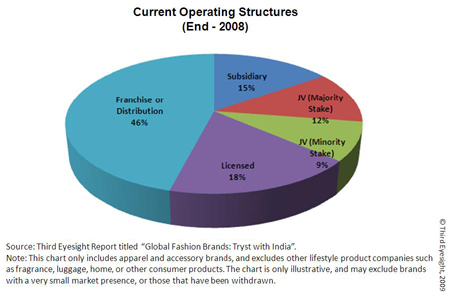
By the end of 2008, just under half of the brands were present through a franchise or distribution relationship, while over a quarter had either a wholly-owned or majority-owned subsidiary. These structures allowed the brands to have greater control of operations, particularly of product.
Shifting Strategies
Many international companies have evolved their presence in India into structures different from those at the time they entered the market.
A good example depicting the shift in business strategy is that of VF Corporation which entered India in 1980s by assigning the Wrangler license to Dupont Sportswear. Since then it has launched a variety of brands in different product categories with number of Indian partners and finally formed a joint venture, VF Arvind Brands Pvt. Ltd., with Arvind Brands.
Another example of a company that has evolved its presence is Benetton, which first entered India through a licensee (Dalmia). Benetton then transitioned in 1991 into 50:50 joint-venture and finally in 2004 took over the Indian business completely. However, it adopted the franchising route in 2006 for its premium fashion brand, Sisley, appointing Trent (a Tata Group company) as the national retail franchisee.
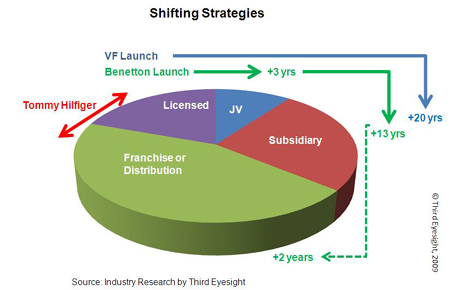
Many other companies such as Nike, Tommy Hilfiger, Marks & Spencer and Pierre Cardin (as described in our report “Global Fashion Brands: Tryst with India”) have changed their approach as the original structures did not perform as well as they had expected.
Obviously, each such change has cost the brands time, management effort, money and, sometimes, market share.
We believe that these shifts and the pain related to it could have been reduced, had the brands ruthlessly questioned the motivation for considering this market and their expectations from the market in determining an appropriate strategy.
What’s Ahead?
In the midst of economic upheaval around the world, how does India look as a market for international fashion brands?
Well, it is difficult to generalize even in the best of times. In the current global turmoil there is certainly a lot more unpredictability about international expansion for most companies.
Although India’s position as a target market for international brands has been improving, as is evident from the number of launches in the last 6-7 years, some companies considering international expansion may prefer entering other markets that may seem more “familiar”, developed and safe (such as Europe, Japan, South Korea or Taiwan). Against such comparisons, India’s growing but fragmented market can seem chaotic and difficult to deal with.
However, the fact remains that there are very few markets globally that can provide the sustained size of mid-term and long-term opportunity that India does. We are already seeing the more far-sighted and committed brands consolidating their position and presence in the market by continuing to look at expansion, even while examining how they can make their existing points of sale perform better. We also constantly come across new companies carrying out investigations into the market.
In the current environment we expect to see a shift in the nature of launch vehicle. While franchising seems to be a safe option for risk-averse brands in the current times, we will probably see more brands with a long term strategy, who would establish a controlled presence either through joint-ventures or through wholly-owned subsidiaries, since they can lay the foundation of the business today at much lower costs today than in the past few years.
India’s foreign direct investment (FDI) policy, allowing FDI only up to 51% in retail trading of “Single Brand” may have held back some fashion brands as they are still managed by owner founder with a conservative outlook on “control”. However, in the last couple of years, we have found companies not being deterred by the barriers to FDI.
As their comfort and familiarity with India has grown, international companies are more willing today to create corporate structures that allow them a presence in the market today and a step-through to a more controlling stake as and when government regulations allow.
All in all, we feel that international brands are in India not only to stay, but also to expand. There is yet a lot of potential untapped in the market, and as the integration of the Indian consumer with global trends continues, international brands can expect to find India an increasingly fertile ground for growth.
(c) 2009, Third Eyesight
Devangshu Dutta
May 2, 2009
Wal-Mart has just opened a new store Supermercado de Walmart in Houston (Texas). The Houston Chronicle reports that the Supermercado aims to reach out to the Hispanic population, tailoring the foods more to Hispanic tastes and needs and adding signs in Spanish. Wal-Mart is also reportedly planning to open a Mas Club this summer, based on its Sam’s Club warehouse outlet, but focussed again on Hispanic customers. (The original article is here: Wal-Mart gives its Supermercado concept a tryout).
Going by some of the negative comments attracted by the article, it is legitimate to ask: what will Wal-Mart’s existing customers think, and how will they behave?
I guess the answer is clearly not black or white (or beige, red, yellow or brown for that matter).
Wal-Mart is segmenting and localizing its offer as a smart information-rich retailer should.
Some customers who hold a tightly parochial view may feel alienated when they read about this development and may stop shopping at Wal-Mart, but most probably won’t bother as long as their local Wal-Mart continues to deliver what they want at prices they like.
Vibrant societies and economies are true melting pots; rather than exclude, filter and ensure conformity, they imbibe and blend newness. The fact is that real assimilation causes both to change – the ones coming in and the society / geography taking them in – and we have to accept that change often brings some pain with it, as expressed by the reader commenting on Houston Chronicle’s website.
The first waves of European settlers created a change when they started landing in North America 500-odd years ago, and so has every wave of immigrants since – Chinese, Japanese, German, Irish, Italian, Eastern European, Korean, Indian, Caribbean and so on. The first settlers will always be suspicious and exclusive in their approach towards the second set, the second lot of the next and so on.
The wave of economic homogenization driven by the post-war baby boom and infrastructure expansion was possibly one of the largest in recent history (other than the Soviet Union and the Chinese Cultural Revolution, which were more political than economic). However, we’ve seen the US market grow in diversity in the last 2-3 decades – not only because of differences due to race or country of origin, but also due to geographic, economic and otherwise cultural differences.
Today many of the diverse segments today in the US are large enough to express their unique needs, and expect them to be fulfilled. While the cookie-cutter approach served well during the years of national expansion across homogenized markets, that approach is counter-productive today. A retailer like Wal-Mart can’t be expected to ignore that fact.
