
Devangshu Dutta
May 11, 2010

REVIEW: BEATING THE COMMODITY TRAP: Richard D’Aveni (Harvard Business Press)
In his latest book, Professor Richard A. D’Aveni focusses on a topic that most businesses should be acutely concerned with: the problem of commoditization. In interviews he has accurately described commoditization as “the black plague on modern corporations” and “a deadly disease that’s spreading like crazy”.
Certainly, if one had to pick the ultimate nightmares to keep CEOs awake at night, commoditization would definitely be among the top of the list. Specifically, given the economic uncertainties around the world in the last couple of years, business leaders who are not concerned about their products or services being turned into commodities are either supremely equipped to maintain their differentiation, or immensely deluded as to their capabilities to fight market forces. Prof. D’Aveni suggests that maintaining differentiation alone is not enough to sustain business.
A product or service becomes a commodity when it is not distinguishable from competing offerings and therefore not valued above the competition. Prof. D’Aveni views commoditization along two key attributes: the benefits or features that are being offered and the price (margin) that is available to the business. Based on his model, he has identified three types of competitive stress that a business could face:
The book suggests competitive strategies that a business could take to avoid getting caught in the commodity trap. These strategies can be boiled down to the biological choice: fight or flight (escape). Professor D’Aveni echoes the basic warfare strategy laid out by many military and business strategists through the ages. He suggests that businesses need to gauge the opponents, choose their battles, and pick opponents against whom they can win. He also calls for pre-emptive action: where companies can, they should either change the business environment to avoid commodity battles entirely, or initiate the battle of commoditization and control its direction and momentum.
In fact, anticipation and pre-emption is the key to avoiding the commodity trap. To help with this, Prof. D’Aveni offers a relatively simple framework to analyse a current market situation in terms of a price-benefit matrix, and to identify the advance corrective actions to be taken.
The book is short and straight-forward enough to pick through a domestic flight, or to read in the back-seat during a long commute between office and home. The easy to understand framework gets the messages across quickly. In analysing the variations of commoditization, both in consumer and business oriented industries, the Professor also offers up something for everyone.
However, the book’s strengths also turn out to be among its biggest weaknesses. The book would have benefited from more depth to each of the concepts. Skipping quickly from one area to the other, in some places the book risks losing coherence of thought.
Some short books are like downhill hairpin bends on a mountain road; Prof. D’Aveni’s book is one of those. Much as you might be tempted to go fast, it’s advisable to go slow. If you speed through it, you might miss a nugget that actually makes sense to your business.
One of the other grouses I had was with the examples quoted. The predominantly US market examples reduce the book’s relevance for a global audience – the Professor presumes the reader will know the company and its context well enough to understand the lessons being discussed. In some cases the examples are incomplete and possibly even incorrect: one such is the example of Zara. The broad-brush attributes Zara’s business success to turning fashion into commodity, and ignores the fact that fashionability and desirability are a cornerstone of Zara’s offer, not the cheapest price. Others would possibly be far more accurate examples of commoditization in the context of price.
However, if you are sufficiently concerned about the possibility of being commoditized out of profitability, or being marginalised out of market share, I would suggest that you could easily overlook these flaws. The fundamental premise of the book is far too important to ignore. [Beating the Commodity Trap on Amazon]
(This review was written for Businessworld.)
admin
January 7, 2010
By Tarang Gautam Saxena, Chandni Jain and Neha Singhal
In Retrospect
While India was a promising market to many international brands, it was not completely immune from the global economic flu. More than its primary impact on the economy, the global downturn sobered the mood in the consumer market. Even the core target group for international brands, that had just begun to splurge apparently without guilt, tightened their purse strings and either down-traded or postponed their purchases.
In 2008 in the midst of economic downturn, skepticism and uncertainty, the international fashion brands had continued to enter India at nearly the same momentum as the previous year. Many international brands such as Cartier, Giorgio Armani, Kenzo and Prada entered India in 2008 targeting the luxury or premium segment. However, given the high import duties and high real estate costs, the products ended up being priced significantly higher than in other markets. Many players ended up discounting the goods heavily to promote sales while a few also gave up and closed shop.
As the Third Eyesight team had foreseen last year, 2009 saw a further slowdown and fewer international brands being launched during the year. The brands that were launched in 2009 included Beverly Hills Polo Club, Fruit of the Loom, Izod, Polo U.S., Mustang, Tie Rack and Timberland. Some of these had already been in the pipeline for quite some time and invested a considerable time and effort in understanding the dynamics of the Indian retail market, scouting for appropriate partners, building distribution relationships and tying up for retail space, setting up the supply chain and, most importantly, getting their operational team in place.
International Fashion Brands in India

After many deliberations, the well-known global brand Donna Karan New York set foot in the Indian market in 2009 through an agreement with DLF Brands to set up exclusive DKNY and DKNY Jeans stores India. The brand is also reported to have signed a worldwide licensing agreement with S Kumars Nationwide Ltd to design, manufacture and retail DKNY menswear in certain specific countries.
Second Chances
Amongst the international brands that have recently entered the Indian market, a few are on their second or even third attempt at the market.
For instance, Diesel BV initially signed a joint venture agreement in 2007 with Arvind Mills, and the partnership intended opening 15 stores by 2010. However, by the middle of 2008, the relationship ended with mutual consent, as Arvind reduced its emphasis on retailing international brands within the country. Within a few months of the ending of this relationship, Diesel signed a joint venture with Reliance Brands for a launch scheduled for 2010. Both partners seem to be strategically aligned with a common goal as the international iconic denim brand wants to take on the Indian market full throttle and the Indian counterpart has indicated that it wants to rapidly build its portfolio of Indian and foreign brands in the premium to luxury segments across apparel, footwear and lifestyle segments.
Similarly, Miss Sixty entered India in 2007 through a franchisee agreement with Indus Clothing. It switched to a joint venture with Reliance Brands in the same year but the partnership was called off in 2008, despite plans to open more than 50 stores in the first three years of operations. Miss Sixty has finally entered India through a franchise agreement with a manufacturer of women’s footwear and accessories. The company has currently introduced only shoes and accessories category and is looking at potential partners for its label Energie and girls’ range Killah.
Other brands that have re-entered the Indian market include Germany-based Lerros whose first presence in India was back in mid-1990s. The brand re-entered the market in 2008 through own brand stores and is growing its presence through this route as well as through multi-brand stores.
Oshkosh B’gosh is another brand that had entered India in mid 1990s, through a licensing agreement with Delhi based buying house, Elanco. The licensee found the childrenswear market hard to crack, and closed down. In 2008, Oshkosh re-entered the Indian market through a licensing partnership with Planet Retail and is now available through shop-in-shop counters at Debenhams stores. Reports suggest that it may consider setting up exclusive brand outlets.
During the turbulence of 2008 and 2009, a few brands also exited the market. Some of them were possibly due to misplaced expectations initially about the size of the market or about the pace of change in consumer buying habits. Others were due to a failure either on the part of the brand or its Indian partners (or both) to fully understand what needed to be done to be successful in the Indian market. Whatever the reason, the principals or their partners in the country decided that the business was under-performing against expectations and for the amount of effort and money being invested, and that it was better to pull the plug.
Some brands that have been pulled out of the Indian market during 2008 and 2009 include Dockers, Gas, Springfield and VNC (Vincci). Gas (Grotto SpA) is reported to remain interested in the market but has not found another partner after its deal with Raymond fell through in 2007 and all dozen of its standalone stores were shut down.
The Scottish brand Pringle and its Indian licensee did not renew their agreement upon its expiry. The Indian partner has reportedly signed an agreement to launch another international brand in India, while Pringle is said to be looking for new licensee.
The good news is that successful relationships outnumber every exit or break in relationship possibly by a factor of ten. Some of the brands that have sustained are among the early entrants having a presence in India since the late-1980s and 1990s or even earlier. These include Bata, Benetton, adidas, Reebok (now also owned by adidas), Levi Strauss and Pepe. Having grown very aggressively during 2006 and 2007 Reebok quickly became the largest apparel and footwear brand in India, while Benetton and Levi’s are expected to cross the $100-million mark for sales this year.
Entry Strategy & Recent Shifts
As envisaged in Third Eyesight’s report from a year ago, with changing market conditions and a growing confidence in the Indian market, there has been a shift among international brands in the choice of the launch vehicle. While franchising has been the preferred mode of market entry in the recent past for risk-averse brands, more brands today demonstrate a long-term commitment to the Indian market, and are choosing to exercise ownership through wholly or partially owned subsidiaries and through joint ventures.
In 2009, we have seen a noticeable shift in favour of joint-ventures as the choice for entry into the market. Even the brands already present are looking to modify the nature of their existing presence in India in order to exert more control over the retail operations, products, supply chain and marketing.
Current Operating Structure
(End 2009)
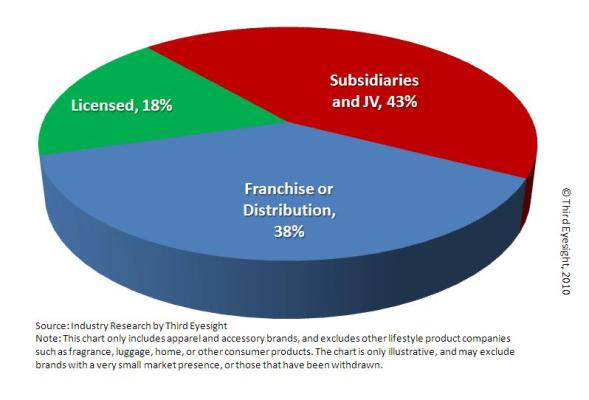
Brands that changed their operating structures and, in some cases partners, in recent years include VF (Wrangler, Lee etc.), Lee Cooper, Lee, and Louis Vuitton amongst others.
Mothercare, the baby product retailer, which is present through a franchise agreement with Shopper’s Stop has, in addition, recently formed a joint venture with DLF Brands Ltd to enable the expansion through stand-alone stores. Gucci, which had initially entered in 2006 with the Murjani Group as a franchisee, has recently changed over to Luxury Goods Retail, and is now in the process of restructuring the relationship into a joint venture.
VF has also been reported to be looking to license Nautica, Jansport and Kipling to a new partner. Until now, these brands were handled through the joint venture with Arvind Brands. Arvind has increasingly focused on its core business, closed stores and scaled down expansion plans for the international brands.
Burberry that had entered India in 2006 through a franchisee arrangement with Media Star opened two stores under this arrangement. It has now set up a new joint venture with Genesis Colors and plans to open 20 stores across the country.
More recently Esprit has also been reported to have approached Aditya Birla Nuvo to deepen its engagement by moving from its distribution arrangement into joint venture as the international brand sees excellent potential in the Indian market.
Buckling up for 2010
Throughout 2009, the one fact that became clear was that the Indian market was resilient. Now, as the global economic condition stabilizes, confidence levels of brands and retailers in India have also improved.
Several launches are already expected in 2010, and possibly many more are being worked upon. In the following 12 months, consumers can expect to find within India acclaimed brands such as Diesel, Topman, Topshop and the much-anticipated Zara. Many more Italian, British and French brands are examining the market.
Most of the international fashion brands already present in the market are also projecting a cautiously upbeat outlook in their plans, while a few are looking positively bullish.
For example, Pepe, an old player in premium and casual wear segment, has reported plans to grow its retail network further and open 50 more franchise stores by September 2010. Similarly the German fashion brand S. Oliver that entered the Indian market in 2007 is looking to grow significantly. It has already moved from a franchise arrangement with Orientcraft to a joint-venture with the same partner, and has stepped up its above-the-line marketing presence. The brand has recently reported its plans to scale up its retail presence to 77 stores by the end of 2012 while also strengthening its presence through shop-in-shop in multi-branded outlets in high potential markets.
Those international brands that have tasted success have not achieved it by blindly importing business models and formulas from other markets. Most have had to devise a different positioning from their home markets. Some have significantly corrected pricing and fine-tuned the product offering since they first launched. These include The Body Shop which decreased its prices by up to 30% this year, and Marks & Spencer which reduced prices by 20-40%. Others are unearthing new segments to grow into; for instance, Puma and Lacoste are now seriously targeting womenswear as a growth market.
On the operational side, the good news for retailers and brands is that the average real estate costs have reduced significantly, although marquee locations remain high. In several locations lease models have also moved from only fixed rent to some form of revenue sharing arrangement with the landlord. And, while the sector has seen some employee turmoil as many non-retail executives who came into the business in the last 5-7 years have returned to other sectors, employee salary expectations are also more realistic.
As customer footfall and conversions pick up, international brands are also shoring up their foundations for future expansion in terms of better processes and systems, closer understanding of the market, and nurturing talent within their team. Third Eyesight’s recent work with international brands’ business units in India highlights the international players’ concern with ensuring a consistent brand message, improved organizational capabilities right down to front-line staff, and focus on unit productivity (per store and per employee).
We may yet see a few more exits, and possibly some more relationships being reshuffled and partners being changed. However, all things considered, we can look forward to a net increase in the number of international brands in the country.
The Indian consumer is certainly demonstrating more optimism and as far as there are no major unforeseen global or domestic shocks, this optimism should translate into a healthier business outlook for international brands as well. According to early signs, 2010 could be an excellent curtain-raiser for a new decade of growth for international fashion brands in India.
[The 2009 report is available here: “International Fashion Brands – India Entry Strategies”]
(c) 2010, Third Eyesight
[Note: This report is based on information collected from a combination of public as well as proprietary sources, and in some cases may differ from press reports. However, no confidential information has been shared in this report.]
Devangshu Dutta
January 5, 2010

If we were to look at phrases that have cropped up during the recent recessionary times in the consumer goods sector, “private label” has to be among those at the top of the list.
From clothing to cereals, toothpaste to televisions, there is hardly a category that has not seen retailers trying their hand at creating own labelled products.
The first motivation for most retailers to move into private label is margin. On first analysis, it appears that the branded suppliers are making tons of extra money by being out there in front of the consumer with a specific named product. The retailer finds that creating an alternative product under its own label allows it to capture extra gross margin. Typically the product category picked at the earliest stage of private label development would be one for which several generic or commodity suppliers are available.
At this early stage, the retailer is aiming for a relatively predictable, stable-demand and easily available product whose sales would be driven by the footfall that is already attracted into the store. A powerful bait to attract the customer is the visible reduction in price, as compared to a similar branded product. If the product can be compared like-for-like, customers would certainly convert to private label over time.
However, maintaining prices lower than brands can also be counter-productive. In many products, while customers might not be able to discern any qualitative difference, they may suspect that they are not getting a product comparable to one from a national or international brand. And while private label can drive off-take, the price differential can also erode gross margin which was the reason that the retailer may have got into private label in the first place. Over time, such a strategy can prove difficult to sustain, as costs of developing, sourcing and managing private label products move up.
The other strong reason a retailer chooses to have private label is to create a product offering that is differentiated from competitors who also offer brands that are similar or identical to the ones offered by the retailer. Department stores, supermarkets and hypermarkets around the world have all tried this approach – some have been more successful than others. The idea is to provide a customer strong reasons to visit their particular store, rather than any of the comparable competitors.
Of course, when differentiation is the operating factor, the products need more insight and development, and closer handling by the retailer at all stages. A price-driven private label line may be sourced from generic suppliers, but that approach isn’t good enough for a line driven by a differentiation strategy. In this case, costs of product development and management increase for the retailer. However, to compensate, the discount from a comparable national brand is not as high as generic nascent private label. In fact, some retailers have taken their private label to compete head on with national brands – they treat their private labels as respectfully as a national branded supplier would treat its brand.
So what does it take to go from a “copycat” to being a real brand?
Third Eyesight has evolved a Private Label Maturity Model (see the accompanying graphic) that can help retailers think through their approach to private label, whether their product offering is dominated by private label, or whether they have only just begun considering the possibility of including private label in their product range. The model sketches out a maturity path on five parameters that are affected by or influence the strength of a retailer’s private label offering:
In some cases, retailers may have multiple labels, some of which may be quite nascent while others might be highly evolved, clear and comparable to a national brand. This could be by default, because the labels have been launched at different times and have had more or less time to evolve. However, this can also be used as a conscious strategy to target various segments and competitive brands differently, depending on the strength of the competition and their relationship with the consumer.
The interesting thing is that size and scale do not offer any specific advantage to becoming a more sophisticated private label player. Some extremely large retailers continue to follow a discounted-price “me-too” private label strategy where even the packaging and colours of the product are copied from national brands, while much smaller players demonstrate capabilities to understand their specific consumers’ needs to design, source and promote proprietary products that compare with the best brands in the market.
For a moment, let’s also look at private labels from the suppliers’ point of view. As far as we can see, private label seems to be here to stay and grow. Suppliers can treat private labels as a threat, and figure out how to ensure that they retain a certain visibility and relationship with the consumer. On the other hand, interestingly, some suppliers are also looking at private label as an opportunity. They see the growth of private label as inevitable, and would much rather collaborate in the retailer’s private label development efforts. This way they can maintain some kind of influence on the product development, possibly avoid direct head-on conflict with their own star branded products and, if everything else fails, at least grab a share of the market that would have otherwise gone over to generic suppliers.
If you are retailer, I would suggest using the Private Label Maturity Model to clarify where you want to position yourself, and continue to use it as a guide as you develop and deliver your private label offering.
If you are a supplier concerned about private label, my suggestion would be to gauge how developed your customer is and is likely to become, and ensure that you are at least in step, if not a step ahead.
Of course, if you need support, we’ll only be too happy to help! (Contact Third Eyesight to discuss your private label needs.)
Devangshu Dutta
December 18, 2009
(Contributed to the BusinessWorld cover story – “What 2 Expect in 2010”, issue of January 4, 2010)
Everything that can be said and assumed about the Indian market is true at some level of granularity. Very simply, in India there is a segment for every product, an opportunity for every service, be it ever so small. But when bubbles are bursting all over, as the Noughties Decade comes to a close, the puzzle that is Indian consumer market also warrants a fresh look.
For most of the Noughties Decade India has seen Generation-C, the “Choice” generation, coming of age. They have moved over from being “secondary customers” consuming off their parents’ incomes, to entering the work-force and becoming customers in their own right.
It may sound trite, but Gen-C customers have grown up with many models of 2-wheelers and 4-wheelers and colour television with multiple channels. They have many more career options and many more opportunities in each career. Not only have they grown up on a diet of choice, they have also grown up with much higher confidence about the future, about their place in the world and what they can expect. And they have infected the outlook of generations older than them as well with a similar confidence.
Therefore, for most of the decade, it has been a distinctly rosy picture for consumer goods marketers and retailers. Business plans routinely expected 20-50% annualised growth, and businesses even delivered those figures on some basis or the other. Organizations as diverse as retailers and management consultants were inspired by India’s age-old image as the Bird of Gold. Supermarket chains mushroomed like never before, department stores and speciality retailers grew their footprints, quick-service and casual dining expanded covers, while electronics, durables, leisure companies, and car brands all counted India among their hottest markets.
Product off-take reflected this outlook. Amongst the FMCG sector, while basic items such as the bath and shower segment demonstrated a steady annualised growth of about 7%, premium cosmetics galloped at almost 20% a year. While the relatively mature 2-wheeler market grew at just over 7.5% annually between 2002-03 and 2008-09, the 4-wheeler passenger vehicle market demonstrated growth of almost 14% a year in the same period.
All this was before the recent rude interruption.
A speed-breaker began showing up in the consumer market in late-2007 and grew larger through 2008. Once the global financial markets melted down in late-2008, media sentiment turned acutely negative about the Indian market as well. And, eventually, with uncertainty prevailing around the world, consumer spending in India did take a hit. Consumers cut back on the frequency of purchases or traded down.
On the trade side, retail businesses began acknowledging that stores were performing below plan and went into rationalisation mode. For branded suppliers, where some of the growth had come from stuffing the pipeline and filling new shelves, wholesale order books became thinner.
Yet, as painful as the economic scenario might have appeared, the Indian consumer market has shown remarkable resilience. Demand in smaller cities and towns has remained robust. Regional brands, especially, found plenty of opportunity to grow in markets and geographical regions where they were under-penetrated or absent.
And as the mood lifted through the latter half of 2009, consumer demand clearly moved back up. The speed at which the demand rebounded would suggest that the Indian market was relatively sheltered from the global economic storm.
However, there are some critical differences to understand.
On the one hand, Gen-C’s confidence shook for the first time – a generation that has only seen upward mobility, witnessed job cuts and salary freezes or declines even if only second-hand. Comparisons with the Great Depression may be exaggerated but it is a scenario they can now imagine as a possibility. At least three new professional academic batches have or will have moved into the job market under these sober conditions. On the other hand, tremendous inflation in basic costs supports some amount of uncertainty about the future. The fact that many of the Gen-C would have just begun or would be about to begin families serves to only heighten such anxiety.
So, let’s recognise two immutable facts about the Indian consumer market in the current environment.
First: that the ancestral “steel safes” are back, at least figuratively if not literally. Customers do want to save more for now. And if they are spending, they want to feel that they are extracting far more value than the price they are exchanging across the counter, value that will last long after the transaction at the store. In recent years, this inherent ‘value orientation’ of the Indian consumer was neglected by many. Now every product, service or brand must aim to deliver this sustainable value, and demonstrate the value repeatedly.
Secondly, each business needs to look at the lifetime value of a customer if it can. Rather than cutting the golden bird open and trying to extract all the golden eggs at once, one needs need to keep the bird well-fed, happy and healthy, and enjoy its rewards over several years. Rather than creaming the market, pricing, branding and distribution need to be structured for a sustainable relationship with the customer.
Some businesses will work better than others in this market, and strategies will need to be adapted. A lifecycle approach may handy in identifying the business segments which might meet the steel safe criterion, or the golden goose criterion, or both.
The first segment that comes to mind is weddings. Wedding expenditure is seen as a “social investment” for both the families, and the actual items bought are an investment into the couple’s future together. So, bridal trousseaux and wedding wardrobes, wedding arrangers and catering, and household goods provide significantly more tangible and intangible value than the money spent.
Similarly, “first child” isn’t usually a segment in any marketing handbook, but should be. The couple’s first born, especially if the baby is the first in its generation will usually get a disproportionate amount of attention and spending on clothing and utilities. A baby’s growth into a child, of course, can provide a relationship and marketing opportunity that can last for years, but the first 2-3 years are specifically valuable. What’s more, given India’s demographic dividend in the form of a sustained under-30 age group, baby products have a sustained and growing value as a market.
As the child grows, there are clear indicators of current and future value that can drive purchases. While base schooling is an essential expenditure, extra-classes and tuitions are a high-value discretionary investment that parents are choosing to make. Sports, on the other hand, however essential they may be to a child’s development are often seen as a distraction. That is, unless the child is attending sports coaching and the parents have an eye on helping the child create a career from it – in which case, a coach who is apparently good, branded equipment and kit are definitely worth investing in. So a cricket coaching franchise might just be the ticket to fortune, while a toy company may struggle. Some may decry the decline in art, craft, philosophy and fundamental sciences, but these are not on the list of priority of most parents. In the short to medium term, parents would continue to disproportionately push their wards into academic disciplines that are seen to develop marketable skills and pay well. Expect continued growth in the engineering, medical and management education market, but also in other vocational disciplines.
On the other hand, everything is not an investment for the future. Present comforts may also provide extra value, through convenience.
Some of these comforts may be as small as enjoying out-of-home exotic meals (pizza and pasta still qualify as exotic for the bulk of the population). Or if eating out looks out of budget, ready-to-eat and ready-to-cook meals are an easy substitute. Jubilant, Yum, McDonald’s, Haldiram, Sarvana’s, Nirula’s and the thousands of other casual dining and snack food chains have a long clear highway of growth ahead, as do snacks and packaged food companies such as Nestle, Britannia and ITC.
Brown goods and white goods that offer comfort and convenience – coolers, water heaters, convectors, air-conditioners and kitchen gadgets – continue their onward march, despite the huge shortfall in electricity. Even if the big brands struggle with their price points and overheads, regional brands and private labels will continue growing strongly in these segments.
Health is another area for significant investment. With prevalence of lifestyle-ailments, from stiff necks to high blood pressure, basic pharmacists to cardiovascular specialists are all in demand. Anticipate significant growth to continue in over-the-counter medication, medical devices, as well as clinical and hospital care.
At the other end of the scale, with decent and adequate public transport lacking in most cities, we can expect personal vehicles to increase multi-fold, despite the small blip in 2008-09. About 60 million 2-wheelers and over 10 million passenger vehicles have already been added during the decade, and the growth trend looks set to resume from 2010, unless there are significant oil price or vehicle taxation shocks delivered by the government.
And as consumer confidence resurges, more overt displays or personal spends will return as well, including apparel, footwear, home products, accessories, vacations, fitness and recreation, but we would expect them to follow behind the higher priority “safe” or “geese” segments.
Finally, the one thing that marketers in any product need not be really concerned about whether there is a future in this market. Even, Hindustan Unilever, a mature FMCG company with very high distribution penetration built over decades, still counts less than 60% Indians as its customers.
Surely most companies have a much longer road ahead before they need to be worried about their markets becoming saturated.
Devangshu Dutta
December 16, 2009
Following on our article (“Numbers and Stories”, 23 November 2009), our friends at Retailwire.com thought it would be interesting to run a poll to ask the Retailwire community what they thought about retailers using research. The original discussion is here on Retailwire, but we’ve reproduced the comments and the poll results as they stand today (16 December 2009).
As evident from the graph below, the short answer is “no, companies don’t use research well”; only 15% of the respondents felt that companies are “good” in using research, at their best. Should we blame the companies or the researchers? The comments seem to suggest that the blame needs to be shared equally.

Comments below:
This sounds a lot like a chapter we wrote for ESOMAR’s Best Practices book. We have devalued research in favor of insights, which can rely much more on a good narrative and much less on good data. A management team that expects insights from research all the time is asking for trouble down the road. A research team that doesn’t focus on quality first and insights second is doomed to failure when management makes the wrong moves. Research needs to give management the best information possible in a way that management can understand it. Management needs to understand that research is providing the best information it can within budget constraints. The two need to work together. [Stephen Needel, Managing Partner, Advanced Simulations]
One of the concerns I have at present is how SKU rationalization research is viewed, so quickly judged, and acted upon. Many retailers are looking only through a narrow interpretation based on shear numbers and not taking into consideration other more visionary factors about specialty brands, niche items, and growth brands. If this keeps up, consumers will have very few choices and most of the stores will all look the same with exact assortments. Only price will differentiate one from the other. The results will be rather ironic. [David Biernbaum, Senior Marketing and Business Development Consultant, David Biernbaum Associates]
I agree that there is a lot of bad “research” out there in the world. Any analytical study has to be right, applicable, and actionable. If a study doesn’t meet these criteria, it is worse than useless–it can actually pollute the minds of decision makers by letting them think they know something they don’t. Before spending any valuable share of mind on numbers, executives should ensure:
1) Is it right? If I only had a buck for every time I’ve seen a big name consulting firm presentation with numerical “findings” using a flawed methodology or with no statistical significance…. I’d be retired in Paris right now.
2) Is it applicable? So, some other retailer says their TV spend has a 150% return (or some consultant claims that). So what? Your business is different. Consumers react differently to every retail concept. You do need to know for you.
3) Is it actionable? Oh, we all know about the study designed to validate the CEOs hunch. Want to guess what the consultant’s findings will say? If you are going to do research, you’d better be prepared to act on the findings–either way.
This is why in-market testing is such a powerful technique in retail. While it does take commitment to do it right, it is one of few techniques that almost always meets these criteria. [Jonathan Marek, Senior Vice President, APT]
It is absolutely true that marketers do not often take the time to understand the basis of the research that they are presented with. Understanding how the research is developed and the analysis approach used to develop recommendations is an important, if misunderstood, part of the job description for a data-driven marketer.
I do find, however, that marketers more often do not carry out sufficient research to draw conclusions, even when that research is relatively easy and low-cost to execute. If you have access to email addresses, you can execute basic research surveys to customers and gain valuable insights in less than a week, at a very low cost. Those opportunities to “fill in the gaps” are often overlooked. Sometimes those insights can make the difference between success and an indifferent failure of a key initiative.
Marketers must understand the opportunities that research affords them, even when timelines are tight. Obtaining the Voice of the Customer, particularly the Best Customer, is a practice that should be followed religiously. Only then will marketers be able to gain insight and make truly data-driven decisions. [Mark Price, Managing Partner, M Squared Group, Inc.]
We have to keep in mind that corporations are run by human beings that often make decisions on emotion rather than logic. I have many clients who have been very successful making decisions by shooting from the hip, yet they always prefer to see my research, just to be sure. Most of my clients are very bright people and my research generally confirms their own instinctive thoughts. There have been times when I have been brought in to do an autopsy on a project to find out why a store failed. Typical reasons are:
Researchers did not want to offend management so they candy-coated the results.
Key decision makers are suffering from some kind of physical or emotional impairment which affects their ability.
Corrupt middle managers that change the research results.
Researchers leaving out a key piece of data (i.e. not telling management that the Mexican format store they have planned is in a Puerto Rican neighborhood).
Overall, I don’t think retailers have a narrow view of research. Researchers can do a better job in communication by simplifying the results, being blunt, and putting their integrity ahead of their paycheck. [David Livingston, Principal, DJL Research]
I think there are two elements at play here:
First and perhaps foremost, retail is an emotional business. We can have reams of data and still use the words “It feels like….” and make significant decisions based on those gut feel moments. Certainly this has long been true in the world of merchandising. Something “feels like” it’s going to be a home run or a dog, and it “feels like” we’d better take a markdown or run a promotion to goose traffic. And actions are taken accordingly.
Now, can I tell a retailer in all honesty to ignore those gut feels? I really can’t. I can encourage them to use data to support actions taken based on those feelings and obviously that’s what I do…every day. But I can’t ask them to ignore their gut completely.
This brings me to the second issue: we don’t always present data in an easily distilled and understandable format. Our retail survey respondents repeatedly ask to have their Business Intelligence delivered in simpler ways. While “red light, yellow light, green light” might be a little too simple for some decisions, the data just has to be usable and quickly actionable.
Finally…if a retailer (or any company really) is going to make such a dramatic shift, it has to be driven from the top. And the C-level exec driving the initiative also has to LISTEN to what he/she is being told in response. Otherwise you get a company similar to Home Depot under Nardelli. [Paula Rosenblum, Managing Partner, RSR Research]
Decisions are always made without perfect information to support them. But sometimes, decisions are made that ignore the available information or decline the implications.
Research is clearly most valuable when it can be turned into actionable recommendations. We are all too aware that research can be used as a fishing expedition without a clear objective. However, there is also a danger in using research designed just to prove a point rather than develop real, new learning.
On balance, I believe that research, properly done, interpreted, and acted upon, can vastly improve the decision making process. [Ray Jones, Managing Director, Dechert-Hampe & Co.]
I’m reminded of the Samuel Taylor Coleridge quote “Water, water, everywhere, nor any drop to drink.” Research/knowledge is the raison d’ tre for The Luxury Marketing Council www.floridaluxurycouncil.com; it’s what I do. The highest level executives or those who will someday sit in the corner office recognize the value of research. They’re able to sift through the myriad of information to find what’s relevant and actionable.
There are a couple trends re: research. Some executives don’t want facts to get in the way of their vision. Historically, these individuals’ careers stall. Also, there are many companies that have pared down their employees to the point that executives don’t have time for the facts–they’re too busy keeping the ball moving. The third group often doesn’t understand how to read the research, how it affects them and/or how they can use it for their benefit.
Relevant research is an imperative for retailers. Having a 360 on your targeted customer and understanding their collective experiences is the key to personal and business success. [Chris Ramey, President, Affluent Insights]
Devangshu Dutta mentions many of my personal concerns regarding research. But before I go any further I have to add, my name is Joan and I am a researcher. I’ve spent many years working in the industry to help alleviate some of the barriers Mr. Dutta listed. There is still much to be done of course.
In this world of easy access to numbers/statistics, upper management demands and gets “stuff” by which they make decisions. Trying to explain the difference between good research and everything else often falls on deaf ears. Management expects those who supply the data, whether they are staff or outside consultants, to bring the quality, validity and relevance required. And in turn they do not question the underlying premise of what they are buying, or what they are buying into.
And when forecasts don’t work out as expected, new products fail and marketing strategies are ineffective, it’s all about how research failed to deliver. Researchers preach to the choir when they have meetings about quality standards.
CASRO (Council of American Survey Research Organizations) has a Code of Standards and Ethics. Companies who belong to CASRO must adhere to them. And this is one way in which clients can insure research results are reliable.
CASRO is initiating an ISO certification program. I believe more client companies and executives will relate to and understand ISO (because their own companies go through similar ISO certification processes), perhaps choosing vendors and staff accordingly. In my opinion, this could be a turning point for the acceptance and recognition of true quality marketing research. I hope so.
As for the story telling aspect of research…well that’s another “story” entirely. I’ve mentored many researchers and advised them to always answer three basic questions, What? So what? And Now what? These questions get to the heart of why research is conducted in the first place. Good reporting and presentation requires training. If you believe that anyone can be a researcher and choose vendors or staff based on that assumption, you get what you get and it may fall below the standards Mr. Dutta advocates. [Joan Treistman, President, The Treistman Group LLC]
During my 11 years with Kenosia I used a phrase with clients “One truth.” By combining disparate data sources, a retailer or a brand manager can get to the “one truth” and then make a business decision regarding direction. Far too often, decisions are made using one source of data which can lead to less than effective results.
Example, if a retailer only views their loyalty data to make business decisions about advertising, are they understanding all the trends happening in their market? Probably not. Combining their loyalty data with demographic data makes it better and adding additional information from a syndicated data provider makes it even better yet.
The great news is, there are a dozen technology solutions to help both retailers and brand managers combine data and the data to combine is available and affordable. It boils down to first understanding the questions and then going out and combining all the best data sets to create the answers. [John Boccuzzi, Jr., Managing Partner, Boccuzzi, LLC]
The use and misuse of research, data and “insights” varies widely across retailers and brands. Typically, the larger the company, the more primary research they have and the more reliant on primary research they are.
Unfortunately, great research and insights are, as many here are illustrating above, not nearly as commonplace as they should be. There are many reasons for this:
– Flawed and biased methodologies (e.g., let’s “Focus Group” this”);
– Vendors who specialize in one research/data collection area over another;
– The research goals and objectives themselves: pure answers to hard marketing questions rarely come directly from research but rather from what is done with it, i.e., what is the data needed to create information to support or disallow a hypothesis?
Budgets, which have mostly seen cuts for the past two years; though the cost of collecting data has come way down in many cases.
All these challenges with research underscore the importance of knowing who your customers are, having an ongoing dialogue and relationship with them, and gleaning insights from them. There is nothing better than customer (transactional) data to gain an objective perspective and insights for your business.
Unfortunately, many companies are data rich and insight poor. Even worse, many companies, retailers included, don’t know their customers or how they behave. This is continuing to change for the better, however, and those who are focused in this area are the ones who will make better decisions and be more successful in the long run. [Phil Rubin, CEO, rDialogue]
One simple question expresses the confusion around statistics: “Why do we have Democratic and Republican Pollsters?” I think it was Harry Truman who when confronted by economists telling him “Well on one hand the statistics are saying this, but on the other they could mean this” said “Someone get me a one armed economist.”
The thing with retail is that we don’t need answers to thousands of different questions. We ask the same questions a thousand times: how does this product sell, what is its net profit, how important is it to my customers, does it fit my brand objective, how does it relate to other products, are there viable substitutes, etc? Instead of poring over tons of numbers, the POS data should be used to construct answers to questions.
So the fundamental reason retailers (and anyone, really) make bad decisions from raw data is because they don’t know what questions they’re trying to answer. Start there. [Bill Bittner, President, BWH Consulting]
The fact that information is available and is being used effectively are two separate things! Usually a company uses too much information, regardless of correct or incorrect, or it does not use information. Very few companies strike and maintain a balance between insight, gut feeling/intuition and relevant, timely information in decision making. [Pradip Mehta, Principal, Mehta Consulting, LLC]
I’ve found that the overall views of research within companies goes in cycles. Of course, leadership changes come into play with the research points of view as well. Some executives understand how to use it better. Some have used it so much they can go by gut.
In any case, a research cycle may start when a huge mistake is made by using strictly gut instinct (Tropicana?), then more and more insights will come from research and less from gut until, one day, it is determined that there is too much science and not enough art, and the cycle starts all over again.
I do believe though, that research is one of the faults with our nation’s fashion business today. Too much science, not enough art. The talent and guts it takes to take a big chance on new, fun fashion seems to have been relegated to trend reports, focus groups, ethnography and best seller lists. The rare exception to that rule is Forever21…instincts still survive there. Perhaps they can teach the industry a lesson. [Lee Peterson, EVP Creative Services, WD Partners]
Where would Disney be without fairy tales? SMWeiss’
The problem, dear Brutus, is in ourselves. Retailers and brands have created vast action machines with thought paradigms behind. Anyone doing research is likely to be looking to fit information into the existing machine. And for each individual, when they formulate a research query, they bring their own current thinking into it–obviously! This means that the results they get back reflect, in far too great a way, their own predispositions. This, coupled with the fact that lots of research is “ask” type research–interviews–guarantees a sluggish and distorted view of reality, what I call the Picasso business view; shared distortions, unperceived as such by both researchers and respondents.
The partial antidote to this is “observational” type research, and the hierarchy of truth. And observation here must be of the real world, not some laboratory simulation, which typically just further cements the existing distorted paradigm. The hierarchy of truth means distinguishing between what is most rock solid and least likely to be distorted, and that which may be as changeable as the weather. (That’s right, Maude. It used to be just common sense that the weather changes. ; )
One example near and dear to my heart is OBSERVING how many items people buy in a store. The most common number, whether in a convenience store or a supercenter is ONE. But the “world” absolutely refuses to believe this, because it does not match their own conceptions/perceptions. An observation like this is at the pinnacle of retail truth, and must be allowed to shatter any part of the paradigm that does not conform to it. THAT’S “revolutionary,” but it is also the route to racing past the competition that is spending their time dancing on peanut butter.
No one should reproach themselves for participating in a social Picasso view of their business. (Although I may insult you from time to time. ; ) All of us are afflicted with the phenomenon noticed many years ago, about historians and their “research” of the past. Looking into the past, for a historian, is much like looking at a reflecting pool at the bottom of a very deep well. The image the historian tends to come away with is a reflection of himself. Business people are no different. [Herb Sorensen, ScientificAdvisor, TNS Global Retail & Shopper Practice]
There are plenty of great tools to make sense of all of the information. The challenge is balancing it with the human side. Take, for example, the stores. Are all corporate employees required to walk the stores and report what they see? View the stores in the evening when store management has left for the day. These age-old problems are still far too common, yet they are the source of some of the most valuable information available anywhere. Sales will be increased, labor decreased and earnings improved if this information is acted upon. [Ralph Jacobson, Global Consumer Products Industry Marketing Executive, IBM]

