
admin
October 11, 2022
SHARLEEN D’SOUZA, Business Standard
Mumbai, 10 October 2022
In early 1994, Titan started selling watches with precious stones in them and called this new line, Tanishq. It went on to become a separate division of Titan Company and grew into the country’s largest branded jewellery outfit, helping raise Titan’s sales to ~28,799 crore last financial year.
Thirteen years later, in 2007, Titan Eye+ set out to shake up the eyewear market. Though it also sells sunglasses of other brands, it is the prescription segment that Titan redefined and now, according to its website, has 550 Eye+ exclusive stores in 229 cities.
In 2017, Titan sought to do an encore in yet another large market in which the demand, as in jewellery and eyewear, was almost recession-proof and largely commoditised, leaving ample space for a pan-Indian branded chain. Thus was born Taneira, with an avowed intent to become the country’s largest organised saree retailer.
“Titan had earlier tried to organise the jewellery market through Tanishq, which is successful, and this is an attempt by Titan to organise the saree market,” Ambuj Narayan, chief executive officer (CEO) of Taneira, told Business Standard.
What is unsaid is that jewellery to sarees can also be seen as a horizontal brand extension, the two do go together on occasion.
Natural extension
The Indian wear market is a 5,000-year old segment estimated to be worth ₹50,000 crore a year and growing at a compound annual growth rate of 6 to 8 per cent. Sarees account for 80 to 85 per cent of its sales, with kurta sets, blouses, and lehengas comprising the rest. Yet, despite the size and growth, there is hardly any nationally known brand in this segment, with Nalli Silks being one of the notable exceptions.
Titan insiders say the company believed sarees to be a natural extension for it, given its past success with design-led lifestyle brands. They say the company organised an internal competition to see who came up with the best expansion strategy.
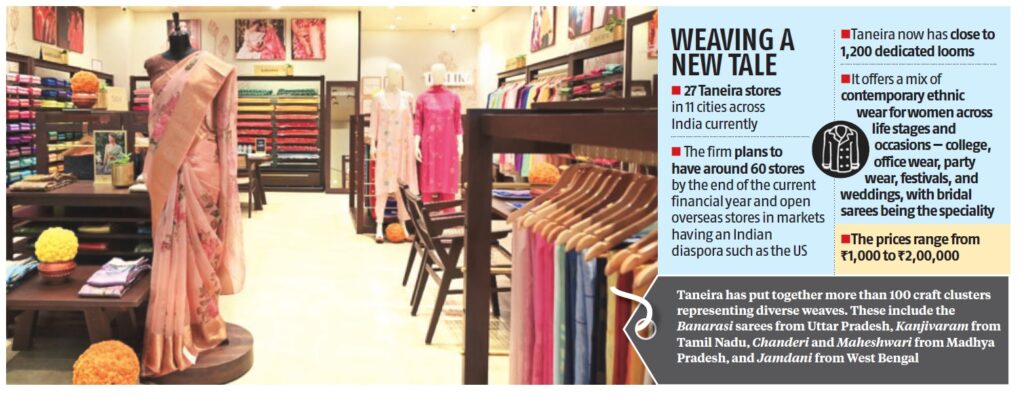
The result is a bouquet of design-differentiated products — primarily sarees and kurta sets — made from pure natural fabrics sourced from all over India. The company put together more than 100 craft clusters representing the diverse weaves. These include the Banarasi sarees from Uttar Pradesh, Kanjivaram from Tamil Nadu, Chanderi and Maheshwari from Madhya Pradesh, and Jamdani from West Bengal. The output is a mix of contemporary ethnic wear for women across life stages and occasions — college, office wear, party wear, festivals, and weddings, with bridal sarees being the speciality. The prices range from ₹1,000 to ₹2,00,000.
“The Tata group’s ventures have always been consistent with their approach — they stay the course beyond initial hiccups and eventually scale up the business. This is very much how Titan and Tanishq worked their way from initial struggles to eventually scale and become nationwide brands,” said retail expert Devangshu Dutta, CEO at Third Eyesight.
To say that Taneira has had initial hiccups would be an understatement. Three years after its launch, the Covid-induced lockdowns and restrictions brought the entire retail sector down to its knees.
Baptism by Covid
“Pandemic restrictions and high Covid-19 anxiety among the people kept socialising and weddings at a very low level of activity over the past couple of years. For Taneira, being a nascent brand with a yet-to-be-established customer base, the operating environment has been particularly tough,” Titan Company said in its FY22 annual report.
Taneira used this time to realign its strategy of connecting with customers. Thus, during 2021-22, which braved the second Covid wave in its first quarter — the dreadful Delta — and saw the third wave creep into its fourth quarter, sales at Titan’s Indian dress wear division grew by 55 per cent.
Narayan, the CEO, attributes this growth to initiatives that included staying close to the customer through e-commerce. “We really drove e-commerce out and reached out to our customers through video calling and try-at-home activities,” he said.
As consumer sentiment started to improve, Taneira already had two collections ready — wedding weave and the summer collection — which boosted sales. During 2021-22, it also increased its store count to 20 by adding six more. During the fourth quarter, Taneira sales rose 4 per cent.
Today, there are 27 Taneira stores in 11 cities across India. It plans to expand to Tier 1 and Tier 2 cities in the first phase and then to Tier 3 in the second phase of its store expansion.
However, Vishal Gutka, vice-president of research (consumer and retail sector) at Phillip Capital, said: “Taneira follows the same principle Titan used for Tanishq, where it entered an unorganised category and expanded it. But it is still early days to gauge how Taneira will pan out. Also, the company needs to give more clarity on the unit economics of each store.”
Weaving an expansion plan Titan’s annual report talks of a robust expansion plan for Taneira this financial year: “We plan to grow at an exponential rate and make our store count around 60 by the end of the current fiscal year and open overseas stores in markets having an Indian diaspora such as the US.” It adds that Taneira will become a more significant contributor to the overall revenue of Titan in the medium term.
At the heart of this grand ambition lies the humble weaver. Taneira now has close to 1,200 dedicated looms and has a programme called Weaver Shala to support them with technical expertise and in modernising their facilities. It has introduced frame looms along with basic workspace facilities for the weavers in collaboration with the localised weaver-led organisations.
The brand has closely worked with the weavers in Varanasi, Uttar Pradesh, and Champa, Chhattisgarh, and aims to take Weaver Shala to other parts of the country.
Taneira leverages Tanishq’s brand strength; mannequins at Tanishq stores, for instance, are dressed in Taneira sarees.
However, Narayan said Taneira and Tanishq will not be sold under the same roof because Titan wants to establish Taneira as a distinct brand in its own right.
(Published in the Business Standard)
admin
September 20, 2022

New Delhi: The launch of online shopping experience by WhatsApp, along with Jio platforms, the holding company for the digital services businesses of Reliance Industries (RIL), will help these companies to take on e-commerce behemoths such as Jeff Bezos-controlled Amazon and Walmart-owned Flipkart.
Experts are of the view that the partnership will give JioMart, the e-commerce platform of RIL, around 48.7 crore WhatsApp users in India. At present, the total annualised active e-commerce users in the country are only 20 crore.
Rohan Agarwal, partner at research firm Redseer, told Business Standard: “WhatsApp is the primary messaging app for most Indians and the partnership shows the level of access JioMart would have to reach out to them.”
He went on add that it would help in expanding the reach of the e-commerce to users who might not be accessing online retail platforms.
To recap, speaking at the 45th AGM of RIL on Monday (August 29), Isha Ambani, director, Reliance Retail Ventures Ltd (RRVL), gave a presentation on placing online grocery orders using Meta-owned WhatsApp and making payments.
In a global first, JioMart on WhatsApp will aid users in India, including first-time online shoppers, to have a new shopping experience in ordering a wide range of groceries on WhatsApp. They will be able to shop via JioMart’s entire grocery catalogue by easily selecting their favourite items. Also, they will be able to add these products to the cart and pay without leaving the WhatsApp chat.
Mark Zuckerberg, founder and chief executive officer (CEO), Meta, said the association with JioMart would enable people to buy groceries from JioMart in a single chat.
Agarwal highlighted that most of the online grocery businesses generate from big cities and this alliance will be an opportunity for small cities and towns.
The financial daily quoted Devangshu Dutta, CEO, Third Eyesight, as saying that the partnership will have a big impact on the entire e-commerce industry.
He told the publication: “Reliance is the largest retailer in the country and with deep pockets. It wants to (tap) not just the big cities but small cities and towns as well. Given the fact that WhatApp is something consumers are comfortable with, and grocery is related to high-frequency purchases, they are firing on all cylinders.”
Dutta added that the crucial thing for both companies to be successful is to create a delivery process that is quick and cost-effective.
Source: timesnownews
admin
September 16, 2022
Over the past five years, legacy players have made a slew of investments in D2C startups.
Marico has acquired men’s grooming brand Beardo, beauty brand Just Herbs and breakfast brand True Elements. Similarly, Emami acquired vegan cosmetics brand Brillare Science and grooming brand The Man Company. It recently picked up a minority stake in nutrition company TruNativ. Colgate-Palmolive and Reckitt both hold minority stakes in Bombay Shaving Company, whereas Wipro Consumer Care has invested in The Ayurveda Company. ITC has invested in baby and mother care brands Mother Sparsh and Mylo.
Devangshu Dutta explained the reasons behind the trend of larger FMCG companies acquiring D2C brands.
admin
August 29, 2022
By Sharleen D’Souza & Sourabh Lele
‘First-ever end-to-end shopping experience’ on messaging platform, says Mark Zuckerberg

Meta Platforms Inc, the parent company of WhatsApp, will partner with Reliance JioMart for a service where WhatsApp users can buy groceries on the messaging platform from the Indian retail firm.
Mark Zuckerberg, chief executive officer (CEO) of Meta Platforms, said in a Facebook post, “[I am] Excited to launch our partnership with JioMart in India. This is our first-ever end-to-end shopping experience on WhatsApp–people can now buy groceries from JioMart right in a chat.”
“Business messaging is an area with real momentum and chat-based experiences like this will be the go-to way people and businesses communicate in the years to come,” he said in an announcement coinciding with the annual general Meeting (AGM) of Reliance Industries the parent company of JioMart.
A Reliance press statement said the service “will enable users in India, including those who have never shopped online before, to seamlessly browse through JioMart’s entire grocery catalog, add items to cart, and make the payment to complete the purchase–all without leaving the WhatsApp chat.”
WhatsApp users can shop on JioMart via by messaging “Hi” to +917977079770.
Mukesh Ambani, chairman and managing director of Reliance Industries, said, “The JioMart on WhatsApp experience furthers our commitment to enabling a simple and convenient way of online shopping.”
“Reliance Retail is looking at touching as many consumers across the country and WhatsApp is a logical platform as India is the largest market for the messaging app in the world,” said Devangshu Dutta, CEO of Third Eyesight, a retail consultancy firm. While WhatsApp is important for growth, Reliance Retail will also need to work on product availability and the cost of delivering to the customer, he said.
Ambani said Reliance’s retail business model has “five imperatives”, or ‘Panch Pran’. These include: enriching customer experience using technology; operationalising and growing multiple channels; integrating with small merchants and providing them a platform to prosper. The fourth imperative is to expand the product portfolio and the fifth one is to strengthen logistics and supply chain.
Isha Ambani, director at Reliance Retail Ventures, said at the AGM that the digital commerce platforms–reliancedigital.in and JioMart–enabled the retail major to deliver 93 per cent of online orders from stores within six hours. “We rolled out our JioMart Digital (JMD) initiative during the year. The platform enables small electronics merchants to sell the entire product portfolio of Reliance Retail on an assisted selling model, helping them deliver superior customer experience and growing their income,” she said.
The company’s new commerce initiative is on course to partner with one crore merchants as it expands to cover the entire country in the next five years, Isha Ambani said.
Last year, Reliance Retail entered pharmacy retail with the acquisition of Netmeds. That year, it launched new operations through Netmeds Wholesale and onboarded merchants in 1,900 towns and cities.
Source: business-standard
admin
August 3, 2022
Written By Ratna Bhushan

Large restaurants have increased the amount of discounts and promotional offers by 15-20% on their own apps compared with those offered by aggregators Swiggy and Zomato, to offset steep commissions and search optimisation fees being charged by the aggregators and reduce the dependence on them, industry executives said.
India’s largest quick service chain, Domino’s Pizza which operates 1,625 outlets, launched multiple “free rewards offers” on its own app last weekend, across delivery, takeaway and dine-ins.
While Zomato and Swiggy charge commissions of 15-30% on every order, new tech platforms like ThriveNow and Google-backed DotPe levy only 3-5%. These food tech platforms allow restaurants to set up their own digital services.
Domino’s, McDonald’s, Social, Punjab Grill, deGustibus Hospitality, Street Foods of India, Wow!Momo and Pizza Hut are among the ones offering higher discounts on their own apps.
For large brands, orders from their own apps are averaging anywhere between 10% and 25%, though smaller ones are still relying heavily on the aggregators for scale, executives said.
“Our focus is to increase promotions and give more value through our own delivery platforms to entice customers to transact and reduce dependence on more expensive aggregators,” said Rohit Aggarwal, director at Lite Bite Foods, which operates Punjab Grill, Artful Baker and YouMee. He said close to 20% of the company’s delivery business was now through its own platforms.
Executives said the relationship between restaurants and aggregators involved both a huge benefit and cost.
“There’s the inherent benefit which restaurants reap from the aggregators in terms of scale and last-mile delivery, specially for the mid-sized restaurants which don’t have the budgets to set up their own deliveries. But the restaurants are also dealing with the very steep cost of commissions,” said Devangshu Dutta, chief executive of retail consultancy Third Eyesight.
Some brands that offer direct deliveries are also focusing on the nascent but emerging subscription-based meal services and menu customisation.
“It is extremely important for restaurants to take back some control of their digital landscape, rather than being totally dependent on the aggregators. This will not only save them huge delivery costs but also give them access to more customer data; aggregators have thrived on discounts, which is funded almost entirely by the restaurants,” said Anurag Katriar, chief executive of Indigo Hospitality.
In addition to third-party delivery operators such as Dunzo and Shadowfax, which work either through logistics aggregators or directly with the restaurants, brands are also delivering through their own fleet.
Riyaaz Amlani, chief executive at Impresario Handmade Restaurants, which runs Social, Smoke House Deli and Salt Water Cafe, said: “We are offering the best price on our own platforms and our discounts are in the range of 20-25%.”
For large brands, orders from their own apps are anywhere between 10% and 25%, though smaller ones are still relying heavily on the aggregators for scale, executives said.
In addition to third-party delivery operators such as Dunzo or Shadowfax which work either through logistics aggregators or directly with the restaurants, brands are also delivering through their own fleet. Some that offer direct deliveries said they were also focusing on the nascent but emerging subscription-based meal services and menu customisation.
Mid last year, over a dozen large restaurant chains had collaborated to start a #OrderDirect movement, amid escalation of a long-standing tussle between restaurants and aggregators. The food services chains alleged that aggregators charged steep commissions and masked critical customer data.
According to estimates by the National Restaurant Association of India, the annual food services market in India is of about Rs 4.2 lakh crore and could grow to Rs 7.7 lakh crore by 2025.
India’s largest quick service chain, Domino’s Pizza which operates 1,625 outlets, launched multiple “free rewards offers” on its own app last weekend, across delivery, takeaway and dine-ins.
While Zomato and Swiggy charge commissions of 15-30% on every order, new tech platforms like ThriveNow and Google-backed DotPe levy only 3-5%. These food tech platforms allow restaurants to set up their own digital services.
“We’ve grown 40% this quarter over the previous quarter, enabling restaurants to set up their own direct ordering platform; we expect to see further escalation in demand in the upcoming festive season,” said Dhruv Dewan, cofounder at Hashtag Loyalty, which operates ThriveNow.
Jubilant Foodworks, the master franchise for Domino’s Pizza in India, had acquired a 35% stake Hashtag Loyalty late last year.
Thrive charges a 5% commission and is working to increase its scale from 11,300 restaurants at present, Dewan said.
Domino’s, McDonald’s, Social, Punjab Grill, deGustibus Hospitality, Street Foods of India, Wow!Momo and Pizza Hut are among the ones offering higher discounts on their own apps.
For large brands, orders from their own apps are averaging anywhere between 10% and 25%, though smaller ones are still relying heavily on the aggregators for scale, executives said.
“Our focus is to increase promotions and give more value through our own delivery platforms to entice customers to transact and reduce dependence on more expensive aggregators,” said Rohit Aggarwal, director at Lite Bite Foods, which operates Punjab Grill, Artful Baker and YouMee. He said close to 20% of the company’s delivery business was now through its own platforms.
Executives said the relationship between restaurants and aggregators involved both a huge benefit and cost. “ .
“There’s the inherent benefit which restaurants reap from the aggregators in terms of scale and last-mile delivery, specially for the mid-sized restaurants which don’t have the budgets to set up their own deliveries. But the restaurants are also dealing with the very steep cost of commissions,” said Devangshu Dutta, chief executive of retail consultancy Third Eyesight.
Some brands that offer direct deliveries are also focusing on the nascent but emerging subscription-based meal services .
“It is extremely important for restaurants to take back some control of their digital landscape, rather than being totally dependent on the aggregators. This will not only save them huge delivery costs but also give them access to more customer data; aggregators have thrived on discounts, which is funded almost entirely by the restaurants,” said Anurag Katriar, chief executive of Indigo Hospitality.
In addition to third-party delivery operators such as Dunzo and Shadowfax, which work either through logistics aggregators or directly with the restaurants, brands are also delivering through their own fleet.
Riyaaz Amlani, chief executive at Impresario Handmade Restaurants, which runs Social, Smoke House Deli and Salt Water Cafe, said: “We are offering the best price on our own platforms and our discounts are in the range of 20-25%.”
For large brands, orders from their own apps are anywhere between 10% and 25%, though smaller ones are still relying heavily on the aggregators for scale, executives said.
In addition to third-party delivery operators such as Dunzo or Shadowfax which work either through logistics aggregators or directly with the restaurants, brands are also delivering through their own fleet. Some that offer direct deliveries said they were also focusing on the nascent but emerging subscription-based me .
Mid last year, over a dozen large restaurant chains had collaborated to start a #OrderDirect movement, amid escalation of a long-standing tussle between restaurants and aggregators. The food services chains alleged that aggregators charged steep commissions and masked critical customer data.
According to estimates by the National Restaurant Association of India, the annual food services market in India is of about Rs 4.2 lakh crore and could grow to Rs 7.7 lakh crore by 2025.
Source: economictimes
