
admin
January 7, 2010
By Tarang Gautam Saxena, Chandni Jain and Neha Singhal
In Retrospect
While India was a promising market to many international brands, it was not completely immune from the global economic flu. More than its primary impact on the economy, the global downturn sobered the mood in the consumer market. Even the core target group for international brands, that had just begun to splurge apparently without guilt, tightened their purse strings and either down-traded or postponed their purchases.
In 2008 in the midst of economic downturn, skepticism and uncertainty, the international fashion brands had continued to enter India at nearly the same momentum as the previous year. Many international brands such as Cartier, Giorgio Armani, Kenzo and Prada entered India in 2008 targeting the luxury or premium segment. However, given the high import duties and high real estate costs, the products ended up being priced significantly higher than in other markets. Many players ended up discounting the goods heavily to promote sales while a few also gave up and closed shop.
As the Third Eyesight team had foreseen last year, 2009 saw a further slowdown and fewer international brands being launched during the year. The brands that were launched in 2009 included Beverly Hills Polo Club, Fruit of the Loom, Izod, Polo U.S., Mustang, Tie Rack and Timberland. Some of these had already been in the pipeline for quite some time and invested a considerable time and effort in understanding the dynamics of the Indian retail market, scouting for appropriate partners, building distribution relationships and tying up for retail space, setting up the supply chain and, most importantly, getting their operational team in place.
International Fashion Brands in India

After many deliberations, the well-known global brand Donna Karan New York set foot in the Indian market in 2009 through an agreement with DLF Brands to set up exclusive DKNY and DKNY Jeans stores India. The brand is also reported to have signed a worldwide licensing agreement with S Kumars Nationwide Ltd to design, manufacture and retail DKNY menswear in certain specific countries.
Second Chances
Amongst the international brands that have recently entered the Indian market, a few are on their second or even third attempt at the market.
For instance, Diesel BV initially signed a joint venture agreement in 2007 with Arvind Mills, and the partnership intended opening 15 stores by 2010. However, by the middle of 2008, the relationship ended with mutual consent, as Arvind reduced its emphasis on retailing international brands within the country. Within a few months of the ending of this relationship, Diesel signed a joint venture with Reliance Brands for a launch scheduled for 2010. Both partners seem to be strategically aligned with a common goal as the international iconic denim brand wants to take on the Indian market full throttle and the Indian counterpart has indicated that it wants to rapidly build its portfolio of Indian and foreign brands in the premium to luxury segments across apparel, footwear and lifestyle segments.
Similarly, Miss Sixty entered India in 2007 through a franchisee agreement with Indus Clothing. It switched to a joint venture with Reliance Brands in the same year but the partnership was called off in 2008, despite plans to open more than 50 stores in the first three years of operations. Miss Sixty has finally entered India through a franchise agreement with a manufacturer of women’s footwear and accessories. The company has currently introduced only shoes and accessories category and is looking at potential partners for its label Energie and girls’ range Killah.
Other brands that have re-entered the Indian market include Germany-based Lerros whose first presence in India was back in mid-1990s. The brand re-entered the market in 2008 through own brand stores and is growing its presence through this route as well as through multi-brand stores.
Oshkosh B’gosh is another brand that had entered India in mid 1990s, through a licensing agreement with Delhi based buying house, Elanco. The licensee found the childrenswear market hard to crack, and closed down. In 2008, Oshkosh re-entered the Indian market through a licensing partnership with Planet Retail and is now available through shop-in-shop counters at Debenhams stores. Reports suggest that it may consider setting up exclusive brand outlets.
During the turbulence of 2008 and 2009, a few brands also exited the market. Some of them were possibly due to misplaced expectations initially about the size of the market or about the pace of change in consumer buying habits. Others were due to a failure either on the part of the brand or its Indian partners (or both) to fully understand what needed to be done to be successful in the Indian market. Whatever the reason, the principals or their partners in the country decided that the business was under-performing against expectations and for the amount of effort and money being invested, and that it was better to pull the plug.
Some brands that have been pulled out of the Indian market during 2008 and 2009 include Dockers, Gas, Springfield and VNC (Vincci). Gas (Grotto SpA) is reported to remain interested in the market but has not found another partner after its deal with Raymond fell through in 2007 and all dozen of its standalone stores were shut down.
The Scottish brand Pringle and its Indian licensee did not renew their agreement upon its expiry. The Indian partner has reportedly signed an agreement to launch another international brand in India, while Pringle is said to be looking for new licensee.
The good news is that successful relationships outnumber every exit or break in relationship possibly by a factor of ten. Some of the brands that have sustained are among the early entrants having a presence in India since the late-1980s and 1990s or even earlier. These include Bata, Benetton, adidas, Reebok (now also owned by adidas), Levi Strauss and Pepe. Having grown very aggressively during 2006 and 2007 Reebok quickly became the largest apparel and footwear brand in India, while Benetton and Levi’s are expected to cross the $100-million mark for sales this year.
Entry Strategy & Recent Shifts
As envisaged in Third Eyesight’s report from a year ago, with changing market conditions and a growing confidence in the Indian market, there has been a shift among international brands in the choice of the launch vehicle. While franchising has been the preferred mode of market entry in the recent past for risk-averse brands, more brands today demonstrate a long-term commitment to the Indian market, and are choosing to exercise ownership through wholly or partially owned subsidiaries and through joint ventures.
In 2009, we have seen a noticeable shift in favour of joint-ventures as the choice for entry into the market. Even the brands already present are looking to modify the nature of their existing presence in India in order to exert more control over the retail operations, products, supply chain and marketing.
Current Operating Structure
(End 2009)
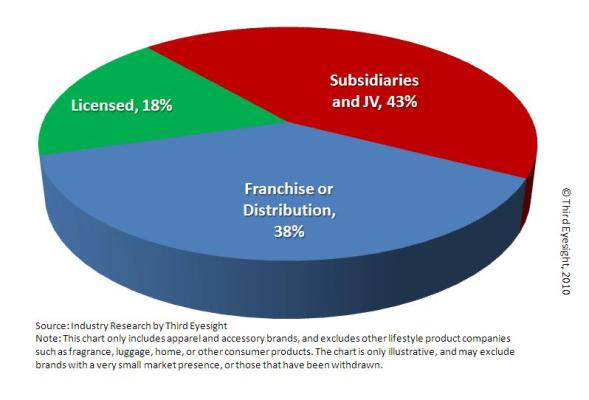
Brands that changed their operating structures and, in some cases partners, in recent years include VF (Wrangler, Lee etc.), Lee Cooper, Lee, and Louis Vuitton amongst others.
Mothercare, the baby product retailer, which is present through a franchise agreement with Shopper’s Stop has, in addition, recently formed a joint venture with DLF Brands Ltd to enable the expansion through stand-alone stores. Gucci, which had initially entered in 2006 with the Murjani Group as a franchisee, has recently changed over to Luxury Goods Retail, and is now in the process of restructuring the relationship into a joint venture.
VF has also been reported to be looking to license Nautica, Jansport and Kipling to a new partner. Until now, these brands were handled through the joint venture with Arvind Brands. Arvind has increasingly focused on its core business, closed stores and scaled down expansion plans for the international brands.
Burberry that had entered India in 2006 through a franchisee arrangement with Media Star opened two stores under this arrangement. It has now set up a new joint venture with Genesis Colors and plans to open 20 stores across the country.
More recently Esprit has also been reported to have approached Aditya Birla Nuvo to deepen its engagement by moving from its distribution arrangement into joint venture as the international brand sees excellent potential in the Indian market.
Buckling up for 2010
Throughout 2009, the one fact that became clear was that the Indian market was resilient. Now, as the global economic condition stabilizes, confidence levels of brands and retailers in India have also improved.
Several launches are already expected in 2010, and possibly many more are being worked upon. In the following 12 months, consumers can expect to find within India acclaimed brands such as Diesel, Topman, Topshop and the much-anticipated Zara. Many more Italian, British and French brands are examining the market.
Most of the international fashion brands already present in the market are also projecting a cautiously upbeat outlook in their plans, while a few are looking positively bullish.
For example, Pepe, an old player in premium and casual wear segment, has reported plans to grow its retail network further and open 50 more franchise stores by September 2010. Similarly the German fashion brand S. Oliver that entered the Indian market in 2007 is looking to grow significantly. It has already moved from a franchise arrangement with Orientcraft to a joint-venture with the same partner, and has stepped up its above-the-line marketing presence. The brand has recently reported its plans to scale up its retail presence to 77 stores by the end of 2012 while also strengthening its presence through shop-in-shop in multi-branded outlets in high potential markets.
Those international brands that have tasted success have not achieved it by blindly importing business models and formulas from other markets. Most have had to devise a different positioning from their home markets. Some have significantly corrected pricing and fine-tuned the product offering since they first launched. These include The Body Shop which decreased its prices by up to 30% this year, and Marks & Spencer which reduced prices by 20-40%. Others are unearthing new segments to grow into; for instance, Puma and Lacoste are now seriously targeting womenswear as a growth market.
On the operational side, the good news for retailers and brands is that the average real estate costs have reduced significantly, although marquee locations remain high. In several locations lease models have also moved from only fixed rent to some form of revenue sharing arrangement with the landlord. And, while the sector has seen some employee turmoil as many non-retail executives who came into the business in the last 5-7 years have returned to other sectors, employee salary expectations are also more realistic.
As customer footfall and conversions pick up, international brands are also shoring up their foundations for future expansion in terms of better processes and systems, closer understanding of the market, and nurturing talent within their team. Third Eyesight’s recent work with international brands’ business units in India highlights the international players’ concern with ensuring a consistent brand message, improved organizational capabilities right down to front-line staff, and focus on unit productivity (per store and per employee).
We may yet see a few more exits, and possibly some more relationships being reshuffled and partners being changed. However, all things considered, we can look forward to a net increase in the number of international brands in the country.
The Indian consumer is certainly demonstrating more optimism and as far as there are no major unforeseen global or domestic shocks, this optimism should translate into a healthier business outlook for international brands as well. According to early signs, 2010 could be an excellent curtain-raiser for a new decade of growth for international fashion brands in India.
[The 2009 report is available here: “International Fashion Brands – India Entry Strategies”]
(c) 2010, Third Eyesight
[Note: This report is based on information collected from a combination of public as well as proprietary sources, and in some cases may differ from press reports. However, no confidential information has been shared in this report.]
Devangshu Dutta
January 4, 2010
Prompted by an article in the New York Times, Bernice Hurst, Contributing Editor of RetailWire, brought up an interesting subject to discuss – the tradition of small, independent retailers on Manhattan’s Lower east side, their survival despite the recession, and their determination to thrive.
One of the retailers interviewed for the article said that the business was “so much fun”. In referring to the kind of products she was developing said, “there are no boundaries to these things”.
Imagination may have no boundaries, but markets always do. When you’re small fry the pond seems limitless. And if all is in harmony (no tuna to gobble you, all fry remaining small, enough algae to feed off, forever), then the market is a good and boundless place. If only.
Personally, I hope there will always be some ponds with room in them to let such small fry bubble up their innovations: they keep the fashion business alive.
They also serve to remind us that there are reasons for running business that are not based on the race-to-scale.
The New York Times article is here – Yes, We’re Open – and the Retailwire discussion is here – Manhattan Still Home to Independent Retailers.
Devangshu Dutta
December 18, 2009
(Contributed to the BusinessWorld cover story – “What 2 Expect in 2010”, issue of January 4, 2010)
Everything that can be said and assumed about the Indian market is true at some level of granularity. Very simply, in India there is a segment for every product, an opportunity for every service, be it ever so small. But when bubbles are bursting all over, as the Noughties Decade comes to a close, the puzzle that is Indian consumer market also warrants a fresh look.
For most of the Noughties Decade India has seen Generation-C, the “Choice” generation, coming of age. They have moved over from being “secondary customers” consuming off their parents’ incomes, to entering the work-force and becoming customers in their own right.
It may sound trite, but Gen-C customers have grown up with many models of 2-wheelers and 4-wheelers and colour television with multiple channels. They have many more career options and many more opportunities in each career. Not only have they grown up on a diet of choice, they have also grown up with much higher confidence about the future, about their place in the world and what they can expect. And they have infected the outlook of generations older than them as well with a similar confidence.
Therefore, for most of the decade, it has been a distinctly rosy picture for consumer goods marketers and retailers. Business plans routinely expected 20-50% annualised growth, and businesses even delivered those figures on some basis or the other. Organizations as diverse as retailers and management consultants were inspired by India’s age-old image as the Bird of Gold. Supermarket chains mushroomed like never before, department stores and speciality retailers grew their footprints, quick-service and casual dining expanded covers, while electronics, durables, leisure companies, and car brands all counted India among their hottest markets.
Product off-take reflected this outlook. Amongst the FMCG sector, while basic items such as the bath and shower segment demonstrated a steady annualised growth of about 7%, premium cosmetics galloped at almost 20% a year. While the relatively mature 2-wheeler market grew at just over 7.5% annually between 2002-03 and 2008-09, the 4-wheeler passenger vehicle market demonstrated growth of almost 14% a year in the same period.
All this was before the recent rude interruption.
A speed-breaker began showing up in the consumer market in late-2007 and grew larger through 2008. Once the global financial markets melted down in late-2008, media sentiment turned acutely negative about the Indian market as well. And, eventually, with uncertainty prevailing around the world, consumer spending in India did take a hit. Consumers cut back on the frequency of purchases or traded down.
On the trade side, retail businesses began acknowledging that stores were performing below plan and went into rationalisation mode. For branded suppliers, where some of the growth had come from stuffing the pipeline and filling new shelves, wholesale order books became thinner.
Yet, as painful as the economic scenario might have appeared, the Indian consumer market has shown remarkable resilience. Demand in smaller cities and towns has remained robust. Regional brands, especially, found plenty of opportunity to grow in markets and geographical regions where they were under-penetrated or absent.
And as the mood lifted through the latter half of 2009, consumer demand clearly moved back up. The speed at which the demand rebounded would suggest that the Indian market was relatively sheltered from the global economic storm.
However, there are some critical differences to understand.
On the one hand, Gen-C’s confidence shook for the first time – a generation that has only seen upward mobility, witnessed job cuts and salary freezes or declines even if only second-hand. Comparisons with the Great Depression may be exaggerated but it is a scenario they can now imagine as a possibility. At least three new professional academic batches have or will have moved into the job market under these sober conditions. On the other hand, tremendous inflation in basic costs supports some amount of uncertainty about the future. The fact that many of the Gen-C would have just begun or would be about to begin families serves to only heighten such anxiety.
So, let’s recognise two immutable facts about the Indian consumer market in the current environment.
First: that the ancestral “steel safes” are back, at least figuratively if not literally. Customers do want to save more for now. And if they are spending, they want to feel that they are extracting far more value than the price they are exchanging across the counter, value that will last long after the transaction at the store. In recent years, this inherent ‘value orientation’ of the Indian consumer was neglected by many. Now every product, service or brand must aim to deliver this sustainable value, and demonstrate the value repeatedly.
Secondly, each business needs to look at the lifetime value of a customer if it can. Rather than cutting the golden bird open and trying to extract all the golden eggs at once, one needs need to keep the bird well-fed, happy and healthy, and enjoy its rewards over several years. Rather than creaming the market, pricing, branding and distribution need to be structured for a sustainable relationship with the customer.
Some businesses will work better than others in this market, and strategies will need to be adapted. A lifecycle approach may handy in identifying the business segments which might meet the steel safe criterion, or the golden goose criterion, or both.
The first segment that comes to mind is weddings. Wedding expenditure is seen as a “social investment” for both the families, and the actual items bought are an investment into the couple’s future together. So, bridal trousseaux and wedding wardrobes, wedding arrangers and catering, and household goods provide significantly more tangible and intangible value than the money spent.
Similarly, “first child” isn’t usually a segment in any marketing handbook, but should be. The couple’s first born, especially if the baby is the first in its generation will usually get a disproportionate amount of attention and spending on clothing and utilities. A baby’s growth into a child, of course, can provide a relationship and marketing opportunity that can last for years, but the first 2-3 years are specifically valuable. What’s more, given India’s demographic dividend in the form of a sustained under-30 age group, baby products have a sustained and growing value as a market.
As the child grows, there are clear indicators of current and future value that can drive purchases. While base schooling is an essential expenditure, extra-classes and tuitions are a high-value discretionary investment that parents are choosing to make. Sports, on the other hand, however essential they may be to a child’s development are often seen as a distraction. That is, unless the child is attending sports coaching and the parents have an eye on helping the child create a career from it – in which case, a coach who is apparently good, branded equipment and kit are definitely worth investing in. So a cricket coaching franchise might just be the ticket to fortune, while a toy company may struggle. Some may decry the decline in art, craft, philosophy and fundamental sciences, but these are not on the list of priority of most parents. In the short to medium term, parents would continue to disproportionately push their wards into academic disciplines that are seen to develop marketable skills and pay well. Expect continued growth in the engineering, medical and management education market, but also in other vocational disciplines.
On the other hand, everything is not an investment for the future. Present comforts may also provide extra value, through convenience.
Some of these comforts may be as small as enjoying out-of-home exotic meals (pizza and pasta still qualify as exotic for the bulk of the population). Or if eating out looks out of budget, ready-to-eat and ready-to-cook meals are an easy substitute. Jubilant, Yum, McDonald’s, Haldiram, Sarvana’s, Nirula’s and the thousands of other casual dining and snack food chains have a long clear highway of growth ahead, as do snacks and packaged food companies such as Nestle, Britannia and ITC.
Brown goods and white goods that offer comfort and convenience – coolers, water heaters, convectors, air-conditioners and kitchen gadgets – continue their onward march, despite the huge shortfall in electricity. Even if the big brands struggle with their price points and overheads, regional brands and private labels will continue growing strongly in these segments.
Health is another area for significant investment. With prevalence of lifestyle-ailments, from stiff necks to high blood pressure, basic pharmacists to cardiovascular specialists are all in demand. Anticipate significant growth to continue in over-the-counter medication, medical devices, as well as clinical and hospital care.
At the other end of the scale, with decent and adequate public transport lacking in most cities, we can expect personal vehicles to increase multi-fold, despite the small blip in 2008-09. About 60 million 2-wheelers and over 10 million passenger vehicles have already been added during the decade, and the growth trend looks set to resume from 2010, unless there are significant oil price or vehicle taxation shocks delivered by the government.
And as consumer confidence resurges, more overt displays or personal spends will return as well, including apparel, footwear, home products, accessories, vacations, fitness and recreation, but we would expect them to follow behind the higher priority “safe” or “geese” segments.
Finally, the one thing that marketers in any product need not be really concerned about whether there is a future in this market. Even, Hindustan Unilever, a mature FMCG company with very high distribution penetration built over decades, still counts less than 60% Indians as its customers.
Surely most companies have a much longer road ahead before they need to be worried about their markets becoming saturated.
Devangshu Dutta
November 23, 2009
Just after noon, on a weekday, I bumped into a family acquaintance at one of the more successful shopping malls in the city.
The question, “What are you doing here?” was underlined by a mildly accusatory look and the subtext, “Why are you spending a week-day shopping?”
My response that I was “working” wasn’t enough; the further explanation that I was doing “research” received a dismissive smirk and ended the conversation. The fact is that I was repeating the time-honoured ritual of RBWA (research by walking around), with its seemingly aimless strolling, sidelong glances, and possibly turning over a hundred items in a dozen shops without reaching for the wallet even once. This is a ritual that is not taught in our temples of management learning. In fact, it is one of the many tens of methodologies that seem to be missed out during the course of our formal education. And very often, what we do get taught is so remote and opaque to most people that they will promptly forget it the moment they walk out of the examination hall.
I was reminded of this walk-about incident during a conversation with two members of the faculty of a professional institute on the subject of research. Most of their students, I had observed, had a narrow interpretation of research – focussed only on consumers being interrogated through a questionnaire. The students were working from the guidance they had received during the previous semesters at the institute.
Unfortunately, the students are not alone – this is also how too many people identify research, including many executives in decision-making positions. I have been frequently puzzled by the confident (brash?) statement I have heard many times: “We don’t need research.” It is only when I probe further do I, and they, discover that while they perhaps don’t need consumer surveys, there are large gaps in their decision making toolkit which can only be filled by inputs from various other kinds of research.
Sometimes the roots of that statement lie in the perception of research as an impenetrable jungle in which it is easy to get lost but difficult to find something immediately useful. Researchers, like all other vocations, have their own professional shorthand (also known as “jargon”) which they sometimes use to identify their own kind, and perhaps sometimes to exclude people who are not from the trade. Very often this jungle is created by “research-as-a-foreign-language”, which many executives are just too apprehensive or too busy to tackle.
But before you pick up the axe and start cutting away at the creepers of bi-variate analysis, quota samples, correlation and projective techniques, let me give you my very simple definition of research which I like to keep in mind when I am asked the question: “Do we need research?”
To me, research is the discovery and collation of diverse pieces of information from various sources, so that it can be analysed using multiple tools, to discover relationships, patterns and directions that can be used to draw conclusions and take decisions.
There is a purpose for which we would discover or collate that information. There may be a set of questions that we need to answer. We need to understand what are the various places where that information may lie, the different forms it might take or the different ways in which we might need to look at the information before anything useful emerges.
And, in the business context (as in many other situations), research is meant to come up with something that is applicable and directly beneficial to the business. So once we’ve got most of the answers we were looking for, it is certainly useful to stop and apply the newly gained knowledge rather than try to refine and perfect it to the infinite degree.
If this definition of research frames the context well enough for you, then you’re on the way to doing and using research well.
Despite the wealth of information available today, far too many bad business decisions are being made in the absence of good information, either because the executives have not bothered to carry out research, or have not had the capability or the time to question the research which is being presented to them.
Worse – perhaps because of the abundant data and the ease of access to it – today many business decisions that turn bad are taken on the basis of information that is presented by someone else (“secondary research” in research language), without questioning the validity of the conclusions, the structure of the study, the context in which the data was analysed. It’s almost as if we couldn’t be bothered to think, because someone has apparently already done the thinking for us – especially if it comes from a “reputable source”. (Ok, that might be smart sometimes. So let me give you a more graphic analogy – could you think of an adult bird regurgitating pre-digested food to feed the chicks? Hmm, not so pleasant an image after all, is it?)
Also, research (especially the number-oriented kind) seems too dry for most people to take in. And I think that is one place market researchers could do themselves a huge benefit if they could tell the story – especially a story with a moral at the end. That is, create the picture for the user as to what all of that information means in simple language, and also show the user how to use the information in the context of his situation or problem. Bedtime stories during childhood and good movies in adulthood work well because there is a coherent narrative, a start, a middle that is interesting and an ending that stays in the mind. You can see the relationships between the characters, and the consequences of those relationships. A good research project report could be seen as something very similar.
Having said that, of course, there are also some researchers go far beyond, who would never let boring facts get in the way of a good story! Apparently a letter to the editor of the National Observer (London) as far back as 1891 complained: “there are three kinds of falsehood: the first is a ‘fib,’ the second is a downright lie, and the third and most aggravated is statistics.” (Mark Twain famously paraphrased this in his autobiography as “lies, damned lies and statistics”.)
How many stores can you think of which are located at sites where their chances of success are exactly the same as that of a snowball in hell? How many products or brand launches come to mind, where you wondered, “what is this company thinking?!” Of course, there would have been pre-launch studies which would have showed just how successful these would be, where the stories were possibly based more on imagination than on facts.
For a decision-maker, the only way to tell the difference between bad statistics (lies) and the true story of the market is to make sure that he or she is equipped with multiple sources of information, and various tools with which to analyse them. Also, if you recall my earlier definition of research, the starting point was the definition of the objectives which a research is supposed to fulfil – if the objectives are vague or undefined, so will the research outputs be.
Numbers (quantitative research) and narrative (qualitative research) can tell us many wonderful stories about the market. Some of those stories are highly imaginative “fairy tales” because of a bad study – that shouldn’t lead us to ignore all the others which can direct us to our objectives.
Devangshu Dutta
September 14, 2009
The dark clouds of recession and rain seem to be lifting just a little bit. Governments have been energetically throwing seeds of stimulus and economists are eagerly spotting “green shoots”. The festive season is around the corner, with anticipation of higher sales.
So perhaps it is time to cheer. Or perhaps not.
In the recessionary environment during the last year or so, ‘cutting back’ rather than ‘building’ has been the philosophy for most businesses.
The implications of these cut-backs are not always visible in the place you have originally made the cuts. But, unfortunately, they inevitably impact the area which should be the last to be touched: customer experience!
The problem arises not so much from the cut-back. Obviously if the business prospects are looking negative or less positive, the management needs to adjust its expectations and also its expense and investment framework.
No, the problem lies in the fact that most such initiatives are internally focussed. Whether it is supply chain (“lean inventory”), operating strength (“fewer people”), merchandise rationalisation (“narrower range and fewer brands”), the implications and benefits that are identified are mostly internal to the business. The driving philosophy is that “a penny saved is a penny earned”.
During the navel-gazing we forget the fundamental principle that the purpose of a business is to deliver a set of goods or services to meet the customer’s needs and expectations; if those needs are not served, the business interest is not served either.
Here are a few examples from the recent past:
These are all companies that have spent millions on store-fronts, real estate, IT systems, brand logos and hip advertising. After all, those are the visible vehicles for the brand and the brand promise.
Unfortunately, because of the internal disconnect between the strategic intent and the operational reality, these millions are now dripping down the drain, one customer relationship at a time.
Which brings me to one significant area of concern – the people who interface with the customer.
In western economies, due to the high cost of manpower, consumer-facing businesses are run on the basis of highly system-driven processes, lean staffing and a self-help orientation, whether the customer is interfacing with a call-centre or with a physical retail store. There are also significant cultural and infrastructure differences that make these models work in those economies.
In modernising countries such as those in Asia, it is quite understandable that the new consumer-facing companies are trying to emulate western “best-practice” models. However, often they falter on two accounts.
Firstly in these relatively hierarchical societies, customers don’t want to feel “help-less”. They may not exactly enjoy an intrusive sales associate, but they enjoy even less the feeling that there is no one around who can help when they want it. A number of retailers have failed this “quantity” test in the last few months.
Secondly, it is not just a “warm body” that is needed to ask a polite question and smile brightly, but someone who is empowered and feels accountable to solve the customer’s specific issue. That is a “quality” issue. Part of it is related to the huge gap between the personal context of most consumer-facing staff and their customers’. The other, significant, issue is the culture of accountability – that the salesperson or the service executive makes the effort to understand and solve the customer’s problem, rather than only focussing on following the law laid down in the operating manual. These needs can only be addressed through training – lots of it, and repeated liberally – and creating a culture that, top to bottom, is focussed on the customer.
Analysts have said that recessions are a great time for the good companies to separate themselves from the rest. That is true to an extent.
However, I believe that in recessions many companies, bad or good, suffer due to circumstances beyond their control – it is in the recovery after the recession that is a much tougher filter.
When the customer’s mood is beginning to move up, so are his or her expectations. Companies that have not cut muscle along with the fat, companies that have not only focussed on themselves in the downturn but have remembered the customer at all times, are the ones which will manage to retain their customer relationships. And will grow faster.
