
admin
June 12, 2026
Christina Moniz, Financial Express/Brand Wagon
12 June 2026
Legacy luggage brand VIP Industries is shedding some of its old baggage. The company, which manufactures Skybags and Aristocrat along with its flagship VIP range, has gone beyond cringey makeovers solely to attract Gen Z, and has embarked on a transformation journey that leverages its legacy to purvey a fresh range of offerings.
The company is modernising its digital presence and supply chain to catch up with competitors.
Managing director Atul Jain admits that the company has been a bit slow on the e-commerce front. It is reinventing its online store, while also making its products available across other e-commerce channels. “Quick commerce is becoming an important channel since there are several use occasions and segments within the luggage market. For instance, consumers often make last-minute purchases for a weekend trip via quick commerce. School bags and backpacks for kids, also great gifting options, are seeing good demand on these platforms,” he says
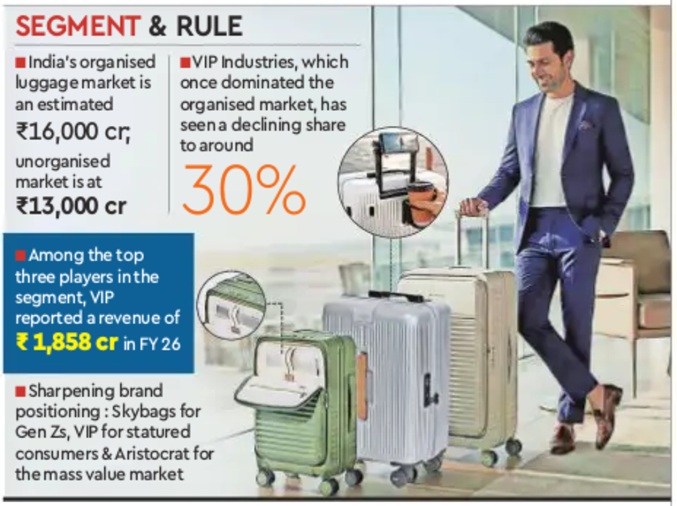
The company, which once dominated the ₹16,000 crore organised luggage market in India, saw a bit of a shakeup last year when the Piramal family sold 32% of its stake to a private equity firm. But it continues to be among the top three players in the category with a 29-30% market share. “Luggage plays the role of a traveller’s companion. We are creating designs to fit that role,” says Jain. “For example, our new VIP suitcases have a coffee cup holder and our cabin trolley bag has an easy access compartment for devices like laptops and iPads.”
The transformation goes beyond the product. VIP’s 350 exclusive physical retail touchpoints in the country are being revamped to offer a new customer experience.
Unpacking opportunities
Overits 55 years, VIP has grown from a briefcase brand into Asia’s largest luggage maker, housing labels like Skybags, Aristocrat, and Carlton (premium segment). While VIP is a premium offering targeted at business and travellers, its Aristocrat brand operates in the mass market and the budget-friendly Alfa targets consumers who typically shop in the unbranded segment. Aristocrat and Alfa together contributed upwards of 40% to the company’s revenue in FY25, followed by Skybags (28%) and VIP (20%).
Like many legacy brands, the VIP Industries’ faces the challenge to ia, stay relevant among Gen Z buyers as a plethora of digital-first brands swamp the market. “VIP has lost ground on relevance and desirability to a generation for whom luggage, like sneakers, is an expression of identity. To them, VIP feels like their parents’ brand,” says Nisha Sampath, managing partner, Bright Angles Consulting. D2C players in the category operate in the business of “lifestyle accessories” and not for “luggage” per se, she points out.
With a design-forward approach, incorporating features like compression systems, silent wheels and charging ports, these new-age brands have embedded themselves in travel “culture”, while also being Instagram worthy, say experts.
Jain says Skybags is VIP’s Gen Z focussed brand, which has over 8,20,000 Instagram followers. “We are sharpening our positioning for Skybags in our design, advertising and marketing outreach, especially on social platforms. The brand has a clear differentiation with youthful colours and prints to attract younger consumers,” he adds.
While D2C players have seen notable growth in recent years, they don’t have the kind of trust and brand equity that VIP has cultivated across its brands, nor do they have the scale or revenue that legacy brands have, he says.
Experts believe there is a significant growth opportunity for legacy players given that the unbranded market still accounts for ₹13,000-14,000 crore. The important lever for legacy brands is to clearly demonstrate value beyond price. “The unorganised market competes heavily on affordability, so organised players need to communicate durability, warranty, after-sales service, and consistent quality – areas where they have a strong inherent advantage over unorganised alternatives,” says Praveen Govindu, partner at Deloitte India. He adds that these brands should also invest in advertising and communicate this value to the end consumer.
Not only are the needs different among different consumer groups, competitive pressures are also diverse. “VIP can segment the market more cleanly with its portfolio of brands if it maintains absolute distinction to ensure clear consumer targeting across not just product attributes and pricing, but also communication and channels,” says Devangshu Dutta, CEO, Third Eyesight.
(Published in Financial Express)
admin
November 20, 2023

Christina Moniz, Financial Express
November 20, 2023
he country’s largest airline IndiGo just announced the launch of a premium luggage range in collaboration with actor Deepika Padukone-backed lifestyle brand Mokobara. The new luggage collection, Moko 6E, offers a check-in bag and a cabin bag in the signature IndiGo blue.
IndiGo has sweetened the deal for its passengers, offering customers an extra 2 kilos of baggage allowance for one year after purchase at no additional cost. With a starting price of Rs 9,999 and a six-year warranty, IndiGo says it is looking to reach more discerning consumers who travel for business or leisure.
The airline already enjoys a substantial share of over 60% in India’s domestic civil aviation sector as per DGCA data. So why is it making its way into the Rs 50,000-crore luggage market in the country? According to an IndiGo spokesperson, the aim is to leverage the carrier’s strong brand presence to target modern Indian jet setters and create a seamless travel experience.
Vejay Anand, CEO, Ironhill India, points out that balancing creating a new identity for the luggage line while leveraging the well-established airline image without diluting its core values will be a delicate task. “This venture was more than a market expansion; it was about intertwining their brand heritage with travellers’ lives, ensuring passengers carry the airline’s reliability beyond flights,” he remarks.
Navigating the market
Although the luggage market is huge in the country, industry reports estimate that the organised and branded segment is around 40% with players like VIP Industries and Samsonite taking up the lion’s share. Devangshu Dutta, CEO of Third Eyesight notes that rather than the potential quantum of business, it is more relevant to see a brand collaboration such as this as helping both companies create a buzz in the market. He observes that there is some degree of resonance in the design philosophies of both brands, pitched largely to millennial consumers.
Ambika Sharma, founder & MD of creative digital agency Pulp Strategy, observes that the carrier’s decision to enter the luggage segment could offer several advantages for IndiGo the brand. “Expanding into luggage provides IndiGo an opportunity to showcase its brand beyond the airline industry, strengthening its overall brand image and positioning it as a lifestyle brand. Offering a branded luggage line can enhance customer loyalty and engagement by providing travellers with a convenient and consistent travel experience,” says Sharma.
She however adds that making a mark in a competitive market with established players will be a challenge for the company. She cautions, “Consumers may not immediately associate IndiGo as a luggage brand, requiring significant marketing efforts to establish brand recognition. Creating a unique selling proposition that distinguishes the Moko 6E luggage from competitors is crucial. Effectively managing logistics and supply chains is critical to ensure timely product delivery and customer satisfaction.”
That said, India is a predominantly price-sensitive market where prominent brands sell luggage for as low as Rs 1,999, the brand may eventually have to revisit its pricing strategy if it has to compete with established players. “By offering a range of pricing options, IndiGo could cater to a wider set of consumers, potentially appealing to different market segments. This would ensure a more comprehensive market penetration while retaining its premium positioning,” states brand expert Anand.
With this association, the collaborator brand, three-year-old Mokobora, a premium travel and lifestyle brand established as recently as 2020, could also get a leg-up in terms of both visibility and accessibility. Anand notes that the lifestyle brand will, through this collaboration, be able to reach out to an audience of about 3 lakh or more air travellers in the country every day.
As of October this year, IndiGo has over 2,000 scheduled daily flights which include cargo operations, as well as CAPF and Army charters, allowing Moko 6E to reach a significant number of travellers daily.
(Published in Financial Express)
