
admin
October 27, 2009
 27/10/2009

 Mr Bruce E Bergstrom VP, Vendor Compliance,Li & Fung |
|
"Sustainability is a great concept like liberty. We are in a world with many problems and sustainability is the solution. This is the answer given by Bruce Bergstrom, VP vendor compliance of sourcing giant Li & Fung, who tackled the difficult question of What is Sustainable Fashion? at the first-ever Sustainable Fashion Forum held earlier this month. |
Session One:
Moderating the first session, Michael Lavergne, director-Asia, Worldwide Responsible Accredited Production (WRAP), posed to the panel "What does it really mean to be sustainable and what is best practice?"
Adding to his big-picture view of sustainable fashion, Mr. Bergstrom says economics play a strong role in the current approaches to sustainability, while solutions taken from social and environmental perspectives are sure to come.
"Sustainability is now a retailer and brand-driven initiative, but we need to convince the manufacturers to see the benefits of sustainable operation starting with raw materials,’" said Hong Lee, manager of Asia Pacific, Control Union.
But when widespread consumerism drives disposable fashion, is there really a place for sustainable fashion? The answer is yes, according to Janvier Serrano, creative director and founder of The 091/091’s Eco Couture brand, which features bags made from recycled scraps.
|
|
|
"Although it is difficult to achieve sustainability right now and it is a big challenge, we must do it. We must be open, we must be proactive. We must educate the consumers to go for quality and not quantity," advised Serrano.
Agreed Amy Small, Creative Director at Green2greener, a b2b trade platform for eco-fashion: "Sustainability is a continuous goal, it is to put back the same amount as what you take out". In her opinion, small companies, successful in sustainable production, can inspire big companies to follow.
"Fashion is not only in clothing but it is a lifestyle and attitude of life. We have to be vigilant on sustainability in day to day operation and living. It is important to impress upon the students of today the concept of sustainable living so that it can be passed down to the next generations", said Mary Yan Yan Chan, director of Style Central Ltd, the exclusive agent of Perclers Paris.
Taking questions and opinions from the floor, the panel and audience agreed that a paradigm shift is needed for the fashion industry to tackle sustainability effectively. There is a need to drive innovation. Governments can also play a part, through education and green policies.
Session Two:
Devangshu Dutta, chief executive of Third Eyesight led the 2nd session panelists to discuss "Is Sustainable Fashion Profitable?" He commented that sustainability is not viable in the long term without financial returns and a good business sense.
"Sustainable fashion can be profitable because shoppers today are looking for something more meaningful. Consumers are accepting the concept of reuse and recycle in a creative way", said Olivier Grammont, founder of eco fashion brand Francs-Bourgeois. He described how his company uses second hand materials for handbags and the finished products are selling well in boutiques.
Concurred James Ockenden, director of publishing house Media Karma which specializes in the environmental technology, energy and finance industries. Ockenden citied the case of an olive oil company that used olive pits to generate energy for the plant. The company has now expanded to processing palm oil waste to produce a power supply to 400 households. Ockenden strongly believes that green legislation is the way forward but subsidy for new technology is necessary. He proposed adding ‘government’ to the three pillars of sustainability, that being economics, environment and social.
 Session 2 Panel: Mr Olivier Grammont, Mr James Ockenden, Ms Cassandra Postema, Ms Dong Shing Chiu |
|
|
Meanwhile Carolina Rubiasih, VP sourcing & product development of the SAK questioned whether today’s consumers, who want value-for-money products, are indeed ready to for sustainable options that generally incur greater costs. The younger generation, however, is adopting healthier lifestyles that will likely encompass sustainable fashion. As time goes by, sustainability will be the norm and a way of life and perspective.
Offering ideas on how to be profitable with sustainable products, Ms Rubiasih advises to produce only what you can sell, improve on the design to reduce wastage, use less packaging layers, increase efficiency in logistics and study the tariff code to tap lower tariff categories with minor adjustments to the material & design. Her privately owned company took such steps and yielded good results, outperforming their previous year’s revenue.
Echoing Rubiasih’s emphasis on the importance of design, Cassandra Postema, director of fair trade fashion brand Dialog said "As designers, we have to design a product that can sell and sustain and compete with the regular products. It took People Tree, an eco-friendly company, 10 years to breakeven."
Some audience members felt that sustainability must be price neutral if not cheaper to sell to consumers and noted that supply chain efficiently is critical to profitability, while innovation and good management can bring costs down. It was also suggested that designers should place attention towards engineering so as to produce more efficiency.
Session Three:
In Session 3 Mr Ockenden facilitated the panel to probe into the question of "Who Wants Sustainable Fashion?" People buy fashion for various reasons, but experts often agree is linked to an emotional element. Companies can encourage sustainable fashion purchases by strengthening its ‘feel-good’ factor.
Sustainable fashion is in-demand among fashion brands, but under the financially low-risk terms of cost and time-efficient production, says Mr. Lavergne. NGOs are nudging the concept of sustainability onto the brands and retailers and the social climate is ripe for them to take such a stand.
Meanwhile Mr. Dutta says that general perception of fast fashion is quite wrong; it is actually not about throw away clothing but a management system that can improve the efficiency of the supply chain. Fashion is by nature not a sustainable concept but how can we make it sustainable? He hopes that in 10-20 years time we will truly have sustainable fashion.
 Moderator: Mr James Ockenden, Direct, Media Karma |
|
|
Summary:
The panelists recognise that sustainable business is still in its infancy, and urge the brands, retailers, buyers and suppliers to take small steps towards sustainability. There is no one answer to the complex and multi-faceted issue and finding solutions will require a collaborative effort. Improvements in education, innovation, technology and government policies will make sustainable fashion possible – and profitable.
Devangshu Dutta
October 8, 2009

Here is a summary of the Sustainable Fashion Forum, and some more pictures from the afternoon.
And here is a previous article on sustainability and corporate responsibility.
admin
May 9, 2009
By Devangshu Dutta, Tarang Gautam Saxena
While the Indian consumers have aspired to own international fashion brands, India’s large population base in turn has been an aspirational market for the international companies.
To remote observers, the Indian market may appear to be a virgin territory as far as international apparel and footwear brands are concerned. But India has seen the presence of international brands for almost a century, including mass brands such as Bata and luxury brands such as Louis Vuitton. However, as the colonial government systematically repressed local textile production, the local resistance to foreign products grew as well. Therefore, until the 1980s, the presence of international fashion brands was negligible.
In the early 1990s, as the Indian economy opened up again, a few international fashion brands entered the Indian market. The pioneering companies during this stage were Benetton, Coats Viyella and VF Corporation.
At this time the Indian apparel market was still fragmented, with multiple local and regional labels and very few national brands. Ready-to-wear apparel was prevalent primarily for the menswear segment which was thus a target for many international fashion brands (such as Louis Philippe, Arrow, Allen Solly, Lacoste, Adidas and Nike).

In the midst of this the media industry was also witnessing a high growth which aided the international brands in gaining visibility and establishing brand equity in the Indian market.
The late-1990s marked a significant milestone in the growth of modern retail in India. Higher disposable incomes and the availability of credit significantly enhanced the consumers’ buying power. A growing supply of good-quality retail real estate in the form of shopping centers and large format department stores also allowed companies to create a more complete brand experience through exclusive brand stores and shops-in-shop.
The number of international brands continued to grow each year at a steady pace until the early 2000s, and took off exponentially thereafter. By 2005 the number of international fashion brands present in India was over three times compared to that in the mid 1990s. The last few years (since 2005) have continued the significant growth of international fashion brands, including luxury brands such as LVMH, Aigner, Tommy Hilfiger and Chanel.
The Popular Entry Strategies
Many of the international companies entering India in the late 1980s and 1990s chose licensing as the entry route to India to gain a quick access to the Indian market at a minimal investment.
A few companies such as Levi Strauss set up wholly owned subsidiaries while others such as Adidas and Reebok entered into majority-owned joint ventures. This helped them to gain a greater control over their Indian operations, sourcing and supply chain, and brand.
In the subsequent years import duties for fashion products successively came down making imports a less expensive sourcing option and the realty boom brought investors in retail real estate that were ideal franchisees for the international brands. By 2003, franchising became the preferred launch vehicle for an increasing number of international companies, while only a few chose to enter through licensing.
In 2006 the Government of India reopened retail to foreign investment (allowing up to 51 per cent foreign direct investment in “Single Brand” retail). Using this route, many brands have entered India by setting up majority owned joint ventures, or transitioned their existing franchise arrangements into a joint venture structure.
The Entry Structure for Some International Brands
| Entry Strategy | Time Period | ||
| 1980s or Earlier | 1990s | Post-1999 | |
| Licensed | Louis Philippe, United Colors of Benetton and 012, Wrangler | Allen Solly, Arrow, Jockey, Lacoste, Lee, Nike, Van Heusen, Vanity Fair | Puma |
| Wholly Owned Subsidiary | Bata, Pepe Jeans | Levi’s® | Hanes, Triumph |
| Joint Venture (Majority) | Adidas, Reebok | Diesel, Nautica, Sixty Group | |
| Franchise or Distribution | Aldo, Burberry, Canali, Versace, Debenhams, Esprit, Gucci, Guess, Hugo Boss, Mango, Marks & Spencer, Mothercare, Tommy Hilfiger | ||
| Joint Venture (incl. Minority Stake) | Celio, Etam, Giordano | ||
Source: “Global Fashion Brands: Tryst with India” (A Report by Third Eyesight) © Third Eyesight, 2009
Note: The above table shows the structure used during entry, and not the structure that exists currently.
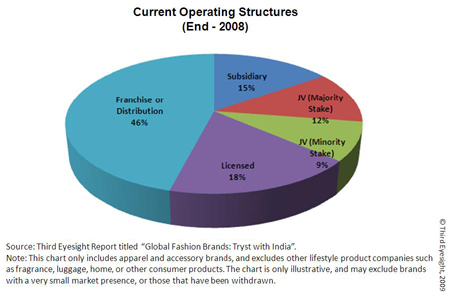
By the end of 2008, just under half of the brands were present through a franchise or distribution relationship, while over a quarter had either a wholly-owned or majority-owned subsidiary. These structures allowed the brands to have greater control of operations, particularly of product.
Shifting Strategies
Many international companies have evolved their presence in India into structures different from those at the time they entered the market.
A good example depicting the shift in business strategy is that of VF Corporation which entered India in 1980s by assigning the Wrangler license to Dupont Sportswear. Since then it has launched a variety of brands in different product categories with number of Indian partners and finally formed a joint venture, VF Arvind Brands Pvt. Ltd., with Arvind Brands.
Another example of a company that has evolved its presence is Benetton, which first entered India through a licensee (Dalmia). Benetton then transitioned in 1991 into 50:50 joint-venture and finally in 2004 took over the Indian business completely. However, it adopted the franchising route in 2006 for its premium fashion brand, Sisley, appointing Trent (a Tata Group company) as the national retail franchisee.
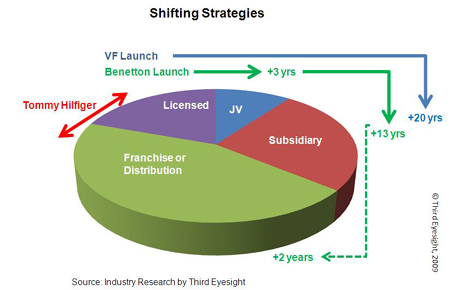
Many other companies such as Nike, Tommy Hilfiger, Marks & Spencer and Pierre Cardin (as described in our report “Global Fashion Brands: Tryst with India”) have changed their approach as the original structures did not perform as well as they had expected.
Obviously, each such change has cost the brands time, management effort, money and, sometimes, market share.
We believe that these shifts and the pain related to it could have been reduced, had the brands ruthlessly questioned the motivation for considering this market and their expectations from the market in determining an appropriate strategy.
What’s Ahead?
In the midst of economic upheaval around the world, how does India look as a market for international fashion brands?
Well, it is difficult to generalize even in the best of times. In the current global turmoil there is certainly a lot more unpredictability about international expansion for most companies.
Although India’s position as a target market for international brands has been improving, as is evident from the number of launches in the last 6-7 years, some companies considering international expansion may prefer entering other markets that may seem more “familiar”, developed and safe (such as Europe, Japan, South Korea or Taiwan). Against such comparisons, India’s growing but fragmented market can seem chaotic and difficult to deal with.
However, the fact remains that there are very few markets globally that can provide the sustained size of mid-term and long-term opportunity that India does. We are already seeing the more far-sighted and committed brands consolidating their position and presence in the market by continuing to look at expansion, even while examining how they can make their existing points of sale perform better. We also constantly come across new companies carrying out investigations into the market.
In the current environment we expect to see a shift in the nature of launch vehicle. While franchising seems to be a safe option for risk-averse brands in the current times, we will probably see more brands with a long term strategy, who would establish a controlled presence either through joint-ventures or through wholly-owned subsidiaries, since they can lay the foundation of the business today at much lower costs today than in the past few years.
India’s foreign direct investment (FDI) policy, allowing FDI only up to 51% in retail trading of “Single Brand” may have held back some fashion brands as they are still managed by owner founder with a conservative outlook on “control”. However, in the last couple of years, we have found companies not being deterred by the barriers to FDI.
As their comfort and familiarity with India has grown, international companies are more willing today to create corporate structures that allow them a presence in the market today and a step-through to a more controlling stake as and when government regulations allow.
All in all, we feel that international brands are in India not only to stay, but also to expand. There is yet a lot of potential untapped in the market, and as the integration of the Indian consumer with global trends continues, international brands can expect to find India an increasingly fertile ground for growth.
(c) 2009, Third Eyesight
Tarang Gautam Saxena
May 8, 2009
In a recent workshop on fashion styling, we were discussing how the retail seasons have evolved. In the developed economies, from the traditional two seasons – spring-summer and autumn-winter – the number of seasons grew as fashion brands discovered or invented (take your pick!) sub-seasons to create and satisfy distinct demand in specific time periods. For many companies, the number of “seasons” has grown to 10-12 now including transitions and “promo season” series.
India, you would think, essentially has two seasons, the summer and the festive season. However, in the last decade or so, as exposure to the global culture has increased, other “seasons” such as the “Valentine’s Day” have emerged and proved important for retailers.
In fact, events such as the “Sabse Sasta Din” (“the cheapest day”) on the 26th January (India’s Republic Day) created by Kishore Biyani’s Big Bazaar in 2006 should also qualify as seasons, given the huge sales upsurge during the event. In fact, the impact has been such that many other retailers and brands have also taken this concept rather seriously this year. In fact, after a rather dull consumer response in the festive season in 2008, many of our clients reported rocking sales in the last week of January 2009 on the back of heavy promotional campaigns.
More recently while voter awareness campaigns such as “Pappu can’t vote” have been effective marketing initiatives to get many of us out of our comfort zones and exercise our voting rights, many retailers and brands have also seized this opportunity of citizens’ awakening by offering up to 20% discounts to those who have voted. The economic slowdown is certainly getting people to think differently and more creatively. So, “Jago re” (awaken) brands, retailers and countrymen – go ahead and fashion your own season!
admin
September 22, 2008
The Textile and apparel industry is of particular importance to India. It not only provides employment to a broad base of semi-skilled and unskilled labour but also helps to extend the economic bounty to urban and semi urban areas. Though India has a history of thousands of years in global trading of textile, it contributes only 3% to the global exports of textile and clothing.
While the urge to grow exists, there is a huge difference between the current exports of about Rs. 864 billion (US$ 20 billion) and the target of Rs. 2,500 billion (US$ 55 billion) by 2012. To achieve this vision, exports must grow at around 25-35 per cent a year for the next 4 years, depending on how weak or stable the current year is. This growth rate seems difficult considering the fact India has actually grown its exports of textiles and apparel at an annualized growth of a little over 14 per cent from 2003-04 to 2007-08.
Even if the industry looks at increasing the volume of exports to achieve the vision, the ports do not have the handling capacity considering that they currently operate at 91 to 92 % of available capacity.
Hence, incremental thinking will not help to achieve the vision.
Our key concern is the value “lost” by the industry. Being the low cost supplier does not necessarily translate into greater market share. The Indian Industry must look at enhancing the value delivered rather than competing on the cost platform. Indeed, India compares poorly to other countries on the value captured per employee. (For instance, if the export value captured per employee in India was as much as Turkey, India’s exports would be close to China’s exports of US$ 161 billion.)
One major concern that needs to be addressed is that India’s exports are still weighted in favour of raw materials and intermediate products, rather than finished products. Apparel exports account for only 41% of India’s textile exports in 2007-08. India’s product mix also needs to be aligned to global market needs, rather than only focussing on “traditional strengths” – this includes enhancing the share of non-cotton products in the basket.
Another area that is neglected is the inherent competitive capability of developing new products. The industry needs to develop and nurture these skill sets to create a sustained competitive advantage in the global scenario. India already provides buyers with value in terms of product development and design, which needs focus and further strengthening.
Further, India’s domestic industry, and its skill at understanding market needs, creating and merchandising product, can also play a valuable role in the industry’s growth.
The competitive advantage offered by being able to influence the development of a product is immense. And given that sourcing lead times are shorter in unpredictable times, a supply base that has been involved with the buyer right from the development stage of the product is most likely to get the final order. Third Eyesight proposes a four dimensional model: Define, Design, Develop and Deliver so as to achieve the industry-wide development, of projecting India as a valuable supplier, and sustaining its value needs.
By creating an ecosystem focused on design and product development, India can create and capture the billions of dollars worth of value that is being lost to other countries.
This is an extract from Third Eyesight’s report presented at the FICCI 3rd Annual Textile And Garment conference in Mumbai. The report was released by the Minister of Textiles, Government of India. To download the full report prepared by Third Eyesight, please click here.
To discuss how we can help you with your specific business needs, please get in touch with us via email (please send it to services [at] thirdeyesight [dot] in) or via this form: CONNECT.

 Moderator: Mr Michael Lavergne
 Session 1 Panel: Mr Javier Serrano, Ms Mary Yan Yan Chan, Mr Bruce E Bergstrom, Mr Hong Lee
  Moderator: Mr Devangshu Dutta
  Overview of the forum