
Tarang Gautam Saxena
February 7, 2011
It has been almost two decades since the government in India re-opened the economy to international investors and brands. During the first dozen years or so, apart from a single visible bump in 1995, every year had a steady dribble of fashion brands coming into the country. It was not until 2005 that this rate accelerated to over 20 international fashion brands entering the Indian market annually, even as the existing brands grew their own retail footprint in the market.
2008 and 2009 were both slightly damp by comparison, reflecting the global economic sentiment, but we were optimistic as we laid out our expectations for 2010. While writing the previous version of our research report released a year ago, we felt that 2010 was going to be promising and it could well be a “curtain-raiser for a new decade of growth for international fashion brands in India”.
The increased bustle in the market has endorsed our forecast. Though initially slow, the growth of new international brands entering the Indian market in 2010 bounced back with the same vigour as before the downturn. Some brands that had exited the Indian market earlier also made a comeback as in the earlier years.
The Entry Strategies In 2010
The most preferred entry route for the international fashion brands entering India in 2010 has been franchise or distribution, with more than half the brands selecting this strategy that allows high control over the product and the supply chain with less intensity of involvement at the front-end. There are two discernible categories of brands that are picking this route: firstly, brands that are usually distributed through department stores and multi-brand independent stores in their home market and other markets, but also those brands that are as yet unsure of their capability to engage intensively with the Indian market. Franchising remained a popular choice in 2010 particularly for the brands looking to test the market or operating in niche or luxury segments.
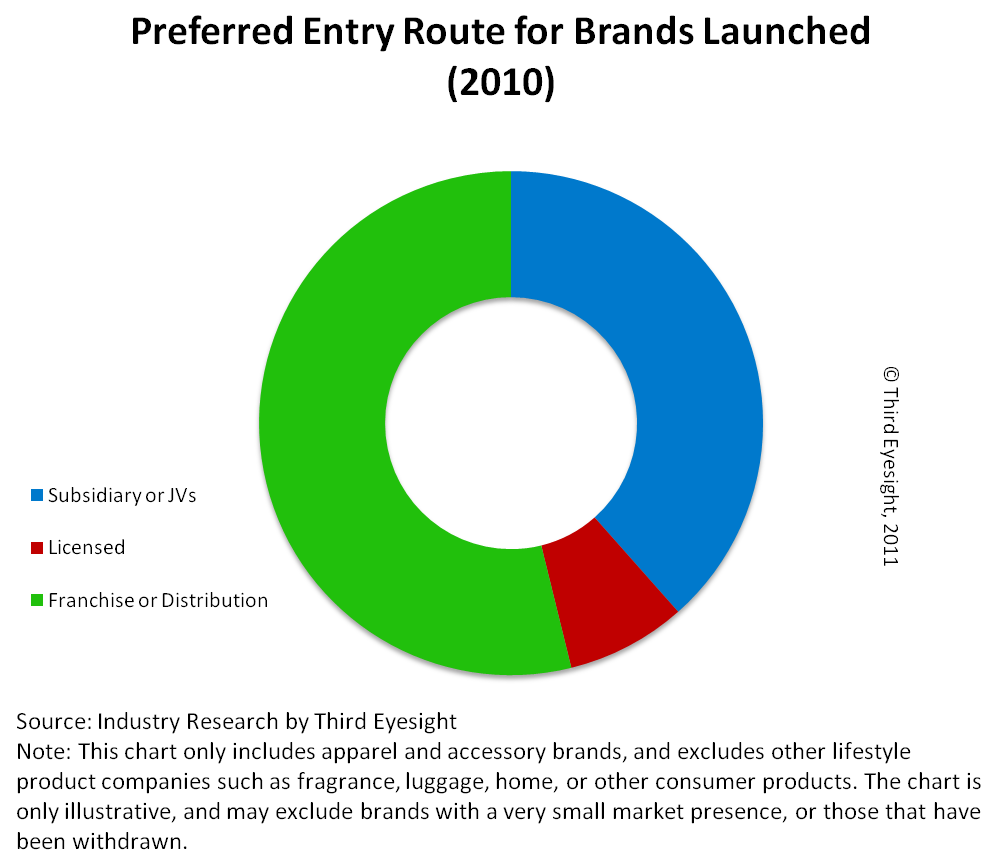
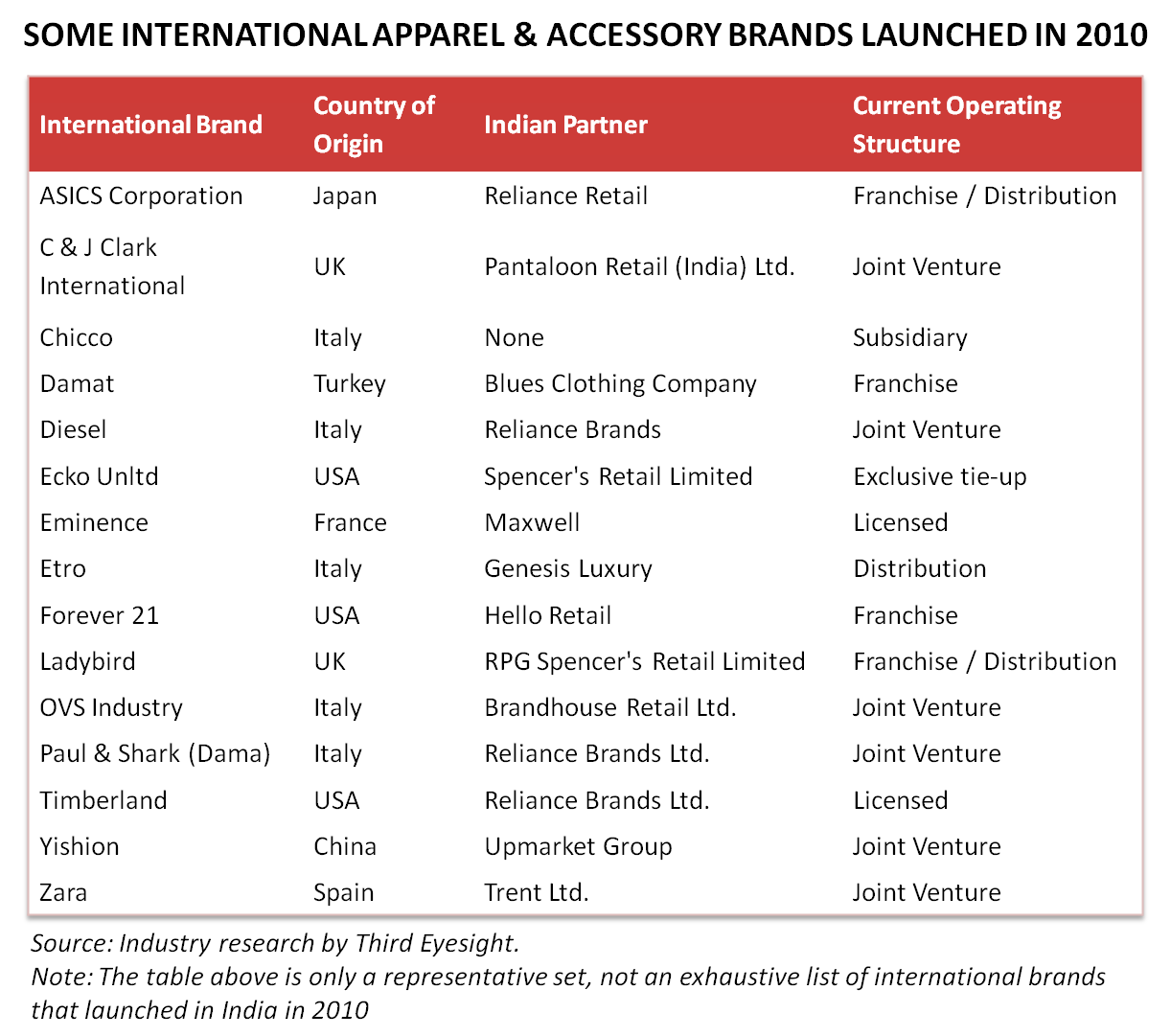
Some brands taking this route for entering the Indian market include Forever 21, Etro, Tom Ford, and Ladybird, amongst others. However, a number of brands that entered in 2010 (nearly 40% for the new entrants) also showed that they wanted a piece of the action through some degree of ownership (whether through a majority or minority stake in a joint venture or through a wholly owned subsidiary). Some – such as S. Oliver – also switched to joint-ventures from their earlier franchise structure.
Under the current regulations governing foreign investment into retail, several companies that typically want control operate either through 100% subsidiaries that sell to independent retail franchisees , or through 51:49 joint-ventures that operate the stores as well.
We are finding increasing signs among companies of a confidence in the market, a growing comfort with the operating environment, and a desire to own and control the direction their brand takes in a strategic market like India. it is likely that if the government decides to allow 100% FDI in single brand retail, several brands will opt to set up wholly-owned subsidiaries that control the entire chain of activities, source-to-store.
International brands opting for the ownership in the Indian venture included OVS (Italy’s Gruppo Coin), Yishion (China) and Chicco (Italy).
Fast Fashion for the Family
Amongst the new launches, a highlight of the year was the launch of the most awaited and discussed-about brand Zara. The first store was launched in Delhi with menswear, womenswear and childrenswear, followed by a store in Mumbai, and a third again in Delhi. While almost every other brand launches with an advertising blitz, Zara – in its usual fashion – needed none. The news buzz it generated created enough traffic to provide record sales during the first few weekends. It was also instrumental in generating 30-40% more footfall in the malls where it opened.
Inditex was certainly one of the brands looking for control, and has formed a 51:49 joint venture with the Tata Group’s retail business, Trent. For now the company has adopted its global supply chain for the Indian market as well which clearly adds cost and time to the supply chain. The merchandise is imported from the central distribution centre in Spain, and includes products manufactured in the Indian subcontinent. Competing brands in the industry have raised questions about Zara being able to build a successful and sustainable business in India just on the back of rapid fashion changes, at prices that are not quite “competitive”. However, the brand is reportedly aware of the struggle in building a successful business around import-led sourcing model and is seen to have planned growth conservatively.
Another southern European value fashion brand, OVS Industry, was launched last year by Oviesse through a joint-venture with Brandhouse Retail from the SKNL group. OVS Industry also offers a range for men, women and kids. While in the first year products have been imported from Italy, the company says it intends to bring in the merchandise directly from the supply source for speed and cost effectiveness, to achieve aggressive growth over the next five years.
Multi-Brand Platforms, Larger Stores
International brands have been drawn to India by its large “willing and able to spend” consumer base and the rapidly growing economy, but so also are Indian companies – manufacturers or retailers – who are ready to act as platforms for their launch.
Given the current restrictions on investment into retail operations, Indian companies are increasingly setting up large multi-brand outlets for an array of international brands under one roof. This allows the Indian franchisee to share overheads among many brands, and also negotiate harder for shopping centre space that is increasingly unaffordable. However, the idea is not only to gain from the operational efficiencies and cost efficiencies, but also to capture a higher share of the wallet of the consumers walking into the stores.
Even those Indian companies that are already retailing their own brands in a particular category are seeking franchise or distribution relationships with international brands, in order to capture a complementary segment of consumers or to offer a larger choice-set to their existing consumers.
For instance, Reliance Brands has partnered with some well known premium to luxury fashion and lifestyle brands. In 2010 alone, it brought Diesel, Paul & Shark and Timberland to the Indian market. On the other hand Maxwell Industries’ relationship with Eminence, a French innerwear brand, has allowed it to address the premium segment in which it was not present, and to compete with other international players such as Jockey, Triumph, Hanes, Fruit of the Loom and others.
RPG Group’s Spencer’s Retail, one of the pioneers of modern retail in the last two decades is looking at increasing the share of its apparel business. Apart from its private labels, Spencer’s is also actively seeking to grow its international brand portfolio quickly. Following up on its launch of Beverly Hills Polo Club in 2008, Spencer’s introduced Ecko Unltd (a youth fashion brand) in 2010. It has also become the platform for the British childrenswear brand Ladybird in its second coming to India.
While the emergence of large multi-brand franchise outlets is driven by Indian franchisees looking to optimise their businesses, the brands themselves are also looking at larger store sizes that are gradually becoming comparable to their stores elsewhere. For instance, the American brand Forever 21 launched with 10,000 square feet for only women’s western clothing and accessories. Similarly, Zara launched its business with a 14,000 square feet store. Larger stores are allowing brands to increase the efficiency of their operations, maximise the visual impact, and increase the speed at which they can achieve critical mass in the country.
Beyond Europe and the US
While European and American brands clearly dominate, 2010 also saw brands from China, Japan and Turkey making inroads to the Indian market.
China’s apparel retailer Yishion launched a 51:49 joint venture with a distribution company, Upmarket Group. Yishion is aiming at rapid growth in the mid price segment in India through own stores and multi-brand outlets (MBOs).
Turkish brands Tween, ADV and Damat from the Orka Group have been brought to the market by Blues Clothing Company, a mid-sized retailer of fashion apparel that also distributes brands such as Versace, Corneliani and Cadini.
The Strategy Shifts & Changing Structures
In the past the international brands have undergone changes in their strategy and operating structures to suit their current context and changing environment. Last year was not an exception to the correction and some brands did undergo a change in their approach and strategy for the Indian market.
Italian denim brand Energie exited the market and their partnership with Reliance Brands in 2007. However, in 2010, the Miss Sixty group entered into a licensing agreement with Arvind Limited which relaunched Energie as part of its portfolio of international denim brands. Arvind already had international brands catering to the mass and the middle segments of the denim market, and with the launch of Energie, it has achieved brand presence in the super-premium category as well.
Another notable denim brand that re-entered the market in 2010 was GAS, also from Italy. After it fell out with Raymond, the brand investigated other relationships, and finally decided to set up a fully-owned subsidiary. The brand was re-launched with one flagship store and through various shop-in-shop counters at Shoppers Stop, the department store chain.
The second attempt of the Germany-based casualwear apparel brand Lerros owned by the House of Pearl was ill-timed in 2008. With business coming up below expectations, the company decided exit the business in India. But instead of exiting the market, it granted the license to manufacture, retail and distribute Lerros to the maker of the Indian denim brand Numero Uno. With a complementary product mix, the principal and the licensee are looking to achieve greater success together.
Another brand that has undergone a shift in its strategy and the operating structure is the Italian brand Zegna, a world leader in luxury menswear. It was first introduced in the Indian market early on in the decade through a franchise arrangement. In 2005 with 51% FDI being allowed the Zegna Group invested in taking a majority stake in its Indian operations. Last year the brand entered into a joint venture with Reliance Brands Limited with the objective of ramping up its India operations and capturing a larger share in the Indian luxury market. For Reliance, it was a great addition to its international brand portfolio.
Compared to 2009, 2010 witnessed hardly any exits, Aigner being one.
Strategies for Growth and Prospects For 2011
Overall the year 2010 has been very positive and the pace of new brands entering the market is picking up. Those already present in the market, have been adapting their strategies to grow their India business. The growth strategy for international brands has revolved around lowering the prices and entering new segments.
The brands that have rationalised their pricing last year to attract more customers include Adams Kidswear. Previously priced significantly higher than the market leaders in that segment, Adams is looking to change its sourcing strategy and source a part of its product range locally. Similarly, having tasted success in the previous year, The Body Shop not only rationalised prices for more products in 2010, but also introduced new products at lower price points.
Another notable trend last year was the focus of international brands on Tier 2 and 3 cities. Marks & Spencer unveiled its plans to enter Tier 2 cities such as Jaipur and Chandigarh and grow its national footprint. Reebok, Adidas, Ed Hardy, Tommy Hilfiger, The Bodyshop and Puma are amongst those that have stated their intent to further expand to such cities. The success of adopting these strategies is bearing results already and the momentum is likely to build further as others follow.
For international brands, as for Indian brands, significant challenges remain in the path of growing their business.
At the base level is drumming up adequate demand. While India is often compared with China because of similar size of population, the fact is that urban discretionary incomes and the concentration of spend are far higher in China. This reflects in the speed with which brands have been able to ramp up in the two countries. For instance, Mango entered the two markets around the same time. However, a the end of 2010, the network of stores in India was only a tenth the size of the store network in China (100-plus), with over 200 more stores projected to open in 2011.
In scaling up, the lack of affordable good retail locations is one of the other biggest hurdles. With the slow growth in 2008 and 2009, brands are significantly more cautious in signing up space at high rentals.
Future challenges also remain more at the internal operational level. Retaining adequately trained front-line staff is an issue. Not only does the increasing number of international brands increase the competition for the employee pool, so also does growth in other segments of the economy and it is tough to sell retail as an employment option of first-choice.
We expect prices to become more realistic, but also operational efficiency to be a driver. Clustering of stores for efficient management, a concerted drive towards lower cost locations and variable (revenue-linked) payments to landlords are likely to be critical in driving better performance. We also expect many brands to seriously consider scaling up the network to provide critical mass to their business, which can also drive local sourcing of merchandise or direct shipments to the Indian business from Indian and other Asian sources.
If the Indian Government announces further relaxation in the foreign ownership norms, we would expect more brands to take equity stakes in the business in India, including the entry of those that wish to operate fully-owned subsidiaries. However, with many different signals from various arms of the government it is best not to try and read the crystal ball too closely on that issue.
Despite challenges and barriers, the market is far from being saturated right now as newer product segments and product lines create ever-newer needs. With India being one of the few large economies showing consistently strong performance, many more are considering the Indian market seriously. Among the ones reported to be interested in launching are GAP, Uniqlo and Polo by Ralph Lauren.
The market may become more segmented and even fragmented with a plethora of international brands being available.
The largest brands currently include Levi Strauss and Reebok which are both reportedly well past the US$ 100 million mark in India, but the race for market leadership is still well and truly on. No matter which brand comes out ahead the winner, without a doubt, will be the consumer.
Devangshu Dutta
September 4, 2010
The last three years have been a roller coaster ride for food & grocery modern retail in India.
Progressive Grocer’s India edition was launched in September 2007, during what was an excellent series of years for the modern retail trade in the country.
It was a year after the launch of Reliance Fresh, and a few months after the acquisition of Trinethra’s chain of 170 stores by the traditionally conservative Aditya Birla Group. Spencer’s announced its plans to raise capital for expansion, while Food Bazaar together with its value-format non-food twin Big Bazaar already accounted for more than half the Future Group’s sales.
Other than the established corporate groups, new entrants such as Wadhawan were also well into growth through mergers and acquisitions, including their purchase of Sangam, Hindustan Unilever’s experiment at retailing directly to consumers, Sabka Bazaar and The Home Store.
The four largest foreign retailers were also making their presence felt through Walmart’s announcement of a joint-venture with Bharti in August, Tesco’s and Carrefour’s intensive investigations of the market and negotiations with potential partners, and Metro’s announcement of its planned growth to 100 outlets.
The modern retail engine seemed to be chugging along strongly. But there were also spots of trouble in paradise.
Protests against the opening of corporate chain stores were seen in a few states. In some cases state administrations even formally stepped in to ask for closure of corporate chains to avoid civic trouble, and it looked as if the lights were going out even before the party had really started!
Along with the battle between modern and traditional, both sides of the debate on foreign direct investment (FDI) into the Indian retail sector were also ramping up their arguments. There was vocal opposition from emerging large Indian retailers, as well as the small traders group, while investors and some of the prominent retailers championed the cause of foreign investment.
In both debates, international examples of the damage wrought by large or foreign retailers to local economies were quoted by those opposed to corporate retailers. And in both, the developmental aspects of modern retail were quoted by proponents of modern retail and FDI.
At Third Eyesight, in early 2007 we had carried out a study (“From Ripples to Waves”) on the increasing impact of modern retail on the supply chain. Amongst the study’s respondents, both retailers and suppliers had favourable things to say about the growth of modern retail and its impact on the supply chains for various products. There was not just talk of efficiency with fewer layers of transactions and lower costs, but also of effectiveness, with suppliers reporting 10-25% higher per square foot sales in modern retail stores as compared to their displays in traditional independent stores.
After years of resisting the impending changes to their ordering and servicing structures, major Indian FMCG and food brands became busy setting up or strengthening teams focussed on the modern trade or ‘organised’ corporate customers.
The market was rich with format experimentation for food and general merchandise retail, typically between 1,000 sq ft and 10,000 sq ft, but also with a gradual growing emphasis on 20,000-80,000 sq ft supermarkets and hypermarkets.
Literally hundreds of food brands from other countries actively sought to tap into the growing Indian market, and modern retailers offered them a familiar environment and a well-managed platform for launch.
At the same time, plenty of respondents also said that they had not made any significant changes to their business. Either inertia or fear of channel conflict was preventing them from pushing ahead with newer business models.
In short, there was no dearth of action and contradiction, no matter where you looked.
However, towards the end of 2007 and beginning of 2008, we had a sense of foreboding. With the rush to expand the store network to get first to some yet-invisible finish line, both property acquisition and human resource costs were driven up by a feeling of a shortage in both. I recall writing a column around that time, urging retailers to look at store productivity as their first priority (See: Priority #1: Store Productivity, Same Store Growth).
By the middle of 2008 the crisis was evident. There was a lot of square footage, much of it in the wrong places. There were issues with the supply chain for managing fresh and perishables, those very products that drive frequent footfall into a food store. More importantly, the global financial storm had started gathering strength, reducing liquidity in the market and making investors and lenders look more closely at existing business models.
The spectacular meltdown of Subhiksha in 2008, and the more gradual but equally deep impact on other businesses was visible. And worrying. Players as disparate as Reliance, with its ambitious plans to grow into a Rs. 300 billion retail juggernaut, and the Shopper’s Stop premium format Hypercity seem to take a break to rethink.
2008 and 2009 were years that I am sure many retailers would like to forget, but they were also very valuable. Some people have compared these years to the churning of the ocean (manthan) by the devas and the asuras in Indian mythology, with the deadly poison halahal coming to the surface before the divine nectar amrit could be reached.
In these two years, we have seen stores closed, formats changed, and organisations made slimmer. Store staff have discovered how to live with small changes like higher ambient air-conditioning temperatures, and are learning the more important science of higher transaction values, even with leaner inventories. Management teams are becoming more accustomed to looking at retail metrics other than only sales growth that could be achieved from new square footage. Vendors are finding newer ways to make their brands more relevant to consumers and to the retailers.
More importantly, these years have also underlined the importance of India as a growth market to non-Indian companies.
2010 so far seems a far happier year. Income and GDP growth figures look much healthier. Real estate inventories in malls that were not released in 2007-2009 are coming on the market, many at terms that are more favourable than earlier. Retailers’ financial results look healthier.
There could always be the temptation to rush headlong into growth again. But I don’t think food retailers or their vendors should drop their guard yet.
The coming months and years need significant sharpening up of customer insight, merchandise and inventory planning capabilities and supply chains. Operational assessments, analytics, organisational capability building, are all tools which will need to be looked at closely.
We are at the cusp of the next growth curve, as the population grows and matures, and the market become more sophisticated.
Though the large-small, local-foreign debate isn’t closed yet, the much-awaited approval from the government to allow foreign investment into multi-brand retail businesses may be around the corner.
Even if FDI doesn’t happen immediately, the majors are already in or preparing to enter and ride the consumption growth that will logically happen. In addition to its support to Bharti’s Easyday chain, Walmart has launched its cash and carry operation, Bestprice. Carrefour reportedly is looking to open its first Indian (wholesale) outlet by November in New Delhi on its own, even as rumours of a partnership with the Future Group fly thick and fast. And Tesco is steadily steaming ahead with the Tata group.
And practically every month we are seeing new products and even new brands being launched by Indian and non-Indian companies.
An old saying goes: the journey of a thousand miles begins with a single step.
From the tumultuous events of the last three years, it seems that the Indian food retail sector must have travelled at least a few hundred miles already. In one sense it has. Many of the developments that we’ve seen in three years would have taken at least a couple of decades in the more mature markets.
However, in another sense, the food and grocery modern retail sector in India has only taken the first few steps, with much to be accomplished still. The sector remains fragmented, and wide swathes of the market are yet to be penetrated – not just by modern trade, but even by brands that already supply traditional retail. The blend of players and business models, not to forget the spicy regional mix of different market segments, promises valuable lessons not only for those in India but potentially for other markets in the world.
There are very big questions seeking answers. How to improve agricultural productivity so that food security is ensured. How to save the abundant harvests rather than letting them rot in unprotected storage dumps. How to ensure adequate calories and nutrition get delivered not just to the wealthy and the middle class, but also to the poorest in the country.
On the retail side, the Indian versions of Walmart, Carrefour and Tesco are possibly still in the making, and may yet surprise us with their origins and growth stories. And e-commerce is a work-in-progress that may be the dark horse, or forever the black sheep.
I think the big stories are yet to unfold, and the unfolding will be exciting, whether we are just watching or actively participating in the modernisation of the Indian food retail business.
Devangshu Dutta
August 17, 2010
Most of the people reading this would be familiar with fast food, and think of it as a cheap, tasteless, “throw-away” excuse for food. You may think of it as a deeply penetrated product category, close to being ubiquitous.
Here’s a picture that tells the other story.
For these kids, who are clearly not able to afford the products, the fries, burgers etc. are aspirational and exciting. For them, McDonald’s is clearly not open early enough (in their lives).
It’s a different perspective when you look through the other side of the glass, I guess.

Devangshu Dutta
August 11, 2010
Retailwire hosted an interesting discussion on ethical consumerism, based on Andrew Benett’s description of the decline of hyper-consumerism, and the emergence of a more conscious, frugal consumer in his new book, “Consumed: Rethinking Business in an Era of Mindful Spending”.
In a recent article Benett identified 10 public figures who also act as beacons for mindful consumption. The list includes people as diverse as US first lady Michelle Obama, talk show host & actress Ellen Degeneres, investor Warren Buffet, PepsiCo CEO Indra Nooyi and rapper Ludacris.
Of course, Ellen, Ludacris or Oprah have a communication reach that most marketers would kill for. Walmart pushing sustainable technologies in its supply chain could possibly achieve more than many governments around the world would hope to, because its powerful carrot of buying budgets is far stronger for many vendors in Asia, than the sticks of legislation. Many of these are genuine, praiseworthy attempts.
However, much as I would like to believe that all celebrities and high profile businesses are evolving into mindful, careful consumers, that would be a gullible step too far. In the current economic climate, consuming too conspicuously is just “not done.” But that may change as markets improve, jobs expand and incomes rise again.
Having said that, if the current fashionable rash of mindfulness raises the profile of concerns around over-consumption and waste, if it actually drives us towards more sustainable behavior and be more gentle to the planet and our future generations then, well, the end justifies the means.
Andrew Benett’s list is here: Top 10 Public Figures Who Are Also Mindful Consumers.
And this is the discussion on Retailwire on this subject.
Chandni Jain
August 9, 2010
India’s traditional skills in textiles, intricate craftsmanship, and creativity in producing a range of design-intensive products have enticed buyers from all over the world. India retains a strong and sustainable position among the top five exporters of textiles and clothing in the world.
India’s textile exports are currently weighted in favour of raw materials and intermediate products leading to ‘value-leakage’, which is a major concern from the long-term competitiveness perspective.
Within India, Delhi holds a position of prominence and can play a significant role in capturing additional value within the country. As a sourcing destination and as a gateway to the rest of India’s textile and apparel sector, Delhi provides unique value in product development and design, and a tremendously flexible supply base.
This capability is especially critical in an unpredictable market where retailers and brands are looking to source ever-smaller quantities of product, increasingly closer to the season.
According to the Director (Merchandising) of one of the largest US retailers sourcing from India, “Delhi scores high on responsiveness, and is more enterprising. It has the capability to handle extraordinary fabrics and is strong in interpretations of artwork.”
The apparel cluster in Delhi-National Capital Region (Delhi NCR) includes locations across four states, and accounts for about twenty five percent share in the country’s current apparel exports. If Delhi’s apparel cluster were to be treated as a country, at US$ 2.6 billion (Rs. 12,000 crores) of apparel exports, it would fall within the Top-20 list, ahead of countries such as El Salvador, South Korea, Philippines, Peru and Egypt. Moreover, being a labour intensive industry, apparel cluster offers immense employment opportunities in NCR, already with current direct employment of over 1 million as per Third Eyesight’s estimate.
A study carried out by Third Eyesight has identified an additional growth opportunity of over US$ 5.5 billion (Rs. 25,000 crores) both in its current markets and products, as well as new product opportunities.
For many buyers, sourcing from Delhi NCR cluster is still restricted to beaded, sequined, and tie-dyed blouses, dresses and skirts. While Delhi remains strong in these products, it now also sells funky denim and jersey wear to young fashion brands, men’s tailored suits to American brands, and women’s undergarments to Europe.
Delhi now offers a base both to international buyers looking at buying finished products, and to Asian, European and American manufacturers looking at setting up alternative manufacturing locations that can tap international as well as the Indian market.
Going forward, the key stakeholders of the Delhi NCR apparel export cluster – individual companies, industry associations and the government need to urgently undertake adequate action steps as the competition is gearing up and the perceived strength of Delhi NCR cluster at the moment may not remain a USP of this cluster in the future.
The Delhi NCR apparel export cluster strategy report along with action steps and key implementation areas was presented at an industry seminar ‘Discovering Growth’ in New Delhi. The seminar was hosted by GTZ in partnership with Small Industries Development Bank of India (SIDBI) and Apparel Export Promotion Council (AEPC). The seminar was attended by the key stakeholders of the Delhi NCR apparel cluster including leading apparel exporters, buying agencies and retailers.
