
admin
June 28, 2022

June 28, 2022
Edited by Surabhi Shaurya, India.com
The blanket ban on single-use plastic items from next month poses a challenge to cool beverages such as Frooti, Real, Tropicana and Maaza. Earlier, beverage company Parle Agro, which owns Frooti and Appy had also urged the government to extend the deadline to implement the ban on plastic straws by six months. For the unversed, the government’s ban on single-use plastics, including plastic straw, is going to be effective from July 1, 2022.
Calling the government’s decision a ‘hasty ban’, Parle Agro had said it will ‘negatively impact’ overall businesses of the industry players in the FMCG (Fast Moving Consumer Goods) and beverage segment. “While Parle Agro endorses the government-led ban on the use of plastic straws, our plea is to postpone the implementation of the injunction by six months,” the company had said in a statement.
Amul Urges Environment Ministry to Postpone Ban
Besides, leading dairy firm Amul has urged the environment ministry to postpone the ban imposed on plastic straw by one year due to lack of adequate availability of paper straws in the domestic as well as international markets. “We have written a letter to Environment Secretary on the proposed ban on single use plastic straw,” Gujarat Cooperative Milk Marketing Federation (GCMMF) MD R S Sodhi had said last month.
GCMMF markets its milk and other dairy products under Amul brand. “The plastic straw in our butter milk and lassi is attached to tetra pack. It is part of primary packaging. So we have urged the Environment Ministry to include it as part of Extended Producer Responsibility (EPR) and recycling,” Sodhi said.
Amul needs 10-12 lakh plastic straws daily. Besides, Sodhi said, the company has urged the ministry to provide local industry one year to set up dedicated facilities for producing paper straws. “Paper straws are not available in domestic market. We don’t have capacity. We are not getting paper straws in international market,” he added.
Why Are Beverage Makers Worried?
To ensure a smooth transition to environment-friendly options like the paper of PLA straws, non-alcoholic beverage makers would require at least 6-8 months.
Parle Agro said that India produces and sells around 6 billion packs of paper-based beverage cartons with integrated plastic straws per annum. The available capacity to provide alternatives like biodegradable PLA straws or paper straws by a local Indian manufacturer is 1.3 million units per day, which is much less than the actual requirement.
“Packaging companies will need to invest in the right infrastructure to accommodate the changes which will require time to ensure the alternative is appropriate and cost-effective, especially during inflationary times,” the company said in a statement, adding that currently, there is no local manufacturer who can accommodate the demand.”
How Will Ban Impact The Sale Of Cold Beverages
The supply chain of beverages sold in small tetra packs will be disrupted with the blanket ban. Moreover, the beverage makers might have to incur heavy import and logistics costs as they import paper straws to replace plastic straws.
Speaking to Moneycontrol, Devangshu Dutta, CEO of retail consulting firm Third Eyesight said, “The companies have to look at alternative solutions, which may increase the costs. It will be challenging for the companies to pass on the increase in cost to the consumer as it may dampen demand, especially given the fact that these products are priced at low price points to target a certain consumer cohort.”
Full list of items to be banned from July 1:
admin
November 28, 2021

By Rasul Bailay & Writankar Mukherjee, Economic Times
November 27, 2021
Reliance Retail aims to be one of the world’s top retailers, but for the last couple of years, it has been a buyer, not a seller. It has bought a string of retail brands — from online pharmacy Netmeds and online furniture retailer Urban Ladder to digital lingerie seller Zivame, online grocer MilkBasket and haute couture label Ritu Kumar. The latest acquisition was Sri Lankan lingerie brand Amante.
These acquisitions are crucial cogs in Reliance Retail’s further push into brick-and-mortar and ecommerce, and are part of Mukesh Ambani-led Reliance Industries Ltd (RIL) unit’s larger strategy: To break into the global top ten retailers. India’s largest retailer (by sales as well as by the number of stores) is currently ranked 53rd in the world, according to Deloitte’s Global Powers of Retailing 2021. Reliance Retail reported an annual revenue of $22 billion and a net profit of $750 million for the fiscal year ending March 2021.
At the same time, the company is looking beyond pure retailing. It’s pursuing a larger play to tap into the growing pie of the country’s overall consumption story — from contract manufacturing to distribution of everything from affordable fashion and consumer electronics to grocery products in India’s $850 billion annual retail market that is expected to swell to $1.3 trillion in the next few years. (Reliance did not respond to ET’s questionnaire.)
Analysts say Reliance’s overall plan is to engage India’s burgeoning consumers in its ecosystem one way or the other at any given point of time: shopping in its vast network of physical stores or on JioMart ecommerce platform, using Jio’s mobile or WiFi networks, watching movies on Jio Cinema, paying through Jio wallet so on and so forth that it is dubbed by the petroleum-to-telecommunications conglomerate as “retail plus” strategy.
“Their plan is to weave their products and services so deeply into your life that from morning to evening you are spending time and money on their networks either directly or indirectly,” says a top executive of an online grocery retailer. “Their idea is to constantly keep consumers engaged in a Jio bubble or in a Jio world.” The executive estimates India has a middle class of around 40 crore people. “Even if they succeed in capturing 10% of that wallet share, it is going to be huge,” he says.
That’s the reason Reliance Retail is betting big on business-to-business (B2B) ecommerce, with a digital wholesale marketplace along the lines of Alibaba for products such as smartphones, televisions, garments and grocery items, among other products, according to people aware of the plan. It’s looking to service a whole gamut of retailers in cities and villages.
Reliance has already started distributing its licencee products of Kelvinator- and BPL-branded consumer electronic items and its smartphone JioPhone Next, produced in collaboration with Google, to retailers outside of Reliance’s stable. The company also boasts a whole host of private brands and many of them are making inroads into general trade.
“The market for modern retail and ecommerce put together would be 15-20% in India. The rest 80% is still in the traditional market. If Reliance can make an entry into the traditional market and partner the smaller stores, the opportunity for growth and revenue is much more,” says an industry executive aware of the plans.
“Reliance’s approach is not to be a threat to small stores or merchants, but to be their enabler, provide them merchandise at best wholesale rates, upgrade their stores and even list them on their ecommerce platforms to help them reach newer consumers,” he adds.
Reliance is doing exactly that. Earlier this year, it started supplying Puric InstaSafe-branded FMCG products like soaps, home disinfectants and sanitisers to kiranas in Punjab and West Bengal. It is planning to roll these items nationwide. The company has put in place a marketing team for the first time to push these products. Similarly, B2B portal Ajio Business is selling T-shirts for Rs 79 onwards, a pair of jeans for Rs 220 and shirts for Rs 170 onwards to small businesses. Last quarter, Reliance Retail forayed into the wholesale business of medicines through Netmeds by roping in neighbourhood pharmacies under its B2B initiative.
These are some of the steps in the conglomerate’s bet not just on pure retail play but on end-to-end gameplay in the retail ecosystem, controlling manufacturing, wholesale, supply chain, ecommerce and payments.
To augment its digital wholesale plans, Reliance Retail has already converted its network of cash-and-carry outlets into fulfilment centres.
Analysts say Reliance’s ambitions are long-term and capital intensive and the company is ready for the long haul and to spend. “Reliance’s plan to rope in and aggregate many elements together — retailers, B2B buyers, suppliers, small players — and bring them on board takes time and is a capital-hungry business,” says Devangshu Dutta, chief executive of consulting firm Third Eyesight. “But controlling end-to-end is Reliance’s game plan in any business, including telecom, where it spans the entire value chain of not just providing the mobile network but also a digital interface with consumers.”
In a bid to feed its ambitious consumption plans, Reliance Retail is lapping up stores and warehouses nationwide to service both ecommerce and B2B sales through its “new commerce” omnichannel plans that will also involve legions of kiranas as last-mile delivery agents as well as buyers of Reliance’s products. Reliance Retail, which operates more than 13,000 stores of various formats, plans to open around 5,000 outlets of its Smart Point that would entail a convenience store, a pharmacy, agnostic centre, a telecom services and financial services products outlet all rolled into one across the country.
Reliance is planning to take this format to even tehsils, according to sources. Real estate agents and mall executives say Reliance is scouting for space for supermarkets, fashion outlets and jewellery and footwear stores.
They say Reliance is also planning to enter newer retail formats like a department store chain to compete with Shoppers Stop and Lifestyle. Also in the works is a Sephora-style beauty and cosmetics chain, they say.
“We will focus on expanding our store footprint multifold this year with co-located delivery hubs over the next few years. They will provide a strong network to reach and serve millions of merchants and customers,” Ambani said at the last AGM of shareholders.
Deloitte’s Global Powers of Retailing 2021 report ranked Reliance Retail as the world’s second fastest growing retailer, behind South Korea’s Coupang Corp.
Global financial and tech titans have taken notice of Reliance Retail’s play and pumped billions of dollars into it. Last year, the holding company Reliance Retail Ventures Ltd raised Rs 47,265 crore by selling about 10% stake to some of the biggest names in global private equity, including Silver Lake, KKR, General Atlantic, Abu Dhabi Investment Authority and TPG.
Reliance will continue with its acquisition spree, say analysts. However, Reliance Retail’s largest, the Rs 25,000 crore acquisition of Future Group, is bogged down by Amazon’s opposition to the proposed deal.
(Published in Economic Times)
admin
November 1, 2021
Written By Vaishnavi Gupta
D2C brands are taking the traditional retail route to scale up

Analysts say that the move to offline retail makes sense for digital-first brands in categories where experiencing the product is an important driver for purchase
While brands across categories made a beeline for e-commerce during the pandemic, physical retail earned prominence among direct-to-consumer (D2C) brands. Melorra, Plum, Pee Safe and Libas, among others, have been building their offline presence over the past year.
The total retail market in India is estimated to be worth Rs 63 lakh crore, of which 95% buying happens through offline formats, according to Devangshu Dutta, founder, Third Eyesight.
Having started as an online-only brand in 2013, Pee Safe launched its first exclusive store in India in February, 2021. The personal hygiene brand currently operates a store each in Gurugram, Bengaluru and Ahmedabad; and plans to launch 50 offline stores in the next 12 months. “There is a strong demand for personal hygiene and wellness products in the offline market. Hence, opening exclusive outlets is a crucial element of our growth strategy,” says Srijana Bagaria, co-founder and director, Pee Safe. These exclusive brand outlets (EBOs) will be launched through the franchise-owned and franchise-operated (FOFO) model.
Online ethnic wear brand Libas, meanwhile, unveiled two brick-and-mortar stores in New Delhi in September, 2021. The brand has an ambitious target of 200 more stores by 2025 in malls and high streets across metro and tier II cities. A click-and-collect facility will be operational soon, says Sidhant Keshwani, managing director, Libas. “We are aiming for our offline market share to be 25% in the coming two years,” he adds.
The brand offers a range of wedding and occasion wear, as well as ready-to-stitch fabrics exclusively in its offline stores. Soon, it also plans to foray into the kidswear and menswear categories, as well as home décor.
Beauty brand Plum, which has been retailing online since 2014, launched its first store in Mumbai in October, 2021. Plum’s founder and CEO, Shankar Prasad, says the goal is to take the store count to 50 by 2023, and for EBOs to contribute “10-20% of our total sales in two-three years”.
Jewellery brand Melorra extended its presence offline back in December, 2020. “We have been growing 200% year-on-year; we expect to post even stronger numbers this year with the addition of offline stores. We are looking to touch $1 billion in revenue in five years,” says the company’s founder and CEO, Saroja Yeramilli.
A good step?
Analysts say that the move to offline retail makes sense for digital-first brands in categories where experiencing the product is an important driver for purchase. “D2C players have so far done a great job of owning the consumer journey which is largely online. They now see that for the next wave of growth and penetration, they need good representation in a larger set of touchpoints,” says Rachit Mathur, partner and MD, BCG.
However, online is likely to remain the primary revenue stream for these digital-first brands. “Brands such as Lenskart, Nykaa and FirstCry have done a great job in driving strong retail presence and viable productivity, but continue to have a higher bias of online sales,” Mathur notes.
D2C brands could perhaps try a mix of formats for an offline foray, from EBOs to a presence in departmental stores, or even small SIS (shop-in-shop) counters in shopping centres. But brands would need to be cognisant of the fact that consumers behave differently depending on the shopping environment they are in. Hence, the interface, service offering, and even the product mix may have to be tweaked. “Simply bringing in technology into an offline environment just because you are an online-first brand may do nothing to enhance the consumer experience, and may even detract from it,” Dutta says.
Source: financialexpress
admin
June 29, 2021
Devika Singh, Moneycontrol
29 June 2021
Post-COVID, the sanitiser market will shrink considerably and there will be room only for old trusted brands or bulk low margin suppliers, suggest experts.
 Every one in two urban households are now using sanitisers, as per data from Kantar.
The pandemic has triggered a gold rush in the health and hygiene sector, particularly sanitisers – even if temporarily.
A severely underpenetrated category in the pre-pandemic period, sanitisers have witnessed massive adoption amongst the consumers since March 2020.
According to data from Kantar, annually, before the pandemic struck (March 2019 – February 2020) hand sanitiser penetration was about 1.2 percent; on an average in a month only 0.1 percent of the urban households bought the product.
However, during the first 12 months of the pandemic, the category reached nearly 50 percent penetration, a quantum leap.
It means everyone in two urban households are now using sanitisers, as per data from Kantar, the world’s leading data, insights, and consulting company.
Overall, the hygiene category had witnessed a huge spike in sales as the first wave of the COVID-19 pandemic struck the country in March last year.
Although the sales declined as the cases subsided, the demand jumped up again with the second wave of the pandemic.
Several companies had made a beeline for the category and joined the sanitiser gold rush.
According to data from Kantar, as many as 350 brands of sanitisers were launched in the first three months of the pandemic.
Consumers are also buying more products in the hygiene category such as vegetable cleaners and surface disinfectants.
Data from Kantar shows that vegetable and fruit cleaners now have a penetration of 2 percent and surface disinfectants 1.5 percent.
“For a category that is driven by a limited number of brands and has not even been there for a year, it is a huge success,” said K Ramakrishnan, MD – South Asia, Worldpanel Division, Kantar.
Though the category overall has seen an increase in demand, industry and experts expect only a few big brands with a strong legacy in the hygiene segment to sustain in the long run.
Hence companies such as Marico have already started deprioritising the category.
“Of late, we have realised that it (sanitisers) is more of a tactical opportunity for us to provide consumers what they needed then,” Pawan Agrawal, CFO, Marico, said.
“These products do not fit into our scheme of things as we understood that consumers will go back to the legacy brands with strong equity in hygiene, and hence three-four brands will have a larger play in the segment,” he added.
Marico, hence, has decided to not make any fresh investments in the category going ahead.
Raymond Consumer Care, which sells sanitisers under its brand Park Avenue, too, has similar plans.
“We believe post-COVID, the sanitiser market will shrink considerably and there will be room only for old trusted brands or bulk low margin suppliers. Given this context, we will maintain strategic presence in the chemist channel, but this segment will not be a priority,” admitted Sudhir Langer, CEO – Raymond Consumer Care.
Other companies such as CavinKare plan to focus on flagship products such as handwashes.
Said Raja Varatharaju, GM Marketing – Personal Care, CavinKare: “As the demand for sanitisers continues to slow down, our core focus will remain on offering a bouquet of products under the health and hygiene portfolio as we move forward. We will increase and strengthen our focus on hand wash, as it is a flagship product in our portfolio.”
Reckitt’s Dettol, ITCs’ Savlon and Hindustan Unilever Limited’s (HUL) Lifebuoy are some of the top brands in the health and hygiene space, which are likely to benefit from this trend in the long run, indicate experts.
Consumers associate certain products and categories with certain brands and are inclined to buy from them, said Devangshu Dutta, Chief Executive at retail consultancy, Third Eyesight.
Hence, companies, which saw in the pandemic the chance to tap the short-term opportunity, do not want to focus on it any longer.
Source: moneycontrol
admin
June 1, 2021
Written By DEVIKA SINGH
The FMCG major in a presentation circulated internally has acknowledged that more than 60 percent of its products do not meet recognised definition of health.

NESTLE USA – entrance to headquarters building with sign (Source: ShutterStock) Nestle
The spectre of ‘unhealthy foods’ is back to haunt Nestle again, this time globally. One of the largest food companies in the world and the maker of popular brands in India such as Maggi and KitKat has been cast in a negative light after (inadvertently) admitting that it has a large share of ‘unhealthy products’ in its portfolio.
If you are wondering what the fuss is about, here are answers to five big questions on the episode, including the potential implication on the company’s Indian unit.
What is the row all about?
Nestle in a document circulated internally has acknowledged that more than 60 percent of its products do not meet the “recognised definition of health” and that some of its products “will never be healthy no matter how much the company renovates,” reported the Financial Times.
According to the UK-based newspaper, the presentation was circulated internally among the company’s top executives earlier this year and said only 37 percent of Nestle’s food and beverages by revenues, excluding products such as pet food and specialised medical nutrition, achieve a rating above 3.5 under Australia’s health star rating system.
Even within its overall food and drink portfolio, about 70 percent of food products failed to meet that threshold, along with 96 percent of beverages — excluding pure coffee — and 99 percent of confectionery and ice cream portfolio, as per the report.
The rating system is used in research by international groups such as the Access to Nutrition Foundation.
Ouch! What does Nestle have to say about this revelation?
After the report surfaced, Nestle S.A released a statement saying that it is working on a company-wide project to update nutrition and health strategy.
“We are looking at our entire portfolio across the different phases of people’s lives to ensure our products are helping meet their nutritional needs and supporting a balanced diet,” said a Nestle S.A spokesperson.
The company in its statement cited its efforts to improve the nutritional footprint of its products. “For example, we have reduced the sugar and sodium in our products significantly in the past two decades, about 14-15 percent in the past 7 years alone.”
However, it also specified that external nutrition profiling systems like the Health Star Rating and Nutri-Score don’t capture Nestle’s entire portfolio.
“About half of our sales are not covered by these systems. That includes categories such as infant nutrition, specialised health products, and pet food, which follow regulated nutrition standards,” the spokesperson said.
The company’s Indian unit also has released a statement on the controversy.
“Nestle India believes that nutrition is a fundamental need and the food industry has a vital role to play in enabling healthier lives. Driven by our purpose, we are constantly striving to increase the nutrient profile of our products, as well as innovate with new and nutritious offerings,” said a Nestle India Spokesperson.
Hmm … will the development have an impact on the company’s Indian unit?
According to analysts, given that Nestle’s India portfolio is quite different from its parent company, the development will not have much of an impact here.
“Given that Nestle has not positioned its products such as Maggi in the health category there is no change in the perception towards its brand with the recent development,” says an analyst at a top brokerage firm.
Out of Nestle’s 35 billionaire brands, only nine have a presence in India. Its brands such as DiGiorno croissant crust pizza, Hot Pockets pepperoni pizza, San Pellegrino drink, and Nesquik with the worst scores, as mentioned in the Financial Times report, are not present in India.
“Indian portfolio is different from the parent company’s as it is a small sub-set with a lot of localisation for country-specific needs. Also, India is one of the few countries which has had a local research and development facility for a long time,” said Abneesh Roy, Executive Vice-President, Edelweiss Financial Services.
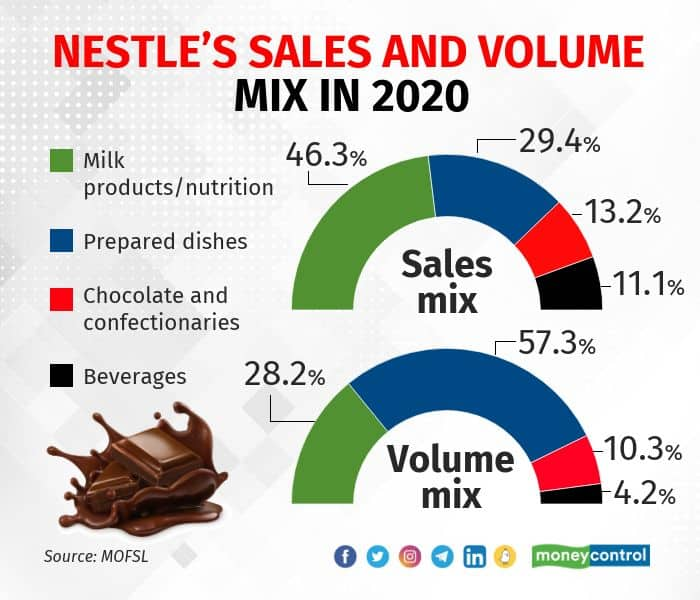
Besides this, Nestle India has a higher share of milk and value-added milk products in its sales mix, which bodes well for the company say analysts given that milk has a high nutritional quotient. Last year, the company drew over 46 percent of its sales from milk and nutrition products, higher than prepared dishes which includes Maggi noodles (shown in the chart below). Volume growth, however, is driven by prepared dishes.
Its initiatives in the country towards introducing atta, spinach variants of Maggi noodles, fruit and nuts to chocolates and reducing sugar and salt content are being seen as an effort to increase the health quotient in its products, by analysts.
Devangshu Dutta, chief executive at retail consultancy Third Eyesight is of opinion that India usually remains unimpacted by developments in these multinationals globally as there is lower sensitivity and awareness in the country. “Take, for example, veganism which is a huge trend in the West but has not caught on as much in India yet.”
He believes the country would eventually be impacted by these developments but not immediately.
What is the real significance of this controversy?
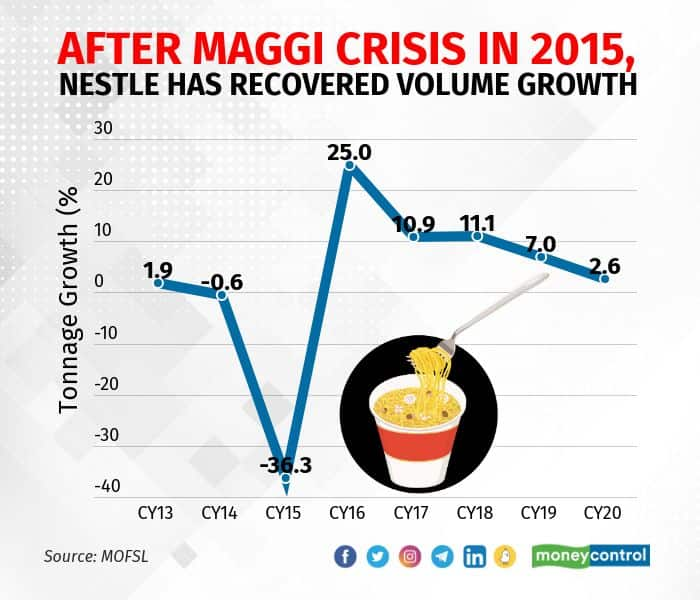
Nestle has come under fire in the past because of concerns about its food products. Back in 2015, Nestle had landed in trouble after Maggi, its most popular product in the country, was found to have monosodium glutamate or MSG by the Food Safety and Standards Authority of India (FSSAI). In a major setback for the company, the food safety regulator had consequently banned the sale of the product in the country. Maggi then commanded over 80 percent of the market share in India. Nestle’s volumes had plunged sharply in 2015 due to the Maggi crisis. (as shown in the chart below).
Subsequently, after five months of legal battle, Nestle relaunched Maggi in the country, however, it resulted in the loss of some of its market share. Today, the company holds almost 60 percent market share in the instant noodles category, as per estimates.
In the light of these events, the recent controversy around its product portfolio becomes significant as Nestle cannot afford a repeat.
Source: moneycontrol
