
Devangshu Dutta
August 17, 2019

Retail is such a pervasive and dynamic a sector of the economy, that it is impossible to identify a single point at which modernisation began. I’ve met countless people who perhaps entered the retail sector during the last 15 years, and who mark the beginnings of modern retail around then. There is no doubt that there has been an explosion of investment in retail chains in the last 2 decades, but we need to acknowledge the foundation on which this development is built. The current titans of the sector are standing on the shoulders of previous giants who have created successes and failures from which we are still learning.
This piece is not an exhaustive history of the evolution of the retail business in India, nor a census of all the brands operating in this sector, but the aim is to capture the flavours of the phases of development. (PDF available here to download.)
Early Years
If we were to trace back the growth of “organised” retail (mind you, I dislike that word!) or modern retail to the first retail chains, we will have to cast our mind back more than a hundred years. While many businesses of that time have disappeared, a few pioneers continue to survive, straddling three eras: the British Raj, the Socialist Raj and the Liberalised Lion economy. The businesses that continue to stand, having been through multiple transformations, include:
Fifty Years of Independence
The 1950s and 1960s remained fertile times, post-Independence and before the heavy-handed Socialist Raj truly began squeezing the life out of Indian businesses. Leading textile companies such as DCM, Bombay Dyeing and Raymond, and footwear companies such as Bata and Carona established chains of retail stores including company-operated stores as well as authorised dealers operating under the companies’ banners.
The 1980s brought the Asian Games, colour television, and a new up-to-date car model to India, all marks of a new vibrancy. Over the 1980s, a new retail wave was led by indigenous ventures such as Intershoppe (launched by a fashion exporter), Little Kingdom and The Baby Shop (children’s products), Nirula’s (fast food) and Computer Point (home computers, PCs and accessories). Many of these were certainly ahead of their time: the critical mass of consumers had yet to develop, the business infrastructure was inadequate, and funding norms were unsuitable to the capital-hungry business of retail. Unlike the textile companies that had large manufacturing and trading businesses, these new retailers were like shooting stars, glorious but visible for only a short period of time. This period, unfortunately, also witnessed the degeneration and disappearance of some of the older stalwarts such as DCM and Carona that were beset by labour disputes, management issues and disconnection from the transforming market.
Numero Uno, an indigenous denim brand, was launched in 1987 soon after VF’s American denim brands were launched, and it took nearly a decade for Numero Uno to reach other geographies in India. Nirula’s, one of the oldest fast food restaurant chains based in North India, expanded across the Delhi NCR in the 1980s and 1990s, and also explored other cities, albeit with mixed success.
Future Group, which today has a large retail and consumer brand portfolio, launched trousers under the name Pantaloons in 1987, initially as a distributed brand, and then denimwear under the brand name Bare. Within a few years the company also launched exclusive stores by the same names, to provide focussed visibility to the brands. About a decade of growth later, the group launched its first large format store under the Pantaloons name, but by now covering a much wider range of products, which became its launch pad for achieving scale.
The RPG group that had acquired Spencer & Co. relaunched it in 1991 in a spanking, new format as Spencer’s in Bangalore, and a short few years later rebadged it again as Foodworld in a joint-venture with a foreign partner. It subsequently went on to launch other formats such as Musicworld and Health & Glow.
Also in 1991, the Rahejas converted an old cinema into a department store, Shoppers Stop, aiming to provide an international shopping experience, although initially focussed on menswear. The store added women’s and children’s sections in subsequent years and the second store was launched four years later after the first one. Subsequent large scale retail expansion only came about towards the end of 1990s.
Little Kingdom is a notable example that I would like to dwell on briefly (partly for the purely personal reason that it was my first retail job!). The business was launched in 1987, headed by alumni of the illustrious IIMs around the country, built on processes and IT systems that could have been the envy of many retailers even 25 years later. The company – Mothercare India Limited – was the first purely retail company to start up and launch a public issue in 1991. During the early 1990s, it was the largest retail chain present across the country, in its categories. In 1991, it also attempted to bring the first home computer, Spectrum, to forward-thinking parents through a mix of in-store sales and door-to-door direct-selling. It was admittedly one of the first to expand internationally, opening a franchise store in Dubai in 1992. During its short life, the team launched multiple brands and formats, including Little Kingdom, Ms (a womenswear brand), The Baby Shop, and became a partner to the international giant VF Corporation’s Healthtex children’s brand and Vanity Fair lingerie brand in India. But, by the mid-1990s – financially overstretched between multiple brands and formats, and backward integration into manufacturing – it was gone.
Physical retail was not the only avenue being explored for growth during these decades. An Indian company imagined replicating the success of western catalogue companies, and launched the Burlington’s mail order catalogue retail venture and even became a joint-venture partner of one of the world’s largest catalogue retailers, Otto Versand (Germany). Other models included direct sales business, such as the Eureka Forbes introducing vacuum cleaners through demonstration parties (which was emulated for the Spectrum home computers mentioned above). With the growth of private television channels, products also began being promoted during non-peak hours through infomercials, though serious TV shopping was still a few years away, coming up in the mid-2000s with dedicated teleshopping channels.
The Foreign Hand and Corporate Retailing
The 1980s and 1990s also saw the launch of international brands from global giants such as VF Corporation (Lee, Wrangler, Vanity Fair, Healthtex), Coats Viyella (Louis Phillippe, Van Heusen, Allen Solly), Benetton (UCB and 012), Levi Strauss, Lacoste, Reebok, adidas, Pepe and Nike, grocery retailers such as Nanz (a three-way German-US-Indian partnership) and Dairy Farm International (with RPG Group’s Spencer’s Retail) and Quick Service formats such as Domino’s, McDonald’s, Pizza Hut, Baskin Robbins and KFC.
India was reopening to business, global management consultants were writing glowing reports about the untapped potential of the (mythical) 200 million middle-class customers and global retailers wanted to own part of the action.
Due to the lack of large-format stores and suitable environments, international brands that entered the Indian market during this phase needed to create exclusive stores to ensure that the brand could be communicated holistically to the consumer, in an environment that was more in the brand’s control, and many of them were, in a sense, “forced” to become retailers in India.
However, around 1996, a very senior member of the cabinet is reported to have said, “Do we need foreigners to teach us how to run shops?” It was an unexpected condemnation, coming as it was from a person and a party otherwise seen as champions of an open economy. It slammed the doors shut to foreign investment and, to my mind, the sector is still yet to fully recover from that ban and the policy contortions that have come over the years to allow international brands and retailers to play a more active role in the market.
Internal weaknesses compounded the decline or exit of some of the businesses. Nanz folded due to various operational challenges and lack of adequate experience. British retailer Littlewoods’ wholly-owned subsidiary pulled out of the market due to problems back home, and in 1998 sold the sole store to the Tata Group, which eventually renamed it Westside.
Despite the early hiccups, India continued to attract international players on account of the high growth and changing social norms. Not only was there greater purchasing power available amongst more Indian consumers, there was a shift in consumer attitude from saving to spending. Several brands, including fashion, luxury and quick service formats, entered the market through licensing, franchising, and joint ventures.
During this period the domestic retail market also drew in more corporate houses, attracted by the apparently abundant market opportunity for them to mine alone or to act as a gateway for foreign companies interested in India. Most were significant diversifications from their existing businesses.
Tobacco, paperboards, agri-commodities and hospitality conglomerate ITC ventured into retailing through Wills Lifestyle and as well as its rural initiative e-Choupal in 2000, followed by John Players and Choupal Sagar respectively. Pantaloon Retail launched a partial hypermarket format Big Bazaar in 2001 and went on to Food Bazaar in 2002, Central in 2004, Home Town and Ezone in 2006. Reliance entered in 2006 with multiple stores of Reliance Fresh being opened simultaneously and over the next few years the company expanded through multiple formats such as Reliance Mart, Reliance Digital, Reliance Trendz, Reliance Footprint, Reliance Wellness, Reliance Jewels to name a few. Telecom major Bharti set up a joint-venture with Wal-Mart at the back end, while the Tata group tied the knot with Woolworths and Tesco in two separate businesses supplying its retail stores, even as it expanded its successful watches and jewellery businesses, as well as Westside.
Even a retail operation like Fabindia, born as an export surplus outlet of a handicraft product business found investors to back a rapid expansion spree, becoming more of a corporate retailer than a front-end for producer organisations and craftspeople.
Through the 1990s and beyond, the market remained in ferment. In 1997 Subhiksha, a small modern retail format for food and grocery was launched. Venture-funded Subhiksha expanded rapidly and over the next decade grew to 1,600 outlets. However, in 2009 the business closed down owing to a severe cash crunch, amidst accusations of criminal mismanagement and fraud.
New product areas emerged highlighting the pace of change of lifestyles, cafes prominent among them. Café Coffee Day opened its first store in 1998 in Bangalore and became the largest organised coffee chain in India by far, though it is now living under the shadow of the recent death of its founder. Barista was also launched in 1999 as India’s Starbucks-wannabe, found its footing, scaled up and lost its way, going on to be sold to Tata Coffee and the Sterling Group, who turned it over to the Italian coffee company Lavazza in 2007, who also exited seven years later. Its current owner, the Amtex Group, is itself going through financial troubles in some of its key businesses.
In the last two decades, while some retailers have gone out of business due to unrealistic business plans, mismanagement or lack of funds, most have taken opportunities to rationalise their operations by shutting down unviable or underperforming locations, aligning businesses to market needs, assessing their brand consistency across various touch points, improving organizational capabilities right down to front-line staff, and focusing on unit productivity.
It’s not just Indian retailers that have faced trouble. Foreign brands have had their own share of problems – some have overestimated the market, or their own relevance to the Indian consumer, while others have had misalignment with their Indian franchisees or joint-venture partners. A number of foreign brands and retailers have also churned partners, or exited the market outright, but most remain committed and invested in the market for the long-haul. The last few years have also seen the successful launch and humongous growth of global leaders such as Zara and H&M, even mass-market Chinese retailers like Miniso, as well as the largest investment commitment made by Ikea (about US$2 billion).
Showing on a Screen Near You
The late-1990s also witnessed a dotcom frenzy that led to a plethora of travel sites, and a few product sales businesses such as Fabmall, Rediff and Indiamart.
However, the online market lacked critical mass in the 1990s and early-2000s. Despite apparent advantages of the online business model, success depended on internet penetration (low!), the appearance of value-propositions that were meaningful to Indian consumers (questionable), investments in fulfilment infrastructure (lacking) and the development of payment infrastructure (regulation-bound). Malls and shopping centres – the new temples of retail – seemed to be sucking up all of the consumer traffic, in any case.
By the mid-2000s the business had reached just about Rs 8-9 billion (US$ 180-200 million), despite 25 million Indians being online. Dotcoms became labelled dot-cons, with an estimated 1,000 companies closing down. However, multiple changes took place in the mid-2000s, among them being the price disruption of the telecom market and explosion of mobile connectivity, as well as a renewed funding appetite among venture funds.
This laid the path for growing the second crop of ecommerce in India. Billions of dollars of investment was poured into creating India’s Amazon wannabes, the high streets ran red by ecommerce-fuelled discounts, aggressive advertising budgets (most promoting discounts) and mergers/acquisitions pushed through by venture investors.
After more than a decade of the second coming, India’s ecommerce business accounts for a market share of total retail in the low single digits. India’s Amazon – if one can call it that – is the Flipkart group, now owned by Walmart, bought at an eyepopping $21 billion valuation and still bleeding cash, and the runner-up is relentless Amazon that continues its aggressive push to own what could be one of the three largest markets in years to come. The Chinese internet giants Tencent and Alibaba are also trying to hack piece off the market, having fulfilled their aim of kicking out Western competitors from their home market.
However, the wild card has just been played by the Reliance Group – having moved from textiles to fibre to oil, the group has made its move into telecom and data (didn’t someone say, “data is the new oil”?). It has strategically pushed handsets and cheap data plans into the hands of the consumers and, according to the latest announcement on Jio Fiber, will soon offer High Definition or 4K LED television and a 4K set-top-box for free. The play is to grab as much of the customer’s share of spend on products and services (including entertainment) as possible.
Looking Ahead
Possibly the biggest driver of modern retail in the coming years will be the shift in the demographic structure of the country. The young consumers who are joining the workforce now are a distinctly different set from previous generations. This is a generation that has grown up in the liberalised economy and has been exposed to innumerable choices since their childhood. The most important factor is that these consumers are increasingly located outside the top 10 or 20 cities in the country, and are becoming more accessible as both physical and virtual access improves for them.
A large number of them may have only occasionally, or perhaps never, experienced modern retail first hand while they were growing up, but they have seen this upmarket environment emerge before them and are not shy of spending within it, even if it is only on select special occasions. Most of them are handling mobile phones (even if it is their parents’) while still in school and being socially active online even on the go. Certainly most of them have hardly ever visited tailors, growing from one set of ready-to-wear clothes to another. It is this set of young consumers whose outlook and habits will drive retailing very differently in terms of product categories and services in the future.
There is another significant set of consumers whose number is swelling annually: that of working women. As they add to the discretionary household income available to spend, they gain influence in purchase decisions, and with them the entire household’s lifestyle also undergoes a shift. There is a greater demand of time-saving solutions and convenience products to make their lives easier. Modern retail environments where their various needs can be taken care of under one roof, and convenience pre-packaged products are natural winners in this shift. Ready-to-wear products for women, grooming, beauty and personal care, women-oriented media products, processed foods and eating out get a boost. Another important shift is that, due to busier lifestyles, they are time-crunched and more likely to rely on branded products and services that they can trust. However, given the nascent stage of the market, these brands could just as well be retailers’ own labels, if they are managed well.
In terms of business, significantly greater efficiency needs to be achieved, both at the front-end and in head office and supply chain operations. Process and system-led planning and execution needs to become the norm. With India’s burgeoning population, people are treated as a cheap resource: on the contrary, each extra person can be expensive beyond just their salary cost to the organisation. Each extra person adds some friction to decision making, reducing the responsiveness of the business. Smart business will begin to realise this, and look closely at employee efficiency and effectiveness in the context of the overall business, rather than just in terms of individual costs.
Even as the retail business in India is far from saturation, and fragmented growth continues, the business will also undergo consolidation simultaneously, as large scale retail operations are enormously capital intensive. Mergers will be a strategy that will be explored to improve the viability of many businesses in this sector.
Should you be tempted to think that, squeezed between large corporates, international retailers and ecommerce giants, it’s “Game Over” for smaller domestic retailers and brands, let me say that the India retail story is not only not over yet, but continues to be written and rewritten. As the market grows and matures, retail businesses also need to differentiate themselves, investing more in product selection or even product development through private label growth to help them stand out in the market. A one-size-fits-all strategy doesn’t work in a country as diverse as India. For the size of the market, we have surprisingly few brands, many of them virtually indistinguishable from their competitors. Development on this front, of indigenous brands and product development capabilities, is an absolute must.
The good news is that already there is more talent available than ever before. Most importantly this management pool has experience of the retail sector not just in good times but during (many) downturns as well.
Eventually, what is needed is a mix that will be healthy for India’s ecosystem at large for a long time to come. This will not be delivered by a blind transplantation of international templates or a rapid-fire expansion across the country, nor by fearful protectionism or regional parochialism. It will only be achieved by the evolution of market-appropriate business models and a mature approach that can be make the Indian retailers robust enough to grow not just domestically, but possibly even globally over time.
admin
September 27, 2014
 Alys
Francis, Nikkei Asian Review
Alys
Francis, Nikkei Asian Review
New
Delhi, 27 September 2014
 A few months ago, a group of wealthy industrialists and other
businessmen gathered in a plush Mumbai hotel suite to pore over
a selection of John Lobb handmade welted shoes that cost up to
$12,000 a pair.
A few months ago, a group of wealthy industrialists and other
businessmen gathered in a plush Mumbai hotel suite to pore over
a selection of John Lobb handmade welted shoes that cost up to
$12,000 a pair.
It may just be a temporary “pop-up” store, but Thomas Collette, John Lobb’s commercial director for India, was excited. He said that a local agent for the bespoke shoemaker would start taking orders by appointment only. “This is a big step for us and a big step as well for the country,” he said.
Although international luxury brands have opened flagship stores all over developing Asia, they have hardly touched the Indian market. This may be about to change.
After all, many people in the population of 1.3 billion are steadily getting wealthier. According to the Associated Chambers of Commerce and Industry of India, luxury spending will reach $14 billion a year by 2016 compared with $8.5 billion in 2013.
But foreign luxury brands have had a tough time in the country, partly due to restrictions on investment.
Many major brands, such as Prada and Versace, only entered after 2006 when the government began to allow foreign investors in single-brand retail operations. Prior to that, foreign companies were only allowed to operate wholesale “cash-and-carry” outlets.
While companies welcomed the chance to open in India — albeit
with the requirement that a local partner owned at least 49% of
the business — they struggled with the lack of suitable retail
space and trained staff, bad supply chains, and a raft of customs
taxes and duties, as well as a long wait to turn a profit because
there was only a nascent market for their goods.
Since 2006, Prada and Gucci have been among the 50-odd brands that have either left India, restructured or quit soured partnerships, according to a 2012 report by retail consultant Third Eyesight.
In 2012, India started allowing full foreign ownership of single-brand retailers but included restrictions such as the need to source at least 30% of products from local small and midsize enterprises. That is virtually impossible for most luxury labels since their brand integrity often rests on the craftsmanship of products made in their home country. Unsurprisingly, the new rules did not trigger an influx of foreign brands.
Jones Lang LaSalle, the real estate company, in August ranked New Delhi and Mumbai near the bottom of its list of 30 major Asia-Pacific cities in terms of the presence of top luxury brands.
Indians optimistic
Some foreign brands, like John Lobb, have decided that franchise and distribution deals are a better way to establish their presence in a difficult market.
John Lobb’s local partner is Regalia Luxury, which spent a year wooing the Hermes-owned brand before securing a deal to sell John Lobb’s “By Request” line of shoes that are custom-made for each client.
Regalia Luxury is one of a number of Indian companies eyeing the rising number of style-conscious local shoppers who are hungry for Western luxury brands but are wary of entering the market on their own.
“From a longer-term perspective, there’s immense opportunity if you do it the right way,” said Regalia Luxury founder Pratik Dalmia, who clinched a franchise for bespoke Italian suitmaker Kiton in 2013 and expects to sign up two more brands by year-end.
But he admits that the market boom has yet to start and that operators will have to “run a tight ship” for the next couple of years.
Indian companies that represent foreign luxury brands need to have a long-term view and keep a close eye on what the younger generation likes — these are the customers with the most potential, since they are more exposed to overseas fashion trends.
“India is all about the customer of tomorrow,” said Darshan Mehta, CEO of Reliance Brands, a subsidiary of Reliance Industries that was set up in 2007 to bring foreign luxury fashion to India.
Mehta often sits in a cafe at DLF Emporio, New Delhi’s first luxury mall which opened in 2008, and watches shoppers. He said many people shop at Zara but they walk into Gucci and Zegna just to have a look. “That is what makes markets like India so promising: the aspirational consumer,” he said.
Unlike China, where a lot of luxury retailers are now at a consolidation stage after years of rapid expansion, brands are still struggling to find space in India for their first shops.
Even in Mumbai, the Emporio is the “only true luxury mall,” according to Mehta.
It may take some time before India’s luxury market takes off, but the market has been boosted by a stream of well-off Indian professionals and students returning after working and studying abroad, including many bankers who left Wall Street and London after the global financial crisis.
Luxury players are also expecting a boost from the introduction of a Goods and Services Tax, which was promised by India’s new government and would get rid of complex multi-level taxes that are hampering the sector.
Reliance Brands, which also represents Reiss and BCBG Max Azria, expects to add three more brands to the company’s stable of 16 foreign brands by year-end.
A few pioneers are even setting up boutiques in smaller cities. Bangalore firm Fervour, which has licenses to sell Nina Ricci and Christian Lacroix, is planning to expand to Chennai and Hyderabad.
But most don’t see these cities as viable markets just yet.
“There is no sustained luxury market outside of Bombay and Delhi,” Mehta said. He expects luxury demand outside the two main cities to take another three years to reach critical mass.
Sanjay Kapoor, the founder of distributor Genesis Luxury, said India’s luxury market is not yet at the point where China was 10 years ago, even if the potential for growth is immense.
Kapoor founded Genesis Luxury in 2008 to sell foreign luxury brands in India and has deals with Jimmy Choo and Armani, among others.
“As awareness and retail space spread, demand will accelerate in smaller cities in the interior of India,” Kapoor predicted.
Tight ships
Amid the shortage of high-quality retail space, one option is to use the “shop in shop” model.
R&B International rents small spaces in other retailers’ stores to sell Australian luxury label Easton Pearson. The manufacturing firm supplied embroidery to the brand for years before nabbing a distribution agreement in India in June.
Dalmia also said he is in no hurry to open flagship stores for John Lobb and Kiton before 2016.
Instead he is targeting ultra-rich customers who want the pampering that comes with exclusive, by-appointment-only services. Clients are shown samples of Kiton’s made-to-measure suits and John Lobb shoes, and then measured by a trained team at a place and time that suits them, often at home in the late evening.
Collette said he’s been pleasantly surprised by how well the brand has been received in India. While the brand has wholly-owned stores in Japan and the U.S., Collette said it would have been impossible for it to enter India alone.
(Published in Nikkei Asian Review.)
Devangshu Dutta
February 24, 2013

Luxury is an ill-defined concept. There is no specific line or limit of price, quality or availability that separates the luxurious from all that is not.
However, like other similarly intangible attributes such as power or grace, we all immediately recognise luxury when we experience it.
In fact, experience — vague as that may sound — is key to differentiating luxury, more than the tangible product being consumed. It’s not just the person’s own direct sensory experience, but also the prestige and status granted by others around her or him that creates the luxury experience.
Surely, with such intangible notions of experience, power and prestige, luxury brands should be among the most influential in the market. They should be pioneers that set the tone for change in improving retail management practices, upping customer service standards, driving quantum leaps in quality.
But is it so? The response from the rest of the retail sector may not quite be “meh”, but I suspect that it would not be far off.
There are strong reasons why luxury brands would have a lower influence as benchmarks in India and why, in fact, they may draw in more influence from the market themselves.
Market presence and location
As an example, in physical presence, luxury brands seem to demonstrate a delayed response to changes in the market, both in terms of market entry and location selection.
Prior to the entry of global brands, luxury products and services in India were naturally defined by niche, largely owner-managed businesses. Business scale was curtailed by internal limitations, and due to the small size, its market reach was also limited. While there were some designer brands that would occasionally get copied by mid-priced retailers, by and large luxury brands lived in their own separate bubble, with little or no influence on the heaving mass of the market.
In contrast, in the Western economies, from where many of today’s luxury brands originate, they are looked up to for inspiration. So, it is natural to expect Western luxury brands to lead the charge into the newly emerging modern retail economy of India. However, according to Third Eyesight’s research of international fashion and accessory brands in India, in the last 25 years it is mid-priced and premium brands that have opened the market. It is only in the last 10 years, well after the economic and retail growth was underway, that luxury brands stepped up their presence.

Sure, during the so-called “retail boom” from 2004, luxury brands went up to one-quarter of all international fashion and accessory brands present in the market. Then, when practically the whole world was in a recessionary mood, and mid-priced and premium brands took a call to defer their India launch plans, luxury brands pushed ahead. In 2009, luxury fashion brand launches accounted for two-third of all foreign fashion brands launched in India. Maybe the brand principals felt that this market could take on the burden of slowing growth elsewhere, or perhaps it was their Indian counterparts who were the source of optimism. Either way, the optimism took a hit in 2010 and 2011 when it was luxury brands that became cautious.
In terms of store openings and location selection too, luxury brands seem to have waited for the overall market to upgrade itself, and have then latched on to that growth. Previously luxury brand stores, such as there were, largely restricted their presence to five-star hotel shopping arcades, while a few took up non-descript sites as they were confident of being destinations in their own right or clustered together to create a precious few bohemian locations in surroundings that were far from luxurious. As modern shopping centres emerged in recent years, these presented an environment where rich consumers — especially the ‘new’ rich — could flock to buy globally benchmarked lifestyle statements. While these were mainly targeted at mid-market to premium brands, some of them are now even attracting designer brands such as Canali at Mumbai’s Palladium mall rubbing shoulders with Zara. These new luxury stores in mid-market or premium locations are performing better than the original “luxury” sites.
Thus, in terms of expressing confidence in the market, luxury brands seem to be following market trends rather than leading them. And far from being the anchors to create demand, they seem to be following where the demand goes.
Design and product development
The most important impact that luxury brands could have on the market is by influencing product design. This fashion trickle-down is supposed to work in two ways: one, through “inspiring” knock-offs by cheaper brands; two, making luxury customers act as opinion leaders and trend-setters for other consumers.
However, various factors dilute the luxury brands’ product and design influence in India: the preponderance of domestic (“ethnic”) style and colour, especially in womenswear, the existing domestic variety in products, the flood of premium (non-luxury) international brands and a customer base that is oblivious to the difference between the premium and luxury segments. In spite of their small size, Indian luxury and designer brands possibly have a larger direct impact, not to mention the massive Bollywood machine that drives mainstream fashion trends on a day-to-day basis. The international luxury giants are conspicuous by their small influence.
In fact, increasingly the influence is flowing the other way. A few luxury brands have attempted to create India-specific items to give the customer what they might want. Some of these may be indulging in superficial pandering such as putting an Indian image on a global product, but others have created Indian products that genuinely reflect what the brand stands for. While some use India as a production sweatshop to minimise the cost of high-skills jobs, others are now beginning to use Indian crafts to design products that are relevant to other global markets. A few examples, without passing judgement on which category they fit into, include: Lladro’s Spirit of India collection, the Hermès sari, the Jimmy Choo “Chandra” clutch bag, Louis Vuitton’s Diwali collection and Canali’s nawab jacket.
Slow, but not yet steady
Another issue with India is the sheer numbers, or the lack thereof!
China’s GDP is about four times the size of India’s but its luxury market size is estimated to be six times that of India. There are 1.7 million households in China that meet the high net-worth criteria, as compared to 125,000 in India. What’s more, according to industry estimates, only about 30 per cent of luxury consumers in China are actually wealthy, while the overwhelming majority are people with mid-market incomes who are given to conspicuous consumption, whether buying luxury goods for themselves or as gifts.
Indian consumers also have a penchant for buying overseas rather than shopping from the same brands’ stores in India. This is not just due to higher costs and import duties in India, but because of wider and more current selections of merchandise in stores overseas. Indians’ luxury shopping destinations include the usual suspects: London, New York, Paris, Milan, Singapore and Dubai. This has meant that while luxury brands recognise Indians as a large, emerging base of customers, for most brands India itself remains an operating market for the future.
Having said that, when compared to any other sector of business, luxury brands in India probably get the most media coverage for every rupee of sales earned. Although they are a small fraction of the sales, luxury brands rule in terms of column centimetres or telecast seconds. The coverage is not restricted to consumer-oriented media such as lifestyle magazines or mainstream newspapers, individual luxury brands are also extensively covered in business media.
One may argue that such is the nature of luxury: this disproportionate visibility and share of mind happen because luxury is not just aspirational, but inspirational. However, that inspiration and influence is yet to become apparent in the business at large. Until we see significantly larger numbers of upper-middle-income customers in India, luxury brands will find it difficult to expand their reach beyond the small base of ultra-rich consumers. The aspiration and price gap is just too wide for the Indian middle class, and there are very few who will emulate their Chinese counterparts and save up a year’s salary for a single luxury item.
And so…
One thing is beyond doubt: the luxury sector in India is undergoing significant change. We could even say it is in active ferment. There has never been so much interest among so many people, or so many brands so widely promoted, as now.
The question is still open on whether it is a good ferment such as the one that produces wine from raw grape juice and fine cheese from plain curds, or the unguided rot that results in a putrid, smelly mess unfit for consumption.
My bet is on the first possibility. In the short term, the luxury business appears to be a mess, littered with fractured partnerships and bleeding financial statements. But the brew needs time to mature. Gradually, as the luxury segment matures along with the rest of the market, we will see the influence trickling down into other segments. But remember, the finest brews do not only impart their flavour to the cask, but imbibe the cask’s characteristics into themselves. So it is with luxury and the Indian market. The message that we have given many other international businesses seems to hold doubly true for the global purveyors of influence, the luxury brands: “As much as you think you would change India, India will change you.”
admin
January 21, 2013
By Tarang Gautam Saxena & Devangshu Dutta
Since the onset of reopening of India’s economy in the late 1980s, fashion is one consumer sector that has drawn the largest number of global brands and retailers. Notwithstanding the country’s own rich heritage in textiles the market has looked up to the West for inspiration. This may be partly attributable to colonial linkages from earlier times, as well as to the pre-liberalisation years when it was fashionable to have friends and relatives overseas bring back desirable international brands when there were no equivalent Indian counterparts. Even today international fashion brands, particularly those from the USA, Europe or another Western economy, are perceived to be superior in terms of design, product quality and variety.
International brands that have been drawn to India by its large “willing and able to spend” consumer base and the rapidly growing economy have benefitted in attaining quick acceptance in the Indian market and given their high desirability meter, most international brands have positioned themselves at the premium-end of the market, even if that is not the case in the home markets. In addition, Indian companies – manufacturers or retailers – have been more than ready to act as platforms for launching these brands in the market and today there are over 200 international fashion brands in the Indian market for clothing, footwear and accessories alone, and their numbers are still growing.
Global Fashion Brands – Destination India
Europe’s luxury brands have had a long history with India’s princely past, but modern India tickled the interest of international fashion brands in the 1980s when it set on the path of liberalisation. The pioneering companies during this stage were Coats Viyella, Benetton and VF Corporation. At the time the Indian apparel market was still fragmented, with multiple local and regional labels and very few national brands. Ready-to-wear apparel was prevalent primarily for the menswear segment and was the logical target for many international fashion brands (such as Louis Philippe, Arrow, Allen Solly, Lacoste, Adidas and Nike). (Addendum: The rights to Louis Philippe, Van Heusen and Allen Solly in India and a few other markets were sold after several years to the Indian conglomerate, Aditya Birla Group, as part of the Madura Garments business.)
The rapidly growing media sector also helped the international brands in gaining visibility and establishing brand equity in the Indian market more quickly. However, this period did not see a huge rush of international brands into India. West Asia and East Asia (countries such as Japan, South Korea, Taiwan and even Thailand) were seen as more attractive due to higher incomes and better infrastructure. In the mid-1990s there was a brief upward bump in international fashion brands entering the Indian market, but by and large it was a slow and steady upward trend.
The late-1990s marked a significant milestone in the growth of modern retail in India. Higher disposable incomes and the availability of credit significantly enhanced the consumers’ buying power. Growth in good-quality retail real estate and large format department stores also allowed companies to create a more complete brand experience through exclusive brand stores in shopping centres and shop-in-shops in department stores.
By the mid-2000s, however, a very distinct shift became visible. By this time India had demonstrated itself to be an economy that showed a very large, long-term potential and, at least for some brands, the short to mid-term prospects had also begun to look good.
While India was a promising market to many international brands, it was not completely immune to the global economic flu. More than its primary impact on the economy, it sobered the mood in the consumer market. Even the core target group for international brands tightened the purse strings and either down-traded or postponed their purchases.
In 2008, in the midst of economic downturn, scepticism and uncertainty, international fashion brands continued to enter India at nearly the same momentum as the previous year. Many international brands such as Cartier, Giorgio Armani, Kenzo and Prada entered India in 2008, targeting the luxury or premium segment. However, given the high import duties and high real estate costs, the products ended up being priced significantly higher than in other markets. Many brands ended up discounting the goods heavily to promote sales, while a few gave up and closed shop.
The year 2009 saw the true impact of the slowdown as fewer international brands were launched during the year. The brands that launched in 2009 included Beverly Hills Polo Club, Fruit of the Loom, Izod, Polo U.S., Mustang, Tie Rack, Donna Karan/DKNY and Timberland amongst others. Some of these had already been in the pipeline for quite some time and had invested considerable time and effort in understanding the dynamics of the Indian retail market, scouting for appropriate partners, building distribution relationships and tying up for retail space, setting up the supply chain and, most importantly, getting their operational team in place.
2010 was better in comparison: although initially slow, the growth of new international brands entering the Indian market in 2010 bounced back later during the year, and some brands that had exited the Indian market earlier also made a comeback. Amongst the new launches, a highlight of the year was the launch of the most awaited and discussed-about Spanish brand Zara. The first store was launched in Delhi to an absolutely phenomenal response, followed by a store in Mumbai, and a third again in Delhi. The Italian value fashion brand, OVS Industry, was launched in 2010 by Oviesse through a joint-venture with Brandhouse Retail from the SKNL group. While in its first year products were imported from Italy, the company had mentioned that it intended to bring in the merchandise directly from the supply source for speed and cost effectiveness, to achieve aggressive growth over the following five years.
2010 indicated a fresh round of optimism as the pace of new brands entering the market picked up, and those already present in the market showing signs that they were adapting their strategies to grow their India business, including lowering prices and entering new segments.
Though the number of new brands entering the Indian shores in 2011 and 2012 may not have matched the numbers in the peak years, both years have been healthy and the list of new brands ready to enter in 2013 already seems promising.
Amongst others, 2011 saw the entry of Australian brands such as Roxy and Quiksilver having tied up with Reliance Brands for distribution. The largest British football club and lifestyle brand Manchester United, signed up with Indus-League Clothing Ltd. to bring the fashion products to India, after having launched café bars in India in 2010 through a franchisee.
2012 brought in luxury brands such as Christian Louboutin, Roberto Cavalli and Thomas Pink, womenswear brands such as Elle, Monsoon and fashion accessories brands such as Claire’s.
Routes to Market – The Evolution
The choice for entry strategy for the fashion brands has evolved over the years. During the initial years licensing was the preferable route for international brands that were testing the market. This shifted to franchising as import duties dropped and brands looked at exerting more control on the product and the supply chain. More recently, brands seem to be opting for some degree of ownership, as they begin to take a long-term view of the market.
In the 1980s and the early 1990s, licensing was a popular entry strategy amongst the global fashion brands, with minimal involvement in the Indian business.

In the mid-1990s a few companies such as Levi Strauss set up wholly owned subsidiaries while others such as Adidas and Reebok entered into majority-owned joint ventures. This helped them to gain a greater control over their Indian operations, sourcing and supply chain, and brand. In the subsequent years import duties for fashion products successively came down making imports a less expensive sourcing option and the realty boom brought in many investors in retail real estate who became franchisees for the international brands. By 2003, franchising became the preferred launch vehicle for an increasing number of international companies, while only a few chose to enter through licensing.
In 2006 the Government of India reopened retail to foreign investment (allowing up to 51 per cent foreign direct investment in single-brand retail). Using this route, many brands have entered India by setting up majority-owned joint ventures, or moving their existing franchise relationships into a joint venture structure. By the end of 2008, more than 40 per cent of the international brands were present through a franchise or distribution relationship, while more than 25 per cent had either a wholly-owned or majority-owned subsidiary. All these structures allowed the brands to have greater control of operations, particularly of the product.
Amongst the international brands that entered the Indian market, a few were on their second or even third attempt at the market. For instance, Diesel BV initially signed a joint venture agreement in 2007 with Arvind Mills. However, by the middle of 2008, the relationship ended with mutual consent, as Arvind reduced its emphasis at the time on retailing international brands within the country. Within a few months of ending this relationship, Diesel signed a joint venture with Reliance Brands as the iconic denim brand wanted to take on the Indian market full throttle and the Indian counterpart had indicated that it wanted to rapidly build its portfolio of Indian and foreign brands in the premium to luxury segments across apparel, footwear and lifestyle segments.
Similarly, Miss Sixty entered India in 2007 through a franchisee agreement with Indus Clothing. It switched to a joint venture with Reliance Brands in the same year but the partnership was called off in 2008. Miss Sixty finally entered India through a franchisee agreement with a manufacturer of women’s footwear and accessories.
During the turbulence of 2008 and 2009, a few brands also moved out of the market. Some of them were possibly due to misplaced expectations initially about the size of the market or about the pace of change in consumer buying habits. Others were due to a failure either on the part of the brand or its Indian partners (or both), to fully understand what needed to be done to be successful in the Indian market. Whatever the reason, the principals or their partners in the country decided that the business was under-performing against expectations for the amount of effort and money being invested, and that it was better to pull the plug. Amongst the brands that exited the market during 2008 and 2009 were Gas, Springfield and VNC (Vincci).
In the last few years as the foreign direct investment rules are being softened in particular with regard to the more flexibility in the 30% domestic sourcing and clarification on brand ownership norm there is an increasing preference for international companies to enter the India market with some form of ownership while those that are already in the market are looking to increase their stakes in the business.
Several brands have taken the plunge into investing in the Indian operations and moved more aggressively into the market. Since the year 2009, international brands increasingly opted for joint-ventures as the choice for entry into the market. Even the brands already present started looking to modify the nature of their presence in India in order to exert more control over the retail operations, products, supply chain and marketing. Brands that changed their operating structures and, in some cases partners, include VF (Wrangler, Lee etc.), Lee Cooper, Lee, Louis Vuitton, Gucci, Burberry amongst others. Mothercare, the baby product retailer, which was initially present through a franchise agreement with Shoppers Stop, formed a joint venture with DLF Brands Ltd to enable the expansion through stand-alone stores.
During 2011, Promod changed its franchise arrangement with Major Brands into a joint-venture that is majority-owned by Promod. From its launch in 2005, the brand has opened 9 stores so far. However with the new joint venture in place, the international brand is reported to be looking at opening 40 stores in the next four years with the hope of increasing the contribution of India business to its global revenue to the extent of 15-20% from a mere 3% at present.
After its partnership with Raymond fell through in 2007 and all of its standalone stores were shut down, Gas (Grotto SpA) scouted around for an appropriate partner for India business. Eventually, the brand set up a wholly owned subsidiary in 2010 for wholesale operation while retail stores were franchised. In 2012 the company formed an equal joint venture partnership with Reliance Brands with plans to ramp up India retail presence.
2012 was a defining year marking the government’s decision to allow 100% foreign direct investment in single brand retail business and permitting multi-brand retail in India. Not only has this encouraged new brands to consider the Indian market but many existing brands have started reviewing their existing operating structures and alliances, and have initiated moves towards greater ownership and a stronger foothold in the Indian market. Some of the brands have taken the decision to step into an ownership position in India as they felt that India was too strategic a market to be “delegated” entirely to a partner (whether licensee or franchisee), or that an Indian partner alone might not be able to do justice to the brand in terms of management effort and financial capital.
S. Oliver restructured its India operations in 2012 by exiting its prior relationship with the apparel exporter Orient Craft and tied up with a new partner through a majority joint venture. To gain a larger share in the Indian market the company has repositioning the brand, changed its sourcing strategy, reduced the entry-level prices by 40% while reducing the store size (from 5,000 sq. ft. to 1,200-2,400 sq. ft.). It has also put in place an aggressive expansion strategy for tier II towns. The change in FDI norms towards the end of last year may cause it to review its position further.
Canali has entered into a majority-owned joint-venture with its existing partner Genesis Luxury. The brand had entered in India in 2004 through a distribution agreement. Through this change the international brand plans to grow its presence in India multi-fold by opening 10-15 stores over the next three-four years.
Pavers England is the first international brand to have applied for and been granted the permission to own and operate its retail business in India through a 100 per cent subsidiary owned by a UK based company. Newcomers such as H&M and Loro Piana are reportedly considering the joint venture route.
As we have already mentioned in one of our earlier papers (“Tapping into the India Gold Rush”) we do not expect a dramatic short-term growth in the number of international brands following the retail FDI relaxation in September 2012. However, at that time we did foresee some changes in the operating structures for the single brand ventures already active in the market, as well as entry of new brands that have been holding back so far as they wanted greater control in their India retail business and this seems to be happening already.
In the luxury sector, 51 percent FDI and distribution relationships are likely to continue to be a norm, since it is virtually impossible for most luxury companies to meet the 30 percent domestic sourcing requirement in its true spirit. In many cases, the local partner in a joint venture is a mere placeholder until FDI rules are liberalised further and, unless the business grows significantly, most brands will be content to keep the existing structures in place.
In the other segments some more relationships could be reconstituted during 2013, taking the international brand at least a step closer to gaining greater control, even if their partners remain the same.
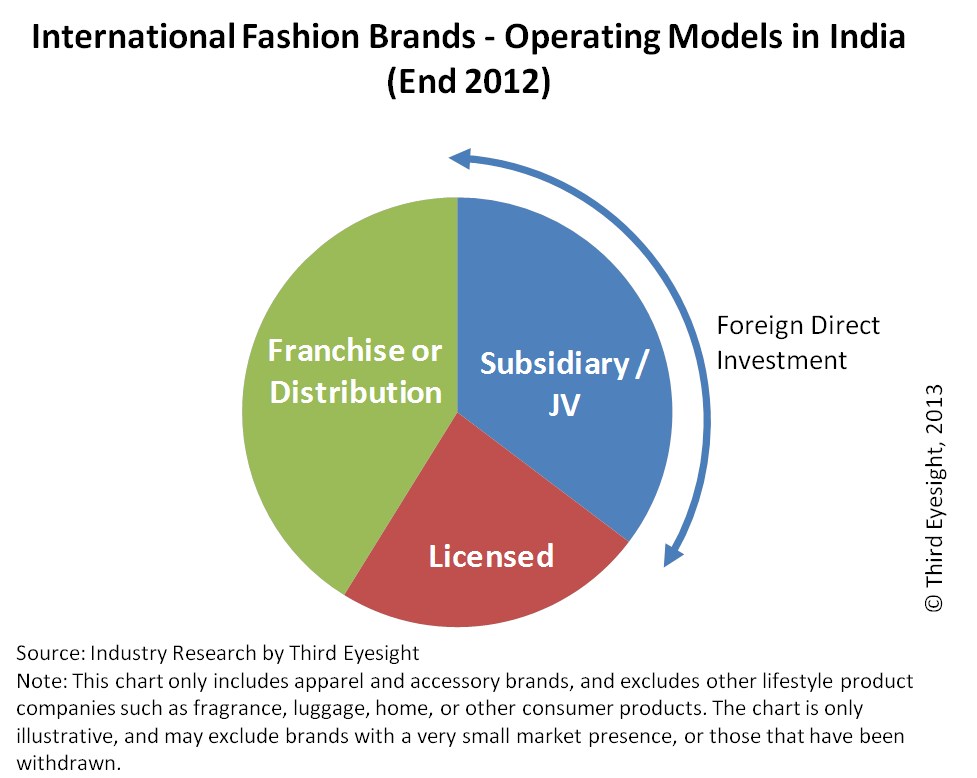
Franchising is still the more common form of route to market for most single brand retail companies although for many international companies an eventual ownership in India business may be desirable. However, licensing should not be excluded from the choice set, especially for companies that are multi-brand retail concepts such as Sephora or those that manage to find a suitable Indian partner that can provide end-to-end support from product sourcing to distribution and retail (for example, the relationship between Elle and Arvind).
Today two thirds of the international fashion brands come from three countries the U.S.A., Italy and the U.K. with nearly 30 per cent originating from the U.S.A. alone.

Is This A Lucky 13?
The theme for the year 2013 is positive for most brands, although still cautious.
Amongst the international brands that one can look forward to shopping in 2013 are “Uniqlo” of Fast Retailing, Japan’s largest apparel retailer, Sweden’s H&M, Emilio Pucci and Billabong. But India is not merely a destination anymore for the international brands to grow their business. The country is also increasingly becoming the innovation-platform or testing ground for new concepts and trends. World Co. a Japanese retailer with more than 3,000 stores in Japan and 200 stores in other parts of Asia is also test-marketing women’s apparel and accessories brands such as Couture Brooch, Opaque.clip, zoc, Tk Mixpie and Hot Beat to gain insights into consumers’ psyche. Italian brand United Colors of Benetton has recently introduced a global retail interior design concept which is present in major European cities but is the first-of-its-kind store in Asia and may well set the trend for the rest of Asia.
Gucci recently opened its largest store in India recently Delhi-NCR after two failed joint ventures. All of its five stores are now run directly by the company and the Indian business also reported to have turned profitable this year.
Brands such as Mango who have chosen the franchise route are tying up with additional partners (e.g. DLF) in the hope of making the Indian business contribute significantly to the overall revenue of the company.
UK-based apparel chain Marks & Spencer is accelerating its expansion in India with plans to add ten stores in the next six to eight months in the country. The company has identified India as one of the key markets to become the world’s most sustainable retailer by 2015. It plans to increase the number of stores in India from 24 currently to over 30 through the 51:49 joint venture with Reliance Retail.
Puma SE, the global sports lifestyle company for athletic shoes, footwear, and other sports-wear aggressively set out to gain 30 per cent of the Indian organised retail sportswear market within a year, from a share of 18-20 per cent in the top four branded sportswear segments in 2011. To this end the company targeted opening nearly 100 more stores during 2012. While the actual numbers are reportedly short of target, the brand has been opening amongst the largest stores during the year.
The confidence in the India opportunity is rising again, with existing global brands expecting the contribution from India business to grow multi-fold in a few years. However, the approach is of careful consideration and brands realise that India is a unique market, different not only from the West but also from other Asian economies such as China. Rather than adopting a “cut-and-paste” approach one needs to seriously consider the appropriate business model for India. Many of the global players have had to create a different positioning from their home markets. Some have significantly corrected pricing and fine-tuned the product offering since they first launched; these include The Body Shop and Marks & Spencer. Others are unearthing new segments to grow into; for instance, Puma and Lacoste are now seriously targeting womenswear as a growth market.
It is not only international brands that are more optimistic. Indian partners are also reviewing their approach. For instance, the Arvind Group that had looked at reducing its emphasis on international fashion brands in 2007-08 has recently acquired the business operations of Planet Retail which operated the franchises of British fashion retailers Debenhams and Next, and American lifestyle brand Nautica in India. The company termed Debenhams’ franchise as a significant acquisition as it provided an entry into the department store segment. Arvind plans to increase the India presence of Debenhams from 2 stores to 8 over the next three years. It also plants to grow the network of Next, the large-format speciality stores, from 3 to 12 in the same period.
As customer footfall and conversions pick up, international brands are also shoring up their foundations for future expansion in terms of better processes and systems, closer understanding of the market, and nurturing talent within their team. Third Eyesight’s study of the market highlights international brands’ concerns with ensuring a consistent brand message, improved organisational capabilities right down to front-line staff, and focussing on unit productivity (per store and per employee).
India shows signs of a healthier business outlook for International brands but the game has just begun and with competition getting tougher, we can expect interesting times ahead.
Devangshu Dutta
February 27, 2012
Luxury is dichotomous, conflicted and conflict-creating by its very nature. “Luxuria” is Latin for “Lust”, the first in the list of the Seven Deadly Sins. The British poet Edith Sitwell is quoted as saying, “Good taste is the worst vice ever invented.” Luxuries are not a basic fundamental need to start with, yet to seek them out is innate in our nature.
For the most part, the term luxury has been and continues to be applied to tangible goods whether found naturally, hunted or manufactured, rather than to intangible services. Yet, it is the intangible that differentiates what is luxurious from what is not.
Certainly, the definition of luxury changes with time. There was a time, in today’s advanced markets, when hot water baths were a luxury and available frequently to only a few people. Indian pepper was once more expensive than gold. In fact, a significant part of European exploration of the world during the last millennium was driven by the craze for spices from “the Indies” before morphing into empire-building. Today, most modern Europeans would call neither a hot bath nor spices as a luxury, and many would gladly delegate to someone else their share of global travel.
If we want to understand the shifts in the luxury market and how the emerging markets of luxury such as India and China might evolve in future, we must understand the two most fundamental drivers of price premium: the social esteem achieved and the possessor’s own experience of the product or service.
When viewed together in the Experience-Esteem Price Premium Model (see graphic), we see the relationship of price premium and these two factors zig-zagging in an N-shape for immature or rapidly evolving markets (“New”), whereas in more mature markets the premium would follow more of an S-curve (“Stable”). The term “market” here refers to not just geography but consumer segments, including segments defined by need/use rather than by demographics such as income or age.
In rapidly evolving markets there is a significant premium available on products and services that are conspicuously expensive, whose price (or at least the apparent price level) is known in the buyer’s social circle. It’s a positive feedback loop: high social recognition keeps the price up, which in turn improves the social esteem of the buyer. Expensive cars and gadgets, designer brand apparel and accessories, holidays that would be the envy of others, Big Fat Indian Weddings (for and by Indians) all fit into this category. Beyond social recognition, however, the buyer’s own experience and satisfaction also plays a role in driving the price premium: the better the buyer’s own experience is for a given amount of social recognition, the higher the price premium is likely to be. This gives rise to the familiar pyramid for the luxury market, where the highest price is available for products and services that deliver both high social status and a superlative personal experience. In “New” or evolving markets, more of the premium is attributable to social status; the buyer’s thought process is: “if you’ve spent a million Rupees or Yuan on something and no one knows about it, it’s not that valuable”. In more evolved or “Stable” markets, on the other hand, where tastes have had longer to evolve, personal experience becomes important in driving premium for at least some products: for example, high-fidelity unbranded speakers bought by music aficionados or a vacation in an unknown destination fit the bill. The satisfaction, and the premium, is driven more from the personal high-quality experience, not from receiving recognition or respect from someone else.
Developing taste needs time both at the personal level and for the society. On the other hand, status difference is a factor in all societies, at any given time. The pull between conspicuous and inconspicuous consumption at the higher price end plays out between indulgence and luxury versus opulence. Opulence may or may not enhance the buyer’s experience, but its main function is to make a status-statement, including instances such as millions being spent on “public” spaces to enhance a political leader’s own standing.
The thing with status is this: If others see you as worse off than them it is their problem; if you think you’re worse off than others, it is yours. By and large, the luxury industry, as it has evolved over the last 30-40 years, feeds on this status insecurity that is multiplied and amplified by media.
Luxury used to mean something that was expensive because it was highly desirable but also scarce. Today ubiquity seems to be the driving force of luxury not scarcity. As economic growth has created nouveau riche worldwide, brands (especially logo-bearing ones) have emerged to deliver instant gratification and legitimacy. Distinct, recognisably expensive brands are the accepted currency in the world of cachet. In the final price, the share of marketing spend is often higher than the cost of the core product. In a consumer society that is more conscious of the status that the product offers rather than its utility, it is the recognition and identification that matters most.
This has led to the trickle-down effect with luxury brands becoming increasingly more accessible, not just in terms of physical availability but also in terms of price units through bridge, diffusion and prêt lines, and licensing. A particular consumer may not be able to buy a Chanel dress or Dior gown, but she can surely scrounge enough to buy a perfume that promises at least a whiff of celebrity status!
The vintage of the product or service is an important component of the status or recognition premium, especially when the buyer has newly come into money. This is why the market is dominated by European luxury brands that can claim ancestry of at least a few decades, if not centuries, while there are barely any brands of note from other geographies. This is not conclusive evidence of European tastes being better or more acceptable, just the economic cycles through which societies around the world have been.
So where does India stand for luxury marketers? The Indian operations of most brands that have been launched in the last few years are bleeding, and seem unsustainable. And yet, it is tempting to compare the emerging golden bird of India to the golden dragon of China.
In our work with brands and marketers from around the world, we have to constantly remind people that not all emerging markets are the same. The explosion of luxury and premium brands in China during the last decade or so has been aided by sudden economic growth that came after a long cultural and economic vacuum. When the new money wanted links with the old and when uniform grey-blue suits needed to give way to something more expressive, well-established western premium and luxury brands provided the most convenient bridge. As China evolves further and consumer become more discerning, I believe we will see the emergence of Chinese and smaller new international brands that differentiate themselves on the core product, rather than relying on a long foreign history.
India’s case is slightly different. Discernment may be a new experience to some Indians who have come into money recently, for whom brands can be a valuable guide and “secure” purchase. Globally well-known premium and luxury brands or products that are endorsed by “people in the know” (including works of art) are the first to benefit from this spending.
However, discernment and taste are not new to India and, more importantly, differentiation and self-expression never disappeared even during the darkest years of “socialistic” economics. Therefore, India will see a layered approach to the luxury market and grow in a more fragmented manner, with slower expansion of individual brands. There would be multiple tiers of growth for international as well as Indian luxury products. For international brands customisation and Indianisation will be important, as is already visible in bespoke products by Louis Vuitton and Indian products by brands such as Canali (jackets) and Lladro. And there is a real prospect of luxury Indian brands emerging to respectable size, if they can stay the course and travel the distance.
As the market matures spending by Indian consumers on indulgences will also grow, driven by the need to satisfy themselves rather than for the status they could gain. In fact, another market to watch out for is India itself is a source of indulgences for foreigners – luxurious Indian experiences in which price is not the object but the experience – Big Fat Indian Weddings, ayurvedic treatments and meditation holidays for non-Indians are a case in point.
While on indulgences, in closing, I refer back to the ExEs Price Premium Model. For a limited number of people the price premium curve follows a clockwise-D, starting from Indulgences. For them invisible or inconspicuous products whose only function is to enhance the owner’s or buyer’s own experience are the most prized. In many cases, the fewer people that know about it, the better and more premium it would be.
In fact, perhaps invisibility could be the greatest indulgence of all in a world of hyper-information, self-promotion and instant celebrity. Increasingly we will find that anonymity and invisibility will be treated as luxuries, and service providers will charge a huge premium for taking you down below the radar, making you invisible. We don’t really need to wait to see that emerge. That world of luxurious anonymity is already here, and its most valuable service providers are banks in offshore tax havens!
(Edit: This article appeared in a special issue of the Strategist on March 26, 2012.)
(View PDF or download from Slideshare >> )
