
admin
July 8, 2022
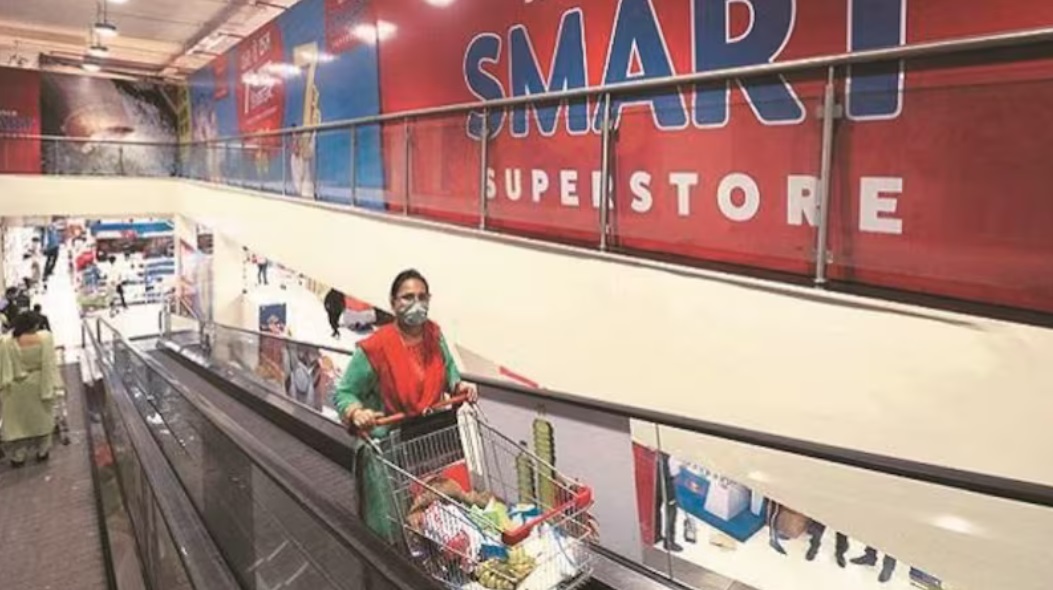
Akash Podishetty & Krishna Veera Vanamali, Business Standard
New Delhi, 8 July 2022
India’s $900 billion retail market has emerged as one of the most dynamic industries and is expected to reach anywhere between $1.3-$1.5 trillion by 2025. The organized retail is seen gaining 15% market share in the overall retail space, while food & grocery and apparel and lifestyle may account for 80% of India’s retail market by 2025.
Large market offers big opportunities. And it looks like Reliance Retail has seized it, with its massive omni-channel retail play of physical stores, B2B with kiranas and e-commerce.
The company went on an acquisition spree and partnerships in the last three years, adding to its portfolio some of the biggest names, including Hamleys, Dunzo, Zivame etc.
It has also partnered with famous global retail chain 7-Eleven. Catering to India’s affluent consumers, Reliance, meanwhile, houses some of the most iconic brands such as Versace, Armani Exchange, GAP, GAS, Jimmy Choo, Michael Kors among others. The premium segment has become one of the fastest growing categories.
Also firming up its inorganic play, the company is planning to acquire dozens of niche local consumer brands to build a formidable consumer goods business.
Arvind Singhal, Chairman and Managing Director, Technopak Advisors says, there’s focus on physical retail expansion. Reliance is looking to cater to both price conscious and brand conscious customers, while trying to capture as much of the private consumption market as possible, he says.
Reliance Retail’s competitors are nowhere close to even put up a fight. The company has over 15,000 offline stores across categories, compared with DMart’s 294 stores or Aditya Birla Fashion’s 3,468 outlets.
Reliance retail’s revenue has grown five times in the last five years and the core retail revenue of $18 billion is greater than competitors combined, according to a Bernstein report.
Speaking to Business Standard, Devangshu Dutta, CEO, Third Eyesight, says, Reliance wants a decent share of Indian consumers’ wallet. From that perspective, Reliance still has a long way to go, he says. As consumer preferences evolve, Reliance too should adapt.
An undisputed leader in the domestic market, the aim of Reliance, according to Mukesh Ambani, is to become one of the top 10 retailers globally. Part of this bet is based on the premise that incomes and consumption power of Indians will increase across the board in coming years. However, could the uneven recovery that different segments of the population have seen stop the pie from growing larger and prove to be a dampener for Ambani’s ambitions?
(Published in Business Standard)
admin
April 21, 2021

Debojyoti Ghosh, Fortune India
April 21, 2021
Billionaire entrepreneur Kumar Mangalam Birla-led retailer Aditya Birla Fashion and Retail Limited (ABFRL) has continued its build-up in the ethnic wear market with its fourth deal since 2019 and second this year. In February, the Mumbai-based fashion retailer picked up a 33.5% stake in fashion designer Tarun Tahiliani’s Goodview Properties—that will own and operate the designer’s eponymous couture label—for ₹67 crore. That was a month after ABFRL acquired a 51% stake in Kolkata-based designer Sabyasachi Mukherjee’s company, Sabyasachi Couture, which sells garments, accessories, and fine jewellery, for ₹398 crore.
ABFRL, which owns fashion brands such as Louis Philippe and Van Heusen, said in a statement that ethnic wear “is a large and growing market with a significant opportunity to build scale” and expects it to be an important category over the next few years.
Experts note the two recent deals come as the luxury industry, including fashion, has been hammered by the pandemic. The year-long shutdown in global travel has slowed over a decade of growth across luxury categories. Indeed, the global fashion industry’s profit is expected to have slumped about 93% in 2020, according to a report by consulting firm McKinsey and The Business of Fashion in December.
“[Luxury] business has been hit hard during the pandemic, like all fashion and retail businesses. And a significant injection of money is needed to maintain the business momentum, and to scale it further,” says Devangshu Dutta, chief executive of retail consultancy Third Eyesight.
In March, Italy’s billionaire Agnelli family—best known as the founders of automaker Fiat—acquired a 24% stake in French luxury shoemaker Christian Louboutin for $642 million. Three months before that it paid $95 million for a controlling stake in Shang Xia Paris, a Chinese luxury goods business founded by French luxury brand Hermès and Chinese designer Jiang Qiong Er.
Many fashion firms have used the Covid-19-induced slowdown to reshape business models, streamline operations, and sharpen their customer propositions, said the report by McKinsey and The Business of Fashion.
And that is exactly what Tahiliani plans to do with his new corporate partner. The duo will create a new entity—80% held by ABFRL and 20% by Tahiliani—to launch a new brand of apparel and accessories in the affordable premium ethnic wear segment, while it also plans to launch a men’s ethnic wear brand.
“Discussions with ABFRL have been in the works for nearly two years. I couldn’t be happier about entering into this partnership. They understand scale and numbers like no one else in the market today. Each of their home-grown brands is a resounding success,” Tahiliani, founder and CEO of Tarun Tahiliani Brand, tells Fortune India. “This collaboration permits me the financial freedom to focus on designing,” he adds.
ABFRL aims to build the new ethnic wear brand into a ₹500-crore business in the next five years, with more than 250 stores across India. The first tranche of stores is expected to open by September. “This new entity with ABFRL currently concentrates only on menswear. In our collective opinion, at present, there is only one branded national player in the Indian ethnic [wear] for men space. In order to scale this up, we need to be in three or four categories of clothing. This will give depth, both in terms of style and sizing to the men who come into the store,” says Tahiliani.
Currently, the top panIndia ethnic wear brand for men is Vedant Fashions’ Manyavar. The Kolkata-based company forayed into women’s wear in 2016 selling lehengas, saris, and the like under the label Mohey,
ABFRL’s previous deals in the segment—both in 2019—were a 51% stake in fashion designers Shantanu & Nikhil’s Finesse International Design for a reported ₹60 crore, and its ₹110-crore acquisition of Jaypore. Both make apparel, footwear, accessories, and other items.
ABFRL’s managing director, Ashish Dikshit, declined to comment for this story. ABFRL had, when announcing the Sabyasachi Couture investment, said it expected that deal to accelerate its strategy to build a comprehensive portfolio of brands across segments, occasions, and geographies.
Experts say ABFRL’s recent investments allow it to tap into the designer’s creative stream and goodwill, while providing the financial and organisational muscle of a large corporate. Albeit one that is not aiming too far upmarket.
“We shouldn’t see the ABFRL [stake] acquisitions as entry into couture, which is a different business from the ready-to-wear market. It is the expansion of these brands into ready-to-wear, tapping into the desirability of the designer brand, while making it accessible and affordable to a larger market is what will be of interest,” says Third Eyesight’s Dutta.
Indeed, Mukherjee, in a press release in late January, noted, “As my brand evolved and matured, I began searching for the right partner in order to ensure continuity and long-term sustainable growth.”
Nonita Kalra, a veteran fashion editor, says that the ABFRL deal shows the growing heft of the [Sabyasachi] brand in the fashion business. “Corporates aren’t sentimental. They are hard-nosed about investments, with careful due-diligence. ABFRL is paying what it is worth and expecting it to grow bigger. They are never going to invest in a stagnant business,” she says.
Experts, though, caution that while corporate partnerships and acquisitions allow a designer-entrepreneur and their investor partners to unlock some of the value being built, it is essential to have clarity about each brand’s design language and target consumer. “With [ABFRL’s] new venture [in men’s ethnic wear with Tahiliani], the key thing to understand is how the company will differentiate it from Shantanu & Nikhil’s positioning and focus, which is also menswear-driven,” says Abneesh Roy, executive vice president, Edelweiss Securities. “The challenge will be ensuring that each brand maintains its distinctive identity, while deriving synergies from the group.”
ABFRL has stitched up some unique deals; it now has to ensure they don’t unravel.
(The story originally appeared in Fortune India‘s April 2021 issue).
admin
September 27, 2014
 Alys
Francis, Nikkei Asian Review
Alys
Francis, Nikkei Asian Review
New
Delhi, 27 September 2014
 A few months ago, a group of wealthy industrialists and other
businessmen gathered in a plush Mumbai hotel suite to pore over
a selection of John Lobb handmade welted shoes that cost up to
$12,000 a pair.
A few months ago, a group of wealthy industrialists and other
businessmen gathered in a plush Mumbai hotel suite to pore over
a selection of John Lobb handmade welted shoes that cost up to
$12,000 a pair.
It may just be a temporary “pop-up” store, but Thomas Collette, John Lobb’s commercial director for India, was excited. He said that a local agent for the bespoke shoemaker would start taking orders by appointment only. “This is a big step for us and a big step as well for the country,” he said.
Although international luxury brands have opened flagship stores all over developing Asia, they have hardly touched the Indian market. This may be about to change.
After all, many people in the population of 1.3 billion are steadily getting wealthier. According to the Associated Chambers of Commerce and Industry of India, luxury spending will reach $14 billion a year by 2016 compared with $8.5 billion in 2013.
But foreign luxury brands have had a tough time in the country, partly due to restrictions on investment.
Many major brands, such as Prada and Versace, only entered after 2006 when the government began to allow foreign investors in single-brand retail operations. Prior to that, foreign companies were only allowed to operate wholesale “cash-and-carry” outlets.
While companies welcomed the chance to open in India — albeit
with the requirement that a local partner owned at least 49% of
the business — they struggled with the lack of suitable retail
space and trained staff, bad supply chains, and a raft of customs
taxes and duties, as well as a long wait to turn a profit because
there was only a nascent market for their goods.
Since 2006, Prada and Gucci have been among the 50-odd brands that have either left India, restructured or quit soured partnerships, according to a 2012 report by retail consultant Third Eyesight.
In 2012, India started allowing full foreign ownership of single-brand retailers but included restrictions such as the need to source at least 30% of products from local small and midsize enterprises. That is virtually impossible for most luxury labels since their brand integrity often rests on the craftsmanship of products made in their home country. Unsurprisingly, the new rules did not trigger an influx of foreign brands.
Jones Lang LaSalle, the real estate company, in August ranked New Delhi and Mumbai near the bottom of its list of 30 major Asia-Pacific cities in terms of the presence of top luxury brands.
Indians optimistic
Some foreign brands, like John Lobb, have decided that franchise and distribution deals are a better way to establish their presence in a difficult market.
John Lobb’s local partner is Regalia Luxury, which spent a year wooing the Hermes-owned brand before securing a deal to sell John Lobb’s “By Request” line of shoes that are custom-made for each client.
Regalia Luxury is one of a number of Indian companies eyeing the rising number of style-conscious local shoppers who are hungry for Western luxury brands but are wary of entering the market on their own.
“From a longer-term perspective, there’s immense opportunity if you do it the right way,” said Regalia Luxury founder Pratik Dalmia, who clinched a franchise for bespoke Italian suitmaker Kiton in 2013 and expects to sign up two more brands by year-end.
But he admits that the market boom has yet to start and that operators will have to “run a tight ship” for the next couple of years.
Indian companies that represent foreign luxury brands need to have a long-term view and keep a close eye on what the younger generation likes — these are the customers with the most potential, since they are more exposed to overseas fashion trends.
“India is all about the customer of tomorrow,” said Darshan Mehta, CEO of Reliance Brands, a subsidiary of Reliance Industries that was set up in 2007 to bring foreign luxury fashion to India.
Mehta often sits in a cafe at DLF Emporio, New Delhi’s first luxury mall which opened in 2008, and watches shoppers. He said many people shop at Zara but they walk into Gucci and Zegna just to have a look. “That is what makes markets like India so promising: the aspirational consumer,” he said.
Unlike China, where a lot of luxury retailers are now at a consolidation stage after years of rapid expansion, brands are still struggling to find space in India for their first shops.
Even in Mumbai, the Emporio is the “only true luxury mall,” according to Mehta.
It may take some time before India’s luxury market takes off, but the market has been boosted by a stream of well-off Indian professionals and students returning after working and studying abroad, including many bankers who left Wall Street and London after the global financial crisis.
Luxury players are also expecting a boost from the introduction of a Goods and Services Tax, which was promised by India’s new government and would get rid of complex multi-level taxes that are hampering the sector.
Reliance Brands, which also represents Reiss and BCBG Max Azria, expects to add three more brands to the company’s stable of 16 foreign brands by year-end.
A few pioneers are even setting up boutiques in smaller cities. Bangalore firm Fervour, which has licenses to sell Nina Ricci and Christian Lacroix, is planning to expand to Chennai and Hyderabad.
But most don’t see these cities as viable markets just yet.
“There is no sustained luxury market outside of Bombay and Delhi,” Mehta said. He expects luxury demand outside the two main cities to take another three years to reach critical mass.
Sanjay Kapoor, the founder of distributor Genesis Luxury, said India’s luxury market is not yet at the point where China was 10 years ago, even if the potential for growth is immense.
Kapoor founded Genesis Luxury in 2008 to sell foreign luxury brands in India and has deals with Jimmy Choo and Armani, among others.
“As awareness and retail space spread, demand will accelerate in smaller cities in the interior of India,” Kapoor predicted.
Tight ships
Amid the shortage of high-quality retail space, one option is to use the “shop in shop” model.
R&B International rents small spaces in other retailers’ stores to sell Australian luxury label Easton Pearson. The manufacturing firm supplied embroidery to the brand for years before nabbing a distribution agreement in India in June.
Dalmia also said he is in no hurry to open flagship stores for John Lobb and Kiton before 2016.
Instead he is targeting ultra-rich customers who want the pampering that comes with exclusive, by-appointment-only services. Clients are shown samples of Kiton’s made-to-measure suits and John Lobb shoes, and then measured by a trained team at a place and time that suits them, often at home in the late evening.
Collette said he’s been pleasantly surprised by how well the brand has been received in India. While the brand has wholly-owned stores in Japan and the U.S., Collette said it would have been impossible for it to enter India alone.
(Published in Nikkei Asian Review.)
Devangshu Dutta
February 24, 2013

Luxury is an ill-defined concept. There is no specific line or limit of price, quality or availability that separates the luxurious from all that is not.
However, like other similarly intangible attributes such as power or grace, we all immediately recognise luxury when we experience it.
In fact, experience — vague as that may sound — is key to differentiating luxury, more than the tangible product being consumed. It’s not just the person’s own direct sensory experience, but also the prestige and status granted by others around her or him that creates the luxury experience.
Surely, with such intangible notions of experience, power and prestige, luxury brands should be among the most influential in the market. They should be pioneers that set the tone for change in improving retail management practices, upping customer service standards, driving quantum leaps in quality.
But is it so? The response from the rest of the retail sector may not quite be “meh”, but I suspect that it would not be far off.
There are strong reasons why luxury brands would have a lower influence as benchmarks in India and why, in fact, they may draw in more influence from the market themselves.
Market presence and location
As an example, in physical presence, luxury brands seem to demonstrate a delayed response to changes in the market, both in terms of market entry and location selection.
Prior to the entry of global brands, luxury products and services in India were naturally defined by niche, largely owner-managed businesses. Business scale was curtailed by internal limitations, and due to the small size, its market reach was also limited. While there were some designer brands that would occasionally get copied by mid-priced retailers, by and large luxury brands lived in their own separate bubble, with little or no influence on the heaving mass of the market.
In contrast, in the Western economies, from where many of today’s luxury brands originate, they are looked up to for inspiration. So, it is natural to expect Western luxury brands to lead the charge into the newly emerging modern retail economy of India. However, according to Third Eyesight’s research of international fashion and accessory brands in India, in the last 25 years it is mid-priced and premium brands that have opened the market. It is only in the last 10 years, well after the economic and retail growth was underway, that luxury brands stepped up their presence.

Sure, during the so-called “retail boom” from 2004, luxury brands went up to one-quarter of all international fashion and accessory brands present in the market. Then, when practically the whole world was in a recessionary mood, and mid-priced and premium brands took a call to defer their India launch plans, luxury brands pushed ahead. In 2009, luxury fashion brand launches accounted for two-third of all foreign fashion brands launched in India. Maybe the brand principals felt that this market could take on the burden of slowing growth elsewhere, or perhaps it was their Indian counterparts who were the source of optimism. Either way, the optimism took a hit in 2010 and 2011 when it was luxury brands that became cautious.
In terms of store openings and location selection too, luxury brands seem to have waited for the overall market to upgrade itself, and have then latched on to that growth. Previously luxury brand stores, such as there were, largely restricted their presence to five-star hotel shopping arcades, while a few took up non-descript sites as they were confident of being destinations in their own right or clustered together to create a precious few bohemian locations in surroundings that were far from luxurious. As modern shopping centres emerged in recent years, these presented an environment where rich consumers — especially the ‘new’ rich — could flock to buy globally benchmarked lifestyle statements. While these were mainly targeted at mid-market to premium brands, some of them are now even attracting designer brands such as Canali at Mumbai’s Palladium mall rubbing shoulders with Zara. These new luxury stores in mid-market or premium locations are performing better than the original “luxury” sites.
Thus, in terms of expressing confidence in the market, luxury brands seem to be following market trends rather than leading them. And far from being the anchors to create demand, they seem to be following where the demand goes.
Design and product development
The most important impact that luxury brands could have on the market is by influencing product design. This fashion trickle-down is supposed to work in two ways: one, through “inspiring” knock-offs by cheaper brands; two, making luxury customers act as opinion leaders and trend-setters for other consumers.
However, various factors dilute the luxury brands’ product and design influence in India: the preponderance of domestic (“ethnic”) style and colour, especially in womenswear, the existing domestic variety in products, the flood of premium (non-luxury) international brands and a customer base that is oblivious to the difference between the premium and luxury segments. In spite of their small size, Indian luxury and designer brands possibly have a larger direct impact, not to mention the massive Bollywood machine that drives mainstream fashion trends on a day-to-day basis. The international luxury giants are conspicuous by their small influence.
In fact, increasingly the influence is flowing the other way. A few luxury brands have attempted to create India-specific items to give the customer what they might want. Some of these may be indulging in superficial pandering such as putting an Indian image on a global product, but others have created Indian products that genuinely reflect what the brand stands for. While some use India as a production sweatshop to minimise the cost of high-skills jobs, others are now beginning to use Indian crafts to design products that are relevant to other global markets. A few examples, without passing judgement on which category they fit into, include: Lladro’s Spirit of India collection, the Hermès sari, the Jimmy Choo “Chandra” clutch bag, Louis Vuitton’s Diwali collection and Canali’s nawab jacket.
Slow, but not yet steady
Another issue with India is the sheer numbers, or the lack thereof!
China’s GDP is about four times the size of India’s but its luxury market size is estimated to be six times that of India. There are 1.7 million households in China that meet the high net-worth criteria, as compared to 125,000 in India. What’s more, according to industry estimates, only about 30 per cent of luxury consumers in China are actually wealthy, while the overwhelming majority are people with mid-market incomes who are given to conspicuous consumption, whether buying luxury goods for themselves or as gifts.
Indian consumers also have a penchant for buying overseas rather than shopping from the same brands’ stores in India. This is not just due to higher costs and import duties in India, but because of wider and more current selections of merchandise in stores overseas. Indians’ luxury shopping destinations include the usual suspects: London, New York, Paris, Milan, Singapore and Dubai. This has meant that while luxury brands recognise Indians as a large, emerging base of customers, for most brands India itself remains an operating market for the future.
Having said that, when compared to any other sector of business, luxury brands in India probably get the most media coverage for every rupee of sales earned. Although they are a small fraction of the sales, luxury brands rule in terms of column centimetres or telecast seconds. The coverage is not restricted to consumer-oriented media such as lifestyle magazines or mainstream newspapers, individual luxury brands are also extensively covered in business media.
One may argue that such is the nature of luxury: this disproportionate visibility and share of mind happen because luxury is not just aspirational, but inspirational. However, that inspiration and influence is yet to become apparent in the business at large. Until we see significantly larger numbers of upper-middle-income customers in India, luxury brands will find it difficult to expand their reach beyond the small base of ultra-rich consumers. The aspiration and price gap is just too wide for the Indian middle class, and there are very few who will emulate their Chinese counterparts and save up a year’s salary for a single luxury item.
And so…
One thing is beyond doubt: the luxury sector in India is undergoing significant change. We could even say it is in active ferment. There has never been so much interest among so many people, or so many brands so widely promoted, as now.
The question is still open on whether it is a good ferment such as the one that produces wine from raw grape juice and fine cheese from plain curds, or the unguided rot that results in a putrid, smelly mess unfit for consumption.
My bet is on the first possibility. In the short term, the luxury business appears to be a mess, littered with fractured partnerships and bleeding financial statements. But the brew needs time to mature. Gradually, as the luxury segment matures along with the rest of the market, we will see the influence trickling down into other segments. But remember, the finest brews do not only impart their flavour to the cask, but imbibe the cask’s characteristics into themselves. So it is with luxury and the Indian market. The message that we have given many other international businesses seems to hold doubly true for the global purveyors of influence, the luxury brands: “As much as you think you would change India, India will change you.”
Devangshu Dutta
March 13, 2012
Among consumer sectors, very few can match up to fashion in terms of its global nature. Despite food having led the way in global trade through spices, it is the fashion sector that led the global march of brands. As the economies in Europe and Asia recovered and grew, historical colonial linkages as well as modern culture-vehicles such as movies carried images of what was cool in the benchmark culture. Fashion brands were the most identifiable representation of cool.
India itself has known international fashion and luxury brands for several decades. From the mass footwear brand Bata to the top-notch luxury of LVMH, some of whose most important global customers included the rulers of Indian princely states, international fashion brands have an age-old connection with India.
In spite of these old links, the absolute base of consumers for fashion brands was small, and for them, prior to the 1980s , India was a relatively low potential market with low attractiveness and low probability of success.

A transition began in the 1980s, as India moved emphasis from central planning and a restrictive economy to a more liberal business regime, and brands and modern retailers started growing in presence gradually. During this transition period, other than the notable exception of Bata, it was mainly Indian brands that were at the forefront of modernisation of retail in India, with the first retail chains being set up for textiles, footwear and clothing. Though the seeds were laid earlier – Liberty is credited with the launch of the first ready-to-wear shirt brand in the 1950s, Raymond with the first ready-to-wear trouser brand in the 1960s – the growth started in real earnest only in the 1980s when apparel exporters such as Intercraft (with brands like “FU’s”), Gokaldas Exports (“Wearhouse”), and Gokaldas Images (“Weekender”) also tried their hand at modern retail, as did corporate groups (“Little Kingdom” for kids and “Ms” stores for womenswear).
Yet, even in the early to mid-1990s, when western companies looked at the Asian economies for international growth, West Asia and East Asia (countries such as Japan, South Korea, Taiwan and even Thailand) were seen as more attractive due to higher incomes and better infrastructure. In the mid-1990s there was a brief upward bump in international fashion brands entering the Indian market, but by and large it was a slow, steady process of increase.
By the mid-2000s, however, a very distinct shift became visible. By this time India had demonstrated itself to be an economy that showed a very large, long-term potential and, at least for some brands, the short to mid-term prospects had also begun looking good. In a few years, from 2005 onwards, the number of international fashion brands entering the market has increased 4-fold.

Market Still Evolving, but Brands are Confident
The sheer number of brands that are now present in India and the new ones that are entering every year is a clear sign of strengthening confidence among international brands that India is now one of the most important markets that they cannot ignore for long.
There is a visible acceleration of growth in absolute revenues, too, being achieved by individual brands. Brands such as Levi Strauss, Reebok, Louis Philippe (a British brand formerly owned by Coats Viyella, now by Aditya Birla Group for India and other territories) and its sister brands took perhaps 12-15 years to break through the threshold of Rs. 500 crores (Rs. 5 billion) in sales turnover, but industry opinion is that the “0 to 500” trajectories today are faster and that younger brands are likely to take less time – under a decade – to cross the threshold. While modern apparel retail currently contributes less than 20 per cent of the total apparel market, with growing incomes and increased availability of modern retail environments, consumers are spending more on branded fashion than ever before. In the year closing March 2012, at least 2-3 additional brands (including Indian ones) are expected to cross the Rs. 500 crores threshold.
Clearly, there are few markets globally that can support potential growth from zero to US$100 million in a decade, with the potential to even reach a billion-dollar mark within the next couple of decades. However, some of these markets are already hugely competitive, and also going through painful economic churns. India, on the other hand, is a market that is at the earliest stages of consumer growth – it is, in the words of the managing director of a European brand, a market where “a brand can enter now and live out its whole lifecycle”.
In fact, it is tempting to compare the emerging golden bird of India to the golden dragon of China where western brands seem to have rapidly established as products of choice for the newly affluent Chinese consumer during the last 15 years or so.
In our work with brands and marketers from around the world, we have to constantly remind them that not all emerging markets are the same. The explosion of luxury and premium brands in China during the last decade or so has happened on the back of explosive economic growth that came after a long cultural and economic vacuum. When the new money wanted links with the old and when uniform grey-blue suits needed to give way to something more expressive, well-established western premium and luxury brands provided the most convenient bridge.
On the other hand, in India “discernment” may be a new experience to the newly-rich Indians for whom brands can be a valuable guide and “secure” purchase, but discernment and taste are not new to India as a whole. More importantly, differentiation and self-expression never disappeared even during India’s darkest years of “socialistic” economics. Therefore, the Indian market has a more “layered” approach to the premium fashion market and will continue to grow in a more fragmented, more organic manner than the Chinese market. There would be multiple tiers of growth available for international as well as Indian brands. For international brands customisation and Indianisation will be important. This is already visible in bespoke products by Louis Vuitton and Indian products by brands such as Canali (jackets) on the one hand, and significant re-thinking on product mix and pricing by brands such as Marks & Spencer. That brands are willing to rethink their position in the context of the Indian market demonstrates that they see India as a strategic market, worth investing in for the long term.
Another sign of the growing confidence amongst international brands in the Indian market is the number of companies that are looking at directly investing in joint ventures, or even going further to set up wholly-owned subsidiaries in the country.
It is worth keeping in mind that setting up a subsidiary is a decision that is not taken lightly, regardless of the size of the business and the amount of investment, since it involves a disproportionate amount of management time and effort from the headquarters during the launch and early growth phase where revenues are small and profits non-existent.
Among our clients, brands have taken the decision to step into an ownership structure in India when they feel that India is too strategic a market to be “delegated” entirely to a partner (whether licensee or franchisee), or that an Indian partner alone may not be able to do justice to the brand in terms of management effort and financial capital.
In the last few years we have seen several brands take the plunge into investing in the Indian business, among them S. Oliver (Germany), Marks & Spencer (UK) and Mothercare (UK).
During 2011 specifically, Promod changed its franchise arrangement with Major Brands into a joint-venture that is majority-owned by Promod. From its launch in 2005, the brand has opened 9 stores so far. However with the new JV in place, the venture is reported to be looking at opening 40 stores in the next five years.
Most recently, Canali was one of the brands that moved into a majority-owned joint-venture. The brand entered in India in 2004 through a distribution agreement with Genesis Luxury. This has recently given way to a joint venture between the two companies that is owned 51 per cent by Canali. The brand currently operates five exclusive stores in India has plans to accelerate the brands growth in India by opening 10-15 stores over the next three-four years.

The Impact of FDI Regulations
If a “theme of the year” has to be picked for the Indian retail sector in 2011, it must be ‘Foreign Direct Investment’. The debate during the year was hardly a clean and clear “pro vs. con” exchange of ideas. It was a motley mix of extreme lobbying for and against FDI, some balanced reasoning on why FDI should be allowed, and also moderate voices calling for governing the speed at which and the conditions under which foreign investment could be allowed. In many cases there seemed to be dissenting voices emerging from within the government. One possible impact of this uncertainty through the year was that several brands postponed their decisions regarding the potential entry and the strategy that they would follow in India with regard to partnership or investment.
In November 2011, the Indian government announced that 100 per cent foreign investment in single brand retail and 51 per cent foreign ownership of multi-brand retail operations, but was forced to back-track due to vociferous opposition from several quarters. At the very end of the year, the government finally reopened 100 per cent foreign ownership retail operations, albeit limiting it to single brand retail businesses. However, it allowed this under the condition that the Indian retail operation would source at least 30 per cent of its needs from Indian small and mid-sized suppliers.
The condition of 30 per cent domestic sourcing from SMEs is well-intentioned – aiming to provide a growth platform for India’s manufacturing enterprises – but unachievable for brands that do not currently source any serious volumes from India. In fact, for most international fashion brands India contributes less than 10 per cent of their total sourcing, in many cases well under 5 per cent.
Under these circumstances, we shouldn’t expect any dramatic changes, though we do expect the growth in joint-ventures and subsidiaries to continue in the coming months and years.
If an international brand perceives India to be at the right stage of development, and it wishes to exert significant or complete control over its Indian presence, then a majority or completely owned subsidiary seems the most logical step, and the brand will find a way to structure its involvement in India appropriately.
However, many brands that today have a 51 per cent ownership in India are stopping short of climbing to 100 per cent until they can sort out how to meet the SME sourcing conditions.
Getting Over the Sourcing Hurdle
The problem with the 30 per cent sourcing rider is simple. When a brand launches in India, it would like to present the consumer with the most complete product offering that showcases its capabilities and positioning as relevant to the target consumer in India. In most instances, the brand would not be sourcing the full range of its merchandise from India.
This is not a problem if the brand approaches the market through a wholesale or franchise structure, or even with a retail business that is not owned by it 100 per cent.
But for a retailer that wants to own the Indian business completely, complying with the 30 per cent domestic sourcing restriction means developing a new set of suppliers in India from scratch, pulling in the design and product development staff to work with them, and to develop ranges that suit not only the Indian market, but also other markets around the world. Simply putting together an India-specific sourcing team to replicate the entire range to buy small volumes for the Indian business is neither practical nor feasible for most of these brands. This means that the product development and sourcing team must be willing to see India as a strategic supply base for the future, just as their selling-side colleagues may be seeing it as a strategic market.
In this context it is worth repeating something that I have said before: retail managers are generally risk averse, and like to move in packs – where there are some brands, more come in and create a mutually reinforcing business environment. The presence of other international brands – especially from their own country – helps in creating a familiar context at first sight and encourages further exploration of the market. At least for the executives handling international retail expansion, India presents a more ‘familiar’ and ‘developed’ face today than ten years ago.
However, the explosive growth that we have witnessed in terms of the number of brands present in India is not mirrored by the growth of fashion sourcing out of India. In fact, even when compared to what has happened in the global textile, apparel and footwear sourcing environment since quotas were removed in 2005, the India’s export growth looks dispiritingly low, even stagnant. China still remains the largest source for fashion products, while countries such as Bangladesh, Indonesia and Viet Nam have grown their share aggressively. India’s share of clothing exports is a lowly one-tenth that of China.
In our work related to global sourcing strategies for western retailers, on an objective measurement matrix of sourcing competitiveness India rates highly. In several cases, sourcing from India as a hub (and, for European retailers, Turkey as a hub) has been seen as a logical counterweight to balance out the high concentration of current sourcing in China.
However, product development and sourcing is not entirely an objective process – in fact, sourcing habits are sometimes the hardest to change. The buyer’s subjective experiences – sometimes buried deeply in the past career – have a significant role to play. A conversation from 2001 with the sourcing head of a European brand sticks in my mind, when he said, “I don’t really want to buy anything from India – Indian suppliers can do a very limited product range, quality isn’t always good and the shipments are always late.” On probing further, I discovered that his last transaction was in 1992, after which he never set foot in India again. Much as we might present statistics and facts about the developments in the Indian textile and apparel industry, a personal injury early in his career has left a deep scar that obviously influenced this gentleman’s buying decisions worth over €300 million in global apparel sourcing, or about €700-800 million worth of sales.
There is clearly much to be done in terms of encouraging modernisation and better organisation amongst apparel suppliers, and making those changes visible to buyers. Even brands that are well-engaged with the Indian supply base have between 40-70% of their people here focussed on in-line and post-production quality issues. We are today at a stage where larger and better-equipped apparel exporters would be best placed to address the needs of international brands within India, but find the volumes too small to bother with setting up entirely different documentation and accounting processes.
Health & Safety and Labour compliances are also areas in which the brands will not forego their corporate standards. Can we imagine a brand saying that its European customers do not want their products made in sweatshops, but for the Indian consumers of the brand this is not (yet) an issue? While this may be a fact, would a high profile brand risk its global reputation to source competitively for its small Indian business?
So a government dictat to international brands’ fully-owned subsidiaries to ensure that they source 30 per cent of their needs is not enough. At best it will encourage some of the brands to start looking at India more seriously, but a more likely scenario for most brands is that they will carry on business as usual until the supply base in India pulls up its socks, or until the business in India becomes large enough to be interesting to their existing Indian suppliers who are currently focussed on exports.
Certainly the government itself needs to do much for more manufacturing-friendly policies, as well as focussed investment in infrastructure that can provide rapid, efficient and cost-effective transportation from the country and within the country.
It is time to bridge the gap between “textile exports” and “fashion retail” in the country. Remember, the explosive growth of brands in China followed the manufacturing explosion, not the other way round. Until the Indian apparel, textile and footwear manufacturing sector grows strongly, the actual volume growth of modern fashion retail will remain hobbled, regardless of the number of brands that enter the market.
To me this statement by a senior professional from one of Hong Kong’s largest apparel companies says it all: “The Indian industry looks like a formidable competitor, the day it decides to wake up.”
Drawing the Full Circle of Confidence
In closing I would like to mention the least acknowledged, but a very important part of the growth of international brands in India: the acquisition of brands overseas by Indian companies. The Aditya Birla group laid an early foundation when it bought out, for India and several other territories, the perpetual rights for Coats Viyella’s brands including Louis Philippe, Van Heusen and Allen Solly. Lerros was a slightly different example – being a brand that was set up by the House of Pearl in Germany – but that also circled back to India. More recently (2010) we have the example of the Swiss company Switcher Holdings, whose with brands including Switcher, Respect and Whale, was bought by PGC Industries.
In markets such as the EU, there are today brands that may be available because they are finding difficult to survive in harsh trading environments and that do not have the financial or management bandwidth to take on initiatives in growing markets like India. These offer a legitimate growth platform for Indian companies that are strong in manufacturing those product categories and want to move higher up the value chain from being a generic commodity “supplier”.
Although exporters may initially approach these brands for franchise or license relationships, to some it soon becomes clear that if they are in a position to make an incremental investment they could well own the perpetual rights and perhaps the whole business, rather than investing in building up someone else’s brand, especially in the business in India is likely to grow very rapidly. Obviously, this new-found confidence needs to be backed with solid management capability, but as other consumer goods companies such as Tata (beverages, automotive), Mahindra (automotive) and Dabur (personal care) have shown, it is entirely feasible to look at growth in India as well as internationally by using an existing international brand as a stepping stone.
It also presents a challenge of classifying such brands as international or Indian. Bata was founded in the Czech Republic and went global from there – however, today it is legitimate to treat it as a Canadian brand since its headquarters moved there in the 1960s. Among other products, Gloria Jean’s Coffee was founded in the USA, but is now completely Australian-owned. In that sense, today would that not make Louis Philippe, Allen Solly, Switcher Indian brands?
I think this puzzle is a challenge that many people in the industry in India would look forward to contributing to.
—–
Additional comment after reading the following blog post on Forbes on Single Brand Retailing (March 12, 2012):
Policies restricting foreign investment are not the biggest barrier to entering the Indian market. Brands and retailers that are clear that India is a strategic market with which they wish to engage will find a way. Even the largest global retailers have created structures that allow them a toehold in the market, awaiting a larger opening, despite the current ban on FDI in multi-brand retail.
The biggest barrier to entering India is actually the comfort zone within which the management team of an international retailer or brand may be operating. For some, the business environment of India needs at least a small step outside that comfort zone, for others it needs a big leap of faith.
There are encouraging signs of this happening already. Research carried out by Third Eyesight shows that the number of foreign brands operating in India in the fashion segment alone have quadrupled since 2005-2006, and a significant chunk of these are operating with direct investment in the Indian operations, whether as 100 per cent owned subsidiaries or as joint-ventures, indicating their growing comfort and confidence in the market.
One last word of advice: assess the opportunity pragmatically; don’t come looking for “a small percentage of the 1.3 billion population” in the short term – it takes time and patience to develop a meaningful share in the market.
