
admin
February 28, 2011
 Business
Standard, Mumbai, February 28, 2011
Business
Standard, Mumbai, February 28, 2011
Sayantani
Kar (with inputs from Preeti Khicha)
When some of India’s big retail chains banded together recently to substitute Reckitt Benckiser’s products with private labels to protest the latter’s decision to cut sales margins on its products, they were doing something many global retailers have done with great success. Part of their overall strategy, especially for large chains in the US and Europe, is to develop quality private label products that complement other pieces in their marketing mix. While this is one way retailers can differentiate their firms from competition, it also helps them flex their muscles in their relationships with brand manufacturers. Indeed, retail giants Tesco, Walmart and Carrefour have a significant portion of their sales coming from private labels — ranging from 10 per cent for Costco and 50 per cent for Tesco.
India is a back runner in the private label race, but it is
catching up. A Shoppers Trend Study by Nielsen found awareness
about private labels has gone up from 64 per cent in 2009 to 78
per cent in 2010 across 11 cities in India. Nielsen Director (retail
services) Siddharthan Sundaram says, “Over the last three
to four months, we found an increased awareness of private labels
in categories such as staples, household products, personal care
products such as soaps, biscuits and packaged groceries.”
Thanks partly to the recent economic downturn, there is greater
acceptance — and even loyalty — to such brands in India,
say marketers. Future Group Business Head (private brands) Devendra
Chawla reasons, “A label on the shelf becomes a brand by
covering the two feet distance from the shelf to the trolley.
After all it is the consumer’s choice.” Even in the
toughest segment for private labels to crack — fast moving
consumer goods including food and personal care — store labels
claim share of 19-25 per cent.
Low-involvement categories such as household cleaners were among the first to see the entry of private labels (17-44 per cent of sale in modern trade), bringing in huge margin-lifts for modern retailers. In categories such as food products — jams, biscuits and staples — private labels today contribute more than 25 per cent of modern trade sales. Little wonder, retailers are now mining shopper data to make private labels shed their ‘low’ly tag — low involvement and low cost. Store chains are segmenting their brands according to consumer needs, combining more than one brand according to consumer behaviour, besides launching high-involvement premium products and innovative packaging to give national brands a run for their money.
Innovate or die
Retail innovation has had a big role to play in speeding up the
process of consumer acceptance. Future Group’s retail arm,
which includes Big Bazaar and Food Bazaar, calls its in-house
products ‘private brands’ not labels. It has a separate
team, headed by Devendra Chawla, to research and test FMCG products
before launch. The team has a range of private brands — Tasty
Treat, Fresh and Pure, Cleanmate, Caremate, Sach, John Miller,
Premium Harvest and Ektaa. Look at how it is using shopper data
to improve its products. The insight that kids found ketchup bottles
cumbersome and had to be served — making it inconvenient
if an adult was not around — led it to change the packaging
that in turn gave the brand a margin advantage. By offering ketchup
in pouches, it saved on the price of the glass bottle and freight
(pouches take up less space in a truck, hence more can be fitted
in). While ketchup in glass bottles continue to be Rs 99 for a
kilo, its Tasty Treat ketchup pouches come in Rs 59 packs.
By working with vendors it has also come up with interesting combinations — for example, its Tasty Treat jam has three small tubs packed as one unit, each tub containing a different flavour to offer consumers larger variety.
Retailers have now donned the hats of “product selectors” and “product developers” at the same time, points out Third Eyesight CEO Devangshu Dutta. “So far, most of the retailers were just selecting products from vendors which are mostly lower-priced knock-offs of manufacturer brands,” he says. Not any more.
Ashutosh Chakradeo, head (buying, merchandising and supply chain), HyperCity Retail, explains the process his company follows: “To develop food products, we identify vendors, tie up with food laboratories, chefs and consumers to be part of the tasting panels. Before launching a private label we do at least a month of consumer testing. We identify customers from our loyalty programme called Discovery Club, which tells us who buys a certain category of product. We give the relevant consumers our private label products for trial for a month. We meet the customers at their homes, take their feedback and these changes are incorporated into the private label brand.”
“Our stores act as research labs and are a constant source of feedback,” points out Chawla of Future Group. Chawla estimates 3-4 per cent of the sales of private labels are ploughed back into packaging and design innovation. Reliance Retail CEO Bijou Kurien says, “The teams are our main investment in private labels. Our 100-strong designers across all the formats help in coming up with product designs that fill a need gap or offer a few more features at the same price as national brands.” Reliance Retail has recently launched its own brand of watches priced Rs 149-199 which “no national player can offer” points out Kurien.
The edge
Most vendors directly supply to retailers’ distribution centres,
cutting out cost leakage at the distributor’s and carrying
and forwarding centres. Direct access to store shelves and aisles
also cuts out the high mainstream advertising costs that brands
have to bear. By clever product arrangements and in-store promotions,
retailers can sway the shopper and draw attention to the price
advantage. Chakradeo says, “We display private labels in
heavy footfall areas in the store. We complement displays —
so we keep our private label ketchup near the bakery.”
To tackle the tricky personal care category of face creams and shampoos that Aditya Birla Retail’s More chain has entered, it plans to communicate promotional offers straight to its loyalty programme members. “It will help us induce trials,” says Thomas Varghese, More’s CEO.
Bundling products is another way to woo the value-conscious consumer. Six months back, Future Group started bundling its private brands. Chawla says, “Take home-cleaning, which requires a floor cleaner, glass cleaner, toilet cleaner and utensil cleaner which we combined as a shudhikaran solution of our Cleanmate brand.” The combi-pack costs Rs 125, which would come to around Rs 220-250 if shoppers bought a la carte. The margins are still high at 26 per cent. “Vendors are assured of volumes,” points out Chawla.
What it also does is convert the fence-sitter who has not yet bought into a category. For example, consumers who avail of the shudhikaran solution also get into the habit of using glass cleaners — a category which has a small base and gets most of its sales from modern trade. Similarly, Future Group saw a 25 per cent spurt in the sales of soups when it clubbed soup mugs with its Tasty Treat soup packets based on the insight that Indians preference to sip their soup out of a coffee mug.
Don’t be surprised if you see MNC brands coming out with combo-offers for their products, way bigger than the occasional bucket with a detergent!
Growing up
There are signs the industry is evolving. Private labels in FMCG
are shedding their low-cost tags. But retailers know better than
to vacate low price-points altogether. Instead, they are segmenting
their brands just as a manufacturer brand would do. Chakradeo
of Hypercity says, “Over a period, we hope to increase the
stickiness and the differentiation our brands bring to our stores.
Particularly, in staples where we have seen our private label
business grow rapidly. This is a very quality and price-sensitive
category. We started with basic products but now we have premium
daals (lentils) and basmati rice as part of our portfolio.”
Future Group too has its ‘good, better, best’ policy firmly in place. In staples, the stores offer some products ‘loose’, such as rice, wheat, lentils, which is at the bottom of the ladder. Its Food Bazaar version of the products straddle the middle category, and above the two is its brand, Premium Harvest, which retails at a price higher than some manufacturer brands.
Stickiness may also result from the manner in which retailers are positioning their brands. Future Group’s brand Ektaa will retail regional food and staples across its stores in the country so that migrants can buy supplies they are comfortable with. Be it Govindbhog rice and kasundi (a rice variety and mustard sauce preferred by Bengalis), khakra (Gujarati snack) or murukku (loved by Tamilians). Boston Consulting Group Partner & Director Abheek Singhi says, “Indian retailers are not cut-pasting private label products from other markets but adapting them.”
Are private labels a risk worth taking? Chakradeo says, “The entire product formulation for our cleaners was done in partnership with Dow Chemicals, USA. We did not make any investment and we gave them a percentage of sales as fee. Investments are not huge in making private labels as in most cases it is partnered with vendors. It is more of operating expenses than capital expenditure.”
Future Group brought down logistics costs further by 6-8 per cent by appointing vendors in more than one region for 10 of its product categories to fill its distribution centres. Chakradeo adds, “As the volumes go up, we will be able to put up for backend infrastructure facilities for development and R&D.”
Should national brands be worried? Devangshu Dutta says, “As long as retailers have access to the production and development and have customers for it, the private labels will remain profitable.” India Equity Partners Operating Partner V Sitaram sums up, “In modern trade, though the market leaders will face some slip in market share, the number 3 or 4 brands might have a bigger problem in certain categories thanks to private labels.”
As retailers leverage consumer insights to deploy private labels more effectively, national brands are aggressively fighting the challenge. From sprucing up supply chains to galvanising in-store promotions, they are covering all bases. KPMG Executive Director Ramesh Srinivas says, “Earlier brands had to adjust between a modern trade and a general trade supply chain. The former had to be serviced directly at the stores or had their own supply chain while the latter used the manufacturer’s supply chain. Now, some brands separate modern trade teams and even distributors.”
Britannia Category Director (delight and lifestyle) Shalini Degan says, “We have divided our portfolio into three categories, A,B,C, each having its benchmark fill-rate. We don’t allow fill-rates to drop below those levels. Why the segmentation? We need to focus on brands which have a higher traction in modern trade when servicing it, else we might end up focusing on brands that are not modern trade-led.”
Fill-rates denote how often and to what accuracy the retailer’s orders for a product are supplied by the manufacturer. Low fill-rates could mean lost opportunity since the shopper sees an empty shelf or a private label instead of the brand she might have thought of picking up.
Samsung Vice-President and Business Head (home appliances) Mahesh Krishnan says, “We have gone in for central billing system 4-5 months back with all large-format retailers. Orders are tracked on a daily basis giving retailers more control over the chain.”
In other words, private labels are here to stay and will evolve as more and more chains gain national footprint and the economies of scale kick in. Dutta of Third Eyesight says, “Gross margins for organised retailers are still low compared to global standards: So, margin fights will continue for some time till retailers gain a bigger share of the pie.”
(Also read: The Private Label Maturity Model.)
Tarang Gautam Saxena
February 7, 2011
It has been almost two decades since the government in India re-opened the economy to international investors and brands. During the first dozen years or so, apart from a single visible bump in 1995, every year had a steady dribble of fashion brands coming into the country. It was not until 2005 that this rate accelerated to over 20 international fashion brands entering the Indian market annually, even as the existing brands grew their own retail footprint in the market.
2008 and 2009 were both slightly damp by comparison, reflecting the global economic sentiment, but we were optimistic as we laid out our expectations for 2010. While writing the previous version of our research report released a year ago, we felt that 2010 was going to be promising and it could well be a “curtain-raiser for a new decade of growth for international fashion brands in India”.
The increased bustle in the market has endorsed our forecast. Though initially slow, the growth of new international brands entering the Indian market in 2010 bounced back with the same vigour as before the downturn. Some brands that had exited the Indian market earlier also made a comeback as in the earlier years.
The Entry Strategies In 2010
The most preferred entry route for the international fashion brands entering India in 2010 has been franchise or distribution, with more than half the brands selecting this strategy that allows high control over the product and the supply chain with less intensity of involvement at the front-end. There are two discernible categories of brands that are picking this route: firstly, brands that are usually distributed through department stores and multi-brand independent stores in their home market and other markets, but also those brands that are as yet unsure of their capability to engage intensively with the Indian market. Franchising remained a popular choice in 2010 particularly for the brands looking to test the market or operating in niche or luxury segments.
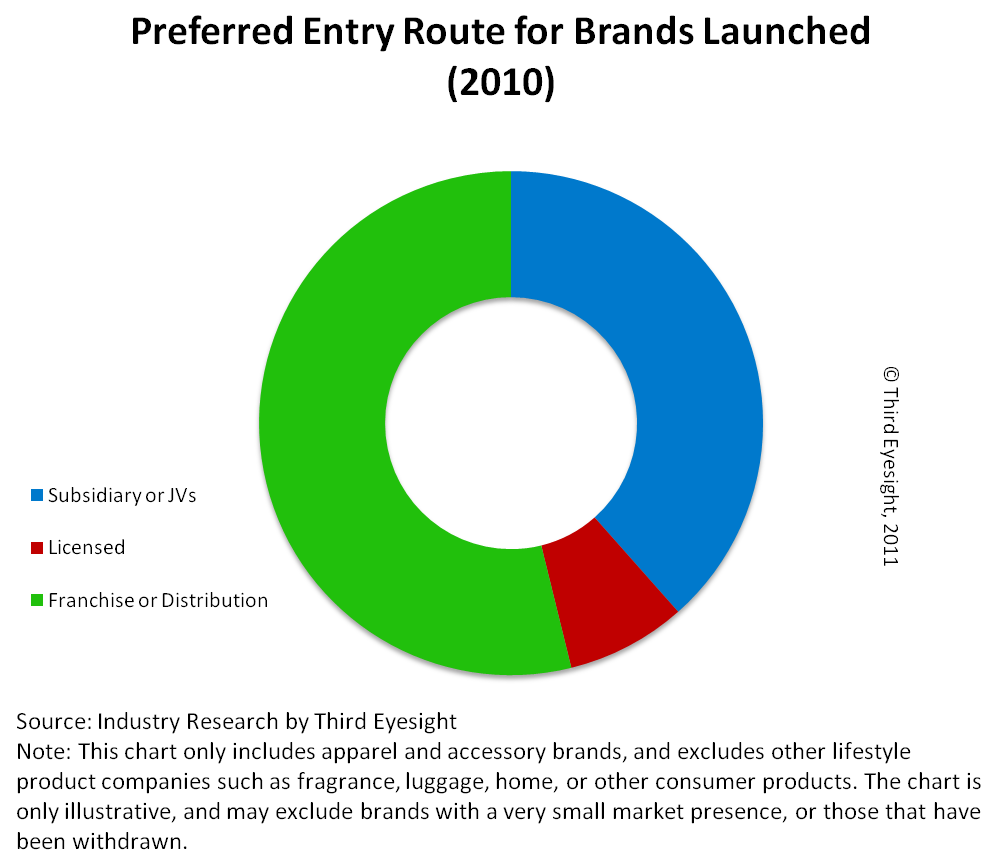
Some brands taking this route for entering the Indian market include Forever 21, Etro, Tom Ford, and Ladybird, amongst others. However, a number of brands that entered in 2010 (nearly 40% for the new entrants) also showed that they wanted a piece of the action through some degree of ownership (whether through a majority or minority stake in a joint venture or through a wholly owned subsidiary). Some – such as S. Oliver – also switched to joint-ventures from their earlier franchise structure.
Under the current regulations governing foreign investment into retail, several companies that typically want control operate either through 100% subsidiaries that sell to independent retail franchisees , or through 51:49 joint-ventures that operate the stores as well.
We are finding increasing signs among companies of a confidence in the market, a growing comfort with the operating environment, and a desire to own and control the direction their brand takes in a strategic market like India. it is likely that if the government decides to allow 100% FDI in single brand retail, several brands will opt to set up wholly-owned subsidiaries that control the entire chain of activities, source-to-store.
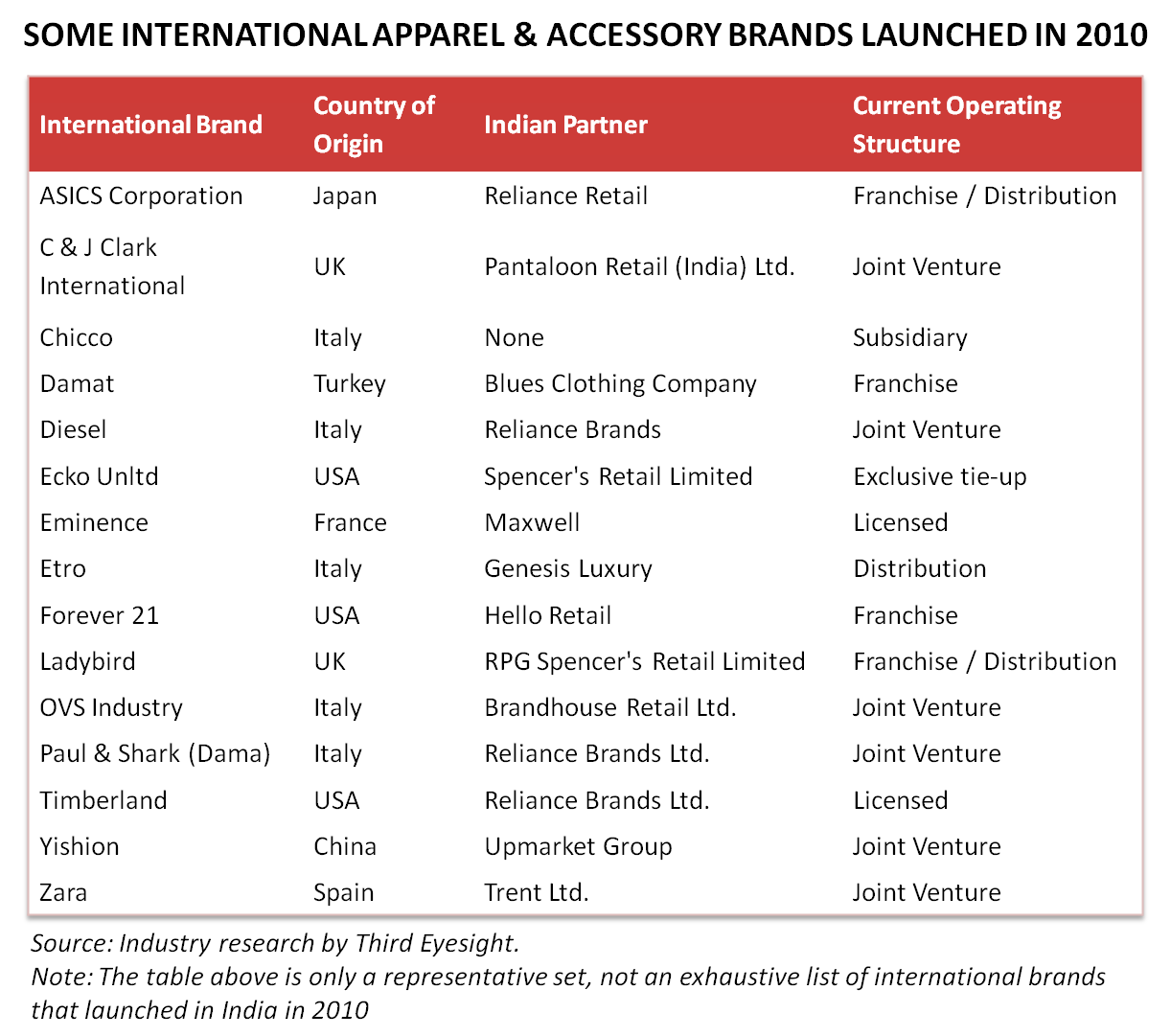
International brands opting for the ownership in the Indian venture included OVS (Italy’s Gruppo Coin), Yishion (China) and Chicco (Italy).
Fast Fashion for the Family
Amongst the new launches, a highlight of the year was the launch of the most awaited and discussed-about brand Zara. The first store was launched in Delhi with menswear, womenswear and childrenswear, followed by a store in Mumbai, and a third again in Delhi. While almost every other brand launches with an advertising blitz, Zara – in its usual fashion – needed none. The news buzz it generated created enough traffic to provide record sales during the first few weekends. It was also instrumental in generating 30-40% more footfall in the malls where it opened.
Inditex was certainly one of the brands looking for control, and has formed a 51:49 joint venture with the Tata Group’s retail business, Trent. For now the company has adopted its global supply chain for the Indian market as well which clearly adds cost and time to the supply chain. The merchandise is imported from the central distribution centre in Spain, and includes products manufactured in the Indian subcontinent. Competing brands in the industry have raised questions about Zara being able to build a successful and sustainable business in India just on the back of rapid fashion changes, at prices that are not quite “competitive”. However, the brand is reportedly aware of the struggle in building a successful business around import-led sourcing model and is seen to have planned growth conservatively.
Another southern European value fashion brand, OVS Industry, was launched last year by Oviesse through a joint-venture with Brandhouse Retail from the SKNL group. OVS Industry also offers a range for men, women and kids. While in the first year products have been imported from Italy, the company says it intends to bring in the merchandise directly from the supply source for speed and cost effectiveness, to achieve aggressive growth over the next five years.
Multi-Brand Platforms, Larger Stores
International brands have been drawn to India by its large “willing and able to spend” consumer base and the rapidly growing economy, but so also are Indian companies – manufacturers or retailers – who are ready to act as platforms for their launch.
Given the current restrictions on investment into retail operations, Indian companies are increasingly setting up large multi-brand outlets for an array of international brands under one roof. This allows the Indian franchisee to share overheads among many brands, and also negotiate harder for shopping centre space that is increasingly unaffordable. However, the idea is not only to gain from the operational efficiencies and cost efficiencies, but also to capture a higher share of the wallet of the consumers walking into the stores.
Even those Indian companies that are already retailing their own brands in a particular category are seeking franchise or distribution relationships with international brands, in order to capture a complementary segment of consumers or to offer a larger choice-set to their existing consumers.
For instance, Reliance Brands has partnered with some well known premium to luxury fashion and lifestyle brands. In 2010 alone, it brought Diesel, Paul & Shark and Timberland to the Indian market. On the other hand Maxwell Industries’ relationship with Eminence, a French innerwear brand, has allowed it to address the premium segment in which it was not present, and to compete with other international players such as Jockey, Triumph, Hanes, Fruit of the Loom and others.
RPG Group’s Spencer’s Retail, one of the pioneers of modern retail in the last two decades is looking at increasing the share of its apparel business. Apart from its private labels, Spencer’s is also actively seeking to grow its international brand portfolio quickly. Following up on its launch of Beverly Hills Polo Club in 2008, Spencer’s introduced Ecko Unltd (a youth fashion brand) in 2010. It has also become the platform for the British childrenswear brand Ladybird in its second coming to India.
While the emergence of large multi-brand franchise outlets is driven by Indian franchisees looking to optimise their businesses, the brands themselves are also looking at larger store sizes that are gradually becoming comparable to their stores elsewhere. For instance, the American brand Forever 21 launched with 10,000 square feet for only women’s western clothing and accessories. Similarly, Zara launched its business with a 14,000 square feet store. Larger stores are allowing brands to increase the efficiency of their operations, maximise the visual impact, and increase the speed at which they can achieve critical mass in the country.
Beyond Europe and the US
While European and American brands clearly dominate, 2010 also saw brands from China, Japan and Turkey making inroads to the Indian market.
China’s apparel retailer Yishion launched a 51:49 joint venture with a distribution company, Upmarket Group. Yishion is aiming at rapid growth in the mid price segment in India through own stores and multi-brand outlets (MBOs).
Turkish brands Tween, ADV and Damat from the Orka Group have been brought to the market by Blues Clothing Company, a mid-sized retailer of fashion apparel that also distributes brands such as Versace, Corneliani and Cadini.
The Strategy Shifts & Changing Structures
In the past the international brands have undergone changes in their strategy and operating structures to suit their current context and changing environment. Last year was not an exception to the correction and some brands did undergo a change in their approach and strategy for the Indian market.
Italian denim brand Energie exited the market and their partnership with Reliance Brands in 2007. However, in 2010, the Miss Sixty group entered into a licensing agreement with Arvind Limited which relaunched Energie as part of its portfolio of international denim brands. Arvind already had international brands catering to the mass and the middle segments of the denim market, and with the launch of Energie, it has achieved brand presence in the super-premium category as well.
Another notable denim brand that re-entered the market in 2010 was GAS, also from Italy. After it fell out with Raymond, the brand investigated other relationships, and finally decided to set up a fully-owned subsidiary. The brand was re-launched with one flagship store and through various shop-in-shop counters at Shoppers Stop, the department store chain.
The second attempt of the Germany-based casualwear apparel brand Lerros owned by the House of Pearl was ill-timed in 2008. With business coming up below expectations, the company decided exit the business in India. But instead of exiting the market, it granted the license to manufacture, retail and distribute Lerros to the maker of the Indian denim brand Numero Uno. With a complementary product mix, the principal and the licensee are looking to achieve greater success together.
Another brand that has undergone a shift in its strategy and the operating structure is the Italian brand Zegna, a world leader in luxury menswear. It was first introduced in the Indian market early on in the decade through a franchise arrangement. In 2005 with 51% FDI being allowed the Zegna Group invested in taking a majority stake in its Indian operations. Last year the brand entered into a joint venture with Reliance Brands Limited with the objective of ramping up its India operations and capturing a larger share in the Indian luxury market. For Reliance, it was a great addition to its international brand portfolio.
Compared to 2009, 2010 witnessed hardly any exits, Aigner being one.
Strategies for Growth and Prospects For 2011
Overall the year 2010 has been very positive and the pace of new brands entering the market is picking up. Those already present in the market, have been adapting their strategies to grow their India business. The growth strategy for international brands has revolved around lowering the prices and entering new segments.
The brands that have rationalised their pricing last year to attract more customers include Adams Kidswear. Previously priced significantly higher than the market leaders in that segment, Adams is looking to change its sourcing strategy and source a part of its product range locally. Similarly, having tasted success in the previous year, The Body Shop not only rationalised prices for more products in 2010, but also introduced new products at lower price points.
Another notable trend last year was the focus of international brands on Tier 2 and 3 cities. Marks & Spencer unveiled its plans to enter Tier 2 cities such as Jaipur and Chandigarh and grow its national footprint. Reebok, Adidas, Ed Hardy, Tommy Hilfiger, The Bodyshop and Puma are amongst those that have stated their intent to further expand to such cities. The success of adopting these strategies is bearing results already and the momentum is likely to build further as others follow.
For international brands, as for Indian brands, significant challenges remain in the path of growing their business.
At the base level is drumming up adequate demand. While India is often compared with China because of similar size of population, the fact is that urban discretionary incomes and the concentration of spend are far higher in China. This reflects in the speed with which brands have been able to ramp up in the two countries. For instance, Mango entered the two markets around the same time. However, a the end of 2010, the network of stores in India was only a tenth the size of the store network in China (100-plus), with over 200 more stores projected to open in 2011.
In scaling up, the lack of affordable good retail locations is one of the other biggest hurdles. With the slow growth in 2008 and 2009, brands are significantly more cautious in signing up space at high rentals.
Future challenges also remain more at the internal operational level. Retaining adequately trained front-line staff is an issue. Not only does the increasing number of international brands increase the competition for the employee pool, so also does growth in other segments of the economy and it is tough to sell retail as an employment option of first-choice.
We expect prices to become more realistic, but also operational efficiency to be a driver. Clustering of stores for efficient management, a concerted drive towards lower cost locations and variable (revenue-linked) payments to landlords are likely to be critical in driving better performance. We also expect many brands to seriously consider scaling up the network to provide critical mass to their business, which can also drive local sourcing of merchandise or direct shipments to the Indian business from Indian and other Asian sources.
If the Indian Government announces further relaxation in the foreign ownership norms, we would expect more brands to take equity stakes in the business in India, including the entry of those that wish to operate fully-owned subsidiaries. However, with many different signals from various arms of the government it is best not to try and read the crystal ball too closely on that issue.
Despite challenges and barriers, the market is far from being saturated right now as newer product segments and product lines create ever-newer needs. With India being one of the few large economies showing consistently strong performance, many more are considering the Indian market seriously. Among the ones reported to be interested in launching are GAP, Uniqlo and Polo by Ralph Lauren.
The market may become more segmented and even fragmented with a plethora of international brands being available.
The largest brands currently include Levi Strauss and Reebok which are both reportedly well past the US$ 100 million mark in India, but the race for market leadership is still well and truly on. No matter which brand comes out ahead the winner, without a doubt, will be the consumer.
Devangshu Dutta
November 30, 2010
This article is based on a presentation at the 2nd International Summit of Processed Food, Agribusiness and Beverages, organised by the Associated Chambers of Commerce (ASSOCHAM) and supported by the Ministry of Food Processing, Government of India. The presentation was made to a mixed audience of retailers, manufacturers, farmers, government functionaries and service providers, and rather than provide answers, the objective was to raise questions that were not being discussed.
The old saying goes: where there are issues, there are opportunities. By that standard, the perishable commodities supply chain offers plenty of issues and, hence, opportunities.
Part of the problem, or opportunity, is that there are so many steps between the farmer and the consumer, so many hands through which the produce passes, especially in the case of India. With every step in this supply chain, there is the potential of waste and deterioration with time, and on the flip side, there is also an opportunity to add value and improve.
Misalignment on Motivation
One core issue, at the heart of most problems with the perishables supply chain, is widely different perspectives and the lack of alignment.
For instance, there is competition at the basic level between cities and villages. But there is even misalignment between the development needs of ever-growing cities that are taking over neighbouring agricultural lands, and the need to feed people living in those very cities. Similarly, the motivations for small sustenance-driven landholders are different from those of the wealthier farmers with large holdings. And, of course, within the supply chain, the tug of war is between consumer vs retailer, retailer vs brand, brand vs producer.
This is but natural in any economy, even more so in India whose rapid growth is widening the already existing gaps and intensifying the inherent disconnects.
Misalignment on Value
However, there is also another significant potential misalignment, of which we need to be keenly aware. This is in the very definition of value.
Given that we have been discussing “value-addition” as a driver for the food supply chain, I think we also need to understand that the word value has various connotations and implications, depending on who we are speaking about. Each throws up different challenges, and needs to be dealt with differently.
In my mind, the three aspects of value related to the food sector are:
The complication is that these three aspects address three very different audiences in society.
For a large part of India’s population, simply providing adequate calories is the main problem. For this chunk of people, not only do we need to have more productive land under use, we need to maximise the output from each piece of land, and ensure that the productive output reaches the population that needs it the most. Within that, there are several social, political, logistical and economic challenges to tackle: clarity of land-holding, availability of arable land to agriculture rather than non-agricultural uses, unit area productivity with efficient use of other resources, safety during transportation and storage, and distribution at prices that are affordable.
Nutritional value is the next step up: packing more nutrients into each gram of produce and delivering the right mix and balance is a critical issue for consumers who get enough calories, but can benefit hugely in physical and mental health through the quality of the nutrition they are taking in.
In pushing up both calorific and nutritional value, we also run into two entirely different debates.
One is whether genetic modification (GM) is desirable. The argument against GM foods is that we shouldn’t tamper with the most basic building blocks of biology, because we don’t understand the implications completely. The powerful argument for GM is that it is a must, to ensure that we have enough and ever-improving food available to a growing population.
The second debate is about organic produce. The organic camp believes strongly that organic is better, nutritionally superior. The other side argues that organic delivers no clear demonstrable increase in either calories or nutrition, and instead pushes production down and prices up: a recipe for complete disaster in a growing country.
But most interesting to me is the fact that in most industry platforms such as this, when we speak of “value-addition”, it is neither calorific nor nutritional value that is being targeted, but only economic value.
Obviously, companies are profit-driven by their very nature, and if calorific or nutritional value does not deliver economic value to them, they will not focus on those aspects. For that reason, most companies engaged in or being encouraged to participate in the food supply chain do so through food processing: the transformation of the basic produce into a manufactured packaged product with higher economic value per gram. A thinking consumer may be tempted to ask, am I getting proportionately better food (especially more nutrition) for the extra unit value that I am paying for orange juice (as compared to oranges), ketchup (as compared to tomatoes) or chips (when compared to potatoes)?
My concern is that such a deep misalignment in the definition of value can cause a huge amount of friction and potential politicisation, especially if only one aspect of “value-addition” is constantly in focus.
Misalignment on Losses
I’d also like to briefly comment on another aspect of value: losses.
We’ve all come across the much-quoted “fact” that in India 30-40% of the agricultural produce is wasted. That’s incredible! A country otherwise so frugal pushes a third of its valuable food into the gutters? Can that really be true?
I have not come across any authoritative study that clearly demonstrates that India actually wastes that much food.
Of course, there is wastage due to improper harvesting, lack of post-harvest processing and gaps in the storage and transportation infrastructure. But that figure, depending on what product and part of country you pick, varies hugely and the overall average is nowhere close to the 30-40% figure.
Overestimating the size of the problem leads to overestimation of the opportunity, and that misdirects investment. I think the correct way to look at the issue is not just in terms of value-lost, but in terms of opportunity lost. There is certainly an opportunity for farmers to grow their incomes by ensuring that better agricultural and post-harvest techniques are followed. If harvesting products at the right time, chilling the produce at the farm immediately, adequate sorting and grading, or even the simple act of washing can lead to higher prices for the farmer, I’m all for it.
The opportunities we are missing may be bigger than the waste that we imagine.
The Drivers of Value
Obviously, the technological, political and business mandate changes dramatically, depending on where we want to focus on building value. Is it to increase, improve, protect or change the produce? Are we going to focus on the seed, on growth, on harvest and post-harvest, on processing, on storage, on packaging or marketing.
Given the diversity of the questions, I think the discussion on value should also include – openly – a widely inclusive group. Obviously large corporate retailers, brands and producers, and the various arms of the government would be part of the discussion, but the table should also have room for farmers of every hue, technology innovators that address not just aggregated large land-holdings but also small farms, and platforms that encourage both ultra-modern and traditional knowledge, both from within India and outside.
By focussing on an over-simplified view of “value-addition”, we risk not addressing fundamental issues. In fact, we could be losing sight of humongous opportunities.
In the food supply chain, we are dealing with a product that is perishable; given our economy’s rapid transformation, the opportunities are perishable, too. We should get cracking.
(To download the PDF of the presentation, please click here.)
Devangshu Dutta
September 4, 2010
The last three years have been a roller coaster ride for food & grocery modern retail in India.
Progressive Grocer’s India edition was launched in September 2007, during what was an excellent series of years for the modern retail trade in the country.
It was a year after the launch of Reliance Fresh, and a few months after the acquisition of Trinethra’s chain of 170 stores by the traditionally conservative Aditya Birla Group. Spencer’s announced its plans to raise capital for expansion, while Food Bazaar together with its value-format non-food twin Big Bazaar already accounted for more than half the Future Group’s sales.
Other than the established corporate groups, new entrants such as Wadhawan were also well into growth through mergers and acquisitions, including their purchase of Sangam, Hindustan Unilever’s experiment at retailing directly to consumers, Sabka Bazaar and The Home Store.
The four largest foreign retailers were also making their presence felt through Walmart’s announcement of a joint-venture with Bharti in August, Tesco’s and Carrefour’s intensive investigations of the market and negotiations with potential partners, and Metro’s announcement of its planned growth to 100 outlets.
The modern retail engine seemed to be chugging along strongly. But there were also spots of trouble in paradise.
Protests against the opening of corporate chain stores were seen in a few states. In some cases state administrations even formally stepped in to ask for closure of corporate chains to avoid civic trouble, and it looked as if the lights were going out even before the party had really started!
Along with the battle between modern and traditional, both sides of the debate on foreign direct investment (FDI) into the Indian retail sector were also ramping up their arguments. There was vocal opposition from emerging large Indian retailers, as well as the small traders group, while investors and some of the prominent retailers championed the cause of foreign investment.
In both debates, international examples of the damage wrought by large or foreign retailers to local economies were quoted by those opposed to corporate retailers. And in both, the developmental aspects of modern retail were quoted by proponents of modern retail and FDI.
At Third Eyesight, in early 2007 we had carried out a study (“From Ripples to Waves”) on the increasing impact of modern retail on the supply chain. Amongst the study’s respondents, both retailers and suppliers had favourable things to say about the growth of modern retail and its impact on the supply chains for various products. There was not just talk of efficiency with fewer layers of transactions and lower costs, but also of effectiveness, with suppliers reporting 10-25% higher per square foot sales in modern retail stores as compared to their displays in traditional independent stores.
After years of resisting the impending changes to their ordering and servicing structures, major Indian FMCG and food brands became busy setting up or strengthening teams focussed on the modern trade or ‘organised’ corporate customers.
The market was rich with format experimentation for food and general merchandise retail, typically between 1,000 sq ft and 10,000 sq ft, but also with a gradual growing emphasis on 20,000-80,000 sq ft supermarkets and hypermarkets.
Literally hundreds of food brands from other countries actively sought to tap into the growing Indian market, and modern retailers offered them a familiar environment and a well-managed platform for launch.
At the same time, plenty of respondents also said that they had not made any significant changes to their business. Either inertia or fear of channel conflict was preventing them from pushing ahead with newer business models.
In short, there was no dearth of action and contradiction, no matter where you looked.
However, towards the end of 2007 and beginning of 2008, we had a sense of foreboding. With the rush to expand the store network to get first to some yet-invisible finish line, both property acquisition and human resource costs were driven up by a feeling of a shortage in both. I recall writing a column around that time, urging retailers to look at store productivity as their first priority (See: Priority #1: Store Productivity, Same Store Growth).
By the middle of 2008 the crisis was evident. There was a lot of square footage, much of it in the wrong places. There were issues with the supply chain for managing fresh and perishables, those very products that drive frequent footfall into a food store. More importantly, the global financial storm had started gathering strength, reducing liquidity in the market and making investors and lenders look more closely at existing business models.
The spectacular meltdown of Subhiksha in 2008, and the more gradual but equally deep impact on other businesses was visible. And worrying. Players as disparate as Reliance, with its ambitious plans to grow into a Rs. 300 billion retail juggernaut, and the Shopper’s Stop premium format Hypercity seem to take a break to rethink.
2008 and 2009 were years that I am sure many retailers would like to forget, but they were also very valuable. Some people have compared these years to the churning of the ocean (manthan) by the devas and the asuras in Indian mythology, with the deadly poison halahal coming to the surface before the divine nectar amrit could be reached.
In these two years, we have seen stores closed, formats changed, and organisations made slimmer. Store staff have discovered how to live with small changes like higher ambient air-conditioning temperatures, and are learning the more important science of higher transaction values, even with leaner inventories. Management teams are becoming more accustomed to looking at retail metrics other than only sales growth that could be achieved from new square footage. Vendors are finding newer ways to make their brands more relevant to consumers and to the retailers.
More importantly, these years have also underlined the importance of India as a growth market to non-Indian companies.
2010 so far seems a far happier year. Income and GDP growth figures look much healthier. Real estate inventories in malls that were not released in 2007-2009 are coming on the market, many at terms that are more favourable than earlier. Retailers’ financial results look healthier.
There could always be the temptation to rush headlong into growth again. But I don’t think food retailers or their vendors should drop their guard yet.
The coming months and years need significant sharpening up of customer insight, merchandise and inventory planning capabilities and supply chains. Operational assessments, analytics, organisational capability building, are all tools which will need to be looked at closely.
We are at the cusp of the next growth curve, as the population grows and matures, and the market become more sophisticated.
Though the large-small, local-foreign debate isn’t closed yet, the much-awaited approval from the government to allow foreign investment into multi-brand retail businesses may be around the corner.
Even if FDI doesn’t happen immediately, the majors are already in or preparing to enter and ride the consumption growth that will logically happen. In addition to its support to Bharti’s Easyday chain, Walmart has launched its cash and carry operation, Bestprice. Carrefour reportedly is looking to open its first Indian (wholesale) outlet by November in New Delhi on its own, even as rumours of a partnership with the Future Group fly thick and fast. And Tesco is steadily steaming ahead with the Tata group.
And practically every month we are seeing new products and even new brands being launched by Indian and non-Indian companies.
An old saying goes: the journey of a thousand miles begins with a single step.
From the tumultuous events of the last three years, it seems that the Indian food retail sector must have travelled at least a few hundred miles already. In one sense it has. Many of the developments that we’ve seen in three years would have taken at least a couple of decades in the more mature markets.
However, in another sense, the food and grocery modern retail sector in India has only taken the first few steps, with much to be accomplished still. The sector remains fragmented, and wide swathes of the market are yet to be penetrated – not just by modern trade, but even by brands that already supply traditional retail. The blend of players and business models, not to forget the spicy regional mix of different market segments, promises valuable lessons not only for those in India but potentially for other markets in the world.
There are very big questions seeking answers. How to improve agricultural productivity so that food security is ensured. How to save the abundant harvests rather than letting them rot in unprotected storage dumps. How to ensure adequate calories and nutrition get delivered not just to the wealthy and the middle class, but also to the poorest in the country.
On the retail side, the Indian versions of Walmart, Carrefour and Tesco are possibly still in the making, and may yet surprise us with their origins and growth stories. And e-commerce is a work-in-progress that may be the dark horse, or forever the black sheep.
I think the big stories are yet to unfold, and the unfolding will be exciting, whether we are just watching or actively participating in the modernisation of the Indian food retail business.
Devangshu Dutta
August 17, 2010
Most of the people reading this would be familiar with fast food, and think of it as a cheap, tasteless, “throw-away” excuse for food. You may think of it as a deeply penetrated product category, close to being ubiquitous.
Here’s a picture that tells the other story.
For these kids, who are clearly not able to afford the products, the fries, burgers etc. are aspirational and exciting. For them, McDonald’s is clearly not open early enough (in their lives).
It’s a different perspective when you look through the other side of the glass, I guess.

