
admin
November 26, 2025
Aakriti Bansal, Medianama
November 26, 2025
MediaNama’s Take: The Central Consumer Protection Authority’s (CCPA) decision to publish 18 self-declarations confirms only a partial picture of its dark pattern(s) identifying exercise. The authority has stated that 26 platforms have filed their declarations, but it has made only 18 of them public. This gap means the public still cannot see what eight major platforms submitted or whether those filings contain any meaningful detail. Moreover, even among the published declarations, several are one-paragraph statements that offer almost no insight into the scope or accuracy of the companies’ internal audits.
LocalCircles’ new survey adds further complications, reporting that 21 of the 26 platforms that submitted declarations still display at least one dark pattern. This finding suggests that the CCPA’s reliance on voluntary self-assessment may not be enough to shift platform behaviour at scale. It also raises questions about what the unpublished declarations contain and whether the missing submissions are similarly sparse or incomplete.
Notably, the CCPA has not clarified how it plans to verify the accuracy of any of the declarations, whether published or unpublished. If filings remain unverified for months, compliance risks turning into a box-ticking exercise rather than a meaningful regulatory process. Therefore, the next phase matters far more than the publication of select declarations, because the current approach raises more questions than it answers.
What’s the News
The CCPA has made 18 dark pattern self-declarations public, despite stating that 26 platforms have filed their compliance letters. The publication follows an RTI filed by MediaNama that revealed which companies had submitted their declarations, and pointed out that none of the filings had been available to the public at the time.
These declarations stem from the Ministry’s June 5 advisory, which required e-commerce and quick commerce companies to conduct internal audits under the 2023 Guidelines for Prevention and Regulation of Dark Patterns and submit compliance letters within 90 days.
For context, Moneycontrol reported that Amazon has still not filed its declaration and has asked for additional time. A senior government official told the publication that the government “has done what it had to” and does not plan further discussions.
The official also said that any punitive action would depend on consumer complaints routed through channels such as the national consumer helpline. This indicates that the enforcement approach continues to be reactive rather than compliance-driven.
What Did The CCPA Ask Platforms To Do?
The June 5 advisory set out a simple compliance framework for digital platforms. It asked every e-commerce and quick commerce company to complete a self-audit of its website and mobile app within 90 days and check their interfaces for the 13 dark patterns listed in the 2023 guidelines. Platforms were required to file a self-declaration confirming compliance once this internal review was complete.
However, the advisory did not specify how the audit should be conducted. Companies were free to choose any methodology, and the CCPA did not prescribe a standard format, a uniform checklist, or a minimum evidence requirement. Also, the advisory did not require independent audits or third-party validation.
Furthermore, there was no explanation of how the CCPA planned to verify whether the declarations were accurate or complete. In effect, the responsibility for defining the scope, depth, and rigour of the audit rested entirely with each platform.
What the CCPA Has Done With the Declarations
As mentioned before, the CCPA has now published 18 self-declarations on its website. The release confirms that companies submitted their compliance letters, but it does not indicate whether the authority evaluated the accuracy or depth of the filings.
Several platforms submitted very short statements that simply assert compliance without describing any checks or findings. BigBasket, Zomato, Blinkit and Swiggy were among the companies that filed especially minimal disclosures. The CCPA has not explained why these filings were accepted or whether any follow-up questions were asked. Therefore, asking for and disclosing self-declarations shows some administrative progress, but it does not reflect any regulatory scrutiny.
This lack of verification aligns with concerns raised by Devangshu Dutta, Founder of business consulting firm Third Eyesight. He told MediaNama that self-declarations “do not change things much” when regulators do not audit submissions or impose consequences.
Further, Dutta remarked that most companies comply at the minimum level required if their claims are not examined and are not made public in full. According to him, revenue-driving design choices such as forced add-ons, confusing checkout flows or misleading scarcity claims will not be voluntarily removed sans oversight.
What Independent Evidence Shows
LocalCircles’ latest audit presents a sharply different picture from the companies’ filings. The organisation found that 21 of the 26 platforms that submitted “dark pattern free” declarations still use one or more manipulative design practices. The assessment relied on feedback from more than 250,000 consumers across 392 districts along with AI-assisted testing.
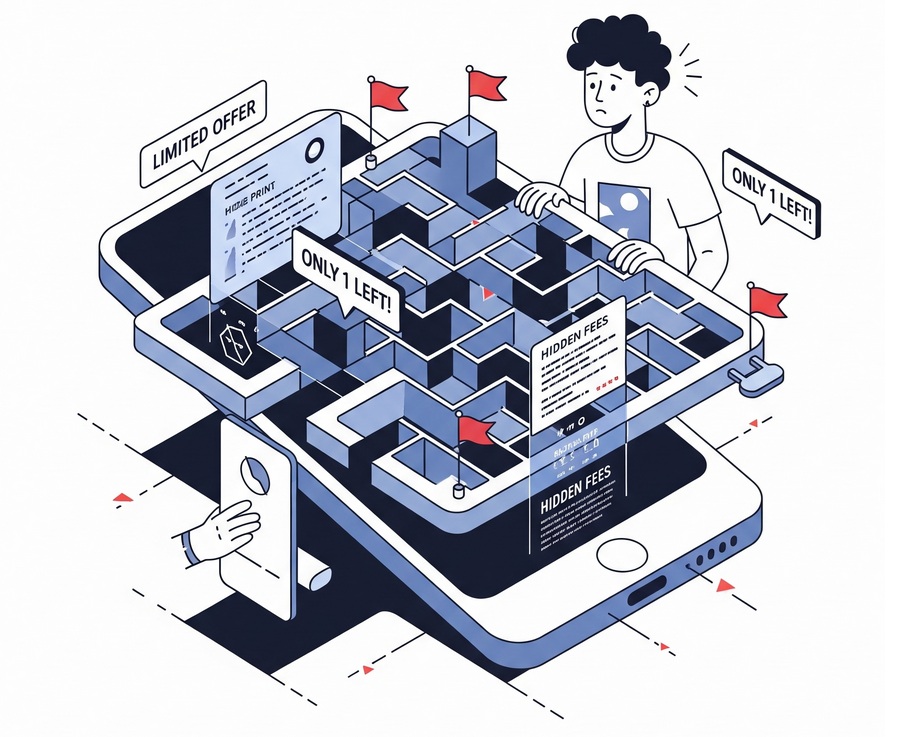
The most common violations include forced action, subscription traps, bait and switch, basket sneaking, interface interference and disguised advertisements. In practice, these dark patterns respectively mean that users are pushed into steps they did not choose, face hidden or hard-to-cancel subscriptions, see offers change during checkout, encounter fees added at the last moment, get nudged toward platform-favoured choices, and come across ads that appear as regular listings.
LocalCircles also identified drip pricing (gradually adding mandatory fees during the checkout process) on 11 of the 26 companies, including Flipkart, Myntra, Cleartrip, MakeMyTrip, BigBasket, Zomato and Blinkit, among others. The organisation said that many platforms appear to misunderstand what qualifies as drip pricing, which has led to incomplete corrections.
Trust Can Erode Due To Gap Between Declarations And User Experience
Sachin Taparia, Founder of LocalCircles, said that the problem begins with the absence of any verification. “Our understanding is that CCPA is wanting that companies submit a self-declaration at the earliest. However, there is no cross checking of claims that is being done by the CCPA, and as a result the companies are not being as thorough with their dark-pattern detection and resolution,” he said.
Taparia added that discrepancies between declarations and user experience could harm trust. “LocalCircles has found dark patterns on 21 of the 26 platforms submitting self-declarations. If this exercise is not done with high accuracy, both platforms doing so and CCPA could see consumer trust being impacted,” he said.
Importantly, Dutta echoed this concern, saying that the absence of penalties or reputation-related consequences allows companies to self-declare compliance while keeping revenue-generating patterns intact. He described the current process as “more an administrative formality [rather] than a behaviour-changing regulatory tool”.
Why This Matters
The gap between self-declarations and independent audits in the true sense of the word brings the real enforcement question into focus. What should the next phase of regulation look like?
In this context, Dutta said that regulators need to move beyond self-certifications and mandate detailed user experience (UX) audit reports that map every user journey, including pop-ups, onboarding, search, checkout, cancellations and returns.
He explained that regulators should reinforce this by demanding substantive evidence instead of brief compliance letters. This evidence can include screenshots and screen recordings of key flows, version histories that show how an interface changed over time, and product design documents or A/B testing results that reveal why specific nudges were introduced. To explain, A/B testing is essentially a method for comparing two versions of something to see which one performs better.
Furthermore, Dutta noted that platforms already collect extensive data on user complaints and drop-off points, which can help identify harmful or confusing design choices. He also said that independent third-party attestations, similar to security or accessibility audits, can provide a credible external check and increase the cost of non-compliance.
Multiple Annual Audits For Apps that Change Interface Frequently
Notably, Dutta stressed that most dark pattern categories appear across e-commerce, quick commerce and Direct-to-Consumer (D2C) websites, which means regulators can create a baseline audit standard that works across sectors instead of relying on platform-specific interpretations. He also suggested that audits should occur at least once a year, and companies that frequently modify their interfaces may need to report two or three times annually.
The larger concern now is whether the CCPA plans to move toward such a structured framework. Without independent verification and clear audit expectations, companies can continue declaring compliance even when manipulative designs remain embedded in their interfaces.
(Published in Medianama)
admin
September 3, 2025

Aakriti Bansal, Medianama
3 September 2025
The Goods and Services Tax (GST) overhaul simplifies India’s tax structure and lowers prices for many goods. However, for e-commerce sellers, the change arrives at the worst possible moment. Platforms and sellers must adjust billing systems, invoices, and inventory records just as the festive season begins.
The festive period drives the highest order volumes of the year, and even minor disruptions in invoicing or compliance ripple through the system. Refunds get delayed, seller–platform relations strain, consumers face frustration, and penalties under GST law escalate. Moreover, the episode shows the fragility of India’s e-commerce compliance infrastructure.
Larger sellers can rely on manpower and technology, but smaller businesses remain disproportionately exposed. Platforms, meanwhile, cannot act as neutral intermediaries when their invoicing systems directly control seller compliance. The question now is whether the government, platforms, and sellers can move fast enough to make structural reforms without turning them into seasonal flashpoints.
What’s the News?
The GST Council, chaired by Finance Minister Nirmala Sitharaman, is meeting today and tomorrow (September 3–4), according to a report by Hindustan Times, to decide on a major overhaul of India’s tax system. The timing has already unsettled e-commerce. Platforms like Amazon, Flipkart, and Meesho are holding back on announcing festive sale dates, while sellers report uncertainty about how to handle inventory already billed at old rates.
Shoppers are delaying big-ticket purchases such as smartphones, televisions, and appliances, creating a visible slowdown in demand. Retailers are carrying higher stock levels, waiting to recalibrate pricing once the Council clarifies the new slabs. The pause comes just before the festive sales period, which typically contributes about a quarter of annual revenues for e-commerce platforms.
What the GST Reforms Are
The government has proposed collapsing the four-tier GST structure of 5%, 12%, 18%, and 28% into two slabs of 5% and 18%. A new 40% tier would apply to luxury and sin goods, replacing the existing compensation-cess mechanism.
If the Council approves, several categories will see rate changes. White goods such as washing machines, air-conditioners, smartphones, refrigerators, and televisions would move from 28% to 18%. Small petrol cars and motorcycles would also shift from 28% to 18%. Essentials including ghee, nuts, namkeen, packaged drinking water, and medical devices would drop from 12% to 5%. Everyday consumer products like toothpaste, shampoo, soap, and ready-to-eat foods would also move into the 5% bracket.
The 40% tier would target high-end cars, premium electric vehicles, tobacco, and pan masala. States have pushed back, warning of revenue losses, and discussions are underway on whether higher levies on luxury items or cess surpluses can offset the shortfall.
Implementation Challenges
Satish Meena of Datum Intelligence, a market research firm, flagged the absence of a transition window as “very tricky.” “Everyone wants to make the change because this is the peak sale time,” Meena explained. “But the challenge is how it will be implemented for goods already in warehouses. Once inventory has moved from the company to the warehouse under the old GST, how will you pass on the benefit to the customer?”
Devangshu Dutta, chief executive of Third Eyesight, a retail consulting firm, pointed to similar risks. “Sellers will need to rapidly adjust pricing strategies and inventory details, keeping in mind that the festive season is upon us,” Dutta explained. “One would hope that the changeover of rates doesn’t create supply unpredictability in this critical season.”
Abhishek A. Rastogi, founder of Rastogi Chambers, a law firm specialising in indirect tax and regulatory matters, warned about compliance fallout.“From a compliance perspective, the biggest challenge will be ensuring real-time alignment between product listings, tax rates, and invoices generated. Even a minor mismatch in billing, particularly during the high-volume festive season, could result in serious exposure,” Rastogi said.
Impact on Smaller Sellers
Experts agreed that smaller sellers carry the heaviest burden. “Larger sellers with manpower and technology will cope faster. Smaller sellers will face particular challenges,” Meena noted.
Dutta explained why smaller businesses feel the squeeze. “Businesses of all sizes face the burden of compliance and accurate reporting, but smaller businesses feel the impact disproportionately as their management resources are far more limited. Often it is the owner-manager, the most critical human resource in a small business, whose time gets sucked into ensuring the changes go through smoothly,” he said.
Moreover, Rastogi advised small sellers to act defensively. “Smaller sellers must ensure they maintain proper records of their communications with platforms, raise tickets on billing mismatches, and document tax advice received. Such proactive record-keeping will protect them if litigation arises later. They should also consider contractual safeguards when signing with platforms,” he said.
Platforms Under Pressure
Platforms also operate under strain. Meena pointed out that festive sales remain unannounced. “Typically, the sales should be in the week of October 13–14, or the following week. That has not been announced till now because of this GST issue,” he said.
Dutta argued that platforms must step in to steady sellers. “Sales, inventory, and return reconciliation is an ongoing issue and potential point of dissatisfaction among sellers. To avoid adding to this, e-commerce platforms need to provide enhanced seller support to smooth out the turbulence during the GST changeover,” he said.
Rastogi underlined that platforms share liability. “Legally, the burden to discharge GST liability lies on the seller. However, given that invoicing systems are often managed by e-commerce platforms, there is a shared responsibility to ensure the correct GST rate is applied. Any platform-level error that causes sellers to become non-compliant could become a contentious issue,” he explained.
He also laid out remedies. “Sellers impacted due to platform-level glitches can seek remedies under contract law and indemnity clauses in their agreements with the platform. They may also explore legal recourse if non-compliance is triggered without their fault. Ultimately, disputes of this nature will test how liability is apportioned between sellers and platforms,” Rastogi mentioned.
Consumer and Market Effects
The uncertainty already shapes consumer behaviour. “There is already a decline in demand over the last two weeks as customers are delaying purchases, waiting for festive discounts,” Meena observed. “If sales are pushed too close to Diwali, customers may move to offline stores where delivery is immediate and pricing on appliances can match e-commerce.”
Notably, Dutta pointed out that offline businesses could benefit. “Small offline businesses that don’t have GST numbers and don’t need to compile GST returns may be able to quickly benefit from lower input costs and may be able to become more price competitive,” he said.
Need for Government Clarity
Both Dutta and Rastogi called for immediate guidance.
Dutta warned that reforms must not create “supply unpredictability in this critical season.”
Rastogi pressed for intervention. “There is a strong case for the government to issue clarificatory circulars or transitional relief, particularly given the festive season volumes. Without such guidance, both sellers and platforms face a high risk of disputes, and the compliance ecosystem may be overburdened,” he noted.
Why It Matters
The GST reforms land as festive season spending sets the direction for the retail year. E-commerce platforms draw about a quarter of their annual revenues during this period, and sellers use these weeks to recover margins. Datum Intelligence estimates that online shoppers will spend around Rs. 1,20,000 crore in 2025, up 27% from 2024, with quick commerce taking 12% of that share. At this scale, even small invoicing or compliance errors can lock up billions of rupees in disputed sales.
The reforms already shape consumer behaviour. Shoppers hold back purchases while they wait for clarity on tax rates, and platforms face pressure to adjust quickly. If festive sales move closer to Diwali, buyers may switch to offline stores that match appliance prices and provide immediate delivery.
The rollout will show whether platforms and sellers manage a nationwide tax change in the middle of their busiest season or allow it to disrupt India’s largest online retail channel.
(Published in Medianama)
