
admin
December 17, 2013
 Raghavendra
Kamath, Business Standard
Raghavendra
Kamath, Business Standard
Mumbai,
December 17, 2013
 In
a move that will pave its way to enter Indian retailing segment,
UK-based retailer Tesco is picking up 50% stake in Trent Hypermarkets
run by Tata-owned Trent.
In
a move that will pave its way to enter Indian retailing segment,
UK-based retailer Tesco is picking up 50% stake in Trent Hypermarkets
run by Tata-owned Trent.
Tesco will make an application to Foreign Investment Promotion Board, Trent said in a statement today. Tesco already has a franchise agreement with Trent to provide background support to Trent in terms of technical know-how, sourcing and so on. Trent Hypermarkets runs 16 Star Bazaar branded hypermarkets in the country.
Trent said the proposed venture will build on existing portfolio of Star Bazaar stores in Maharashtra and Karnataka.
"The application envisages a minimum foreign direct investment in line with the applicable multi brand retail trading policy," the statement said. According to reports, Tesco is expected to make an investment of $110 million in India.
Noel Tata, Vice Chairman of Trent, said: “The application is a positive step forward in the relationship between the Tata Group and Tesco. We believe that our understanding of the Indian market coupled with Tesco’s unparalleled global retail expertise will allow us to leverage the tremendous potential of the market to the benefit of all stakeholders.”
Devangshu Dutta, chief executive, Third Eyesight, a retail consultant said: "When Tesco got into partnership with Tatas, the intent was to look at retail and not the back-end. Whenever Tesco expanded into new markets, they have done high level of localisation. In partnership with Tatas, they worked in the back-end, so its logical thing to take this partnership to a joint venture in retailing."
Dutta says many South Korean and japanese retailers are looking at Indian market seriously.
"Given the size and growth rate of India, any retailer who is looking to build a significant business in overseas markets, will look at India. Timing may not be appropriate for some of them, but they will definitely pursue their India plans", he said.
Tesco has a wholesaling business in the country and a global support centre based out of Bangalore.
admin
December 17, 2013
Palash
Ghosh, International Business Times
December
17, 2013
 British
supermarket and retailing giant Tesco PLC said it wants to open
multibrand stores in India, making it the first international
retailer to enter the huge Indian market after New Delhi lifted
restrictions on foreign investments into the retail space in September
2012. Tesco, the third-biggest retailer in the world, has applied
to India’s Foreign Investment Promotion Board and initially plans
to invest $110 million in the country. On acceptance of the bid,
Tesco will operate in India through a 50-50 partnership with the
Mumbai-based conglomerate, Tata group.
British
supermarket and retailing giant Tesco PLC said it wants to open
multibrand stores in India, making it the first international
retailer to enter the huge Indian market after New Delhi lifted
restrictions on foreign investments into the retail space in September
2012. Tesco, the third-biggest retailer in the world, has applied
to India’s Foreign Investment Promotion Board and initially plans
to invest $110 million in the country. On acceptance of the bid,
Tesco will operate in India through a 50-50 partnership with the
Mumbai-based conglomerate, Tata group.
According to its application, Tesco proposes to open three to five stores every financial year and plans to sell 14 categories of products, including tea, coffee, vegetables, fruits, meat, fish, dairy products, wine, liquor, textiles, footwear, furniture, electronics, jewelry and books. Under new rules approved by India’s trade ministry last year, foreign investors can now own up to 51 percent of their operations in the country, which is perhaps one of the largest untapped retail markets left in the world, not only due to its sheer size, but its rising middle class.
Specifically, Tesco said it will enter India by investing in the Tata-controlled Trent Hypermarket Ltd., which operates the Star Bazaar and Star Daily franchises in the western India province of Maharashtra and in the southern state of Karnataka.
India had not received any such application by a foreign retailer
until now (15 months after the government removed investment barriers),
partly due to heavy government regulations and serious political
opposition. Indeed, recently Wal-Mart, the largest retailer on
the planet, canceled a joint venture with India’s Bharti
Enterprises, due to draconian regulations. "We welcome the
decision of Tesco to invest in India," India’s Commerce
and Industry Minister Anand Sharma told reporters. "And on
our part, we assure them all support for expedited clearances.
… We hope that this will mark a new beginning in transforming
India’s retail industry. I am sure that the other global [retail]
leaders will also look at investing in India.”
In August of this year, the Indian government further relaxed foreign investment rules by permitting global multibrand retailers to obtain 30 percent of their products – i.e., sourcing — from local small and medium enterprises only at the beginning of their business operations, Business World reported. They will also be permitted to open shop in cities with populations below 1 million (which they had been banned from doing previously).
Interestingly, Tesco has decided to close its unprofitable stores in Japan and the United States (while restructuring its underperforming locations in its British base), but seems to think India offers huge potential. "We believe that our understanding of the Indian market, coupled with Tesco’s unparalleled global retail expertise, will allow us to leverage the tremendous potential of the market to the benefit of all stakeholders,” said Noel Tata, the vice chairman of Trent Limited, according to Press Trust of India. Tesco also operates stores in China, South Korea, Thailand, Malaysia, Poland, Hungary, Ireland, Slovakia, Czech Republic and Turkey.
However, given India’s slowing economy and lack of corporate investment, Tesco may be entering into some risky waters. In India, the opening of the country to foreign retailers remains controversial – opponents of the ruling Congress Party fear this will eliminate millions of the country’s small grocery stores. In response, Reuters noted, the government insists such investment will create millions of jobs and improve efficiencies in moving the food supply from farms to store shelves (thereby reducing the amount of food that has rotted and contributing to food price inflation).
However, another factor at play is next year’s general elections,
which could remove the Congress Party from power and put in place
the opposition Bharatiya Janata Party (BJP) party, which generally
opposes retail ventures from foreign entities. "The new
[investment] rules have removed some major stumbling blocks and
should encourage foreign retailers to enter India," said
Devangshu Dutta, head of retail consultancy Third Eyesight. "[But]
most [foreign] retailers are still likely to wait for the outcome
of the elections next year before they make a decision.”
(This article appeared in the International Business Times.)
admin
December 14, 2013
Vishnu Rageev R, Money Indices
New Delhi, December 14, 2013
 An
empowered middle-class has been fuelling the growth of India all
these years, prompting multinational companies like Coca-Cola
India, fondly called Coke, to (re)strategise and relook at its
markets for a better share from the country’s continually
widening multi-billion dollar retail basket.
An
empowered middle-class has been fuelling the growth of India all
these years, prompting multinational companies like Coca-Cola
India, fondly called Coke, to (re)strategise and relook at its
markets for a better share from the country’s continually
widening multi-billion dollar retail basket.
The company, which has seen six consecutive years of double-digit
growth, will settle with an additional investment of $5 billion
to deliver innovation, develop business relations and strategic
partnerships, uplift consumer experience, ensure product affordability,
and build countrywide brand loyalty in the coming years.
Some interesting times are in store for Coca-Cola India, as the CEO of its historic rival PepsiCo, Indra Nooyi, recently announced an investment of $5.5 billion in the country by 2020. The proposed investments by these two cola giants, estimated at $10.5 billion, will restore foreign investor confidence at a time when India’s growth story has been hit by economic turbulences, pushing it to a decade low.
“We are here to be successful,” said Ahmet C Bozer, Executive Vice-President, The Coca-Cola Company (TCCC), at an interactive session in Greater Noida, after the opening of Coca-Cola’s 57th bottling plant in India. “India would continue to flourish and our $5 billion investment plan is very well on track. We do not anticipate it to come down. Rather, it can be more. I see India emerging as one of the top five markets for TCCC by 2020.”
The non-alcoholic ready-to-drink beverage industry, which witnesses one of the largest investments in the country, has contributed significantly to the growth of allied industries. This industry is witnessing robust growth, driven by a combination of factors such as increased investments and innovations. Macro-indicators and the demographic dividends too favour robust growth for the beverage industry in India.
20 years of happiness
In 1977, George Fernandes, the Industry Minister in the then Janata Party government of Prime Minister Morarji Desai, issued an exit order to Coca-Cola. Although reasons for the exit order are still unknown, it was widely rumoured that the exit was ordered because the company was reluctant to share its secret formula with the government. However, India was too big a market to be kept off its radar forever.
“Our last two decades have been a journey of innovations, offering portfolio choices to consumers, contributing to the growth and development of the community and society in our own small way and playing a key role in bringing overall economic growth and development to India,” says Deepak Jolly, Vice-President, Public Affairs & Communications, Coca-Cola India & South West Asia. “Along the way, we have seen the acceptability of packaged beverages growing. Today, packaged beverages are a convenient and safe source of hydration, refreshment, and nutrition. Our lives are much easier with the pick and go options of packaged beverages, which have become a part and parcel of our everyday lives and count as good value-for-money options.”
Coca-Cola India has specifically been adaptive to the Indian environment. The company learnt quickly from their initial mistakes and tweaked its business model. Instead of worrying about competition, the company focussed on the consumer, which was an apt strategy.
“Over the last 20 years, Coca-Cola has made a genuine attempt to touch the lives of Indian consumers and be a part of their lives,” feels Jagdeep Kapoor, Chairman and Managing Director of Samsika Marketing Consultants Pvt Ltd. “Whether it is in terms of distribution spread or in terms of adapting to the Indian language in their advertising campaign, they have tried to be relevant to the Indian consumer through ‘Thanda Matlab Coca-Cola’ and the message of ‘Opening up Happiness’ and spreading indulgence through ‘Haan Mein Crazy Hoon’. Their focus on distribution, penetration and their aggressive ‘Prizing Sizing’ strategy has helped grow volumes and gain consumer acceptance.”
Coca-Cola India currently provides direct and indirect employment to over 1,50,000 people. The company provides extensive support to community programmes across the country through a series of Corporate Social Responsibility (CSR) initiatives focussing on education, health, and water conservation. ‘Support My School’ campaign is the company’s flagship CSR programme which has revitalised close to 200 model schools in India.
Quenching India’s thirst
For the Atlanta-based TCCC, a country of 1.2 billion people remains one of the last big frontiers as Indians on average consume only 12 eight-ounce bottles of Coke a year when compared with 230 bottles in Brazil and 92 bottles globally. Through horizontal expansion, the company is looking to increase per-capita consumption in India.
“The non-alcoholic ready-to-drink beverage segment has been growing at a compound annual growth rate (CAGR) of 13 per cent since 2009, and is one of the segments that have defied the economic slowdown,” adds Arvind Varma, Secretary General, The Indian Beverage Association (IBA). “We expect the country’s beverage industry to continue to grow in double digits in 2013, despite the recessionary trends being shown by most economies the world over, including the Indian economy.”
“We are working on a strategy to generate sales of our soft drinks across all seasons rather than just the summer,” adds Deepak Jolly. “We are working to de-seasonalise the business and want to make it a 12-month business. That means not just year-round marketing, but efficient distribution systems, reaching remote untapped markets, affordable pricing, innovative cooling solutions, and trade activation. Our spending will be in keeping with our brand plans, and our communication strategy will also be aligned to this business reality.”
“Yes, it is critical for Coca-Cola to tweak their existing business circus in India,” says Ramanujam Sridhar, Founder and CEO, Brand Comm. “India’s beverage market has evolved and is as promising as any foreign market. You might remember that earlier, beer was a beverage which was consumed only during summer. Today, there are customers for beer round the year. Coca-Cola also has to apply a similar strategy by creating occasions and moments in its customers’ mind so that they would come for it on a daily basis. Of course, it is a great brand.”
The company has introduced many revolutionary strategies over the last 20 years. It even introduced a few innovations like solar cooler, Vitingo, Minute Maid Nimbu Fresh, PET bottles, fountains, dispensers, etc.
Growing portfolio and volume
On October 24, 1993, Coca-Cola was launched in Agra. Since then, Coca-Cola India has taken rapid strides in the packaged beverage market, bringing two of the country’s largest soft drinks brands – Thums Up and Sprite – into its portfolio. Coca-Cola India is now one of the fastest growing brands, registering an 18 per cent volume growth during Q3, 2013.
“We have registered volume growth in India for the past 29 consecutive quarters, 19 of which have seen double-digit growth,” informs Deepak Jolly. “Over the last six years, Coca-Cola has delivered double-digit volume growth in India. Two of the company’s core sparkling brands – Sprite and Thums Up – are the country’s top-selling soft drink brands. Trademark Coca-Cola is one of our fastest growing sparkling brands and Maaza is India’s largest-selling juice drink. Kinley is the country’s largest retail packaged drinking water brand.”
Offering an unmatched portfolio of beverages, Coca-Cola India manufactures and markets brands like Coca-Cola, Diet Coke, Thums Up, Fanta, Limca, Sprite, Maaza, Minute Maid Pulpy Orange, Minute Maid Nimbu Fresh, Minute Maid Mixed Fruit, Minute Maid Apple, Minute Maid Guava, Minute Maid 100% Juice (Minute Maid Apple, Minute Maid Orange, Minute Maid Grape), Georgia, Georgia Gold, Kinley, Kinley Club Soda, and burn through a network of over two million outlets.
Seemingly, India remains among the top growth markets for the American multinational. Other major growth markets are Thailand with 18 per cent growth, Russia (8 per cent), Mexico (3 per cent), and Brazil (3 per cent).
Cola business of Coca-Cola
At the core of Coca-Cola’s business in India, as in the rest of the world, is its production and distribution network, called “Coca-Cola system”.
In India, the Coca-Cola system comprises a wholly-owned subsidiary of The Coca-Cola Company, namely Coca-Cola India Pvt Ltd, which manufactures and sells concentrate and beverage bases to authorised bottlers who use these to produce “our portfolio of beverages”, says Deepak Jolly. These authorised bottlers independently develop local markets and distribute beverages to grocers, small retailers, supermarkets, restaurants, and numerous other businesses. “In turn, these customers make our beverages available to consumers across India.”
The Coca-Cola system in India now operates 58 manufacturing plants, catalysing economic growth and providing employment, explains Deepak Jolly. “Coca-Cola, along with its bottling partners, has robust plans to capture growth in India with investments in innovation, expansion of distribution network, cold drink equipment placement, and augmentation of manufacturing capacity.”
The Coca-Cola system has already invested $2 billion in India between 1993 and 2011, refreshing and hydrating consumers more than 500 times per second. The company is also one of the largest buyers of sugar, mango pulp, and coffee beans in India.
Cola war
Coca-Cola and PepsiCo together dominate the market for carbonated soft drinks in India, where soda sales overall are estimated to total $1.05 billion. Coca-Cola enjoyed leadership position in carbonates in 2012, accounting for 60 per cent of the total value of sales, points out a study by Euromonitor. “Stronger distribution in the existing categories and entry in new markets in rural India helped the company retain its strong position,” says the study.
Coca-Cola and Pepsi are healthy and historic rivals and they would continue to be so, says Varma of IBA. “It is an ongoing market race all over the world wherever both these cola giants are present. India is not an exception. It is really difficult to say who is better than the other. India has enough room for both the companies to grow and multiply. The market would further open as they bring in more investments.”
Elections or no elections, PepsiCo’s India-born Nooyi said the firm would invest $5.5 billion by 2020 to more than double its capacity. “We are not guided by elections. We are guided by the potential of India. We are not waiting for any election results. We are investing in India for its economic story,” Nooyi had told recently after her meeting with Finance Minister P Chidambaram.
Pepsi had a head-start in India over Coca-Cola in its current avatar not only in terms of timing, but also in terms of distribution, reach, and product diversification (supported by Pepsi’s global M&A activity during the 1990s and 2000s), opines Devangshu Dutta, Chief Executive, Third Eyesight. “Pepsi has a larger proportion of non-carbonated beverages and a packaged snack portfolio that Coca-Cola lacks, which potentially provides a larger share of wallet to Pepsi and provides avenues for consumers who may be looking at relatively ‘wholesome’ options.”
Pepsi has 42 plants in India, including franchises. “India is a country with huge potential and it remains an attractive, high-priority market for Pepsi. We’ve built a highly successful business in India over the course of many years and we believe we’ve only scratched the surface. This investment is PepsiCo’s vote of confidence in India’s future,” Nooyi had said.
Coca-Cola’s growth will primarily be driven by rural areas, as urban areas are facing a degree of saturation, as well as shifting to healthier options, such as fruit/vegetable juice and bottled water. The company has equipped retail outlets in remote rural areas with solar coolers. Smaller pack sizes are also driving sales in rural areas whereas PET bottles are pushing sales in urban areas. However, the company does not have any immediate plans to get into ready-to-eat market.
Both – Coca-Cola and Pepsi – announcements (on investment) came on the same day and convey the underlying thrust of competition both the brands would engage in as they raise piles of money to stay ahead, avers Sridhar of Brand Comm. “Both the brands have good marketers and they must work for developing better connect and loyalty among customers. The pace at which they can travel into more rural areas with intriguing campaigns will ultimately decide the success rates.”
India is the largest market for Pepsi. It will continue to expand the range of foods and beverages in its portfolio. In India, it has eight brands that generate Rs. 1,000 crore or more in annual retail sales — Pepsi, Lay’s, Kurkure, 7UP, Slice, Mirinda, Mountain Dew, and Aquafina.
[Article continued below…]
Devangshu Dutta
December 5, 2013
(Published in ETRetail.com on 6 December 2013)
Franchising isn’t rocket science, but advanced space programmes offer at least one parallel which we can learn from – the staging of objectives and planning accordingly.
A franchise development programme can be staged like a space launch, each successive stage being designed and defined for a specific function or role, and sequentially building the needed velocity and direction to successfully create a franchise operation. The stages may be equated to Launch, Booster, Orbiter and Landing stages, and cover the following aspects:

Stage 1: Launch
The first and perhaps the most important stage in launching a franchise programme is to check whether the organisation is really ready to create a franchise network. Sure, inept franchisees can cause damage to the brand, but it is important to first look at the responsibilities that a brand has to making the franchise network a success. Too many brands see franchising as a quick-fix for expansion, as a low-cost source for capital and manpower at the expense of franchisee-investors. It is vital for the franchiser to demonstrate that it has a successful and profitable business model, as well as the ability to provide support to a network of multiple operating locations in diverse geographies. For this, it has to have put in place management resources (people with the appropriate skills, business processes, financial and information systems) as well as budgets to provide the support the franchisee needs to succeed. The failure of many franchise concepts, in fact, lies in weakness within the franchiser’s organisation rather than outside.
Stage 2: Booster
Once the organisation and the brand are assessed to be “franchise-ready”, there is still work to be put into two sets of documents: one related to the brand and the second related to the operations processes and systems. A comprehensive marketing reference manual needs to be in place to be able to convey the “pulling” power that the brand will provide to the franchisee, clearly articulate the tangible and intangible aspects that comprise the brand, and also specify the guidelines for usage of brand materials in various marketing environments. The operations manual aims to document standard operating procedures that provide consistency across the franchise network and are aimed at reducing variability in customer experience and performance. It must be noted that both sets of documents must be seen as evolving with growth of the business and with changes in the external environment – the Marketing Manual is likely to be more stable, while the Operations Manual necessary needs to be as dynamic as the internal and external environment.
Stage 3: Orbiter
Now the brand is ready to reach out to potential franchisees. How wide a brand reaches, across how many potential franchisees, with what sort of terms, all depend on the vision of the brand, its business plan and the practices prevalent in the market. However, in all cases, it is essential to adopt a “parent” framework that defines the essential and desirable characteristics that a franchisee should possess, the relationship structure that needs to be consistent across markets (if that is the case), and any commercial terms about which the franchiser wishes to be rigid. This would allow clearer direction and focussed efforts on the part of the franchiser, and filter out proposals that do not fit the franchiser’s requirements. Franchisees can be connected through a variety of means: some will find you through other franchisees, or through your website or other marketing materials; others you might reach out to yourselves through marketing outreach programmes, trade shows, or through business partners. During all of this it is useful, perhaps essential, to create a single point of responsibility at a senior level in the organisation to be able to maintain both consistency and flexibility during the franchise recruitment and negotiation process, through to the stage where a franchisee is signed-on.
Stage 4: Landing
Congratulations – the destination is in sight. The search might have been hard, the negotiations harder still, but you now – officially – have a partner who has agreed to put in their money and their efforts behind launching YOUR brand in THEIR market, and to even pay you for the period that they would be running the business under your name. That’s a big commitment on the franchisee’s part. The commitment with which the franchiser handles this stage is important, because this is where the foundation will be laid for the success – or failure – of the franchisee’s business. Other than a general orientation that you need to start you franchisee off with, the Marketing Manual and the Operational Manual are essential tools during the training process for the franchisee’s team. Depending on the complexity of the business and the infrastructure available with the franchiser, the franchisee’s team may be first trained at the franchiser’s location, followed by pre-launch training at the franchisee’s own location, and that may be augmented by active operational support for a certain period provided by the franchiser’s staff at the franchisee’s site. The duration and the amount of support are best determined by the nature of the business and the relative maturity of both parties in the relationship. For instance, someone picking up a food service franchise without any prior experience in the industry is certainly likely to need more training and support than a franchisee who is already successfully running other food service locations.
Will going through these steps guarantee that the franchise location or the franchise network succeeds? Perhaps not. But at the very least the framework will provide much more direction and clarity to your business, and will improve the chances of its success. And it’s a whole lot better than flapping around unpredictably during the heat of negotiations with high-energy franchisees in high-potential markets.
admin
December 2, 2013
Vandana, The Week
Mumbai, December 2, 2013
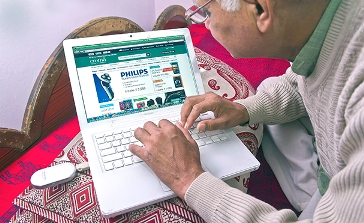 Online
buying might be in vogue these days, thanks to a growing tribe
of youngsters shopping online. But there are old-schoolers, like
Srikant Bahal, who do not believe in virtual shopping.
Online
buying might be in vogue these days, thanks to a growing tribe
of youngsters shopping online. But there are old-schoolers, like
Srikant Bahal, who do not believe in virtual shopping.
The 36-year-old human resources manager at a private firm loves
his weekly rounds of malls. For Bahal, the touch-and-feel experience
is paramount while shopping. “One cannot judge the quality
of a product by just seeing it. Even though I buy movie and airline
tickets online, when it comes to products, touching is believing
for me,” he says.
However, when Titan started its online store this year, Bahal
gave it a try. He went to a nearby Titan store and shortlisted
some designs to gift his wife on her birthday. The designs were
available online, and he got a discount, too. Also, with the online
deal, he could avoid the hassle of shipping it to Tiruchirapalli
district in Tamil Nadu, where his wife stays.
Bahal has now made it a habit of checking out products at stores
and then clicking the “buy” button online.
Retailers in India are trying to catch customers through every means possible—online, offline, mobile and television. Multi-channel retailing is the buzzword. And traditional brick-and-mortar players such as Titan, Croma, Madura Retail, Fabindia and Vijay Sales have jumped on the e-wagon.
The growth potential, no doubt, is huge. A recent study by Delhi-based consultancy Technopak says the e-tail market is set to grow from $0.6 billion in 2012 to $76 billion by 2021.
Another major advantage of e-tailing is the wide geographical reach. Take, for example, electronics retailer Croma. Owned by Tata Sons, it is physically present only in 16 cities, with 95 stores. But Croma’s online store, just a year and a half old, covers 298 cities and towns. “Let customers decide which medium they are comfortable with, and we will try to be present there. Going online has opened India for us,” says Ajit Joshi, managing director and CEO, Infiniti Retail, which runs Croma stores.
Experts believe the trend will grow, courtesy real estate woes and high labour costs. Also, in comparison, the capital required to set up an e-tail venture is far less.
The biggest driving factor, however, is the increasing penetration of broadband and availability of browsing devices, including smartphones and tablets.
Alokedeep Singh, head of e-commerce, Titan Company, says sales
have gone up month-on-month, and doubled since it started. For
Croma, sales have gone up from Rs.30-40 lakh a week to about Rs.1
crore a week. Pizza chain Domino’s, too, gives a thumbs-up after
its online launch.
The e-tailing market being already crowded with start-ups selling
everything from toys to homes, traditional players are targeting
customers who are particular about the touch-and-feel experience.
Like in Bahal’s case, the customer can check out a product at a store and then order it online. They can also choose unique products which are not available at stores. Plus, the web sites guide customers on products through videos and chats.
However, unlike a pure-play e-tailer, there will also be integration issues for brick-and-mortar retailers moving online.
“Physical retail requires the supply chain to handle merchandise in bulk coming in from suppliers and smaller bulk going out to stores. In the case of online retail, while the incoming shipments are in bulk, the outbound consignments are to individual consumers, who may also return the merchandise [if not satisfied],” says Devangshu Dutta, CEO, Third Eyesight, a retail consultancy. “This needs operating structures and organisational orientation, flexible and varied enough to handle the wide range of merchandise volumes.”
Experts say that multi-channel retailing as a concept has only recently started gaining prominence across the globe. This has been possible because of an advanced mobile app ecosystem and smartphone penetration going up. India will need some time to catch up, they say. “Multi-channel retailing will be limited by a lack of a supporting ecosystem,” says Ankur Bisen of Technopak. “Right now, 3G access is limited to certain areas. Broadband penetration has gone up, but quality of internet access remains poor. Unless this sector improves, full-fledged multi-channel retail will not be possible.”
The global trend, however, is encouraging. Some of the top e-tailers in the US, for instance, are brick-and-mortar players such as Macy’s, Walmart and Tesco.
The e-tale
* Online retailing or e-tailing in India is set to grow from $0.6 billion in 2012 to $76 billion by 2021
* Traditional brick-and-mortar retailers account for 93 per cent of the market, while corporatised brick-and-mortar retailers have a share of nearly 7 per cent
* E-tailing is set to grow from the current 0.12 per cent market share to 5.3 per cent by 2021, when there would be at least 180 million broadband users in the country
* The e-tail sector could create 1.45 million jobs in the next decade
* The total volume of Indian e-commerce, including financial and travel services, touched $10 billion in 2012
* Some of the top players are Flipkart, eBay India, Snapdeal, Myntra, Amazon India and Jabong
(Edited version; sourced from The Week .)
