
Devangshu Dutta
August 9, 2009
At the end of 2006, in an article about market segmentation, I’d proposed a customer segment called “Cafe Workers” who look at coffee-shops as inexpensive real-estate to work out of. These include professionals, start-up entrepreneurs, small businesspeople and travellers into a city. (Click here to open the PDF file of the article “Slicing the Market“.)
But now, amidst the recession, apparently it is one positioning that some coffee shops don’t want to buy into. The Wall Street Journal reports that there is a backlash from many coffee shops towards customers who enjoy the use of free wi-fi and spend hours occupying tables that should be turning over more. (No More Perks: Coffee Shops Pull the Plug on Laptop Users). Many of the comments on the article are sympathetic towards the cafe owners, calling such customers “moochers”.
While the dismay of cafe owners over customers who abuse the facilities is understandable, could they be doing themselves harm by actively discouraging laptop use? Wi-fi is just one of the sticky aspects of a ‘hanging-around’ culture that the cafes have encouraged in the first place as part of their business model.
By and large, wi-fi enabled cafes around the world are more expensive than the ones which are not. Wi-fi goes along with the more premium positioning, and they should be able to balance the space premium lost on long-term wi-fi users with the grab-and-go customers who are paying higher prices without using the facilities.
That said, in specific cafes or at specific times of day or days of the week when there is a bottleneck, they should be able to limit the length of the IP-lease.
All it takes is a bit of thought and a tiny application of technology, not total disruption of the business model.
Devangshu Dutta
July 16, 2009
The grocery market is loud. From the times when food markets were in streets and town squares, hawkers have cried out their wares, and the freshness or newness of everything made evident to the customers passing by. So, I guess, it is no surprise that today’s FMCG and food market is also tuned to high-decibel promotion.
You don’t need to search too long for the reason – margins are generally thin on these frequent-use products and inventories need to move fast. And what you don’t make a noise about may not be visible to the customer and may remain unsold.
But if that was the whole story, most players should be focussing on one brand, or at most a few brands, and should be using their advertising budgets to maximum effect on these.
Instead we see exactly the reverse phenomenon in the market – more brands, more sub-brands, more varieties of everything. Why? Because newness sells – it creates excitement, anticipation, and in customers with a sense of experimentation it creates the urge to buy.
The old proven method of doing this was the “New Improved” starburst on the pack. The slicker, updated method is to launch a new variety that is apparently different in some way. For instance, if the old supplement helped to strengthen bones, the new line might contain separate “child” and “adult” versions (growth vs. osteoporosis). The old shampoo might have helped to keep hair clean and prevent dandruff – the new one might leave the customer wondering if she should pick the dandruff-fighter that also reduces hair loss, or the variety that makes her hair glossy, or even the one that provides a date for the next weekend! By the time she reaches the end of the shelf, she might have forgotten that her need essentially was to prevent dandruff.
Due to this, the grocery and FMCG product mix is fractal. Each grocery shelf or grocery store is susceptible to fragmentation. Each such fraction is supposed to act as the seed that can allow a new segment in the market or a new use occasion to grow, and provide the FMCG company or the retailer with an avenue for additional business. This phenomenon is particularly visible in a growing consumption environment – consumption feeds proliferation, while proliferation provides further occasions to consume.
However, an unfortunate outcome of this proliferation of brands and SKUs is the heightened noise, in which the brand often loses its unique voice. Also, over time, the brand may be too thinly spread or be undifferentiated from its competitors, and its sales only sustained through ever increasing bouts of expensive advertising – a vicious spiral.
Another issue is the real estate availability and the cost. Chris Anderson wrote about “the long tail” about 5 years ago – the myriad products for which the market is limited, but demand may be sustained over a long period of time through internet sales. However, while the long tail works for e-commerce businesses such as Amazon that carry limited inventory, the physical store runs out of space for micro-segment items very quickly.
All of these factors obviously start hurting visibly when the market turns down, and when marketing investments start being evaluated against the returns. This is when proliferation starts giving way to “rationalization”, reduction of the brand portfolio, narrowing the SKU focus.
We are already seeing signs of this in many of the developed modern retail markets currently, where retailers and their suppliers are closely analyzing which parts of their portfolio they need to sustain, and which they need to drop.
The story in the Indian market is slightly different for a variety of reasons.
First, the market is still growing, and for most FMCG suppliers there are vast expanses of the market are still blank canvases.
Secondly, India has been a branded supplier driven market for a long time, and remains so, by and large. However, the SKU and brand density is nowhere close to what is seen in the West. There is plenty of headroom still for new varieties to be added and new brands to be developed.
But possibly the most important factor is the new modern retailers, who are desperately seeking additional sources of margin. When there is a limit to the traffic that you can divert from traditional mom-and-pop stores, and when you hit the glass ceiling on transaction values per customer, proliferation becomes the game to play. Therefore, these retailers are either busy introducing own labels or encouraging new branded vendors who would offer them higher margins than the more established brands.
Own label is obviously the tricky one. The customer needs to feel comfortable with the switch – in the US, a study showed that consumers would more easily switch to own label merchandise in categories where the “risk” was perceived to be low (such as household goods, rather than children’s products). Also, the best own label gross margins typically come from products that are presented to the consumer as “brands” comparable to national branded products, because the pricing is more on par.
So, on the retailer’s part, this requires sophistication of product development and brand management that may be expensive and may need time to develop. A short-cut could be the acquisition of an existing brand, its entire assets including the organisation, as some retailers have been reportedly looking to do. How well they integrate the brands into their businesses remains to be seen.
In the long term, like their counterparts in more developed markets, these retailers may also come to the point where they wonder whether these owned brands offer them enough return on the expense and the management effort spent on them, or whether they would be better off just buying brands that consumers are already familiar with through multiple channels.
In the short term, however, we can expect proliferation, fragmentation, fractalization in all its forms. We can expect the illusion of plenty of choice to continue driving sales, and more and more products to fulfil needs that even the customer doesn’t know he has.
Devangshu Dutta
May 16, 2009
The world’s largest retailer earned bouquets as well as a few brickbats when it recently opened a Hispanic version of its large store format, named Supermercado de Walmart. The signs around the store are in Spanish as well as English, selling traditional Mexican national brands as well as traditional Hispanic food like tacos, tortas, aguas frescas, sopes, carnitas and barbacoa at the chain’s customary low prices.
The surprise, if any, was that this store was not in a city in Mexico but in Houston, Texas, USA.
Wal-Mart’s logic behind the format is that it would be more relevant to the heavily-Hispanic population in the catchment of the store in Houston, and that it was a natural evolution to what they had been doing for years.
However, some customers and observers do not agree. Quite a number of people are up in arms against this “pandering to immigrants”, which they see as a threat to the unity, homogeneity and identity of the United States of America. One internet commentator condemned this segregation with a rather unique view, saying that segregating customers like this was actually “racist” and belittled the Hispanic customers who live in that area.
We should probably wait for the dust to settle on this debate. Spanish-speaking customers may actually respond positively – or not – to this new format. Yes, some defensive or aggravated English-speaking customers may also boycott Wal-Mart over this move.
As for me, I believe that it is a good move for Wal-Mart to test how far customization can help their business and how finely they can tune their response to customer demands, because they will need all the learnings they can get to effectively tackle markets that are even more different around the world.
Of course, many retailers and marketers in a market such as India would be puzzled by all this fuss. After all, if a Chennai-based company opened stores in Maharashtra, it wouldn’t put up signs in Tamil, neither would a Punjab-based retailer expect its customers in Imphal to understand promotions in Punjabi. Fragmentation and customization is a fact of life to the Indian retailer.
Or is it really that clear?
In fact, India has its share of marketers who seem to think and plan mainly in upper income metropolitan-English, and this bias creeps in not only in the content and structure of promotions but also, unfortunately, influences the merchandise mix. Even while PowerPoint presentations are made about how diverse the country is, and how it is possibly more like many countries rolled into one, we often make use of cookie-cutters for designing our product plan, our marketing strategy and everything else that defines the retail store and the customer experience.
Now, before I am labelled unfair for making sweeping generalizations, let me also say that other than any such urban English bias, there are also another couple of reasons why a retailer may take a template-based or cookie-cutter approach to the market.
Firstly, if you’re launching a new retail chain, there is a need to derive efficiency by driving scale as quickly as possible. Repeating the product formula across locations allows a retailer to increase the impact of merchandising efforts in terms of additional margins due to volume margin terms and better negotiating power with the supplier. Also, the management effort is used in a much more focussed manner, lowering effective management costs.
Secondly, there is the need to demonstrate a consistent image across the entire footprint of the chain, and to appear to be a chain. Repeating the product and presentation formula reinforces the common image and branding.
However, the pertinent question is whether there is any point in following a consistent identity if it appears alien and irrelevant to most of your target customers? In a category such as grocery, where the customer don’t really shop across multiple stores in a chain, is it better to be locally relevant rather than consistent across the country or even a region? Clearly, if you have a national or international template that is locally irrelevant, you don’t have any chance of succeeding with the consumer.
On the other hand, is it really organisationally possible for a chain-store to be local, and if so how can it best strike the balance between chain-wide consistency and tweaking the offer to provide local focus?
To my mind the starting point is the definition of an identity based on a clear value proposition and operating principles. This includes a range of factors from the visual elements of branding to how the staff stack shelves or interact with the customer.
The next step is to make the merchandise locally relevant, because that is what creates the transaction. The answer to “how much local” would also provide the answer to “how the locally-relevant merchandise should be managed”. Organisational models could range from entirely centrally-managed local merchandise and data-driven decisions, to central management of range architecture and purchases but local pull-based replenishment, to outright purchase from local vendors by the specific store’s management to create a truly local store.
Of course, devolving range and purchase decisions to local management raises issues about maintaining control as well. To a certain extent processes and system can help to mitigate the risk of fragmentation of the identity or potential mismanagement.
But the strongest glue is culture, as the manifestation of the organisational identity. Culture defines most strongly “the way” the organisation works.
Imagine the business as an individual with a well-defined personality. In different cities that individual might speak different languages and dress in different clothes, but still express the same values.
With a well defined and well expressed organisational personality, localisation can occur without fear of corruption of the brand identity, consistency and controls. Then the chain-store can truly become a local store and part of the consumer’s life as it is.
The other choice, of course, is to wait for a significant part of the local consumer to adapt to your international or national template. Would you be prepared for that?
Devangshu Dutta
May 9, 2009
Bernice Hurst, Contributing Editor, RetailWire mentioned the “Let Children Grow” campaign in the UK jointly promoted by The Independent on Sunday newspaper and the highly respected gardening charity, the Royal Horticultural Society (RHS). Launched in 2007, the RHS Campaign for School Gardening, sponsored by the food and grocery retailer Waitrose, is a nationwide scheme designed to encourage schools to create gardens and teach children the skills of growing plants.
It is described as “an ambitious initiative to encourage the nation’s children to grow their own fruit and vegetables”. The programme targets deprived areas, particularly those with combinations of poor health, low income and levels of aspiration. By working with young people, the idea is to improve their health while teaching them what to eat and where food comes from. RHS research suggests it can “help improve academic achievement, behavior and confidence among pupils”.
According to the Independent on Sunday, most of the children “are learning for the first time about gardening, and with it the enjoyment of fresh air, appreciation of the environment, healthy eating and in turn the prospect of a longer life.”
Bernice Hurst asks, “Can/should retailers encourage and sponsor such education programs to inspire consumer loyalty?”
As far as I can tell, if there is a country in love with its gardens, it is the UK, so this should be a hit with the parents and the teachers.
Pre-teens certainly don’t mind getting dirt under their fingernails, so it should appeal to them as well.
Whether this has any tangible impact on Waitrose’s image and business remains to be seen but, then, some things should simply be done because they are the right thing to do.
The RetailWire discussion is here: Looking at Literal as Well as Figurative Growth, and the Independent article is here: Digging for victory: Schools back gardens plan.
admin
May 9, 2009
By Devangshu Dutta, Tarang Gautam Saxena
While the Indian consumers have aspired to own international fashion brands, India’s large population base in turn has been an aspirational market for the international companies.
To remote observers, the Indian market may appear to be a virgin territory as far as international apparel and footwear brands are concerned. But India has seen the presence of international brands for almost a century, including mass brands such as Bata and luxury brands such as Louis Vuitton. However, as the colonial government systematically repressed local textile production, the local resistance to foreign products grew as well. Therefore, until the 1980s, the presence of international fashion brands was negligible.
In the early 1990s, as the Indian economy opened up again, a few international fashion brands entered the Indian market. The pioneering companies during this stage were Benetton, Coats Viyella and VF Corporation.
At this time the Indian apparel market was still fragmented, with multiple local and regional labels and very few national brands. Ready-to-wear apparel was prevalent primarily for the menswear segment which was thus a target for many international fashion brands (such as Louis Philippe, Arrow, Allen Solly, Lacoste, Adidas and Nike).

In the midst of this the media industry was also witnessing a high growth which aided the international brands in gaining visibility and establishing brand equity in the Indian market.
The late-1990s marked a significant milestone in the growth of modern retail in India. Higher disposable incomes and the availability of credit significantly enhanced the consumers’ buying power. A growing supply of good-quality retail real estate in the form of shopping centers and large format department stores also allowed companies to create a more complete brand experience through exclusive brand stores and shops-in-shop.
The number of international brands continued to grow each year at a steady pace until the early 2000s, and took off exponentially thereafter. By 2005 the number of international fashion brands present in India was over three times compared to that in the mid 1990s. The last few years (since 2005) have continued the significant growth of international fashion brands, including luxury brands such as LVMH, Aigner, Tommy Hilfiger and Chanel.
The Popular Entry Strategies
Many of the international companies entering India in the late 1980s and 1990s chose licensing as the entry route to India to gain a quick access to the Indian market at a minimal investment.
A few companies such as Levi Strauss set up wholly owned subsidiaries while others such as Adidas and Reebok entered into majority-owned joint ventures. This helped them to gain a greater control over their Indian operations, sourcing and supply chain, and brand.
In the subsequent years import duties for fashion products successively came down making imports a less expensive sourcing option and the realty boom brought investors in retail real estate that were ideal franchisees for the international brands. By 2003, franchising became the preferred launch vehicle for an increasing number of international companies, while only a few chose to enter through licensing.
In 2006 the Government of India reopened retail to foreign investment (allowing up to 51 per cent foreign direct investment in “Single Brand” retail). Using this route, many brands have entered India by setting up majority owned joint ventures, or transitioned their existing franchise arrangements into a joint venture structure.
The Entry Structure for Some International Brands
| Entry Strategy | Time Period | ||
| 1980s or Earlier | 1990s | Post-1999 | |
| Licensed | Louis Philippe, United Colors of Benetton and 012, Wrangler | Allen Solly, Arrow, Jockey, Lacoste, Lee, Nike, Van Heusen, Vanity Fair | Puma |
| Wholly Owned Subsidiary | Bata, Pepe Jeans | Levi’s® | Hanes, Triumph |
| Joint Venture (Majority) | Adidas, Reebok | Diesel, Nautica, Sixty Group | |
| Franchise or Distribution | Aldo, Burberry, Canali, Versace, Debenhams, Esprit, Gucci, Guess, Hugo Boss, Mango, Marks & Spencer, Mothercare, Tommy Hilfiger | ||
| Joint Venture (incl. Minority Stake) | Celio, Etam, Giordano | ||
Source: “Global Fashion Brands: Tryst with India” (A Report by Third Eyesight) © Third Eyesight, 2009
Note: The above table shows the structure used during entry, and not the structure that exists currently.
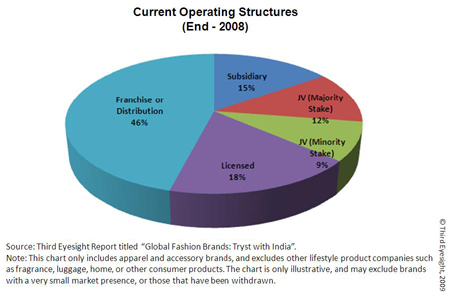
By the end of 2008, just under half of the brands were present through a franchise or distribution relationship, while over a quarter had either a wholly-owned or majority-owned subsidiary. These structures allowed the brands to have greater control of operations, particularly of product.
Shifting Strategies
Many international companies have evolved their presence in India into structures different from those at the time they entered the market.
A good example depicting the shift in business strategy is that of VF Corporation which entered India in 1980s by assigning the Wrangler license to Dupont Sportswear. Since then it has launched a variety of brands in different product categories with number of Indian partners and finally formed a joint venture, VF Arvind Brands Pvt. Ltd., with Arvind Brands.
Another example of a company that has evolved its presence is Benetton, which first entered India through a licensee (Dalmia). Benetton then transitioned in 1991 into 50:50 joint-venture and finally in 2004 took over the Indian business completely. However, it adopted the franchising route in 2006 for its premium fashion brand, Sisley, appointing Trent (a Tata Group company) as the national retail franchisee.
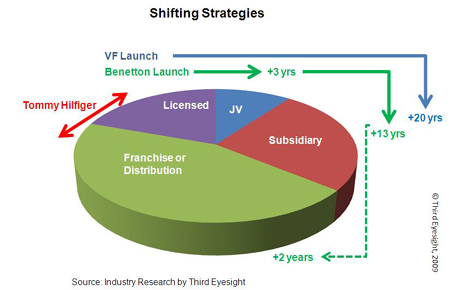
Many other companies such as Nike, Tommy Hilfiger, Marks & Spencer and Pierre Cardin (as described in our report “Global Fashion Brands: Tryst with India”) have changed their approach as the original structures did not perform as well as they had expected.
Obviously, each such change has cost the brands time, management effort, money and, sometimes, market share.
We believe that these shifts and the pain related to it could have been reduced, had the brands ruthlessly questioned the motivation for considering this market and their expectations from the market in determining an appropriate strategy.
What’s Ahead?
In the midst of economic upheaval around the world, how does India look as a market for international fashion brands?
Well, it is difficult to generalize even in the best of times. In the current global turmoil there is certainly a lot more unpredictability about international expansion for most companies.
Although India’s position as a target market for international brands has been improving, as is evident from the number of launches in the last 6-7 years, some companies considering international expansion may prefer entering other markets that may seem more “familiar”, developed and safe (such as Europe, Japan, South Korea or Taiwan). Against such comparisons, India’s growing but fragmented market can seem chaotic and difficult to deal with.
However, the fact remains that there are very few markets globally that can provide the sustained size of mid-term and long-term opportunity that India does. We are already seeing the more far-sighted and committed brands consolidating their position and presence in the market by continuing to look at expansion, even while examining how they can make their existing points of sale perform better. We also constantly come across new companies carrying out investigations into the market.
In the current environment we expect to see a shift in the nature of launch vehicle. While franchising seems to be a safe option for risk-averse brands in the current times, we will probably see more brands with a long term strategy, who would establish a controlled presence either through joint-ventures or through wholly-owned subsidiaries, since they can lay the foundation of the business today at much lower costs today than in the past few years.
India’s foreign direct investment (FDI) policy, allowing FDI only up to 51% in retail trading of “Single Brand” may have held back some fashion brands as they are still managed by owner founder with a conservative outlook on “control”. However, in the last couple of years, we have found companies not being deterred by the barriers to FDI.
As their comfort and familiarity with India has grown, international companies are more willing today to create corporate structures that allow them a presence in the market today and a step-through to a more controlling stake as and when government regulations allow.
All in all, we feel that international brands are in India not only to stay, but also to expand. There is yet a lot of potential untapped in the market, and as the integration of the Indian consumer with global trends continues, international brands can expect to find India an increasingly fertile ground for growth.
(c) 2009, Third Eyesight
