
admin
June 1, 2021
Written By DEVIKA SINGH
The FMCG major in a presentation circulated internally has acknowledged that more than 60 percent of its products do not meet recognised definition of health.

NESTLE USA – entrance to headquarters building with sign (Source: ShutterStock) Nestle
The spectre of ‘unhealthy foods’ is back to haunt Nestle again, this time globally. One of the largest food companies in the world and the maker of popular brands in India such as Maggi and KitKat has been cast in a negative light after (inadvertently) admitting that it has a large share of ‘unhealthy products’ in its portfolio.
If you are wondering what the fuss is about, here are answers to five big questions on the episode, including the potential implication on the company’s Indian unit.
What is the row all about?
Nestle in a document circulated internally has acknowledged that more than 60 percent of its products do not meet the “recognised definition of health” and that some of its products “will never be healthy no matter how much the company renovates,” reported the Financial Times.
According to the UK-based newspaper, the presentation was circulated internally among the company’s top executives earlier this year and said only 37 percent of Nestle’s food and beverages by revenues, excluding products such as pet food and specialised medical nutrition, achieve a rating above 3.5 under Australia’s health star rating system.
Even within its overall food and drink portfolio, about 70 percent of food products failed to meet that threshold, along with 96 percent of beverages — excluding pure coffee — and 99 percent of confectionery and ice cream portfolio, as per the report.
The rating system is used in research by international groups such as the Access to Nutrition Foundation.
Ouch! What does Nestle have to say about this revelation?
After the report surfaced, Nestle S.A released a statement saying that it is working on a company-wide project to update nutrition and health strategy.
“We are looking at our entire portfolio across the different phases of people’s lives to ensure our products are helping meet their nutritional needs and supporting a balanced diet,” said a Nestle S.A spokesperson.
The company in its statement cited its efforts to improve the nutritional footprint of its products. “For example, we have reduced the sugar and sodium in our products significantly in the past two decades, about 14-15 percent in the past 7 years alone.”
However, it also specified that external nutrition profiling systems like the Health Star Rating and Nutri-Score don’t capture Nestle’s entire portfolio.
“About half of our sales are not covered by these systems. That includes categories such as infant nutrition, specialised health products, and pet food, which follow regulated nutrition standards,” the spokesperson said.
The company’s Indian unit also has released a statement on the controversy.
“Nestle India believes that nutrition is a fundamental need and the food industry has a vital role to play in enabling healthier lives. Driven by our purpose, we are constantly striving to increase the nutrient profile of our products, as well as innovate with new and nutritious offerings,” said a Nestle India Spokesperson.
Hmm … will the development have an impact on the company’s Indian unit?
According to analysts, given that Nestle’s India portfolio is quite different from its parent company, the development will not have much of an impact here.
“Given that Nestle has not positioned its products such as Maggi in the health category there is no change in the perception towards its brand with the recent development,” says an analyst at a top brokerage firm.
Out of Nestle’s 35 billionaire brands, only nine have a presence in India. Its brands such as DiGiorno croissant crust pizza, Hot Pockets pepperoni pizza, San Pellegrino drink, and Nesquik with the worst scores, as mentioned in the Financial Times report, are not present in India.
“Indian portfolio is different from the parent company’s as it is a small sub-set with a lot of localisation for country-specific needs. Also, India is one of the few countries which has had a local research and development facility for a long time,” said Abneesh Roy, Executive Vice-President, Edelweiss Financial Services.
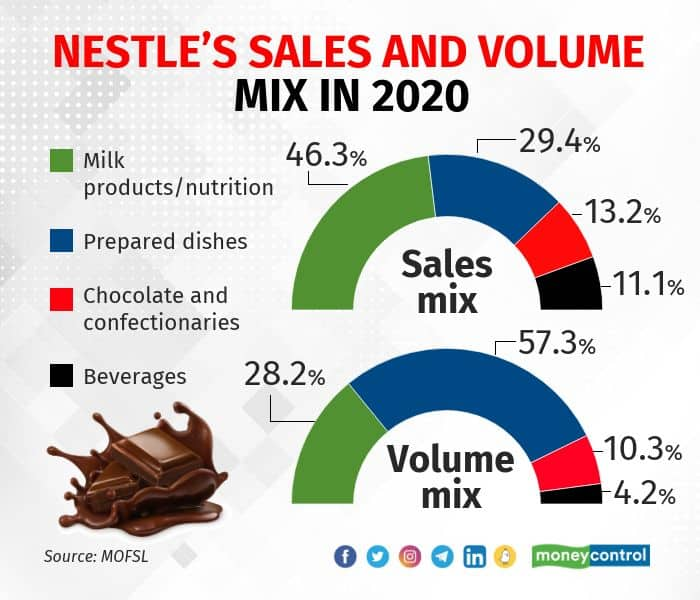
Besides this, Nestle India has a higher share of milk and value-added milk products in its sales mix, which bodes well for the company say analysts given that milk has a high nutritional quotient. Last year, the company drew over 46 percent of its sales from milk and nutrition products, higher than prepared dishes which includes Maggi noodles (shown in the chart below). Volume growth, however, is driven by prepared dishes.
Its initiatives in the country towards introducing atta, spinach variants of Maggi noodles, fruit and nuts to chocolates and reducing sugar and salt content are being seen as an effort to increase the health quotient in its products, by analysts.
Devangshu Dutta, chief executive at retail consultancy Third Eyesight is of opinion that India usually remains unimpacted by developments in these multinationals globally as there is lower sensitivity and awareness in the country. “Take, for example, veganism which is a huge trend in the West but has not caught on as much in India yet.”
He believes the country would eventually be impacted by these developments but not immediately.
What is the real significance of this controversy?
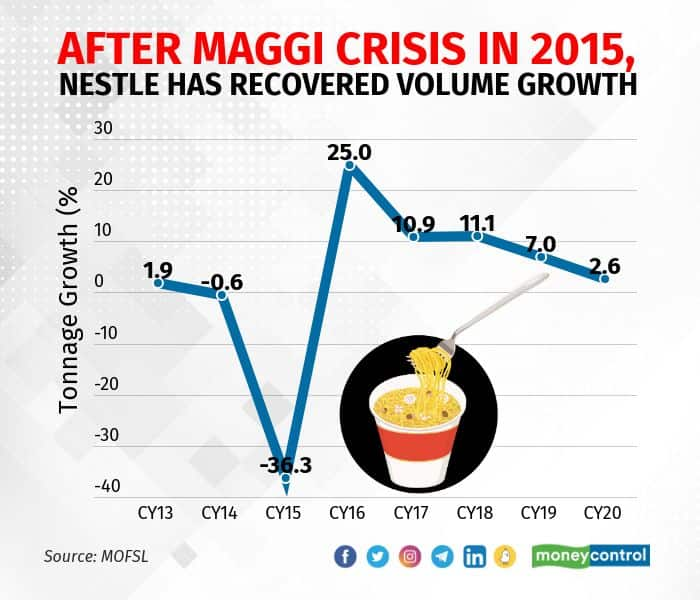
Nestle has come under fire in the past because of concerns about its food products. Back in 2015, Nestle had landed in trouble after Maggi, its most popular product in the country, was found to have monosodium glutamate or MSG by the Food Safety and Standards Authority of India (FSSAI). In a major setback for the company, the food safety regulator had consequently banned the sale of the product in the country. Maggi then commanded over 80 percent of the market share in India. Nestle’s volumes had plunged sharply in 2015 due to the Maggi crisis. (as shown in the chart below).
Subsequently, after five months of legal battle, Nestle relaunched Maggi in the country, however, it resulted in the loss of some of its market share. Today, the company holds almost 60 percent market share in the instant noodles category, as per estimates.
In the light of these events, the recent controversy around its product portfolio becomes significant as Nestle cannot afford a repeat.
Source: moneycontrol
admin
May 29, 2021
Written By Samreen Ahmad
Deal done through subsidiary Tata Digital Ltd; green signal from CCI came last month

According to a report by RedSeer and BigBasket, India’s e-grocery market is expected to grow from $1.9 billion in 2019 to $3 billion by the end of 2020
After Tata Sons announced the acquisition of BigBasket on Friday, the e-grocery player’s co-founder and Chief Executive (CEO), Hari Menon, said it is going to be business as usual at the company.
“Everything is going to be the same and all the founders will continue to be in the company,” Menon said.
Cementing its foray into the online grocery market, Tata Sons, through its subsidiary Tata Digital, has acquired a majority stake in BigBasket. While the company declined to comment on valuations, reports suggest Bigbasket’s valuation at $2 billion.
The Competition Commission of India had last month approved Tata Digital’s acquisition of up to 64.3 per cent of the total share capital of BigBasket’s parent company Supermarket Grocery Supplies.
“Grocery is one of the largest components of an individual’s consumption basket in India, and BigBasket, as India’s largest e-grocery player, fits in perfectly with our vision of creating a large consumer digital ecosystem. We are delighted to welcome BigBasket as part of Tata Digital,” said Pratik Pal, CEO, Tata Digital.
It actively took around six months for both the companies to close the deal. With this acquisition, majority shareholders — Alibaba and Actis LLP — have exited the company. Other investors such as Ascent Capital and serial entrepreneur K Ganesh have also made an exit.
“Trifecta is proud to be a partner in the journey of BigBasket thus far. This investment from the Tata Group is truly a testament of the Indian startup ecosystem coming of age, and interest in category leaders not just from the global investor community but also large strategic partners,” said Nilesh Kothari, managing partner at Trifecta Capital.
According to a report by RedSeer and BigBasket, India’s e-grocery market is expected to grow from $1.9 billion in 2019 to $3 billion by the end of 2020. At an annual growth rate of 57 per cent, it is expected to touch $18 billion by 2024.
“We are excited about our future as part of Tata Group. We would be able to build stronger consumer connect and accelerate our journey,” said Menon, who started the company from a small Bengaluru office along with four partners V S Sudhakar, Vipul Parek, Abhinay Choudhari and V S Ramesh in 2011.
Currently, the company fulfils around 15 million orders per month in 30 cities across India. It has also reached the milestone of $1 billion in annual revenue.
Tata Digital is also raising Rs 5,000 crore through a commercial paper. Analyst tracking the group said the company would need access to capital as it prepares its digital development and operational expenses.
The acquisition of BigBasket is part of Tata Group’s strategy to build a digital consumer ecosystem. The salt-to-software conglomerate is making inroads in new-age digital markets such as online pharmacy and online fitness, according to reports. While it has signed a deal to acquire a majority stake in e-pharma player 1mg, reports say the conglomerate is also in talks to acquire a stake in Mukesh Bansal’s fitness start-up CureFit. “Food and grocery is critical in terms of share of consumption and significant in the Tata Group’s strategy to be a player of consequence in the digital space,” said Devangshu Dutta, chief executive of Third Eyesight.
Source: business-standard
admin
April 21, 2021

Debojyoti Ghosh, Fortune India
April 21, 2021
Billionaire entrepreneur Kumar Mangalam Birla-led retailer Aditya Birla Fashion and Retail Limited (ABFRL) has continued its build-up in the ethnic wear market with its fourth deal since 2019 and second this year. In February, the Mumbai-based fashion retailer picked up a 33.5% stake in fashion designer Tarun Tahiliani’s Goodview Properties—that will own and operate the designer’s eponymous couture label—for ₹67 crore. That was a month after ABFRL acquired a 51% stake in Kolkata-based designer Sabyasachi Mukherjee’s company, Sabyasachi Couture, which sells garments, accessories, and fine jewellery, for ₹398 crore.
ABFRL, which owns fashion brands such as Louis Philippe and Van Heusen, said in a statement that ethnic wear “is a large and growing market with a significant opportunity to build scale” and expects it to be an important category over the next few years.
Experts note the two recent deals come as the luxury industry, including fashion, has been hammered by the pandemic. The year-long shutdown in global travel has slowed over a decade of growth across luxury categories. Indeed, the global fashion industry’s profit is expected to have slumped about 93% in 2020, according to a report by consulting firm McKinsey and The Business of Fashion in December.
“[Luxury] business has been hit hard during the pandemic, like all fashion and retail businesses. And a significant injection of money is needed to maintain the business momentum, and to scale it further,” says Devangshu Dutta, chief executive of retail consultancy Third Eyesight.
In March, Italy’s billionaire Agnelli family—best known as the founders of automaker Fiat—acquired a 24% stake in French luxury shoemaker Christian Louboutin for $642 million. Three months before that it paid $95 million for a controlling stake in Shang Xia Paris, a Chinese luxury goods business founded by French luxury brand Hermès and Chinese designer Jiang Qiong Er.
Many fashion firms have used the Covid-19-induced slowdown to reshape business models, streamline operations, and sharpen their customer propositions, said the report by McKinsey and The Business of Fashion.
And that is exactly what Tahiliani plans to do with his new corporate partner. The duo will create a new entity—80% held by ABFRL and 20% by Tahiliani—to launch a new brand of apparel and accessories in the affordable premium ethnic wear segment, while it also plans to launch a men’s ethnic wear brand.
“Discussions with ABFRL have been in the works for nearly two years. I couldn’t be happier about entering into this partnership. They understand scale and numbers like no one else in the market today. Each of their home-grown brands is a resounding success,” Tahiliani, founder and CEO of Tarun Tahiliani Brand, tells Fortune India. “This collaboration permits me the financial freedom to focus on designing,” he adds.
ABFRL aims to build the new ethnic wear brand into a ₹500-crore business in the next five years, with more than 250 stores across India. The first tranche of stores is expected to open by September. “This new entity with ABFRL currently concentrates only on menswear. In our collective opinion, at present, there is only one branded national player in the Indian ethnic [wear] for men space. In order to scale this up, we need to be in three or four categories of clothing. This will give depth, both in terms of style and sizing to the men who come into the store,” says Tahiliani.
Currently, the top panIndia ethnic wear brand for men is Vedant Fashions’ Manyavar. The Kolkata-based company forayed into women’s wear in 2016 selling lehengas, saris, and the like under the label Mohey,
ABFRL’s previous deals in the segment—both in 2019—were a 51% stake in fashion designers Shantanu & Nikhil’s Finesse International Design for a reported ₹60 crore, and its ₹110-crore acquisition of Jaypore. Both make apparel, footwear, accessories, and other items.
ABFRL’s managing director, Ashish Dikshit, declined to comment for this story. ABFRL had, when announcing the Sabyasachi Couture investment, said it expected that deal to accelerate its strategy to build a comprehensive portfolio of brands across segments, occasions, and geographies.
Experts say ABFRL’s recent investments allow it to tap into the designer’s creative stream and goodwill, while providing the financial and organisational muscle of a large corporate. Albeit one that is not aiming too far upmarket.
“We shouldn’t see the ABFRL [stake] acquisitions as entry into couture, which is a different business from the ready-to-wear market. It is the expansion of these brands into ready-to-wear, tapping into the desirability of the designer brand, while making it accessible and affordable to a larger market is what will be of interest,” says Third Eyesight’s Dutta.
Indeed, Mukherjee, in a press release in late January, noted, “As my brand evolved and matured, I began searching for the right partner in order to ensure continuity and long-term sustainable growth.”
Nonita Kalra, a veteran fashion editor, says that the ABFRL deal shows the growing heft of the [Sabyasachi] brand in the fashion business. “Corporates aren’t sentimental. They are hard-nosed about investments, with careful due-diligence. ABFRL is paying what it is worth and expecting it to grow bigger. They are never going to invest in a stagnant business,” she says.
Experts, though, caution that while corporate partnerships and acquisitions allow a designer-entrepreneur and their investor partners to unlock some of the value being built, it is essential to have clarity about each brand’s design language and target consumer. “With [ABFRL’s] new venture [in men’s ethnic wear with Tahiliani], the key thing to understand is how the company will differentiate it from Shantanu & Nikhil’s positioning and focus, which is also menswear-driven,” says Abneesh Roy, executive vice president, Edelweiss Securities. “The challenge will be ensuring that each brand maintains its distinctive identity, while deriving synergies from the group.”
ABFRL has stitched up some unique deals; it now has to ensure they don’t unravel.
(The story originally appeared in Fortune India‘s April 2021 issue).
admin
April 14, 2021
Written By zenger.news

CHENNAI, India — American tech mogul Jeff Bezos, who owns Amazon, had one billionaire to fight in the Indian e-commerce space — Mukesh Ambani, who owns Reliance Industries. Now, another — Gautam Adani, who owns the Adani Group — has put a leg into India’s highly competitive e-commerce market, which is expected to grow to $200 billion by 2026.
Walmart-owned, and one of India’s largest e-commerce firms, Flipkart has inked a deal with multinational conglomerate Adani Group to build one of its largest fulfillment centers in the financial capital Mumbai.
The fulfillment center, a distribution facility where inventory is stored, so online orders can be picked, packed, and processed, is expected to boost Flipkart’s supply chain capabilities in a tightly contested three-pronged e-commerce race.
Flipkart and Adani Group have not disclosed the financial terms of the agreement. Adani Logistics, a unit of Adani Ports & Special Economic Zone Ltd, will build a 534,000 square foot fulfillment center and lease it to Flipkart to meet the “growing demand for e-commerce in India’s western region”.
“This broad-ranging partnership across our logistics and data center businesses is a unique business model, and we see this as a great opportunity to serve Flipkart’s physical as well as digital infrastructure needs,” Karan Adani, chief executive officer of Adani Ports and Special Economic Zone, said in a joint statement on April 12.

The facility, which can house 10 million inventory units and is roughly the size of nine football fields, is expected to be operational in the third quarter of 2022.
Based in India’s tech capital Bengaluru, Flipkart will also develop its third data center at AdaniConneX Pvt Ltd in the south Indian city of Chennai to store data locally. AdaniConneX is a recently formed joint venture between U.S. EdgeConneX and Adani Enterprises, the flagship company of Adani Group, to provide data center solutions.
The deal will indirectly pit billionaire Adani against India’s richest man Ambani and Bezos.
“The big thing for all e-commerce companies and companies like Adani is having real estate in the right location and offer services and facilities on top of that,” Ashutosh Sharma, vice-president and research director at Forrester Research, India, told Zenger News.
“Having warehouses and distribution centers built closer to import hubs such as Mumbai, Vishakapatnam, and Chennai is a huge advantage. Adani already has a huge presence in these ports and the real estate in those coastal cities. It allows them to handle the shipment, and companies like Flipkart need this kind of capability,” Sharma said.
Flipkart has not disclosed the number of its fulfillment centers in India, but industry estimates vary between 50 and 60. Rival Amazon India said it has 60 such centers across 15 states as of July 2020.
As Amazon and Reliance Industries invest in scaling up their warehousing facilities, Flipkart is following suit and has been steadily investing in its logistics and supply chain capabilities for a while.

In December 2019, it led the $60-million investment round in last-mile delivery start-up Shadowfax. The same month, Flipkart and its parent Walmart participated in a $15-million investment round for fresh produce supply start-up Ninjacart and again invested $30 million in the start-up in October 2020, as per data from the company research platform Tracxn.
Flipkart has also invested in freight service provider BlackBuck.
“An e-commerce business is not limited to simply developing a website and selling goods online, but it depends heavily on efficient supply chain management,” Karan Chechi, director at TechSci Research, told Zenger News.
“The expansion of the facility in one of the most demanded Indian cities is expected to help Flipkart gain a competitive edge over the other existing e-commerce players in the country.”
Amazon and Reliance Retail, part of Reliance Industries, have also pumped money into their e-commerce operations.
Image of an Amazon warehouse unit. (Matt Cardy/Getty Images) The latter bought Future Group’s Retail unit for $3.4 billion and is involved in a legal battle with Amazon India, who is opposing the deal. With the deal, Reliance also acquired Future Retail’s vast logistics and warehousing business.
Last year, Reliance bought a minority stake in lingerie retailer Zivame for an undisclosed amount. Amazon Technologies acquired retail tech start-up Perpule in March this year for $14.7 million.
The nationwide lockdown last year in India due to the pandemic saw e-commerce firms ramping up their warehouse facilities to meet a surge in demand as most of the country was confined to their homes.
“At present, the pan-India footprint of e-commerce warehousing is 4.6 million square meters (49 million square feet), and more than half of it is occupied by a single player, Amazon,” according to a report from real estate consultancy Knight Frank.
Flipkart is in second place with around 15 percent share, while the total occupancy of the top two e-commerce players is about 70-75 percent, the report notes.
The Indian warehousing market is expected to grow at a compound annual growth rate of 9.8 percent to reach $19.53 billion by 2025, as per a Research & Markets release.
Flipkart’s parent Walmart entered the Indian market in 2007 with its business-to-business (B2B) joint venture with Bharti Enterprises, another multinational conglomerate.
“If you look at it from Walmart’s perspective, they had partnerships from the beginning before they entered the market,” Devangshu Dutta, chief executive officer of retail and e-commerce consulting firm Third Eyesight, told Zenger News.
“If you look at the current environment, Adani or Reliance is a good partner to have. Flipkart’s deal is for logistics and data, and it’s not like 100 percent of their fortunes are tied to Adani. It probably provides some cushion against the market pressures that might happen,” Dutta said.
Source: jacksonvillefreepress
admin
March 11, 2021
Written By RANJITA GANESAN
Aditya Birla Fashion and Retail Ltd (ABFRL) has bought significant stakes in luxury couture businesses of fashion designers Sabyasachi and Tarun Tahiliani. What is the business rationale? Read on

The opportunity in Indian wear, or ethnic wear as it is often called, has come to the attention of corporate and private equity investors over the last few years. (Image: Unsplash.com)
To up for an occasion, women can get away with a beautiful saree, kajal, and flowers, said Tarun Tahiliani. Most men, in his view, have to choose from contrasting options such as western shirts or ‘maharaja’ glad rags. “There is a lovely space in between, a kind of contemporary Indian style, which has not reached them yet.”
The couturier—known for pairing Indian silhouettes with modern construction and layering—intends to fill that gap on the racks with a new ready-to-wear brand of celebration wear for men. “The pieces themselves will be toned down and elegant so they can be styled as needed.”
This foray into retail is through a recent Rs 67 crore deal with Aditya Birla Fashion and Retail Ltd (ABFRL), which Tahiliani describes as the yang to his yin. The partners expect to build a business worth Rs 500 crore in the next five years with 250 stores, the first of which will open in September.
The Mumbai-based designer’s pret menswear typically brings in anywhere from Rs 40,000 to Rs 4 lakh a piece. The unnamed new brand, where he will hold a 20 percent stake while the corporate partner will own the remaining 80 percent, will be in the more affordable bridge-to-luxury category. ABFRL also acquired 33.5 percent of Tahiliani’s existing couture label.
For ABFRL, this is the latest in a series of bets on Indian wear by celebrity designers. It bought a 51 percent stake in Sabyasachi for Rs 398 crore in January, and in 2019, it struck a partnership with designer duo Shantanu and Nikhil. “Acquisitions of majority stakes with designers allows the group to tap into the designer’s creative steam and goodwill, while providing the financial and organisational muscle of a large corporate,” said Devangshu Dutta, chief executive of retail consultancy Third Eyesight. “The challenge will be ensuring that each of the brands maintains its distinctive identity and handwriting, while deriving the benefits of being part of a larger group.”
The opportunity in Indian wear, or ethnic wear as it is often called, has come to the attention of corporate and private equity investors over the last few years. It is a US$19 billion market as of 2020, according to Technopak Advisors. By most accounts, at least 70 percent of it still remains unorganised, dominated by unbranded stores and tailors.
The premium-end of the market is growing at 10 percent, Technopak notes. “Given ethnic wear sees no competition from global brands, it is a natural choice for investments,” points out Abha Agarwal who co-heads the consumer vertical at Avendus Capital. Where the majority of Indian wear offerings are aimed at women, men’s wear remains a smaller piece, so far dominated by brands like Manyavar. Various religious festivals and even Republic Day and Independence Day — in a nationalism-charged environment — are viewed as fresh occasions for marketing Indian wear.
Importantly, weddings becoming bigger and fatter has boosted growth and acceptance of the segment. “Each wedding is 2-3 days long now and you need different outfits for all the events — mehendi, sangeet, the vows,” explained Yash Dongre, business head for House of Anita Dongre. “So Indian designer wear is finally being looked at as a serious business.” Anita Dongre, who popularised gota patti-embellished lehengas and jackets, was among the first Indian couturiers to scale up and raise institutional funds.
Thriving Business
Apart from her eponymous label, the company launched ethnic fusion wear brand Global Desi and AND-branded western wear with investments from retailer Future Group and private equity firm General Atlantic.
With Indian wear accounting for 60 percent of its offerings, House of Anita Dongre says it is growing about 20-25 percent year on year. Beyond bespoke bridal outfits, which take time to make, half its collections are kurtas, tunics and sarees that are picked up anywhere between Rs 12,000 and Rs 70,000 apiece.
After Sabyasachi deal, Aditya Birla Fashion and Retail announces strategic partnership with designer Tarun Tahiliani
The company plans to grow those offerings especially in its online business, which it hopes to double over the next months. Dongre paints the expansion of more players as both competition and an advantage. Noting the example of districts like Delhi’s Mehrauli or Banjara Hills in Hyderabad, he says, “Established and emerging designers have set up shop there and that generates traffic for everyone in the area. This will only get everyone to up their game.”
For designers, translating high fashion for a mass retail format without diluting their brand’s ethos can be a delicate dance. “I am conscious about the environment so I was clear about no compromises like using polyester,” said Anju Modi. She chose to partner with handloom-friendly chain Biba, which has about 255 stores countrywide, creating designs with ‘ikat’, ‘bandhini’ and block-printed cottons which are easy to reproduce in large numbers. “In my atelier, all our time and money is focused on developing products with a scientific attention to detail. So to market and distribute at scale I knew I needed to collaborate.”
Why Partnerships Make Sense
Buoyed by demand, more designers are seeking partners to share the high spends involved in marketing and opening stores. “Although my brand was among the first to have an online shop, I took a conservative approach to store openings,” said couturier Neeta Lulla, well-known for draping Bollywood stars.
Ideas For Profit | Aditya Birla Fashion and Retail: With reduction in debt, this fashion giant is poised for the next growth leg
“I see the market and scalability today, and am open to experimenting and restructuring.”
Not just within India, she said top traditional wear designers have a big market in NRIs who are buying online.
There are challenges in the segment, however. The unorganised part of the Indian wear market is still huge, especially in the low to mid-value, noted Technopak’s Amit Gugnani. Further, demand is not uniform as the preferred colours and fabrics vary from region to region. “There is so much heterogeneity in the way India is geographically, you may need product differentiation or else remain in niche geographies,” he added.
The pandemic too brings a note of caution to future plans. Raymond, which launched its Ethnix brand in 2017, says it saw double-digit sales growth except in 2020. The disruption of the last 10-12 months has meant expansion of that ready-to-wear chain, with 32 stores currently, is currently on hold.
Tahiliani said the initial store rollout will be slow and steady as the two partners work on production, marketing campaigns, an online store, and testing customer reaction. But the designer is convinced the future is in retailing. “No one has the time or energy to choose fabrics and go to the tailor. People want to see, they want to try, and then buy. That’s the way of the world now.”
Source: moneycontrol
