
admin
February 14, 2017
Rasul Bailay & Shambhavi Anand, The Economic Times
New Delhi, 14 February 2017

Global marquee fashion and lifestyle brands such as Gap, Zara and The Body Shop are resorting to price cuts to stay competitive and increase their market share in the price-sensitive Indian market.
UK’s cosmetic brand The Body Shop slashed prices across categories in India by 20-30% on Friday while US fashion brand Gap is looking to bring down prices of certain products by 10-15% by allowing its India franchisee Arvind Lifestyle Brands to manufacture them locally.
Arvind will produce 30-40% Gap merchandise in India to be sold here, said J Suresh, chief executive at Arvind Lifestyle Brands. “The process has started and we will introduce them in springsummer 2018,” he said.
Spanish brand Zara, the market leader in fast fashion, too is looking at slashing its prices to bring them closer to Swedish rival H&M, said two people familiar with the matter.
Experts say price cut is one of the most effective ways to increase sales and market share in a price-sensitive market like India, particularly in highly competitive and fast-growing segments such as branded apparels and beauty products.
“Most brands strategically lower prices for the value conscious Indian consumer,” said Devangshu Dutta, chief executive at retail consultancy firm Third Eyesight. “In most cases prices are reduced to drive the demand further,” he said.
Gap currently imports all its merchandise into India and its products are about 40-50% more expensive than those of rivals Zara and H&M. Local production will help it bring down prices and compete better with the two faster-growing rivals.
Suresh of Arvind Lifestyle Brands said his company had an agreement with Gap to produce in India since May 2015 when they entered India, but was waiting for attaining a “minimum quantity” to produce here.
Gap has been struggling to keep pace with Zara and H&M in the Indian market. According to business head of a prominent mall in Delhi that has all the three brands, Gap’s sales are at times less than half of sales of Zara and H&M.
A Gap spokesperson in San Francisco said, “We tailor sourcing strategies as appropriate for the markets and channels we operate in to enable competitive positioning.” A Zara spokesperson declined to comment on a specific query about any price cuts in the near future.
The Inditex-owned fashion brand had reduced prices by up 15% when H&M entered the Indian market in October 2015 with its global strategy of aggressive pricing. The move helped record a 17% sales growth during FY16, though that was its slowest sales growth since opening its first store in the country in 2010. Zara posted sales of Rs 842.5 crore during FY16.
Shriti Malhotra, chief operating officer at The Body Shop India, said the price cut will make its products more accessible to consumers. “Lower prices of our best sellers will bring affordable cruelty free beauty closer to diverse consumers across age groups and geographies, recruiting new fans along the way and strongly reinforcing our philosophy of beauty beyond boundaries,” she said.
Price correction is a tried and tested strategy to revive sales in India.
In September 2015, when Arvind Lifestyle Brands took over the business of beauty and wellness retailer Sephora from former franchisee DLF Brands, the first thing it did was a price correction. “We looked at pricing in Dubai and Singapore and we kept it in the band of 5-10% lower than that,” said Vivek Bali, chief executive of Sephora in India.
The company still does small tweaking of prices here and there on slow moving products.
(Published in The Economic Times)
admin
February 10, 2017
 Sharleen Dsouza, Bloomberg Quint
Mumbai, 10 February 2017
 Less
than seven years after launching the Vivanta brand and four years after
inaugurating its first Gateway property, Indian Hotels Co Ltd. has
decided to re-brand the two verticals and bring them back under the Taj
Group brand.
Less
than seven years after launching the Vivanta brand and four years after
inaugurating its first Gateway property, Indian Hotels Co Ltd. has
decided to re-brand the two verticals and bring them back under the Taj
Group brand.
All existing properties run by the Taj Group will
now be classified under four categories — Taj Hotels, Taj Palaces, Taj
Resorts and Taj Safari. Only its budget chain, Ginger Hotels, will
continue to be operated under the existing brand.
Analysts and
brand consultants maintain that this entire exercise will have no
impact on the company’s performance in the near term. They peg the
benefit of reclassification seeping in only after five years, if at all.
Consultants
also argue that the rebranding exercise by the hotel major won’t do
much to change the perception in the mind of the consumer, which has
been dented due to a drop in service quality.
Devangshu
Dutta, chief executive officer at Third Eyesight, a retail and brand
consultancy firm, is not so critical of the new strategy stating that
the new branding will help Taj classify its properties better and build
market share over a period of time.
Brokerage
house IIFL Ltd. says Indian Hotels’ long-term strategy is to chase
profitability over a period of time. “The earlier positioning didn’t do
much for the consumer. There was a sense of ambiguity in the minds of
the consumer with the earlier classification of hotels. It is very
clear that the company is now looking to improve its bottom line,”
according to Amar Ambani, Head Of Research At IIFL Ltd.
The rebranding will be complete by the end of 2017, the company said.
Chinami
Sharma, chief revenue officer of Taj Hotels, Palaces, Resorts, and
Safaris, said the company will spend not more than three to four
percent of its revenue on the rebranding exercise.
Indian
Hotels’ consolidated revenue in the quarter ended December stood at Rs
1,129.29 crore, down 2.8 percent year-on-year compared to Rs 1,162.19
crore. Its net profit rose to Rs 93 crore compared to Rs 13 crore in
the year-ago period.
The reclassification of hotels will not have an impact on the pricing strategy of the Taj Hotels properties, the company said.
(Published
in BloombergQuint)
admin
February 9, 2017
This is a recording of a short, candid talk by Devangshu Dutta (chief executive, Third Eyesight) at the ASSOCHAM’s 8th Global Food Processing Summit in New Delhi, India.
He touched upon the inherent conflicts in the food supply chain we need to be aware of before formulating policies and practices, and strongly urged everyone to look at food security from the point of view of sustainability and risk-management. (Transcript below.)
TRANSCRIPT:
I’ll just take just few minutes to share a few thoughts with you on the sector.
The session was titled “Make in India: Platform for investment opportunity in food processing sector and 100 percent FDI in food retail”.
As we all know, whoever’s been following the news, there’s all this buzz around FDI into retail being allowed, not only for physical retail but also for e-commerce companies, and there are two very strong sets of drivers. On the one hand is the likes of Walmart and Tesco and people who want to actually set up food retail. and you know food is the largest consumption in our basket of consumer products, so they obviously want to tap into that demand. The second side is Amazon and the likes of it where again you know there are no barriers in terms of location, you are buying on the net, tapping into a consumer who’s looking for convenience, and there you need to actually service that demand with food and grocery which is packaged, so there is obviously a very strong push a very strong lobby for that to happen. At the same time there’s a very strong lobby against that because there are domestic retailers who invested a lot of money over the last maybe 10-15 years in setting up a lot of retail stores. In the recent years there have been a few e-commerce companies that have come up as well with domestic and foreign capital. So there is this conflict.
In this whole ecosystem of food production and supply and retail there are some fundamental conflicts that we need to be aware of, before we get into any kind of thinking about what should be done with the sector.
First of all is foreign vs. Indian; this is a conflict which is there the world over, and I think we will see that increase in Europe, in the US, and in other places. You know, “local versus foreign” is a conflict which we will keep seeing. I think we have moved a little bit away from that within, not only this government’s regime but also the earlier government’s regime, where we started to welcome foreigners back into the country and said, “let’s do trade together”. I think it’s important to keep it in mind that local interests will always always be take predominance over foreign interests. If any government comes in and says, “I will give foreign interests precedence”, it’s going to not be there in power the next time, so that’s something which is to be kept in mind.
The second is this is a conflict between large and small…large retailers versus small retailers. A Reliance had to close shops in Uttar Pradesh, had to close shops in Kerala because they were impacting small retailers. So it’s not just about Walmart impacting small retailers, it’s also about the large Indian companies impacting smaller companies.
The third conflict is between traditional and modern, and this is happening again even in farming. Indian farmers tend to follow traditional practices, there are fragmented land holdings, and then you have modern entrepreneurial farmers, you have cooperatives which are adopting different techniques, and there is a conflict which happens at that level as well. At the local level it can get hugely political and then it starts raising barriers. So if you talk about the food supply chain, it’s not a simple thing to deal with.
Fourthly, the biggest biggest conflict – and that’s not really a conflict outright because these are people who are working together – but there are differences of interests and, therefore, there are conflicts…that is between retailer, supplier and the farmer, the interests are not aligned. A retailer wants lower prices, a supplier wants even lower prices, but the farmer wants higher yield and higher prices, so that conflict, just something on account of price and commercial terms and various other things, is bound to create friction in that supply chain.
Having understood that, I think we need to also acknowledge the fact that retailers are unlikely to invest in the supply chain and in farming. Amazon is not going to set up food processing. Amazon is not going to set up farms which are contract farming. Let’s face it, even Future Group hasn’t. Future Group has set up a food park. Future Group has taken over companies which are in food production companies but Future Group has has not set up, ground-up, contract farming. They’ve tried but it’s not their core competence, it’s not even their core interest. Reliance has done a little bit, ITC has done a few things but it’s not something which is fundamentally their business. They’re retailers, that’s what drives them, so what they can do is they can create an ecosystem.
Let’s take the example of McDonald’s or a Pizza Hut or say a Domino’s. These are foreign quick service restaurants which have come into the country. A McDonald’s had to actually build its supply chain from scratch to get the potato fries, to get the burgers done, to get the patties done and they created an ecosystem, in some cases they invested or co-invested with Indian partners, but in most cases they encouraged Indian partners to talk to their partners from Europe, US etc.
When we talk about people like Future Group, it has done a lot in being a platform for Indian companies to come on board and sometimes international companies as well. They’re a platform for them to launch and grow their business. So what the retailer can do is create the ecosystem, create the demand pipeline. Beyond that it is up to the food producer, it is up to the farmer, to take that opportunity and move on. It’s not for the retailer to handhold from scratch all the way to selling on the shelves.
In terms of the practices that we need to adopt I’d like to say this, that while we keep talking about international standards, food is a very local thing. We may be going into a world where 50 years down the line all of us will be having a white-gray powder which has no flavour and that’s what the future of food…I hope not!…The fact is the food is a very local thing because of tastes, because of cultures, because of the environment that you are in. And we are actually losing a lot. People who are here from farming, if you look back not, even very far – maybe 20-25 years – certainly, if you look back 50 years, what was being farmed we’ve lost probably 30-40 percent of that produce, because there is no demand, because it is difficult to grow, because it’s seasonal, because it is difficult to process, difficult to sell. If you go to the sabziwala today versus if we went to the sabziwala 10 years ago, you will find that the variety of produce has actually diminished. So while we are talking about food processing, what is happening is…and I’d like to mention this…You know, sometimes we come to conferences like this and we run our businesses, we run with a split personality. We do what is convenient for the business, we do what is good for the business in terms of cost, in terms of ease of processing, in terms of ease of selling etc. When it comes to us as consumers, we want fresh, we want variety, we want flavor, we want colour, we want all of it. Why do we have the split personality? Why can’t we actually combine the two and do what is right for us as consumers, our children as consumers, the environment, and the future as well?
Sustainability is should be a big driver and we forget that the kind of food processing which is going on right now, by and large the kind of plants which are being put up, are based on technology which was developed in North America and Europe between 1900 and say 1960-70. That’s been the most wasteful part of the last century in terms of energy, in terms of water, in terms of labour, in terms of anything. It’s resource intensive. Now imagine even if 20% of India – over 200 million people – started to live and depend on that kind of a lifestyle and that kind of an industrial structure! This country will be finished, certainly! The world would be finished! We cannot do that, so we’ve got to do stuff which is good for us as consumers, the environment as a whole, and good for the business. It can’t just be one. We cannot be uni-dimensional in our thinking.
Last point: I think diversity is a very, very important part of the food supply chain and diversity means that there are “many”. We tend to look at large companies as being the standard and, therefore, large being good. But the fact is that if you take food which is an integral part of our lives…You cannot live without air, you can live without food and water for a few days, you can’t survive. You can live without clothes for your entire life.
If let’s say the food supply chain and even the processing, the acquisition and everything else, if it gets consolidated beyond a certain point it becomes extremely vulnerable. Anybody who’s looked at financial services risk management or any any kind of risk assessment, you would know that it is good to have a diversified basket. From the point-of-view of farming, from the point-of-view of manufacturing, from the point-of-view of retail, consolidation beyond a certain point is actually detrimental to quality and to safety. So if you’re looking at food safety, if you’re looking at sustainability, we need to actually encourage many, many, many entrepreneurs, many small businesses.
For that…I don’t know if anybody is there from the government sitting in this audience…but Make in India will only happen if we make it easier. Today all of us who are in business know that India is one of the most hostile environments to do business of any sort. It does not matter whether you are in manufacturing, whether you’re a truck driver, whether you are running a consulting business. With all the regulations…we don’t lack regulation, there’s too much regulation…we don’t have an environment where it is easy to do business. If that can happen we will find that we will have an extremely diverse and vibrant ecosystem which will grow and we can actually be the standard, the international standard which can be followed by everybody else. I think what we should do is try and get the government to work in that direction. If we can do that, if that’s one outcome we can achieve out of this conference I’ll be really, really, really happy.
Thank you so much!
admin
January 25, 2017
Raghavendra Kamath, Business Standard
Mumbai, 25 January 2017
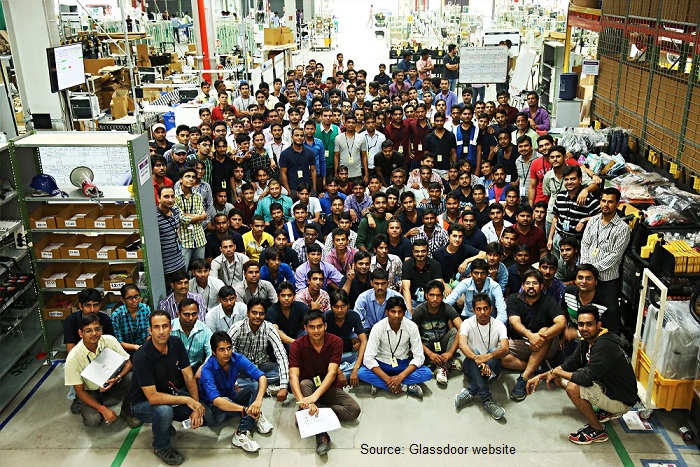
To expand its storage capacity in India, Amazon had opened its largest Fulfilment Centre in Sonipat, Haryana.US-based e-commerce giant Amazon took about a million square feet of office spaces on lease last year, making it equal to what it took between 2008 and 2015 in the country.
Founder and chief executive Jeff Bezos said last year that it would invest another $3 billion in India, amid intense competition in the e-commerce space.
Much of the leased space could be used for seller and development services, besides a 30,000-sq ft building in Bandra Kurla Complex for its India headquarters.
According to Propstack, a data analytics firm for commercial property transactions, various Amazon entities have leased about 1.3 million sq ft since 2008.
Amazon launched its online marketplace in India in 2013 but had been present in the country for eight years for research and development services.
An Amazon India spokesperson said: “As a policy, we do not comment on what we may or may not do in the future.”
Properly consultant Colliers International elaborated on the latest activity by Amazon as the year closed — 100,000 sq ft in the Mohan Co-operative area in Delhi, 150,000 sq ft in Ambience Corporate Tower 2 in Gurgaon and 300,000 sq ft in World Trade Tower Noida.
Before that, through 2016, it leased 90,000 sq ft at Ambience Corporate Tower II NH8 in Gurgaon and 350,000 sq ft at Mindspace, Madhapur, in Hyderabad.
Rival Flipkart, which operates through Flipkart India, Flipkart Internet and Flipkart Payment Gateway, recently took 600,000-sq ft office space in an Embassy group project in Bengaluru.
“Amazon has been investing systematically in expanding its product portfolio, bringing Indian merchants on to their Indian and global platform, and expanding its delivery infrastructure,” said Devangshu Dutta, chief executive officer at retail consultancy Third Eyesight.
Dutta said with its plans to grow private labels and the current e-commerce foreign direct investment regulations which require companies to increase the share of unrelated merchants, the Bezos-led company requires significant organisational capacity and hence is growing office spaces.
Added Raja Seetharaman, director at PropStack, “Amazon is going ‘all out’ in the battle for e-commerce market share in India. They realise that India would be their next biggest market outside the US. With a median age of 27 and growth rate of 6.5-7 per cent, Amazon is willing to invest ‘whatever it takes’ to win.”
The company’s long-term investments, along with futuristic technology like drone deliveries, which it is already piloting in the US, indicate that Amazon is well positioned to be a leader in the e-commerce sector, Seetharaman said.
LEASE DEALS IN 2016
Source: Colliers International
(Published in Business Standard)
admin
January 17, 2017
Suparna Goswami, Forbes
Bengaluru, 17 January 2017

The past week saw India’s Flipkart appointing a non-founder CEO who is also part of Tiger Global Management, the online marketplace’s largest investor firm.
A few days later, Snapdeal, another large Indian online marketplace, brought in real estate firm Housing.com’s CEO Jason Kothari as its chief strategy and investment officer. This news comes on the heels of a recent merger between Housing.com and real estate brokerage firm Prop Tiger, which has raised funds from SoftBank – a major investor in Snapdeal.
Are we seeing a pattern of investor overreach into startups in India?
With this latest SoftBank connection, many are starting to lament how young businesses in India are facing excessive interference from venture capitalists. Some experts tracking the ecosystem have written about the number of years left before “impatient investors take control of the startups” – but how well founded are these suspicions? I spoke with a few local venture capitalists for their side of the story, and perhaps unsurprisingly, many were upset with the media for “sensationalizing” a trend that’s not quite the harbinger it appears to be.
Dev Khare from Lightspeed India Partners Advisors, a VC firm, says things shouldn’t be viewed as black and white. “Just because Flipkart announced a professional CEO who happens to have an association with its investor firm Tiger Global Management doesn’t mean [its] founders no longer will have a say in the company,” says Khare.
“In the end it all boils down to making money. If a company isn’t doing well, the equity that VCs and founders jointly hold will have no value. I don’t see this as a battle between VCs and founders,” he says.
For other VCs, it’s all about the individual needs of a company, and labelling the investor’s role as “interference” is the wrong way to approach the issue.
Tarun Davda, managing partner with VC firm Matrix Partners believes that all investors look out for the wellbeing of their investment, no matter how that presents itself.
“We’re helpful when asked for advice but never fool ourselves into believing that we know more about the business than the founders,” says Davda.
He believes there are often cases where founders feel they can better serve their company by bringing on a more experienced CEO, particularly where founders may lack the experience or skills to take a company ahead through all stages of evolution. Davda provides the example of Google, probably the biggest startup success story of our generation, which had to bring in Eric Schmidt as its CEO early in their journey.
Devangshu Dutta, managing partner of venture accelerator PVC Partners, chalks up the media reaction to local culture. Dutta says Indians have a habit of looking down on founders for handing control over to an outsider.
“There is no harm in accepting that sometimes a company needs a new person at the helm to turn around things,” says Dutta. “In India, we tend to take these things as failures; but [they] could be the outcome of well thought out strategic decisions.”
And in reality, for many startups the Flipkart and Snapdeal episodes are a non-issue; founders are aware of their capabilities and strengths, and their limitations.
Ganesh Shankar, founder of FluxGen Technologies, an IoT startup, is fine to pass on the reins of the company to a person who doesn’t alter the company culture too much. “I guess I [would] be glad if I can find a person willing to take on the top leadership role provided he or she has the experience to scale the business,” he says.
Others view it as a matter of practicality, that these seemingly hard decisions are part of the fiduciary responsibility of the VCs towards their LPs.
Pallav Pandey, CEO of startup BroEx, doesn’t believe that VCs interfere in a company’s affairs unless they’re forced to. “Both founders and investors are stakeholders and after having given enough time to founders [to succeed], if it is inevitable that a new CEO needs to be brought in to steer the company forward, then it should be done,” he says.
However, not all agree with this view. One startup founder I spoke with, who asked not to be named because of the potential harm to his business’ relationships, says the reality of a boardroom meeting is darker than what’s usually projected.
“Founders and VCs are fair-weather friends. One can’t expect things to be always amicable. The main flip side of raising huge funds is that somewhere down the line a founder’s opinion gets diluted. That’s a hard reality,” the founder says.
(Published in Forbes)
