
admin
March 21, 2020
Chaayos and Chai Monk are selling more than 3.5 lakh cups every day between them. Still, it isn’t an easy market to crack.
Written By Nishant Sharma

The moment a customer places an order at a Chaayos outlet, an IoT-enabled brewer starts preparing chai that can be made to order in 80,000 different ways.
Called Chai Monk, the robot has reduced the time taken to make a cup by nearly a third to 2.25 minutes, Nitin Saluja, co-founder of the tea café chain, told BloombergQuint. “This not only helps maintain a consistent taste of the tea consistent, but also reduces waste and manpower.”
Reducing costs is crucial for the company as it competes in a nation of tea drinkers where for most people, chai outside home means sipping a milky and spiced black tea concoction at a roadside shop. Along with Chai Point, Chaayos has been trying to create a culture of tea cafes.
The bet was the size of tea market in India. According to the National Sample Survey Office data, Indians drink 17 cups of tea for every single cup of coffee. Tea Board’s data show nearly 80 percent of 1.35 billion kilograms of tea produced in India is consumed locally. And the tea retail, according to Euromonitor International, stands at Rs 18,000 crore, nearly 2.5 times that for coffee.
That’s only one part of the problem. Profitability is difficult even after scaling up as the fortunes of established coffee chains Café Coffee Day, Costa Coffee and Barista show.
The store count of Coffee Day Enterprises Ltd.’s Coffee Day, India’s largest café chain, fell by nearly a fourth over the previous year to 1,469 in the quarter ended September, with same-store sales declining nearly 4 percent. While the company’s debt burden led to the tragic suicide of the founder, profitability at the store level has remained elusive.
When CCDs and Baristas started, they were pushed as places of social gathering, according Arvind Singhal, managing director at the retail consultant Technopak Advisors. “The amount people spend (there) isn’t enough to be profitable,” he said. “There’s a reason food accounts for 50 percent of the revenue of cafes, which shows that there’s nothing like a coffee culture or tea culture here.”
How The Beverages Stack Up
Figures in Rs
| Metric | Tea Cafes | Coffee Joints |
|---|---|---|
| Average Bill | 150-250 | 250+ |
| Price Per cup | 65+ | 100+ |
That hasn’t deterred investors and entrepreneurs. The initial success of tea cafes has helped birth more than a dozen tea startups. Even salt-to-software conglomerate Tata Group launched Tata-Cha, a café-styled outlets that also deliver tea, in 2018—it’s second attempt at the format. And investors have ploughed nearly $150 million in them so far, according to data shared by Tracxn and BloombergQuint’s calculations.

For Chai Point, average bill ranges between Rs 150 and Rs 200, rising annually 15-18 percent, according to Amuleek Singh Bijral, who co-founded the company in 2010. Outside the outlets, it has created a delivery-oriented demand. “Opening huge stores cannot be the only strategy.”
Chai Point tied up with nearly 2,000 companies to introduce BoxC.in, an Android-based IoT-enabled automatic tea and filter coffee dispenser. This is one of the company’s fastest-growing arms in less than three years, raking in more than a third of its revenue.
Bijral said 40 percent of their revenue comes from in-store sales, and the remaining from delivery. But that doesn’t mean it’s not scaling up. The company intends to add 70 stores to its count of 175 in 2020-21. The company is experiment with smaller store formats
And it’s looking at food for increasing revenue. Chai Point plans to become an all-day breakfast brand and is working on offering a croissant burger and egg parantha, apart from a menu that already offers poha, upma, samosa and sandwiches. While the company said that its foods segment contributes 18 percent to overall revenue, in-stores sales account for 35 percent.
Chai Point’s average monthly store sales stands at Rs 9-10 lakh, with average same-store sales growing 15-20 percent, according to Bijral. “Average sales per square foot is Rs 24,000-25,000,” he said. “These are all signs that shows business is here to stay.”
“Money to be made is real and devil is in the execution,” Bijral said, adding that the company is on track to report full-year operating profit in FY21.
Chai Point Keeps Lid On Expenses
Figures in Rs crore
Chaayos

Chaayos is betting the neo-café model, like Luckin Coffee of China—a unicorn that focuses on fast delivery, technology-driven retail and convenience.
Besides the automated brewer, it also gives users the option to use facial recognition to speed up ordering time. But the move has drawn flak over privacy concerns. Still, Saluja said, technology and data is helping the firm manage its inventory and reduce wastage to about 1.5 percent of sales from 4 percent.
The startup is also betting on food which Saluja said is prepared fresh at its 81 outlets. Customers have reposed confidence, he said, citing number. About 96 percent of transactions on the platform have a validated number, according to Saluja, and a repeat customer comes to Chaayos 3.8 times a month.
The average purchase ticket size of Rs 250 and while that may be less than CCD’s Rs 320 or Starbucks’s Rs 550, but the repeat is much higher, he said.
Chaayos’ Revenue Rises
Rs crore
Unlike coffee, tea isn’t a socially driven business, he said, citing that Chaayos clocks a fifth of its day’s sales by 11 a.m. “No one comes for social interaction early in the morning, people are coming because we’re able to replace the ‘Tapriwala’ (roadside vendor) or home tea.”
Chaayos is profitable at the store level, Saluja said, without sharing numbers. The same-store sales grew by nearly a fourth last year, he said. The tea startup aims to reach a store count of 100 by the end of fiscal and aims to open 300-400 in three to four years.
Saluja, summed up the opportunity saying that his outlets may not be the first choice for a meeting or a date. “But we’re going to be the second place where you’re comfortable and are going to come more often than once.”
Still, Devangshu Dutta, chief executive officer of retail and consumer consultancy Third Eyesight, isn’t that optimistic. “The business looks very profitable from outside because cost of goods is very small, but the other aspects are killing it, like real estate,” he told BloombergQuint over the phone. The whole vibe of being a hangout place is embedded in these formats, and the length of time is not in proportion with what people are buying, he said.
According to Dutta, it really comes down to having enough volumes and the portfolio of outlet needs to be looked at periodically. “You need to be ruthless about where they are making money and form what they are making money it to make it a scalable venture.”
Source: bqprime
admin
March 18, 2020
Written By Alnoor Peermohamed & Rasul Bailay, ETtech

ETtech Illustration: Rahul Awasthi
Sales of smartphones, electronics, apparel, home appliances and furnishing have taken a beating due to the Covid-19 virus outbreak, as Indian consumers stay at home and cut back on discretionary spending in an already sluggish market.?
Several consumer brands, retailers and sector analysts told ET that demand has dropped palpably, except food and grocery sales, which are on the up due to uncertainties around stockouts and store closures as infections spread across the country.
Calling it an “unprecedented” situation, several executives and analysts said that a prolonged shutdown of retail stores would further affect the purchasing power of consumers.
“Right now it’s a lack of sentiment to buy, but if this doesn’t clear up by mid-April, it’s going to be a situation of inability to buy,” said a senior analyst at one of the leading global consultancy firms, who did not want to be named as he is not authorised to speak to the media.
He added that job losses are also likely in these directly affected sectors.
The chief executive of a global fashion retailer offered a gloomy outlook saying fashion companies are forecasting growth to fall 20% in the next fiscal year.
“That means next year we will see our growth go down 10% compared to 2019-20,” he said, requesting anonymity.
Large format brick-and-mortar retailers in the country have seen sales of discretionary items decline, while e-commerce marketplaces Flipkart and Amazon, where non-essential items make up over 70% of sales, are staring at a severe blow in the coming quarters, impacting their growth estimates, several people in the know told ET.
In the United States, most big retailers like Starbucks, Apple, Nike, have announced shutting of stores temporarily to fight the spread of infections.
In India, malls, restaurants, retail stores, and cinema halls, have been either shuttered across metros like Mumbai and Bengaluru, or have seen a drastic reduction in footfalls if currently operational.
“Retail sales are down by almost 50%, as 60% of malls and shopping centres are closed in India with more and more states initiating closure,” said an executive of a leading department store chain.
“At-home consumption would increase and sales of packaged food and staples have been rising already. However, there will be a temporary impact on discretionary products such as apparel,” said Kishore Biyani, founder & CEO, Future group, which runs Big Bazaar and Food Hall stores.
Categories such as fashion could bounce back sooner, several people told ET.
Seasonal purchases made before summer are also feeling the heat. A leading national electronics retailer said business has been minimal in the last few days.
Refrigerator and washing machine maker Godrej Appliances’ business head Kamal Nandi said the challenge is more in urban India due to the inflow of international travellers. “If the situation does not normalise by April, sales will be badly hit even if the summer is harsh,” Nandi said.
A senior executive of Reliance Retail said there was too much uncertainty, which if prolonged could reduce purchasing power of consumers.
Grocery sales spike
Sales of food and staples have, however, seen an uptick.
It is not a clear win for offline retailers that have been traditionally strong in this space, as ET reported on March 16, but online retailers such as Grofers, BigBasket, Amazon and Flipkart have
got a leg-up in growing their grocery sales, as consumers jump to purchase items online in the relative safety of their homes.
However, given grocery makes up just 3% of e-commerce sales, an uptick in the category will not see the online sector gain much.
The uncertainty around how long the outbreak will persist has made it harder for analysts to pinpoint when growth could bounce back.
Satish Meena, an analyst with Forrester Research said, keeping in mind conservative estimates, growth in sales of discretionary items would rebound only by October or November.
Meena added that while growth estimates of the still nascent e-commerce industry were being lowered for 2020, the sector would still end up outperforming its previous year sales figures.
Growth in India’s e-commerce market began slowing last year with the market clocking sales of around $31 billion, a growth of around 35% year on year, which was down from almost 60% the previous year, according to analysts.
Even during the festive period in 2019, online sales grew by just 32% in 2019, compared to a 93% growth in 2018, according to Forrester Research.
“It’s a double whammy, because when you were stepping out to watch a movie, you ended up eating out and going to a couple of clothing stores. Now, given the current situation, people are avoiding going to public spaces and that’s hitting discretionary spending,” said Devangshu Dutta, Chief Executive at Third Eyesight, a consulting firm focused on the consumer goods industry.
(With inputs from Writankar Mukherjee in Kolkata)
Source: economictimes
admin
March 16, 2020
Written by Venkata Susmita Biswas
Active sleep solution companies such as Wakefit, Wink & Nod, SleepyCat, Sunday and Flo have adopted a direct-to-consumer model
The mattress market seems to have been woken up from a long slumber, with a few Indian start-ups attempting to disrupt the business model by bringing the concept of ‘mattress in a box’ to India and selling them online.
The unique selling proposition though is the availability of a branded product at a lower price. Active sleep solution companies such as Wakefit, Wink & Nod, SleepyCat, Sunday and Flo have adopted a direct-to-consumer model, thus cutting out the middlemen and commissions. This allows them to sell products at a far lower cost than established mattress manufacturers in India.
Should legacy mattress brands, the likes of Sleepwell, Kurl On and Duroflex — which command almost 50% of the market share — lose sleep over this?
The cost of sleep
Wakefit’s website explains how the company is able to sell products such as memory foam mattresses at a low price: “Usually, mattresses are priced higher due to brand spends being passed on, retail commissions, sales commissions and wholesalers’ profits. Our mattresses are cheaper compared to others in the market because we cut out the middlemen to sell good quality mattresses directly to our customers at fair and honest prices”.
Since consumers cannot touch and feel the products they buy online, these new-age brands have a 100-day no-questions-asked return policy.
Sandeep Prasad, CEO and founder of Wink & Nod, says that in the traditional distributor model, as much as 40% of the price of the product goes into commissions.
The newer players, which only operate online, have tasted success with their offerings. Wakefit, for instance, has grown from earning Rs 7 crore in revenue three years ago, to making Rs 81 crore in 2019. The company aims to net Rs 250 crore in 2020, says its CEO and founder, Ankit Garg.
Legacy mattress brands, which traditionally use the distributor/ retailer set-up, are now warming up to this business model. Duroflex has launched a direct-to-consumer mattress brand called Sleepyhead. Interestingly, the website of this new brand is critical of the business model followed by its parent brand. “Did you know that a mattress that you buy at a retail store costs up to 60% more than the actual cost of the mattress? And don’t forget the delivery cost!” is how its FAQs section reads.
Sleep and tell
Mathew Chandy, MD, Duroflex, says the direct-to-consumer model is best suited for players entering the mid-level price segment. “For products that are more expensive and premium in nature, the retail experience remains an important part of the purchase journey,” he adds.
In the absence of distributors and retail experience, these new-age brands could begin to plateau very quickly. This is precisely why furniture e-commerce brands like Urban Ladder and Pepperfry had to set up experience centres.
Sleep solutions brands have started investing in experience centres to boost volume growth. “Getting consumers to buy high-value products, like mattresses, purely online could be risky as people may have low trust in the brand/ product. Therefore, consumer behaviour will change at a slow pace for this market,” says Devangshu Dutta, chief executive, Third Eyesight.
Even in the evolved markets where online retail has become a way of life, physical stores continue to exist. Especially in the case of upholstered furniture and mattresses, retailers encourage consumers to try out the product.
The challenge for young brands, hence, is to avoid the distributor model and find more affordable ways for consumers to experience their products. Wink & Nod has tie-ups with real estate companies to display its products. For its entry into the tier II and III markets, where selling mattresses exclusively online could be tough, Wakefit plans to build experience centres.
“The challenge here will be to generate footfall without the support of the traditional models, and therefore a brand will have to go for locations with more visibility,” says Dutta. But this means location cost will go up, so even if a company saves up on the distributor model cost, it could end up spending on managing, supporting and supplying the retail experience.
Source: financialexpress
admin
March 13, 2020
Here’s taking a look at how COVID-19 has affected the apparel industry in India and how several companies are coping with the growing crisis…
Written By Dheeraj Tagra

It’s been over two months since the first death case was reported (January 11 in China) due to Coronavirus (COVID-19), which is now declared a global pandemic by the World Health Organization (WHO). Various reports are showing its negative impact on global apparel trade too. All stakeholders of the Indian textile and apparel industry are actively concerned about various aspects of this challenge. Apparel Resources interacted with several companies from across India, exploring how COVID-19 has impacted the industry so far and how it is likely to affect in future, as well as what steps are being taken by the apparel manufacturing units for the safety of their workforce.
As far as major buying countries are concerned, as per the official data, the US apparel imports in January 2020 noticed a downfall of 11.19 per cent (in values terms) of its global imports. The major reason for the same is the impact of Covid-19. Though the official data of the EU is yet to come, Indian apparel exporters are worried about it.
Now as the epicentre of this challenge is shifting from China to Europe, Indian apparel exporters exporting mainly to Europe are more concerned about the situation. Exporters told Apparel Resources that the shipments are being asked to put on hold for one month which will further lead to delay in payments. While Raja M Shanmugham, President, Tirupur Exporters Association (TEA), is of the view that one should see it as a temporary phase and not worry much. “We should not be in a panic situation. The situation has started improving in China, so I expect that Europe as well as other countries/regions will overcome the situation soon.” He further added that China has started dispatching accessories, which is a good sign for Indian apparel industry too.
At the same time, since Japan is also suffering hugely due to the Coronavirus epidemic, Jaipur which is India’s leading apparel hub is also going to be affected in future. Majority of Jaipur’s exporters are working for Japan-based buyers, and so, they are worried in this regard. A leading exporter of the pink city Anil Sharma, Director, Art & Craft Exclusive, Jaipur, said, “So far, there is no major and direct impact on our export business from Japan, as Japanese buyers are ethical and are not cancelling current orders. But as the market is impacted there heavily, the next season is definitely going to be dull for exporters like us who are catering to Japan.”
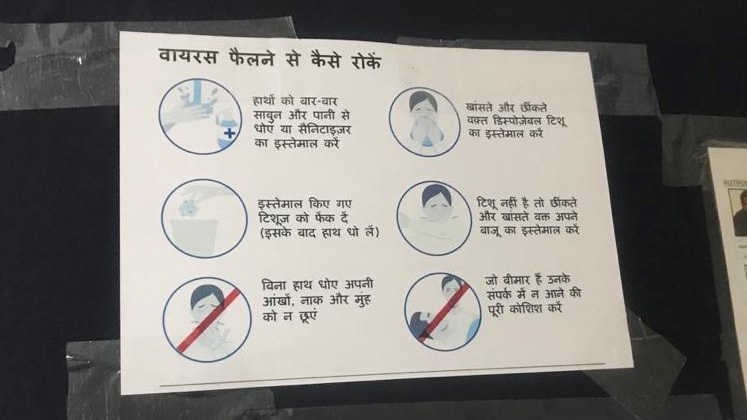
Information in Hindi shared on the notice board of TCNS Clothing Company
Many apparel manufacturers do feel that uncertainty of things is one of the biggest worries for them and whatever developments are there, it will have a temporary impact. Experts believe that India should take this opportunity to put itself in the forefront of polyester-based fabric as well as cotton.
Achal Goenka, Director, Go Go International, Bangalore – a well-known apparel export company, believes, “The business impact has been both good and bad as we have started receiving more enquiries than before from our customers in fabrics/styles which were before more suitable for China. Whether it will eventually translate into orders is what we need to see. We manufacture garments from fabrics imported from China, but now that we are not sure about this fabric supply owing to the current situation, and so, we can’t take these orders. This has clearly impacted our business unfavourably.”
He further adds that trims and accessories supplies are mainly affected, as they were sourced mainly from China. However, customers are agreeing to develop the same in India. Now that the buyer would find more risk to place orders in China going forward, India has an advantage of being vertically integrated and self-sufficient in raw material supply unlike its competitors Bangladesh, Vietnam and Myanmar. However, this will benefit India short-term and temporarily.
Another important aspect in this scenario is the down sentiment of the domestic market, as the share market has also crashed. Overall buying by the customers can be slow and will impact the domestic market too. “Garment is not a primary requirement and when people have less outings to malls, cinema halls, it will naturally have a negative impact on their shopping also,” says Devangshu Dutta, Chief Executive, Third Eyesight, a prestigious consultancy firm.
Source: apparelresources
Trims SME and giants are equally cautious
A multinational thread company, having manufacturing plants in India as well as many other countries, is doing a detailed survey among its customers (garment and footwear manufacturers) so it can have a fair idea about the uncertainty of the market. “This year is definitely not going to be a good year. To have minimal impact, we are trying to know the opinion of our customer and impact on their business, so we can plan accordingly,” shared a senior executive of the company on the condition of anonymity. The company has completely banned the entry of outsiders in its manufacturing facilities as a precautionary measure.
SME manufacturers are facing the challenge of the increased price of yarn and dyeing raw material, as they can’t keep much stock due to the temporary nature of this problem. Traders who used to import accessories are also of the opinion that they have not gained much so far, as whatever additional demand was raised could not be fulfilled completely due to high price and quality issues of Indian accessories.
Initiatives taken by apparel manufacturing units

Hand sanitisers are being placed at various factories
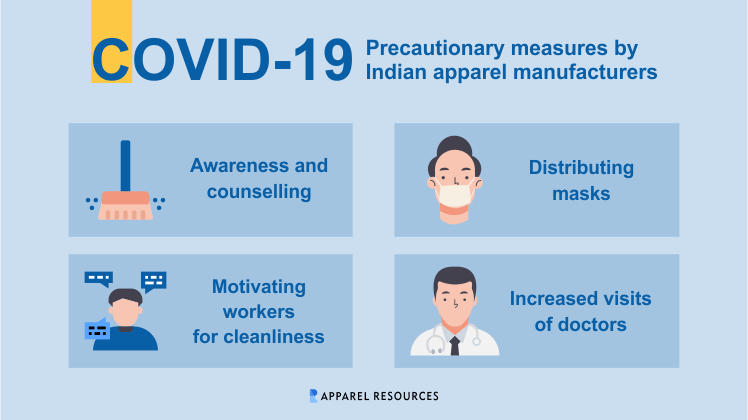
Majority of apparel manufacturing units are fully active in this regard and taking the workers and staff safety on top priority. Travel is almost banned even within India; even local meetings are mostly being held through technical tools. Awareness and counselling are on their top priority, as various sessions have been organised with workers in which HR and compliance teams, along with doctors, explained precautionary measures to remain safe. Factories have also distributed masks to all workers as well as to staff. Hand sanitisers are kept at various places in the factory premises and workers are being motivated to wash hands regularly.
Local administration is also in touch with apparel manufacturing facilities and issuing instruction too.
Orient Fashion Exports, one of the leading export houses of Gurugram, is also keeping a close eye on the temperature of workers, as HR teams are checking it on a regular basis. Rashmi Singh, Welfare Officer of the company, told, “We are also giving a mask to every visitor, offering sanitisers to them. As we counsel our workers, they are now fully informed and taking all required measures.”
CTA Apparels, Noida, one of the most respected names in apparel manufacturing, has increased visits of doctors on the shop floor, and doctors are talking to the workers frequently to motivate them about safety. HR and welfare teams of the company are closely following instructions given by the WHO and Union and State Governments, taking all necessary steps accordingly.
TCNS Clothing Company (W Brand), another well-known firm, has replaced soap cakes with liquid hand wash across all its plants. A. Rehman, Manager Compliance (Export Division) of the company, informed, “We have distributed masks to all of our employees. A training session in this regard was attended by one to all including the top-level management. Awareness messages are being announced twice a day. Even if a worker feels cold, he or she is immediately asked to contact the factory’s medical team.”
admin
March 9, 2020
Written By Devika Singh
According to Technopak, the total Indian ethnic wear market is valued at Rs 70,000 crore.

While a large share of this market remains unorganised, existing organised players such as FabIndia and Manyavar have tasted success.
Swedish retailer H&M recently announced its plans to introduce a saree collection in collaboration with designer Sabyasachi Mukherjee in April. Japanese brand Uniqlo, meanwhile, introduced a special kurta collection, when it launched its first store in India last September. These are just some of the examples of international fashion retailers showing interest in the ethnic wear market in India.
Besides these, some established Indian retailers who primarily deal in western clothing, too, have shown interest in ethnic product lines. Aditya Birla Fashion and Retail Ltd (ABFRL), which manages brands such as Van Heusen and Peter England, plans to soon introduce a mass-market fashion brand in the country, while Raymond launched its Ethnix range last year.
Experts cite a high growth rate seen in the ethnic apparel segment as a reason for this newfound interest in the category. According to Technopak, the total Indian ethnic wear market is valued at Rs 70,000 crore; women’s ethnic wear has an 85% (Rs 59,500 crore) share in the market and is expected to grow at a CAGR of 10% till 2022. While a large share of this market remains unorganised, existing organised players such as FabIndia and Manyavar have tasted success.
Traditional is ‘in’
Raymond has been opening exclusive brand outlets and tapping its extensive distribution network to grab a share of this market. “Raymond has a massive distributional spread and it has a very high recall when it comes to occasion-based selling. Therefore, we see that it is a fitting opportunity for us to pursue,” says Gaurav Mahajan, president, group apparel, Raymond. The company has opened 40 stores so far for Ethnix and plans to add 10 more by the end of this year. Raymond, besides occasion-based or ceremonial wear, is offering casual Indian wear under Ethnix, too. The brand, according to Mahajan, is positioned in the premium category.
Uniqlo’s kurta collection, too, commands a price premium; its products, which include kurta dresses, tunics, stoles, etc, range from Rs 1,290-3,990. The company has tied up with Delhi-based designer Rina Singh for this collection and made it available in its stores across Japan, Singapore, Malaysia, Thailand, Indonesia and Philippines, besides India.
“We are committed to providing customers in India with apparel that comes from our Japanese value of simplicity, quality, and longevity, and made to be affordable and accessible to all. The team was inspired to create a new version of the kurta, made for a progressive woman. Given its versatility, kurta is a democratic shape that could be offered to women across the world,” says a Uniqlo India spokesperson.
ABFRL, which has ethnic wear products under Pantaloons, announced a partnership with designers Shantanu & Nikhil last year and acquired a 51% stake in Finesse International Design. The company had also acquired ethnic apparel retailers Jaypore and TG Apparel in 2019 and plans to leverage these to introduce a mass-market ethnic brand soon.
Fitting issues
Experts are of the opinion that multinational brands are not looking at a pure-play offering in this segment, but plan to leverage this category to drive their growth further into the country.
“The objective is to make the brand a bit more local. Launching ethnic ranges helps these brands drive walk-ins from those consumers who do not wear western outfits,” says Rajat Wahi, partner at Deloitte India.
However, for brands that are looking at this more seriously, there are several challenges and positioning is one of them.
“International brands have a fairly distinct positioning and attract customers because of this distinction. Why would a customer walk into an H&M store to buy Indian wear clothes?” says Devangshu Dutta, chief executive officer, Third Eyesight.
Experts say about 80-90% of the ethnic wear market in India is still unorganised, which is another hurdle.
“Selling ethnic wear requires a different set of skills than western wear. The ecosystem for suppliers and vendors is not fully developed here and companies need to work on this,” says Abheek Singhi, managing director and senior partner, BCG.
For example, he adds, many Indian apparel players have been manufacturing shirts for years for global manufacturers and know all the requirements to produce them at scale. However, ethnic wear has been made at a more local level and therefore “there is a learning curve here for these companies”, he says.
Source: financialexpress
