
admin
September 28, 2020
Written By Mihir Dalal

(From left to right) Doug McMillon, CEO of Walmart, which owns Flipkart; Mukesh Ambani, chairman and MD of RIL; Jeff Bezos, CEO of Amazon
BENGALURU : Last month, Nimit Jain, an entrepreneur, ordered biscuits, shampoo, toothpaste and other items for his family in Kota. He used JioMart—the new online shopping app by Mukesh Ambani’s Reliance Industries Limited—lured by its low prices and freebies.
JioMart was to deliver the order within two days, but Jain’s family didn’t receive the items on time and JioMart didn’t inform Jain about the delay. The delivery was done four days after he had placed the order, a few hours after Jain had complained to the firm via email and Twitter.
A few products were missing, Jain’s parents informed him. It took time to figure out the missing items because the details of the order weren’t available on the app. Jain had paid online and asked JioMart for a partial refund. Instead of receiving an acknowledgement for his refund request, he received a response for his previous email about the delay in delivery. Five days later, Jain got a refund.
Mumbai-based Jain, a computer science graduate from the Indian Institute of Technology, Madras, usually orders groceries from BigBasket and sometimes from Dunzo. He said that he doesn’t plan to use JioMart again.
“A couple of my friends and relatives (in Mumbai and Kota) have also had similarly bad experiences. It doesn’t look like JioMart is ready for online groceries. Their operations and customer care teams weren’t in sync,” Jain said.
Since JioMart expanded to more than 200 cities this summer, scores of customers like Jain have complained about missing products, delayed deliveries and generally poor service. Still, industry executives say that while its service levels have been inconsistent, JioMart is registering similar order volumes to BigBasket, the largest e-grocer, on the back of aggressive marketing and discounts.
These volumes still comprise a small fraction of the overall business of Amazon India and Walmart-owned Flipkart, the two dominant online retailers. But that’s because JioMart is only selling groceries now; it plans to sell other products like fashion and electronics soon. It’s clear that after many years of talk and hype, Reliance, which owns India’s largest offline retail chain, is finally becoming a serious challenger to Amazon and Flipkart, as well as BigBasket and Grofers.
Still, industry executives, logistics firms, consultants and analysts that Mint spoke with said that Reliance will find it tough to break the dominance of Amazon-Flipkart in e-commerce, similar to how Walmart is struggling to challenge Amazon in digital sales in the US even as its stores continue to prosper. Amazon and Flipkart both have deep pockets, proven expertise in e-commerce, popular brands and good knowledge of the Indian market.
“Reliance has the financial muscle, but Walmart (Flipkart) and Amazon are no pushovers,” said Harminder Sahni, managing director, Wazir Advisors, a consultancy. “Today, most people who want to shop online are happy with Flipkart and Amazon. These companies have achieved significant scale and have very few weaknesses. As a latecomer, it will be very difficult for Reliance to make a big dent in the market.”
Reliance did not respond to an emailed questionnaire seeking comment.
Local internet powerhouse
During the pandemic, Reliance has not only moved fast to make inroads into the e-commerce market, it has also consolidated its leadership in organized offline retail. Last month, Reliance bought most of the businesses of Future Group for about $3.4 billion in a deal that will take its retail footprint to nearly 14,000 stores—by far, the largest in India.
In the past six months, Reliance has raised more than $21 billion for its digital unit Jio Platforms. This month, Reliance kickstarted a separate fund-raising spree for its retail unit, Reliance Retail, bagging about $1.8 billion from private equity firms Silver Lake and KKR, two of the investors in Jio. Several more investment firms, including other shareholders in Jio, are expected to join them.
These moves are part of Reliance’s efforts to transform itself into a 21stcentury digital behemoth. It is positioning itself as India’s answer to Amazon, Facebook, Google, Alibaba and other world-class digital giants, and unlike local startups like Flipkart, Ola and Paytm that have or had similar ambitions, Reliance enjoys some unparalleled advantages.
It is now accepted wisdom among politicians and regulators that India needs a ‘local’ internet powerhouse to counter the dominance of America’s Big Tech and the growing influence of Chinese firms, partly because of sovereignty concerns. Reliance’s mastery in lobbying and its political clout makes the firm best-placed to exploit this urgent establishment need to find a domestic internet powerhouse.
Amazon, Flipkart, Facebook and others face many policy-related restrictions that not only serve as obstacles to them but pave the way for domestic firms led by Reliance to enter the fray. For instance, foreign investment rules prevent Amazon and Flipkart from owning inventory or selling private labels (though critics say that these firms do it anyway using clever legal workarounds), while Reliance has no such constraints. Apart from a supportive policy environment and huge capital resources, on the business front, too, Reliance has an enviable digital distribution network and reservoir of customer data on account of Jio.
But despite these formidable advantages, Reliance has yet to prove that it has the chops to realise its ambitious vision.
The war among Reliance and Flipkart and Amazon and other internet firms is also not restricted to retail, but will extend to other sectors like financial services, content and business-to-business commerce. The technology-centric nature of the battle is more suited to the internet companies than to Reliance. There’s little doubt that Reliance will be a major player in the digital business, but the jury’s out on how much value the firm can corner. Its foray in e-commerce and B2B will provide early answers to this question.
Retail battle
After JioMart began testing its service late last year, media reports said that the company would deliver products to customers from local kirana stores. After Facebook invested in Jio in April in a deal that included a business partnership between JioMart and WhatsApp, Ambani said that JioMart would soon connect some 3 crore kirana stores with their neighbourhood customers.
Many analysts, too, expect the partnership with WhatsApp, the most popular app in India, to be a game-changer. In July, Goldman Sachs estimated that Reliance’s entry will help expand the online grocery market by 20 times to about $29 billion by 2024. Reliance’s partnership with Facebook could help the firm become the leader in e-grocery and garner a market share of more than 50% by 2024, Goldman said.
But Mint learns that Reliance is sourcing a majority of orders on JioMart in many cities through Reliance Retail’s supply chain; only a small number of orders are served through kirana stores. JioMart is signing up a few thousand kirana stores every month, but its expansion is happening at a slower rate than many analysts expect. Two industry executives said that JioMart’s average order value is lower than that of other e-grocers, which means that Reliance is losing larger amounts of money on every order.
According to one e-commerce executive, for BigBasket and Grofers, the delivery cost is about 3-4% of the average order value, which exceeds ₹1000. For Reliance, the delivery cost is presently much higher because its order value is below ₹800. The lower order value is partly because most of JioMart’s 200 city-markets are non-metros. BigBasket and others generate an overwhelming majority of their business from the metros. Reliance is betting on expanding the e-grocery market rather, than taking market share from incumbents, which generate an overwhelming majority of their sales from 10-15 cities. But while Reliance may be able to attract customers in smaller cities initially with discounts, profitability will be tough.
“The economics of serving metros are very different from the rest of India. In the mass market, bill values are much, much lower. Right now, Reliance’s main focus is to scale JioMart, so they aren’t worried about the delivery cost,” the executive cited above said. “But eventually, reality will catch up, and they will have to increase basket sizes because this model isn’t sustainable. Grocery has very thin margins to start with. “
Private label push
One obvious way for Reliance to boost margins is by selling more private label products. In the grocery category, Reliance Retail already generates 14% of its revenues from private labels. People familiar with Reliance’s plans said that the company wants to push its private label products to kirana stores. While there are hundreds of well-known brands in FMCG, the grocery category (products like rice, pulses and flour) is largely unstructured. Reliance plans to sell its private label products both in grocery and FMCG.
Apart from retail, Reliance is also rapidly expanding its B2B business. Its private label products form a key component of its retail and wholesale business plans, the people cited above said.
The private label push, however, is making large FMCG companies like Hindustan Unilever, Marico and Dabur, which sell competing products, wary of working with Reliance’s B2B arm.
Like Flipkart and Amazon, which are also expanding their B2B businesses, Reliance’s grand vision over time is to have an integrated ecosystem of wholesale and retail in which it connects consumer goods makers with kirana stores and retailers, supplies a large number of private label products across many categories to retailers and end-customers, and becomes the biggest omnichannel retail firm in the country. But realising this vision will require Reliance to work seamlessly with millions of kirana stores, thousands of brands, modern retailers (all of which will see the firm as a rival to an extent)—and provide exceptional service in a profitable manner to retail customers.
Analysts and industry executives said that Reliance has a higher probability of finding success in categories like fashion (in which it already runs a portal called Ajio) and grocery that are mostly unorganised and have a shortage of established brands. In these categories, Reliance faces fewer barriers from existing players and has a better chance of pushing its private labels in both the wholesale and retail markets. But in categories like electronics and FMCG, which are dominated by entrenched brands, kirana stores and e-commerce firms, Reliance may struggle to scale as fast.
For instance, Flipkart and Amazon dominate online sales of electronics and fashion, which together comprise more than 75% of all e-commerce. To win significant share in electronics, Reliance will have to spend enormous amounts on discounts, marketing and offering favourable terms to brands . But, in fashion, Reliance can tap its low-priced private labels to lure customers without resorting to value destruction.
“The market is too varied for one player to be big in all categories,” an investment banker said. “Reliance will have to carefully choose its battles. There’s a risk that it may spread itself too thin, so it’s wise for them to have started with grocery.”
Meanwhile, while Google and Facebook have together invested more than $10 billion in Reliance, both companies are continuing to expand their own businesses in India. Google and Facebook have ambitions to enter e-commerce and expand in other sectors like payments and content. What this means is that while Google and Facebook will end up collaborating with Reliance in some areas, they will also compete with the firm in others, joining Flipkart and Amazon in the war of the digital conglomerates.
Flipkart and Amazon have already stepped up their lobbying efforts with the emergence of Reliance as a threat. Because of the pandemic that has made e-commerce indispensable, there has been a thaw in the government’s attitude towards the US e-commerce firms. A more antagonistic attitude may return when the pandemic passes.
Eventually, though, the war will be decided by customers. Here, experts are divided on whether Reliance will emerge as the winner. “Reliance still has to do a lot more on getting the customer experience in place, but given the strides they’ve made, it is well-placed to compete in the digital space,” said Devangshu Dutta, head of retail consultancy firm Third Eyesight.
Source: livemint
admin
September 28, 2020
Written By Shruti Venkatesh

Reliance Retail now has the bargaining power to challenge India’s biggest FMCG firms—HUL, ITC, Nestle—on both margins and market share. FMCG firms won’t give in quietly, but RIL’s dominance over both the organised and unorganised grocery retail sectors will make it a difficult map to navigate
The fast moving consumer goods (FMCG) sector in India is like a giant jigsaw puzzle. There are thousands of brands across dozens of segments. When put together, though, they paint a picture of just a handful of companies pulling all the strings.
Take homegrown Hindustan Unilever Limited (HUL). With a market capitalisation of $67 billion, it is India’s largest FMCG company. Many of its products—like Bru or Surf Excel—are so deeply embedded
Source: the-ken
admin
September 25, 2020
Written By CHITRA NARAYANAN
The sentiment against Chinese products is helping retailers of Korean products in India

Tech and media policy professional Prasanto Kumar Roy’s go-to bakeries in Gurgaon are the Korean ones – especially Sibang and Sonya in South Point mall.
He says his favourite dessert is Bingsu, a Korean milk and shaved ice sorbet. Roy also often picks up Korean food items from specialty retail stores in Gurgaon.
He is not alone. Korean products – from food to cosmetics and toys – are inexorably finding their way into the shopping carts of Indians. So much so that a year-and-a-half ago, See Young-Doo, a South Korean who has made India his home since 2004, launched Korikart, an e-commerce store stocking Korean products. It has four lakh users.
“Over 90 per cent of them are Indians,” says the Korikart founder. After K-pop, K-drama, and K-food, it is now K-beauty that is really being loved by Indians, he says. And while vocal for local may be trending, Young-Doo says the sentiments against China that spurred this movement has helped Korikart, as customers are picking up Korean products instead.
Toy sales spike
For instance, he says in recent months, there has been a spike in sales of toy products on the Korikart site. Beauty brands such as Innisfree and foods such as Ramen noodles continue to do well.
The trend is not limited to Korean products alone. Across Delhi NCR, there are now stores stocking Japanese products exclusively or shops that sell Thai and Japanese labels.
On Nykaa, there are over 1,100 Korean beauty products, and it is a category in itself. Similarly, on Ubuy India, you can pick up a plethora of food products from sauces to condiments to noodles from Thailand, in addition to toys, bags and fashion items.
Gone are those days when expats had to trudge to INA market to get their favourite Thai or exotic ingredient.
“This was a trend waiting to happen,” says Devangshu Dutta, CEO of Third Eyesight, a consultancy for retail.
He says back in 2004 when the Japanese and Korean companies had started arriving in huge numbers, he had forecast this was a retail opportunity.
Source: thehindubusinessline
admin
September 24, 2020
Written By MANU BALACHANDRAN
Mattress maker Duroflex is regaining lost ground by ramping up product development, and expanding into new geographies

(Clockwise from top) Mathew Chandy, Mathew Joseph and Mathew George of mattress-makers Duroflex Image: Nishant Ratnakar
Mathew Chandy knows well the importance of having professionals in a family business. After all, the 42-year-old had already seen the flipside, quite early in his family business. A graduate of the National Law School of India University, Chandy was witness to his 57-year-old family venture, mattress maker Duroflex, reach soaring highs and brutal lows largely as a result of a family feud. Now, in firm control of the company, the former lawyer is en route to reclaiming what Duroflex had lost during the turbulent times.
“We lost about 10 years between the mid-1990s and 2000s,” says Chandy. “The opportunity cost was huge, and that’s actually when many of our rivals grew quite well. Over time, we realised that if we had to improve productivity and win the bigger battles, we had to bring in professionals.”
But, bringing in more professionals into a traditional, family-owned business is only one part of winning the battle. Since taking charge as the managing director of the Bengaluru-headquartered company in 2012, Chandy has digitised much of its operations, expanded into new geographies, ramped up its online presence, and is developing personalised products to give Duroflex a much-needed push in the Rs 10,000-crore mattress market in India. Over the next five years, he aims to be a Rs 2,000-crore company, from about Rs 500 crore at present. India’s mattress industry is largely unorganised, with branded companies such as Duroflex, Kurl-on and Sleepwell controlling just about 30 percent of the market. “I am less focussed on the final turnover number,” Chandy says. “I have kept it flexible. But the focus is more on the vision and where we want to take Duroflex.”
As a result, unlike a decade ago, the mattress maker is visibly more aggressive in its approach, increasing its advertising spend and partnering with cricket teams Royal Challengers Bangalore and Chennai Super Kings in the Indian Premier League.
From Kerala’s hinterlands
Duroflex was set up in 1963 by Chandy’s grandfather PC Mathew, who hailed from a family of rubber planters. An engineer, Mathew had been working with the family’s tyre business, National Tyres, with an ambition to branch out and try his entrepreneurial skills.
Soon enough, he was selected for a government mission for entrepreneurs to Germany and Austria as the Indian government looked to kickstart the domestic manufacturing sector. Incidentally, he was joined by Ramesh Pai, a Mangaluru-based industrialist who would later go on to set up another mattress company, Kurl-on. On the trip, while on a factory visit to Mercedes Benz, Mathew saw the use of rubberised coir in car seats, particularly due to its high durability and cushioning. This made the young engineer try his luck in setting up a similar business back in Kerala. He soon started Duroflex, with a manufacturing facility in Alappuzha. “But the machines were stuck with the Customs department, and he had to reverse engineer the entire process to get going,” Chandy says.
The company’s clientele soon included Indian Railways and bus makers, among others. “But, the business was still not profitable,” says Chandy. By the 1970s, Mathew’s older son, Chandy Mathew, who had graduated from the Indian Institute of Technology, Madras and the Indian Institute of Management, Ahmedabad, joined him. In the 1980s, the group expanded its business, setting up two factories in Hyderabad and Bengaluru. “Back then, Kurl-on and Duroflex were of the same size, and until the mid-1990s business was brisk,” adds Chandy, son of Chandy Mathew. The company also set up an export-oriented business based out of Kerala for organic latex, which had also emerged profitable.
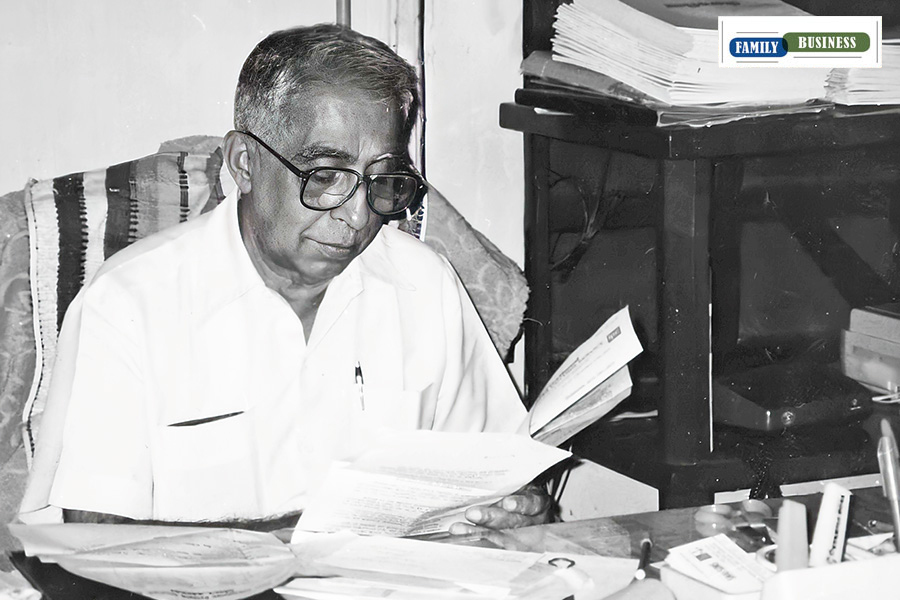
PC Mathew at his work desk in Alleppey, the first office where the Duroflex story began in 1963. The picture is from the early 1970s
Yet, they were finding it difficult to expand further north, particularly because the industry had largely remained unorganised. The group also found it difficult to professionalise the business, with Mathew’s five other children joining it. Around then, the company also tried its luck in manufacturing coir as a substitute for wood, which wasn’t successful, laying the seeds of discord among the brothers. “It’s very important to have family constitutions and succession planning,” Chandy says. “Unlike in a family business, professionals are always judged based on their merit.”
Over the next few years, as the coir business failed to take off, the brothers too had a fallout, with three of them on one side and three on the other. “Over the next 10 years, Duroflex lost a lot of time as the board room battles intensified, and business decisions were stuck,” Chandy says. The dispute then went on to the National Company Law Tribunal, with three brothers leaving the company eventually. “That was the time when Kurl-on grew well,” Chandy says. “But, through it all, Duroflex focussed on setting global standards, but not many investments were made on growth.”
It wasn’t until 2008, when the family finally came together and worked on a settlement. But by then, unfortunately, Chandy’s father had passed away.
Picking up the pieces
Around the same time, Chandy’s uncle, George Mathew took over as the managing director. “He had been single-handedly running the business and had realised he needed to slow down,” says Chandy, who had been working as a lawyer with UBS in London. He was offered the role of running the business back home.
“Around 2012, my uncle had realised it was time for him to retire,” Chandy says. “We debated whether to sell or grow the business. I realised I wanted to be part of the India growth story.” It also helped that the global economy was in the midst of a slowdown, and India was largely immune to the crisis. That year, Duroflex had a revenue of Rs 110 crore.
Over the next year, after he shifted base to Bengaluru, Chandy spent much of his time trying to understand the family business, before revamping it. This included ramping up the marketing budget, focusing on new designs, upping the overall quality of products, and focusing on paying better salaries to employees in an attempt to professionalise the organisation and attract talent.
“Many family businesses believe the capital must be kept with them or in the business,” Chandy says. The company also brought on an advisor, Equitor Value Advisory, a firm specialising in unlocking the brand value of a company. “As opposed to a startup, we had to get an understanding of the brand and how we should get more out of it,” Chandy says. “We had to correct weaknesses and unlock the real value.”
Meanwhile, the company also started hiring more professionals. New recruits included Pradeep Mishra from United Breweries as CFO, Mohanraj Jagannivasan from Wipro to head sales, Mathew Thomas to head the polyurethane foam division, and Smita Murarka from Amante as head of marketing. Today, the company operates 500 exclusive outlets, with over 3,000 dealers and 10 company-owned stores around the country. It employs 1,500 people, including contractual and permanent ones, across five factories.
Over the next few months, the company is aiming to complete a manufacturing plant in Indore, which will help expand business in the western and northern parts of India. This will also need boosting its distribution network, and the affiliation with IPL has helped build brand identity. “We are no longer a regional brand,” says Chandy.
The big leap
When he had taken over the reins of the company, Duroflex sold its products only in the six states of southern India. Rival Kurl-on has over 10,000 dealers, and nine manufacturing facilities across Karnataka, Odisha, Madhya Pradesh, Uttaranchal and Gujarat. “Today, we have a network across 29 states, and over 30 percent of our business comes from non-southern markets. And that is only going to increase,” Chandy says. Much of that, Chandy reckons is also thanks to its foray into the ecommerce sector in 2017, with the launch of Sleepyhead, a product aimed at millennials. It embodies the concept of a mattress in a box, which is logistics-friendly and can be compressed and rolled back, making it easy to ship. “Today, about 30 percent of our revenues come from ecommerce,” Chandy says. “We are trying not to be traditional anymore, and be as agile as possible.”
He was also helped by his cousins, who have since joined the business: Mathew Joseph leads the Sleepyhead business, while Mathew George heads new product development. “He is in charge of new materials, the new range of mattresses and design, including plans to create a work-from-home line of furniture,” Chandy says. Another cousin, Jacob George, working from Mumbai, is in charge of expanding Duroflex’s business in the western market. “Between us, we have a pact to stick together and not fight,” Chandy says. “We will live with our differences and capitalise on them.” By 2018, consumer-focussed private equity (PE) fund Lighthouse invested $22 million (Rs 160 crore) in Duroflex. Lighthouse’s deal was the largest PE investment in a mattress maker after Motilal Oswal PE invested Rs 90 crore in Kurl-on, India’s largest mattress maker, in 2015.
“Unlike other FMCG products, this is a product that has a long lifespan,” says Devangshu Dutta, CEO of retail consultancy Third Eyesight. “But the industry has always remained unorganised.
Now, over the past decade, customers have become more conscious about their purchases and has moved towards branded products. The lockdown has only meant that people have also begun to focus more on their homes.” That’s something Chandy knows well. Over the next few months, he wants to improve the conversation around the mattress category and has roped in celebrities including Milind
Soman and Anil Kumble to campaign for improved sleep and wellness. “What people don’t realise is how important sleep is to general wellness,” Chandy says. Besides, the company is also making inroads into the furniture category with products suitable for working from home, particularly for the millennial audience.
India’s mattress market is expected to grow into a $2.5 billion (Rs 18,300 crore) industry by 2022, according to a 2018 report from RedSeer Management Consulting. The branded mattress market is expected to constitute 37.5 percent of the market by 2022. “Unlike earlier, as a family, we are focussed on new channels and new geographies, and a focus on the future,” Chandy says. “In fact, August was among our best months.” Certainly, Chandy and his cousins are only getting started.
Source: forbesindia
admin
September 1, 2020
Written By Smita Balram, ET Bureau

Leading consumer product companies such as Hindustan Unilever, Dabur and Godrej Consumer Products have started replacing raw materials from China with local indigenous ones, as part of their strategy to either reduce or completely eliminate sourcing from the neighbouring country.
Sunil Kataria, CEO – India & SAARC at Godrej Consumer Products Ltd, said, “We are developing local sources for these imports. Since the world supplies are dominated by China, it will take some time for alte .
Source: economictimes.indiatimes
