
admin
June 17, 2016
 Raghavendra Kamath, Business
Standard
Raghavendra Kamath, Business
Standard
Mumbai, 17 June 2016
 To drive footfalls and attract
brand value, mall developers across the country are rolling out the red
carpet for prominent chains.
To drive footfalls and attract
brand value, mall developers across the country are rolling out the red
carpet for prominent chains.
Recently, H&M signed a lease agreement with a Hyderabad mall
developer, wherein the latter gave the Swedish retailer six months
rent-free, promised an investment of Rs 2.5 crore on fit-outs (a term
used to describe the process of making interior spaces suitable for
occupation) and a 30-year lease, according to a source. This was over
and above the fit period of three to four months.
According to sector experts, department stores ask and get a rent-free
period of three to four months during which they do fit-outs, and get a
lease period of nine-odd years.
According to the same source, Mumbai-based Inorbit Malls has committed
to spend Rs 12 crore on fit-outs and interiors on H&M’s
upcoming stores in Mumbai, Hyderabad and Bengaluru. Inorbit’s public
relations agency did not want to comment.
“They (H&M) say they follow a standard format in signing deals
across 4,100 stores worldwide. If a mall developer is not comfortable
on the terms, they are ready to search for others,” said the source. An
H&M spokesperson said: “We never comment on rumours or future
expansion plans.”
Yogeshwar Sharma, executive director at Select Citywalk, which houses
both H&M and Zara, says they gave a rent-free period of six
months as H&M was new to the country and it would help the
brand to settle down. However, he denied the mall spent money on
fit-outs and interiors.
Sharma said the mall had given a rent-free period of four and a half
months to Zara when it opened in the mall. “Indian brands do not
enforce longer rent-free periods,” he said. Adding that in the longer
view of the mall, they sign 30-35 year leases with global brands.
A Zara spokesperson said: “We cannot comment on our commercial
relations.” Sources said H&M had worked out a special revenue
sharing deal with Phoenix Mills for two of its upcoming stores in
Mumbai. Though there is a buzz that Phoenix Marketcity in the Kurla
area had paid for fit-outs of Zara, Rajendra Kalkar, president-west at
Phoenix denied this.
Recently, Future Group’s Big Bazaar vacated its premises in High Street
Phoenix and H&M is set to open its 30,000 sq ft space on the
same place.
“We give the same treatment for all good brands and there is no
preferential treatment for any,” Kalkar said, adding every deal was
based on commercial negotiations and different from each other.
Added Mukesh Kumar, senior vice-president at Infinity Malls:
“International brands ask for capex on fit-outs and interiors. Some
agree to it and some do not.”
Devangshu
Dutta, chief executive at consultancy firm Third Eyesight, said
international marquee brands are seen as crucial anchors that can drive
high footfall to malls.
According to estimates, footfall at malls are down 20-25 per cent in
the past couple of years, due to economic downturn and onslaught of
e-commerce. Correspondingly, occupancy costs have also come down by
about 15 per cent. 
“Zara and
H&M have already demonstrated the excitement they are able to
generate, not only at launch but the traffic they are able to sustain
over time,” Dutta said.
As far as
recovering the income lost during rent-free periods or co-investment in
initial store fit-out, developers would be working that into their
commercial mix, and looking to recover that from other tenants or to
amortise it over a period of time, he added.
Susil Dungarwal, chief mall mechanic at Beyond Squarefeet
Advisory, a Mumbai-based mall management company, said despite the
terms and conditions, global brands were choosy about where to go.
“They go to a mall only where the latter adds value to the brand,” he
said
Mall owners, he went on, believe they’d be able to recover the
investment on fit-outs and interiors in a few years, as the new brand
will add value to its tenant mix and offer customers a new brand,
impacting in better rental realisation from other tenants, too.
Many malls had shut down in Mumbai, Bengaluru and other cities in the
past couple of years, due to low footfall and business. Beside Nirmal
Lifestyle in Mulund, Neptune Magnet Mall in Bhandup and Centre One in
Vashi, malls that have closed in Mumbai include City Mall and Mega Mall
in Andheri, and Dreams Mall in Bhandup. Kohinoor Mall in Kurla is yet
to become functional.
Eva Mall on Brigade Road and Sigma Mall on Cunningham Road in Bengaluru
have shut shop. Navi Mumbai has seen Gold Souk Mall, Wedding Mall and
Palm Beach Galleria converted into office complexes or showrooms for
automobile companies.
(Published in The Economic Times)
admin
June 14, 2016

Alibaba Group Holdings is
looking to buy, or invest in, an Indian logistics company specialising
in deliveries for online retail players, and towards this end has held
talks with Delhivery and Xpressbees Logistics, according to two people
aware of the development.
The Chinese company is also chalking out a plan to get Paytm to spin
off its marketplace business and plans to top it up with more capital,
said a third source. Alibaba and its affiliate Ant Financial together
own about a 40% stake in the Noida-based company.
These moves are part of an effort by Alibaba to build what founder Jack Ma calls the “iron triangle” of businesses in ecommerce, payments and logistics, and position it to challenge dominant incumbents Flipkart and Amazon.
Paytm and Xpressbees, which is based in Pune, declined to comment.
Sahil Barua, the CEO of Gurgaon-based Delhivery, did not reply to an
email seeking comment.
Times Internet, a part of the Times Group which publishes this
newspaper, is an investor in Delhivery along with Tiger Global
Management and Nexus Venture Partners. In response to questions from
ET, Alibaba said in a statement that it sees “tremendous opportunities”
in India. “We are absolutely committed to developing in this market for
the long term,” it said.
Alibaba is likely to buy a majority or a significant minority stake in
a logistics company, which will give it a major say in operations, said
one of the sources cited above. The investment will be decided in 4-6
months, once Alibaba is ready to launch its horizontal marketplace
platform in India.
Both Delhivery and XpressBees already work
with Paytm’s marketplace as third-party logistics and eKYC partners.
Securing
control over logistics is important because infrastructure comprising
roads, storage and vehicular assets, as well as skills, regulations and
systems are relatively under-developed in India, said Devangshu Dutta,
CEO of retail consultancy Third Eyesight.
“Major players such as Amazon, Alibaba, Flipkart have to take direct or
indirect control to ensure that their logistics capabilities evolve
ahead of their own business growth curve,” he said.
Top executives from Delhivery and XpressBees have
met the team which Alibaba has set up for the India entry. This group
is led by Alibaba’s Global Managing Director K Guru Gowrappan and
Bharati Balakrishnan, the first top executive hired by Alibaba to build
a consumer-facing business in India. Alibaba executives currently work
out of Paytm’s headquarters. 
Delhivery was estimated to be valued at Rs 2,000 crore during its last
funding round. SAIF Partners and IDG Ventures are among the investors
in Xpressbees, whose valuation is not known.
“They are putting their strategy in place. Fundamentally, they will buy
and start with Paytm’s online retail business, because a deal with
Flipkart is not happening right now as they feel it is very expensive.
They will get a logistics partner to build a network like Amazon, which
is very critical,” said a source briefed about Alibaba’s plan.
Besides owning a stake in Paytm, Alibaba owns around 5% of Delhi-based
online marketplace Snapdeal. It held investment talks with Flipkart,
but the two companies were not able to reach an agreement on valuation
and terms. Alibaba and Paytm are working out the contours of the
corporate structure of the marketplace entity, where 100% foreign
direct investment is allowed as per regulations announced by the
government in March.
“All payments will be moved to the payments bank and ecommerce will be
a separate entity which Alibaba will invest in again. We will see some
announcements over the next three to six months,” said a person briefed
about the plan. As India becomes a crucial battleground for the world’s
two largest online retailers, they are deploying contrasting strategies
in an ecommerce market that Internet and Mobile Association of India
estimates will be worth Rs 2.1 lakh crore by December 2016. While
Alibaba has made strategic investments, Amazon India is growing
organically.
Amazon ended 2016 with net sales of $107 billion. Alibaba closed its
financial year in March 2016 with revenue of $15.7 billion.
Winning in India has become critical for Amazon, after it lost out in
China to Alibaba. Last week, Amazon founder Jeff Bezos announced that
his company will invest another $3 billion in India, taking the total
commitment to around $5 billion, putting the spotlight on Alibaba’s
India plans.
Alibaba is also entering India at a time when funding options for local
players have dried up, and sales growth is flattening as online
retailers pull back on discounts. This gives it an opportunity to
cherry-pick assets in the country. India is also important for
Alibaba’s push to globalise its customer base, as it looks to get half
of its revenue from overseas by 2020 as compared 20%. In April, Alibaba
acquired a majority stake in Southeast Asian online retailer Lazada for
$1 billion when it was reportedly running out of money.
(Published in The Economic Times)
admin
June 8, 2016
Madhav Chanchani, The Economic Times
New Delhi, 8 June 2016
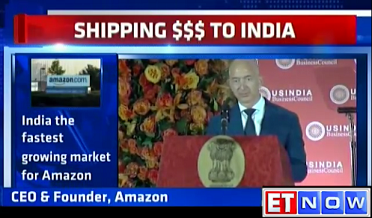
Amazon founder & CEO Jeff Bezos said that the company is planning to invest an additional $3 billion in its India operations, coming nearly two years after the Seattle-based online retail giant announced plans to pump in $2 billion. The announcement takes total investment commitment in India by Amazon, which is competing with market leader Flipkart for the top spot, to $5 billion.
The $5 billion investment will take Amazon India past the combined capital raised by both local rivals, Flipkart and Softbank-backed Snapdeal. While Flipkart has raised over $3.2 billion till date, Snapdeal has mobilised around $1.5 billion.
After losing out to Alibaba in China, winning the Indian market has become critical for Amazon and the latest move underlines that it has a blank cheque for the market.
“We have already created some 45,000 jobs in India and continue to see huge potential in the Indian economy,” said Bezos. “Our Amazon.in team is surpassing even our most ambitious planned milestones, and I’m pleased to announce today that we’ll invest an additional $3 billion on top of the $2 billion that we announced in 2014, bringing our total investment in India to over $5 billion.”
The announcement by Bezos was made during Prime Minister Narendra Modi’s visit to US. The PM also presented Bezos with U.S.-India Business Council (USIBC) Global Leadership Award along with Sun Pharmaceutical founder Dilip Shanghvi. USIBC is a lobbying group for businesses in the two countries.
Amazon has been stepping up its investments in India since the start of 2015, and has picked up momentum in the last two quarters, as ET reported earlier this month.
The main India unit, Amazon Seller Services, has received Rs 8,618 crore since beginning of 2015 and over Rs 9,600 crore since it was set up. In March Amazon also made its intention clear to keep pumping in more capital, as it filed to increase its authorised capital from Rs 8,500 crore to Rs 16,000 crore.
Since Jeff Bezos made the announcement of investing $2 billion in India in 2014, Amazon Seller Services has received Rs 9,029 crore. Till the time of announcement in July 2014 the unit had received Rs 600 crore.
The infusion underlines how Amazon India is ramping up its cash burn rate at a time when local rivals like market leader Flipkart, and Snapdeal are conserving capital and focus more on unit economics.
Last week, Amazon also completed its three year anniversary in India, gaining market share from rivals who have been in business much longer than it has. Flipkart which began by selling books as an online retailer in 2007 and counts Tiger Global as its largest investor, is the market leader in India’s online retail industry.
ET reported in April that Amazon India has already overtaken Snapdeal in terms of number of shipments, and is moving close to leader Flipkart’s market share.
The firm has implemented learning from the China market in India, Bezos said at the Code conference last week.
Amazon started India operations in June 2013 with cash on delivery, the preferred mode of payment, and also leveraged local Kirana stores for delivery of goods. It has also introduced a slew of initiatives for merchants like AmazonTatkal, which enables small businesses to get online in less than 60 minutes.
Amazon India has also built its own logistics network in India, which includes 21 fulfillment centers (FCs) owned by company and 50 owned by its sellers.
But recent norms on foreign investments in online marketplaces are widely expected to put a short term pause on Amazon India’s aggressive gains on market share on local rivals, even though many expect that it still has a long term advantage both in technology and capital available.
Government guidelines expected to pause Amazon’s advance include the cap of 25% that a seller can account for sales on an online marketplace, and if a marketplace can “directly or indirectly influence sale price of goods or services.” Both these factors were proving to be significant in Amazon’s advance in India.
Amazon Inc runs a joint venture with NR Narayana Murthy’s Catamaran Ventures- Cloudtail India Pvt Ltd- which is one of the biggest sellers on the Amazon marketplace in India. While Amazon has never directly acknowledged existence of this entity, on January 29, 2016 it acknowledged it as one of the risks for the first time to its international operations in regulatory disclosures in US.
“In India, the government restricts the ownership or control of Indian companies by foreign entities involved in online multi-brand retail trading activities……..we hold an indirect minority interest in an entity that is a third-party seller on the www.amazon.in marketplace,” said Amazon.com , Inc filing with Securities & Exchange Commission (SEC) on January 29, two months before Indian government unveiled FDI regulations on online marketplace.
Amazon has also sought clarifications on how to market discounts from the government after the recent regulations came in force, as ET reported earlier.
Before the new regulations were announced, Amazon’s growth has outpaced both its rivals Flipkart and Snapdeal. Amazon India’s shipments in 2015 increased by 250% over the prior year, while Snapdeal revealed that it has seen a growth in its gross merchandise value of 90% between FY15 and FY16.
Flipkart
has not disclosed its GMV or growth numbers for 2016. The e-tailer was
targeting GMV of $10-12 billion (Rs 64,000-76,000 crore) by June 2016,
more than double the $4 billion it achieved in 2014-15 but is expected
to have widely missed the target.
But Amazon has continued
growth momentum in 2016, having increased 150% in the first calendar
quarter from a year earlier. It added 90,000 new products daily between
January and March. Now, Amazon India has 55 million products listed on
its platform while Flipkart has more than 40 million and Snapdeal has
35 million.
Both Flipkart and Snapdeal have been on the
defensive mode in 2016 as they look to extend their runways and
monetise existing customers. There is also not much clarity on their
next round of financing after pitching to multiple investors since end
of 2015. And both these organisations are likely to see more challenges
going into the year.
“During
the last 12-18 months, with funding tightening up, companies have
started looking at margin more seriously. Not only are marketing spends
are being refocussed, many senior management exits have happened and
more organisational turmoil is likely in the coming months,” said
Devangshu Dutta, chief executive of retail consultancy Third
Eyesight.
(Published in The Economic Times)
admin
June 2, 2016
Madhav Chanchani, The Economic Times
Bengaluru, 2 June 2016

Amazon has invested an additional Rs 1,350 crore (about $200 million) in its India unit this year, stepping on the pedal as it seeks to accelerate the momentum gained in the past 18 months.
The latest investment in Amazon Seller Services, disclosed in regulatory filings on May 31, takes the total capital infused into the main India unit since early 2015 to Rs 8,618 crore. The money came in March, a few weeks before India introduced discounting and vendor-related restrictions for online marketplaces.
The investment underscores Amazon India’s determination to spare no expenses to fuel growth, outspending rivals that are having to slash budgets and focus on squeezing more revenue per customer. The money will now also be needed for additional compliance-related expenses, said experts.
Amazon this week will complete three years in India, in which time it has bitten off significant market share from domestic rivals who have been around longer. The Seattle-headquartered company in March edged past Soft-Bank-backed Snapdeal in shipments, or volume market share, ET reported in April.
Flipkart , which began by selling books as an online retailer in 2007 and counts Tiger Global as its largest investor, is the market leader in India’s online retail industry.
For Amazon, after losing ground to Alibaba in China, winning in India, the world’s fastest-growing major economy, has become critical. The company in October said it expected India to overtake Japan, Germany and the United Kingdom to become its second-largest overseas market in a few years.
“We have done much more local market customisation in India than we did in China,” Amazon chief executive Jeff Bezos said on Tuesday at the Code/Media conference in California when asked what lessons the company had learnt from China.
Amazon began its India operations by allowing buyers to pay by cash, a novelty for it, and recently has leveraged neighbourhood stores for delivery of goods.
It has introduced a slew of initiatives for merchants including Amazon-Tatkal, so small businesses can get online in under 60 minutes.
Amazon India has also built its own logistics network, which includes 21 delivery or fulfillment centers owned by it and another 50 owned by its sellers. But Bezos also said the Indian and Chinese markets are different, taking a dig at investors who have ploughed sizeable capital into Amazon’s domestic competitors expecting similar successes as seen in China.
“I think some of the investors in India in the early days thought that India might be a replay of China and they have found out that it hasn’t gone that way,” Bezos said at the conference.
Tiger Global and SoftBank have invested about $1billion each in Flipkart and Snapdeal, respectively.
Experts tracking online retail said it wasn’t alien for Amazon to outspend rivals to dominate a market. Amazon in January made its largest single capital infusion into in its India unit atRs 1,980 crore, a month after it sunk inRs 1,696 crore.
“This is only the tip of the iceberg,” said Kartik Hosanagar, professor at The Wharton School of the University of Pennsylvania. “While Flipkart and Snapdeal are struggling to attract new capital, the strategic commitment from Jeff Bezos gives Amazon India a huge advantage.”
Amazon India, however, has to deal with the new guidelines that bar any single merchant from accounting for more than 25% of the sales on an online marketplace and disallow any discounting led by the online platforms.
“The FDI policy has clear implications for Amazon’s growth,” said Devangshu Dutta, CEO of retail consultancy Third Eyesight. “It cannot depend on Cloudtail (Amazon’s leading merchant) to develop its presence beyond 25% of projected revenues, so it does create a huge push for other merchants and brands. This will need significant spending on more manpower, more dispersed delivery infrastructure and higher marketing spends as well. long-term horizon in India.”
A spokeswoman for Amazon India said in an email, “We have witnessed tremendous growth in three years of our operations in India. In 2015, we grew by more than 250% (year-on-year, in terms of shipments) and by over 150% y-o-y in the first quarter of 2016 despite a larger base.”
For all this, however, Flipkart CEO Binny Bansal says he is not worried by Amazon’s pace.
“The more we make quality products affordable and available, that’s the only way to maintain our leadership,” he said in an interview last week when asked if Flipkart was confident about remaining the market leader in 2017. “I am certain that we will remain the largest player by far.”
(Published in The Economic Times)
admin
May 31, 2016
Jochelle Mendonca, The Economic Times
Mumbai, 31 May 2016
 What
does it take to build an ecommerce platform? Well, just on the money
side, Tata Unistore, the Tata group’s online sales arm, paid TCS Rs
36.48 crore in the runup to the launch of the website.
What
does it take to build an ecommerce platform? Well, just on the money
side, Tata Unistore, the Tata group’s online sales arm, paid TCS Rs
36.48 crore in the runup to the launch of the website.
There’s another Rs 20.9 crore of work done in FY16 that is yet to be paid out, TCS’ annual report showed.
The TataCliQ ecommerce site that launched last week had TCS as its primary technology partner .
Data analytics for the site will be provided by Tata IQ, the company said in its presentation.
The
Group says it is a creating a ‘one-of-its-kind, omnichannel’
marketplace which would allow customers to ship-to-stores,
collect-from-stores and return-to-stores.
Experts
said the process requires a great deal of technology to connect stores
to an online site, because different merchandise inventory systems
would need to be connected. The company had to connect its front-end
online ordering system, the store points-of-sale and mobile
applications to back-systems like its warehouse, inventory management
system, customer service and analytics.
“Technology plays a
great part, because if you don’t have the technology, the different
systems can’t talk to each other and the customer won’t get a seamless
experience, which is the basis of omni-channel,” Devangshu Dutta, CEO
of retail consultancy firm Third Eyesight, told ET.
Tata
CliQ is based on a customised ecommerce platform from SAP called
Hybris. The company has an in-house team and 20 technology partners,
including some startups such as Chennai-based artificial intelligence
startup Mad Street Den. The startup, which has been funded by Reservoir
Investments’ Exfinity Fund and GrowX Ventures, provides visual search
and visual recommendation solutions to Tata CliQ. “In fashion, if
someone is looking at a little black dress, typically it makes sense to
show them more offerings of that kind. And then you could have further
personalisation, because with artificial intelligence that is
possible,” Ashwini Asokan, co-founder and CEO at Mad Street Den, said.
Asokan,
who declined to give specifics on the partnership with the Tatas, also
works with ecommerce startups such as Voonik and Craftvilla. She added
that the pace of technology adoption in the ecommerce market in India
was much faster than Western markets.
“The cycle here is
two-to-four weeks. Elsewhere you still have to go through a pilot. It
will really be interesting to see how this plays out with the Tatas vs
Reliance vs the Birlas. In 12-18 months, I think the ecommerce market
in India will look completely different,” Asokan said.
(Published in The Economic Times)
