
admin
June 8, 2016
Madhav Chanchani, The Economic Times
New Delhi, 8 June 2016
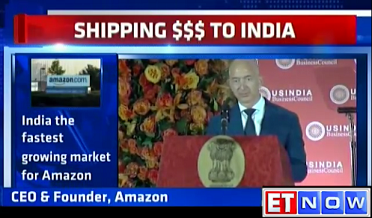
Amazon founder & CEO Jeff Bezos said that the company is planning to invest an additional $3 billion in its India operations, coming nearly two years after the Seattle-based online retail giant announced plans to pump in $2 billion. The announcement takes total investment commitment in India by Amazon, which is competing with market leader Flipkart for the top spot, to $5 billion.
The $5 billion investment will take Amazon India past the combined capital raised by both local rivals, Flipkart and Softbank-backed Snapdeal. While Flipkart has raised over $3.2 billion till date, Snapdeal has mobilised around $1.5 billion.
After losing out to Alibaba in China, winning the Indian market has become critical for Amazon and the latest move underlines that it has a blank cheque for the market.
“We have already created some 45,000 jobs in India and continue to see huge potential in the Indian economy,” said Bezos. “Our Amazon.in team is surpassing even our most ambitious planned milestones, and I’m pleased to announce today that we’ll invest an additional $3 billion on top of the $2 billion that we announced in 2014, bringing our total investment in India to over $5 billion.”
The announcement by Bezos was made during Prime Minister Narendra Modi’s visit to US. The PM also presented Bezos with U.S.-India Business Council (USIBC) Global Leadership Award along with Sun Pharmaceutical founder Dilip Shanghvi. USIBC is a lobbying group for businesses in the two countries.
Amazon has been stepping up its investments in India since the start of 2015, and has picked up momentum in the last two quarters, as ET reported earlier this month.
The main India unit, Amazon Seller Services, has received Rs 8,618 crore since beginning of 2015 and over Rs 9,600 crore since it was set up. In March Amazon also made its intention clear to keep pumping in more capital, as it filed to increase its authorised capital from Rs 8,500 crore to Rs 16,000 crore.
Since Jeff Bezos made the announcement of investing $2 billion in India in 2014, Amazon Seller Services has received Rs 9,029 crore. Till the time of announcement in July 2014 the unit had received Rs 600 crore.
The infusion underlines how Amazon India is ramping up its cash burn rate at a time when local rivals like market leader Flipkart, and Snapdeal are conserving capital and focus more on unit economics.
Last week, Amazon also completed its three year anniversary in India, gaining market share from rivals who have been in business much longer than it has. Flipkart which began by selling books as an online retailer in 2007 and counts Tiger Global as its largest investor, is the market leader in India’s online retail industry.
ET reported in April that Amazon India has already overtaken Snapdeal in terms of number of shipments, and is moving close to leader Flipkart’s market share.
The firm has implemented learning from the China market in India, Bezos said at the Code conference last week.
Amazon started India operations in June 2013 with cash on delivery, the preferred mode of payment, and also leveraged local Kirana stores for delivery of goods. It has also introduced a slew of initiatives for merchants like AmazonTatkal, which enables small businesses to get online in less than 60 minutes.
Amazon India has also built its own logistics network in India, which includes 21 fulfillment centers (FCs) owned by company and 50 owned by its sellers.
But recent norms on foreign investments in online marketplaces are widely expected to put a short term pause on Amazon India’s aggressive gains on market share on local rivals, even though many expect that it still has a long term advantage both in technology and capital available.
Government guidelines expected to pause Amazon’s advance include the cap of 25% that a seller can account for sales on an online marketplace, and if a marketplace can “directly or indirectly influence sale price of goods or services.” Both these factors were proving to be significant in Amazon’s advance in India.
Amazon Inc runs a joint venture with NR Narayana Murthy’s Catamaran Ventures- Cloudtail India Pvt Ltd- which is one of the biggest sellers on the Amazon marketplace in India. While Amazon has never directly acknowledged existence of this entity, on January 29, 2016 it acknowledged it as one of the risks for the first time to its international operations in regulatory disclosures in US.
“In India, the government restricts the ownership or control of Indian companies by foreign entities involved in online multi-brand retail trading activities……..we hold an indirect minority interest in an entity that is a third-party seller on the www.amazon.in marketplace,” said Amazon.com , Inc filing with Securities & Exchange Commission (SEC) on January 29, two months before Indian government unveiled FDI regulations on online marketplace.
Amazon has also sought clarifications on how to market discounts from the government after the recent regulations came in force, as ET reported earlier.
Before the new regulations were announced, Amazon’s growth has outpaced both its rivals Flipkart and Snapdeal. Amazon India’s shipments in 2015 increased by 250% over the prior year, while Snapdeal revealed that it has seen a growth in its gross merchandise value of 90% between FY15 and FY16.
Flipkart
has not disclosed its GMV or growth numbers for 2016. The e-tailer was
targeting GMV of $10-12 billion (Rs 64,000-76,000 crore) by June 2016,
more than double the $4 billion it achieved in 2014-15 but is expected
to have widely missed the target.
But Amazon has continued
growth momentum in 2016, having increased 150% in the first calendar
quarter from a year earlier. It added 90,000 new products daily between
January and March. Now, Amazon India has 55 million products listed on
its platform while Flipkart has more than 40 million and Snapdeal has
35 million.
Both Flipkart and Snapdeal have been on the
defensive mode in 2016 as they look to extend their runways and
monetise existing customers. There is also not much clarity on their
next round of financing after pitching to multiple investors since end
of 2015. And both these organisations are likely to see more challenges
going into the year.
“During
the last 12-18 months, with funding tightening up, companies have
started looking at margin more seriously. Not only are marketing spends
are being refocussed, many senior management exits have happened and
more organisational turmoil is likely in the coming months,” said
Devangshu Dutta, chief executive of retail consultancy Third
Eyesight.
(Published in The Economic Times)
admin
June 2, 2016
Madhav Chanchani, The Economic Times
Bengaluru, 2 June 2016

Amazon has invested an additional Rs 1,350 crore (about $200 million) in its India unit this year, stepping on the pedal as it seeks to accelerate the momentum gained in the past 18 months.
The latest investment in Amazon Seller Services, disclosed in regulatory filings on May 31, takes the total capital infused into the main India unit since early 2015 to Rs 8,618 crore. The money came in March, a few weeks before India introduced discounting and vendor-related restrictions for online marketplaces.
The investment underscores Amazon India’s determination to spare no expenses to fuel growth, outspending rivals that are having to slash budgets and focus on squeezing more revenue per customer. The money will now also be needed for additional compliance-related expenses, said experts.
Amazon this week will complete three years in India, in which time it has bitten off significant market share from domestic rivals who have been around longer. The Seattle-headquartered company in March edged past Soft-Bank-backed Snapdeal in shipments, or volume market share, ET reported in April.
Flipkart , which began by selling books as an online retailer in 2007 and counts Tiger Global as its largest investor, is the market leader in India’s online retail industry.
For Amazon, after losing ground to Alibaba in China, winning in India, the world’s fastest-growing major economy, has become critical. The company in October said it expected India to overtake Japan, Germany and the United Kingdom to become its second-largest overseas market in a few years.
“We have done much more local market customisation in India than we did in China,” Amazon chief executive Jeff Bezos said on Tuesday at the Code/Media conference in California when asked what lessons the company had learnt from China.
Amazon began its India operations by allowing buyers to pay by cash, a novelty for it, and recently has leveraged neighbourhood stores for delivery of goods.
It has introduced a slew of initiatives for merchants including Amazon-Tatkal, so small businesses can get online in under 60 minutes.
Amazon India has also built its own logistics network, which includes 21 delivery or fulfillment centers owned by it and another 50 owned by its sellers. But Bezos also said the Indian and Chinese markets are different, taking a dig at investors who have ploughed sizeable capital into Amazon’s domestic competitors expecting similar successes as seen in China.
“I think some of the investors in India in the early days thought that India might be a replay of China and they have found out that it hasn’t gone that way,” Bezos said at the conference.
Tiger Global and SoftBank have invested about $1billion each in Flipkart and Snapdeal, respectively.
Experts tracking online retail said it wasn’t alien for Amazon to outspend rivals to dominate a market. Amazon in January made its largest single capital infusion into in its India unit atRs 1,980 crore, a month after it sunk inRs 1,696 crore.
“This is only the tip of the iceberg,” said Kartik Hosanagar, professor at The Wharton School of the University of Pennsylvania. “While Flipkart and Snapdeal are struggling to attract new capital, the strategic commitment from Jeff Bezos gives Amazon India a huge advantage.”
Amazon India, however, has to deal with the new guidelines that bar any single merchant from accounting for more than 25% of the sales on an online marketplace and disallow any discounting led by the online platforms.
“The FDI policy has clear implications for Amazon’s growth,” said Devangshu Dutta, CEO of retail consultancy Third Eyesight. “It cannot depend on Cloudtail (Amazon’s leading merchant) to develop its presence beyond 25% of projected revenues, so it does create a huge push for other merchants and brands. This will need significant spending on more manpower, more dispersed delivery infrastructure and higher marketing spends as well. long-term horizon in India.”
A spokeswoman for Amazon India said in an email, “We have witnessed tremendous growth in three years of our operations in India. In 2015, we grew by more than 250% (year-on-year, in terms of shipments) and by over 150% y-o-y in the first quarter of 2016 despite a larger base.”
For all this, however, Flipkart CEO Binny Bansal says he is not worried by Amazon’s pace.
“The more we make quality products affordable and available, that’s the only way to maintain our leadership,” he said in an interview last week when asked if Flipkart was confident about remaining the market leader in 2017. “I am certain that we will remain the largest player by far.”
(Published in The Economic Times)
admin
May 31, 2016
 Jochelle Mendonca, The Economic Times
Mumbai, 31 May 2016
 What
does it take to build an ecommerce platform? Well, just on the money
side, Tata Unistore, the Tata group’s online sales arm, paid TCS Rs
36.48 crore in the runup to the launch of the website.
What
does it take to build an ecommerce platform? Well, just on the money
side, Tata Unistore, the Tata group’s online sales arm, paid TCS Rs
36.48 crore in the runup to the launch of the website.
There’s another Rs 20.9 crore of work done in FY16 that is yet to be paid out, TCS’ annual report showed.
The TataCliQ ecommerce site that launched last week had TCS as its primary technology partner .
Data analytics for the site will be provided by Tata IQ, the company said in its presentation.
The
Group says it is a creating a ‘one-of-its-kind, omnichannel’
marketplace which would allow customers to ship-to-stores,
collect-from-stores and return-to-stores.
Experts
said the process requires a great deal of technology to connect stores
to an online site, because different merchandise inventory systems
would need to be connected. The company had to connect its front-end
online ordering system, the store points-of-sale and mobile
applications to back-systems like its warehouse, inventory management
system, customer service and analytics.
“Technology plays a
great part, because if you don’t have the technology, the different
systems can’t talk to each other and the customer won’t get a seamless
experience, which is the basis of omni-channel,” Devangshu Dutta, CEO
of retail consultancy firm Third Eyesight, told ET.
Tata
CliQ is based on a customised ecommerce platform from SAP called
Hybris. The company has an in-house team and 20 technology partners,
including some startups such as Chennai-based artificial intelligence
startup Mad Street Den. The startup, which has been funded by Reservoir
Investments’ Exfinity Fund and GrowX Ventures, provides visual search
and visual recommendation solutions to Tata CliQ. “In fashion, if
someone is looking at a little black dress, typically it makes sense to
show them more offerings of that kind. And then you could have further
personalisation, because with artificial intelligence that is
possible,” Ashwini Asokan, co-founder and CEO at Mad Street Den, said.
Asokan,
who declined to give specifics on the partnership with the Tatas, also
works with ecommerce startups such as Voonik and Craftvilla. She added
that the pace of technology adoption in the ecommerce market in India
was much faster than Western markets.
“The cycle here is
two-to-four weeks. Elsewhere you still have to go through a pilot. It
will really be interesting to see how this plays out with the Tatas vs
Reliance vs the Birlas. In 12-18 months, I think the ecommerce market
in India will look completely different,” Asokan said.
(Published in The Economic Times)
admin
May 31, 2016
Madhav Chanchani & Aditi Shrivastava, The Economic Times
Bengaluru, 31 May 2016
 Flipkart’s new big strategy is to cross-sell its services — as well as its customers — to its biggest clients.
Chief
Executive Binny Bansal has stitched together a plan to cross-sell
Flipkart’s commerce, supply chain and advertising services to its
top-selling merchants and deep-pocketed brands such as Samsung . He
also wants to monetise Flipkart’s registered customer base of 75
million by selling insights to these merchants and brands on who and
where the top-paying buyers are and what kind of products they want.
“We
are focussing on cross-selling,” Bansal, who took over as CEO in
January, said in an interview last week. There is a “lot of overlap. We
have seen brands using our services from across the board. For example,
Samsung is using our advertising platform, they sell on Flipkart, and,
hopefully in the future, we will power their supply chain”.
Smartphone
brands Samsung and LeEco have spent sizable portions of their marketing
budgets on Flipkart for the product launches of their latest handsets,
also opening brand stores on the platform. Bansal also wants to
establish Ekart and Flipkart’s payments business as independent brands
focused on business clients.
He said in the interview that he
expects Ekart and Flipkart’s fashion website Myntra to become
profitable first, while the core commerce business at Flipkart and
payments will need more scale to start making money.
The new
strategy, if successful, will help Bansal prove to investors that
Flipkart has a business model that can stand on its own by generating
cash flows from Ekart and the advertising business by next year. While
Flipkart has more than $1 billion in the bank, it needs to keep
replenishing its war chest to fend off an increasingly aggressive
Amazon.
“The focus (on the seller-side) is on large brands
that have the deep pockets to pay and the intent to reach scale,
collect data and better their product portfolio in an efficient
manner,” a person directly familar with Bansal’s plan said, declining
to be identified. On the customer-side, the focus is on offering the
“best-quality goods at the lowest cost in the least amount of time”.
Flipkart
has already begun doing this in categories such as television.
Online-focused television brands Vu Technologies and BPL, among
Flipkart’s top three brands in the category, sell highly competitively
priced sets, leveraging the online platform to overcome distribution
costs.
ET reported on April 5 that Flipkart was working
closely with its top sellers, who are expected to account for 60-80% of
the sales on the platform.
This will help Flipkart comply with
recent regulatory guidelines on foreign direct investment in ecommerce
that bar a single vendor from accounting for more than 25% of the sales
on an online marketplace.
WS Retail, in which Flipkart
promoters owned a stake till 2012, is estimated to account for more
than 25% of the sales on the marketplace as most of the exclusive
merchandise is currently sold through it.
Flipkart is also
relying on brands to give discounts now, as the guidelines disallowed
online marketplaces from directly or indirectly influencing sale
prices. ET reported on May 27 that Flipkart had asked brands to reduce
their margins during its latest Big Shopping Days sale on May 25-27.
Experts
tracking online retail in India said Bansal’s strategy would help
Flipkart manoeuvre around the new policy and at the same time give more
control and information to brands. Leading brands have had a fractious
relationship with online retailers and in the past have objected to the
deep-discounting practices followed by these investor-backed ventures.
“Growing
the share of other merchants via the small merchant route in a
fragmented market like India is extremely resource-intensive, and
availability of both human resource and money is going to get even
tighter than it is now,” said Devangshu Dutta, CEO of retail
consultancy Third Eyesight.
(Published in The Economic Times)
admin
May 26, 2016
Raghavendra Kamath, Business Standard
Mumbai, 26 May 2016
 For
the Aditya Birla group this is a first. Although it has trekked down
the acquisitions route to build its fashion empire in the past, be it
the buy-out of rival Kishore Biyani’s Pantaloons, or the numerous
foreign labels under Madura, the group has steered clear of fast
fashion. But with the Rs 200-crore purchase of Forever 21, the group
has finally forayed into this big, but notoriously fickle market.
For
the Aditya Birla group this is a first. Although it has trekked down
the acquisitions route to build its fashion empire in the past, be it
the buy-out of rival Kishore Biyani’s Pantaloons, or the numerous
foreign labels under Madura, the group has steered clear of fast
fashion. But with the Rs 200-crore purchase of Forever 21, the group
has finally forayed into this big, but notoriously fickle market.
“If
you look at fashion globally, fast fashion is largest part of the
market. In India also, more women are moving towards western wear.
Forever 21 is a renowned brand and its proposition is attractive. It is
important for us to expand the portfolio and grow the brand in the long
term,” said Ashish Dikshit, business head, Madura Fashion &
Lifestyle at Aditya Birla Fashion & Retail in a telephonic
interview with Business Standard.
But can Forever 21 deliver the
results it is expected to, especially since it competes with global
giants Zara and H&M? Both have tweaked their value proposition for
India, offering affordable fashion for price conscious local consumers.
Forever
21 entered the country in 2010 with Sharaf Retail, but failed to scale
up operations. In 2013, it forged a partnership with DLF Brands to open
40-50 stores in five years in the country, but these plans too hit a
roadblock. Currently, the brand has 12 stores and a small online
presence and it has been in the hunt for a new partner for a while. In
India, the label targets the young urban woman and not just the
teen-market.
“The partnership will help establish Forever 21 as
one of the largest women’s wear brand in the country,” says Jatin
Malhotra, director, global expansion, Forever 21. The Birla group seems
to be looking at a similar goal. Dikshit said they would not look at
tapping synergies between Birla’s fashion units and Forever 21. “We see
it as a standalone large opportunity. We want to build it as a large
independent business in the long term,” he said.
Globally the
label is known for its large retail stores and its ability to serve up
bargain fare for a generation constantly on the look-out for new
trends. The brand is also seen as a typical American success story, the
journey from a single store set up by Korean immigrants into a
multi-million dollar global chain is the stuff of many case studies.
However in recent years as digital marketplaces have altered the retail
landscape, the label has seen market realities change and has cut down
on the size and number of its stores.
In India, the
proliferation of e-commerce players has been a big disruptor too; by
offering a wider choice of styles and bringing in labels that would
otherwise been out of bounds in the country, it has changed consumer
behaviour and large chains have had to struggle to understand the shift.
However,
on the plus side for traditional retail chains, digital marketplaces
have helped expand the market for fashion, especially among young urban
women and teens. Possibly global labels such as Forever 21, Zara and
H&M offer such chains a way in, as these brands have a high recall
among buyers of fast fashion.
The Birla group is not alone in
looking for a foothold into this market. Landmark group’s fashion chain
Max has also come out with an in-house brand Runway for the same
segment. Max has one store in Bengaluru and plans to set up seven to
eight such stores. “Till three years ago, fast fashion was out of reach
for Indian shoppers. Now with the advent of e-commerce, new brands
launching and people travelling abroad, shoppers are getting used to
it,” said Vasant Kumar, managing director at Max Fashion.
Kishore
Biyani’s Future Group is also looking to launch a fast fashion brand
‘Cover Story’ in Mumbai next month. “Indian companies who have
manufacturing background and sourcing capabilities will do a good job
in it,” said Jaydeep Shetty, CEO of fashion chain Mineral (Future group
has a stake in the company).
Will Forever21 give the Birla group
an advantage over the desi brands, which still have to establish
themselves in this segment? Whatever the outcome, many believe that it
will definitely lead to a tough battle on the streets. “Increased
competition in fast fashion means cheaper clothes and cheaper inputs in
merchandise. I think share of full price merchandise will reduce from
54 per cent to 47 per cent going forward,” Shetty said. But he adds
that it is illogical to presume Indian chains can compete with Zara or
Forever 21 as they look at different demographics.
Zara launches
new designs twice a week and Forever 21 turns its inventory 14 times a
year. “Even in western markets, nobody is able to compete with them
successfully,” he added.
However,
Devangshu Dutta, chief executive at Third Eyesight believes that fast
fashion as a concept does not exist in the Indian market. “In Europe,
customers line up every Wednesday or Thursday to buy a new style or
line. But here, people wait for three to four months to get discounts
on merchandise. You will get very few customers who are ready to pay a
certain sum to buy a new style or new line,” Dutta said. He said
shoppers in the country are more value conscious than fashion
conscious.
For Forever 21 and the Birla group, it is critical that they learn the rules of the game fast enough, before the brutal world of teen fashion changes yet again.
(Published in Business Standard)
