
admin
December 26, 2016
 Alnoor
Peermohamed, Business Standard
Alnoor
Peermohamed, Business Standard
Bengaluru, 26 December 2016
 The
contribution of private labels in India’s online shopping segment is
expected to triple to around $5 billion in 2017 as e-tailers try to
boost earnings and fill gaps in the market in high-margin categories
such as fashion, furniture and home decor.
The
contribution of private labels in India’s online shopping segment is
expected to triple to around $5 billion in 2017 as e-tailers try to
boost earnings and fill gaps in the market in high-margin categories
such as fashion, furniture and home decor.
Private labels make
up less than 10% of online sales today, or around $1.5 billion in
value, largely driven by fashion retailers such as Myntra, Jabong and
Koovs. Going forward, it is expected that this contribution could grow
closer to 20% and will also be driven by high-value items such as
furniture, according to RedSeer Consulting.
“What horizontal
players are doing is they are consolidating buyers of unbranded
products in electronic accessories and some few other categories and
introducing products in those gaps,” said Anil Kumar, chief executive
officer of RedSeer consulting. “This helps them earn additional margins
where people really don’t care what brand they’re buying as long as the
price is right.”
The largest of the horizontal players, Flipkart
and Amazon, are launching new private labels to improve margins in
commodity products such as electronic accessories. Flipkart recently
launched Smartbuy, an umbrella brand for selling electronic accessories
and home decor products, and plans a second brand next year.
Amazon, too, has its own private label Amazon Basics to sell electronic accessories and Symbol and Myx in the fashion space.
Rival
Flipkart relies on subsidiaries Myntra and Jabong to drive private
label fashion sales, with estimates suggesting around a third of the
sales of the two brands being driven by fashion labels.
Amazon
did not respond for comments and Flipkart said it was too early to
comment as the private labels were launched this month.
With
India’s e-commerce expected to grow by 60-70% in 2017, making it a
$30-34-billion industry, a sizeable part of that will be driven by
sales of private label products. The push for private labels largely
comes from investor pressure on e-commerce companies to improve
earnings and get on their way to profitability.
“Given
how the market is at the moment, where there is pressure from investors
who have been asking about profitability or a route to profitability,
products that earn additional margins are going to be a focus,” said
Devangshu Dutta, chief executive at Third Eyesight.
Globally,
Amazon has adopted the private label route, selling everything from
groceries under its own brand to electronics such as Kindle tablets.
While private labels will grow to contribute under 10% of sales on
large platforms such as Flipkart and Amazon, smaller niche players will
look at them more deeply.
As of today, online furniture
retailers see over 50% of their sales being driven by private labels.
Pepperfry and Urban Ladder, the two leading players in this space,
almost exclusively sell furniture under their own brand names. In
online fashion this contribution is 25-30% while for online groceries
it is close to 20%, says RedSeer.
“One
reason is that when you’re stepping into a gap in the market, there’s
no competition so you are not forced to discount. Secondly, if you’re
sourcing it directly and cutting out a brand, the cost of product
development and marketing can be made by the retailer,” added Dutta.
(Published in Business Standard)
admin
December 21, 2016
Sagar Malviya & Shambhavi Anand, The Economic Times
Mumbai/New Delhi, 21 December 2016

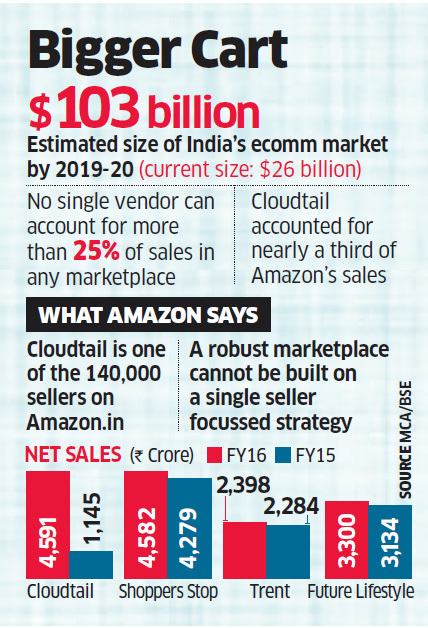
Amazon’s largest seller Cloudtail surpassed the country’s largest department chain Shoppers Stop by revenues which grew fourfold during the year to March 2016, highlighting the growing popularity of online buying as well as of Jeff Bezos’ company in India. This has also posed an unusual problem for the world’s largest online retailer which has to slow down sales of its Indian joint venture firm to comply with government norms.
Cloudtail, a JV between Amazon Asia and Infosys founder Narayan Murthy’s personal investment vehicle Catamaran, posted over 300% jump in revenues to Rs 4,591 crore. This is slightly higher than the consolidated revenue of Shoppers Stop at Rs 4,582 crore and almost twice that of the Tata-owned Trent that logged sales of Rs 2,397 crore during the same period. A year ago, Cloudtail had clocked sales of Rs 1,145 crore. Its net loss too has narrowed to Rs 30 crore from Rs 32 crore.
“On paper, Cloudtail is just a merchant on Amazon but essentially the kind of growth it has seen would not have happened without Amazon’s support,” said Devangshu Dutta, chief executive, Third Eyesight, a consultancy firm.
But for all its success, Amazon is scrambling to reduce its dependence on Cloudtail which as of now accounts for over a third of the sales that take place on its shopping platform in India. That’s because government regulations announced earlier this year do not permit a single vendor to account for more than 25% of sales of an online marketplace where foreign money has been invested.
Amazon, Flipkart and other similar marketplaces have to comply with this guideline by March 31, 2017.
Over the last few months, Cloudtail has almost stopped selling mobile phones. Smartphones constituted the largest category of ecommerce sales and formed a big part of Cloudtail’s overall sales in previous years. But it continues to sell Amazon private labels in India.
An Amazon spokesperson said the company has put a process in place to assess the performance of the sellers on the platform and update sellers if they are close to or about to exceed the 25% threshold.
“Cloudtail is one of the 140,000 sellers that sell on the Amazon.in marketplace. Our marketplace has grown tremendously in the last three years, and sellers have seen growth in business. Our continued belief is that a robust marketplace cannot be built on a single seller focused strategy. We have a robust platform which is open to all,” said the spokesperson. “We have and we will continue to operate within the parameters of the laws and policies of India as we do in each country we operate in.”
Amazon India’s largest rival Flipkart was also heavily dependent on a key vendor, WS Retail, for over three-fourths of its sales until two years ago. But it has gradually reduced its dependence on WS Retail and claims it has moved towards a pure marketplace model which can allow over one lakh sellers to compete on the portal within nearly 80 categories.
India is one of the fastest growing markets for the US etailer and its founder Bezos has pledged to invest $2 billion in local operations. Last month, it invested Rs 2,100 crore in its main India unit, taking total capital invested in Amazon Seller Services to over Rs 7,000 crore in the last 12 months.
The country’s ecommerce market is expected to grow to $103 billion by 2019-20 from $26 billion now, according to Goldman Sachs.
Amazon expects India to overtake Japan, Germany and the UK to become its largest overseas market, besides becoming the quickest to reach $10 billion in gross merchandise value in the company’s history.
It’s showing in Amazon’s performance already. Amazon Seller Services has more than doubled its revenues in the year ended March. It earns its revenues through commissions, advertisements and shipping fees that they charge to sellers.
“Being a third-party market has caused a lot of invention on our side.
The team in India has been very creative on whenever they find a
roadblock or something that has not existed in another country, they
create it themselves, whether from delivery stations to working with
small merchants,” Brian Olsavsky, CFO at Amazon-.com, told investors in
October this year.
(Published in The Economic Times)
admin
December 14, 2016
Sapna Agarwal, Mint
Mumbai, 14 December 2016

Switzerland’s 165-year-old luxury brand Bally is returning to India in a joint venture with Reliance Brands Ltd, with plans to open its first store at the DLF Emporio mall in New Delhi in March 2017.
Under the terms of their agreement, the joint venture will invest in building a world class retail experience by investing in training of staff and opening stores.
Bally is the latest addition to the Reliance Brands portfolio which includes Steve Madden, Thomas Pink, Brooks Bro’s, Diesel and Super Dry. The company will establish a network of stand-alone Bally stores across major Indian cities.
“In the
future, India is the most important country for us. We want to invest
and develop the brand in India,” said Frédéric de Narp, chief executive
officer of Bally who took charge in November 2013 to turn it around.
“Part of this turnaround strategy is the joint venture in India,” said
de Narp, who is credited with the successful turnaround of American
jeweller and watchmaker Harry Winston Inc.
Bally first entered
India in a franchise partnership with Bird Group, which has interests
in travel technology, hospitality and aviation. It had two stores in
India, one at the Palladium mall in Mumbai and the other at DLF Emporio
Mall. Both these stores have closed in the past two years. The
partnership was ended earlier this year.
This time round the
company has spent a few years finding the right partner and fine-tuning
its strategy for India. “We have been working in developing this joint
venture by developing the trust for the last few years,” said de Narp,
adding that more importantly, the joint venture is with Reliance, a
profitable company and a reliable retailer.
In India, Bally
will sell its entire range across men’s and women’s footwear and
accessories. The new store will be part of the brand’s global expansion
which has seen the opening of two new concept flagships in Tokyo’s
Ginza and Los Angeles’ Rodeo Drive this year. The joint venture will
open four stores in Delhi, Mumbai, Kolkata and Chennai in the next 3-4
years, said Darshan Mehta, chief executive officer, Reliance Brands.
In
its previous partnership, Bally which is part of JAB Holding Company, a
privately held group known for its brands like Jimmy Choo, Krispy Kreme
and Belstaff globally, “had underestimated the challenges in investing
in India,” admits de Narp. “Franchise is a challenging model,” he
added. De Narp is looking at investing this time to build a healthy and
sustainable business in India.
To
be sure, a majority of international retailers that have launched
operations in India have come through the franchise route in the last
4-5 years, said Devangshu Dutta, chief executive officer, Third
Eyesight, a retail consultancy firm. “Franchise model is a low-risk
approach for a retailer who is not entirely sure about the market. It
is about experimenting and exploring the market,” said Dutta, adding,
“However, once they have committed they prefer to invest.”
(Published in MINT)
admin
December 12, 2016
Suparna Goswami Bhattacharya, TechinAsia
Bengaluru, 12 December 2016
The entrepreneur overcoming all hurdles to emerge as an icon for
millions – that’s the typical positive story startup media is abuzz
with. Such narratives are often considered the only way to attain
startup goals. In the clamor, we can forget that each startup journey
is unique: before tasting success, even successful entrepreneurs have
faced failure.
The startup narrative can be one-sided, observes
Sharad Sharma, co-founder of Indian tech industry think-tank iSPIRT.
“So many startups fail, but there’s no focus on those entrepreneurs.
Then there are small companies which do not enjoy high valuation[…]
Their learnings can make a big impact in the startup ecosystem.”
Rude awakening
 True.
Not all entrepreneurs have to be the next Sachin Bansal or Mark
Zuckerberg. And this should be fine, as long as they are fulfilling
their dreams.
True.
Not all entrepreneurs have to be the next Sachin Bansal or Mark
Zuckerberg. And this should be fine, as long as they are fulfilling
their dreams.
Shakir Basha couldn’t agree more. He’s the founder of Zippon, a packing and moving service, which eventually had to shut shop.
“I believe in setting up a profitable business on a small scale and gradually taking it to higher levels, especially when you lack business skills and you are a first-timer. But many in today’s generation want to aim for the sky, forget to keep their roots intact and hence fail at what they do. I have personally faced that,” he says. (Right: Zippon founder Shakir Basha. Photo credit: Shakir Basha)
Little wonder then that Aishwarya Raman, who started auto-rickshaw app AutoRaja, found peace working as a zonal head for Ola Auto.
“My main motive of starting AutoRaja was to make the auto-rickshaw drivers a part of the organized sector. Here at Ola Auto, I’m working with the same motive – of course, on a much bigger scale,” says Aishwarya.
In
September 2015, AutoRaja shut down mainly because of lack of funds.
After lying low for a few months, Aishwarya decided to give her dream
another shot.

This
time, the approach was different. “I didn’t want to start another
company immediately. Though my parents encouraged me not to give up on
my dream, I thought I should gain experience by working in a similar
industry but with a different setup.” She approached Ola and they were
more than happy to hire her, given her relevant startup experience.
It’s
common to battle a funding crunch after your startup closes: that’s
when working a regular job provides a much-required cushion. Case in
point: Akash Sharma, who founded Delivree King, a tech-enabled logistic
startup, and Fitfood, a healthy food delivery company. He now works for
MobieFit, a fitness app. “To say that I am disappointed as my previous
ventures did not work will be an understatement. But I’m happy to be
part of the food and fitness industry, which I’ve always wanted. What
life has to offer in terms of opportunities is not known yet, but for
now I am happy working and gaining experience,” says Akash.
Not all entrepreneurs have to be the next Sachin Bansal or Mark Zuckerberg.
It’s all about timing
2015
saw many startups shutting shop. For Akash, Delivree King and Fitfood
were victims of market corrections. Delivree King specialized in
four-hour delivery and guaranteed same- and next-day delivery, besides
offering promotional services for its clients. It had to be shut down
for want of funds. For Fitfood, the timing, unfortunately, was not
right. “I
started Fitfood when food-tech companies were growing. However, by the
time it reached a stage where we needed funds, none of the venture
capitalists we approached were ready to even look at the company. The
timing was bad,” rues Akash. (Left: Akash Sharma founded FitFood and Delivree King. Photo credit: Akash Sharma.)
“I
started Fitfood when food-tech companies were growing. However, by the
time it reached a stage where we needed funds, none of the venture
capitalists we approached were ready to even look at the company. The
timing was bad,” rues Akash. (Left: Akash Sharma founded FitFood and Delivree King. Photo credit: Akash Sharma.)
For
Tapan Kumar Das, access to venture capital wasn’t a problem. The
founder of online meal service iTiffin faced a different problem: low
investor confidence. “There was a lot of negativity around the food
industry. I had to choose between burning my money or shutting down,”
he says, adding that there’s still scope for innovative food-tech
companies despite negativity around the industry.
Knocking at the wrong door
Entrepreneurship
is a place of constant comparison. There is a pressure to raise a
certain amount which will eventually land them adequate press coverage.
However, raising funds from VCs is no cakewalk – especially if one is
not part of the networking circle.
“There is an expectation that
all entrepreneurs either have to be from an IIT, IIM or one of the top
two-three institutes in the country,” says Sukanth Srivastav, who
founded Tooler, a laundry startup. He’s referring to India’s elite
Indian Institutes of Technology (IITs) and Indian Institutes of
Management (IIMs). “The fact remains that a business can be run by
anyone who has an aptitude. We don’t need to complicate things.”
It’s a tough world out there, especially if you are not well-networked.
Graduates
of IITs and IIMs typically have large networking circles, of which
venture capitalists are also a part. “My experience with VCs has not
been pleasant. I had met many of them during my startup stint but the
purpose of their funding is different from what we wanted to achieve as
a startup,” Sukanth says.
The experience taught Sukanth an
important lesson: don’t go by the hype. “Newspaper reports are replete
with stories of VCs out there looking to fund you. This is not the
reality. It’s a tough world out there, especially if you are not
well-networked.” Aishwarya’s experience with VCs was also unpleasant.
“I guess I approached the wrong VCs; they never believed or understood
what I wanted to do.”
Pressure-cooker scene?
Failure is not taken lightly in India – or, for that matter, in any country.
Says Devangshu Dutta from Third Eyesight, a retail- and
consumer-focused consulting firm, “There’s nothing wrong with aiming
high. But entrepreneurs should not feel like failures when their
company does not reach a particular size or valuation.”
Then
there’s family pressure to look for a stable monthly source of income.
“I come from a family where my father has spent his entire professional
career in one company. They do not understand this concept of joining a
startup or starting a business. After my startup stints, I was left
with no money. My mother would often ask why I am wasting my IIT degree
on startups when MNCs are ready to offer me high-paying jobs. So yes, I
felt that pressure,” says Akash.
For Sukanth, the situation was
more or less the same. “In terms of financial growth, I have made zero
progress. I did not have the heart to borrow from my parents to start
another company. There is enough pressure from society to earn a
certain amount. In fact, no one believes in your dreams until you start
making money. That’s the hard fact.”
Editing by Neha Margosa, Michael Tegos, and Steven Millward
(Published in TechinAsia)
admin
December 2, 2016
Nishant
Sharma, Bloomberg Quint
New Delhi, 2 December 2016
 In
its ever biggest markdown of the Indian e-commerce company, a mutual
fund managed by Morgan Stanley slashed Flipkart’s valuation by 38
percent on Tuesday. With this, the valuation of the country’s most
valuable internet company stood at at $5.54 billion – the lowest since
September 2014.
In
its ever biggest markdown of the Indian e-commerce company, a mutual
fund managed by Morgan Stanley slashed Flipkart’s valuation by 38
percent on Tuesday. With this, the valuation of the country’s most
valuable internet company stood at at $5.54 billion – the lowest since
September 2014.
But Flipkart is not alone. Japanese investment
giant Softbank earlier this month, announced a 58.1 billion yen ($513
million) investment loss in two of its biggest investments in India –
cab-hailing firm Ola (ANI Technologies Pvt. Ltd) and e-commerce
marketplace Snapdeal (Jasper Infotech Pvt. Ltd).
This comes at a time when these companies are looking to raise additional funding.
Reality Check
The
country’s top startup evangelists and investors are not too worried
though. Investors BloombergQuint spoke to said that a markdown in
valuation is a much-needed market correction which will bring maturity
in the Indian startup ecosystem that saw euphoric valuations over the
last two years.
“This is nothing but a natural cycle that is
bound to happen”, said Ben Mathias, managing director of Vertex
Ventures in a telephonic interview. Vertex Ventures is the venture
capital arm of Singapore state investment firm Temasek Holdings. “Last
two years, there was a lot of rapture around startups and valuation
were driven up because of that. The situation wasn’t limited to India
but was also seen in Silicon Valley, China and other markets. What we
are seeing today is a rationalisation of valuations and expectations. A
needed market correction has taken place.”
Raising
heaps of money from late-stage mutual funds and cross-over funds in a
heated fund raising environment leads to bubble valuations which
increases the risk of potential markdowns when the market cools off,
added Anshuman Verma, founder and managing director of venture capital
firm M1L and a former partner at Accel Partners.
The Indian
startup ecosystem was booming till 2015, with venture capital
investments flowing in. Indian startups raised $5.5 billion (Rs 36,000
crore) from VC firms and angel investors in 1,096 deals, in 2015 alone,
according to data compiled by research firm VCCEdge.
Tough Times Ahead?
The
markdowns may cause promoters some pain as they will have to dilute a
higher stake to raise funds, but industry experts said that if the
company performs well and is able to meet its targets, lower valuation
will not necessarily dent their ability to raise more funds.
“You
can’t raise money on valuations alone. There are key metrics like
profitability, margins, return rates. All this is what really matters
and is what investors focus on while making investments,” said Sunil
Rao, Partner, Lightspeed Venture Partners
Mathias of Vertex
Ventures added if a company has reached the target it has set for the
year, it shouldn’t worry about raising funds. It can raise money at
robust valuations, despite markdowns.
Not everyone shares that view though.
“Trying
to raise money for your venture post meaningful markdowns is akin to
trying to refill and write with a broken (leaking) pen. It is tiring,
messy, and irritating to write with such a pen. Isn’t it? Markdowns are
demoralisers for companies, and act as leakers.” said Anshuman Verma,
Founder and Managing Director, M1L
Lessons From Markdowns
Verma’s
advice to e-commerce entrepreneurs is they should look at markdowns as
a wake-up call. “They should consider markdowns as pointers to
fundamental problems in the business that must be solved. It should
push them to become more realistic, pragmatic and action-oriented,” he
said.
According to Devangshu
Dutta, chief executive at management consulting firm Third Eyesight,
markdowns are a sign that investors were far more bullish and
aggressive earlier, a view they no longer hold. “If
the survival of the company depends on raising funds at lower
valuations, one should do that. Survival should take precedence over
valuations,” he said.
Verma
said that with subsequent markdowns the startup ecosystem will see
non-prudent founders and their investors accept the harsh realities of
the art of markdowns.
“We will see further humbling of such
founders/investors/companies. Many from the ecosystem still have not
come to terms with the reality of loss-making in late-stage ventures in
India. Few larger internet ventures are not accepting the state of
affairs as they are, and this could be the starting point of all the
problems,” he said.
(Published in BloombergQuint)
