
admin
June 22, 2012
 Asit
Ranjan Mishra, Vidhi Choudhary & Sapna Agarwal, MINT
Asit
Ranjan Mishra, Vidhi Choudhary & Sapna Agarwal, MINT
New
Delhi, 22 June 2012
 Swedish
furniture retailer Ikea will invest as much as €1.5 billion
(around Rs. 10,740 crore today) in India, chief executive Mikael
Ohlsson told trade minister Anand Sharma, signalling an endorsement
of the country by a high-profile investor, something that’s
been rare of late.
Swedish
furniture retailer Ikea will invest as much as €1.5 billion
(around Rs. 10,740 crore today) in India, chief executive Mikael
Ohlsson told trade minister Anand Sharma, signalling an endorsement
of the country by a high-profile investor, something that’s
been rare of late.
Sharma said in a government press release on Friday that Ikea will initially invest €600 million and subsequently an additional estimated €900 million “for initial establishment of 25 retail stores in a wholly owned subsidiary”. Ohlsson and Sharma met in St Petersburg, Russia on Thursday.
While Ikea confirmed in a press statement that it will invest €1.5 billion in retail expansion “over the coming years”, it didn’t refer to the retail stores, nor did it give a timeline for the investment.
Ikea’s decision will come as a symbolic boost for a government that’s been criticized for being unable to push through policies and turning investors off the country at a time when it needs them badly as growth splutters amid global uncertainty.
The gross domestic product (GDP) growth slowed to a nine-year low of 5.3% in the March quarter.
“This quantum of investment at a time when India is facing challenges of credibility both within and outside the country sends a positive statement from a business outlook perspective,” said Arvind Singhal, chairman of Technopak Advisors Pvt. Ltd, a management consultancy firm.
Sharma also met Olaf Koch, CEO and chairman of German wholesaler Metro AG on Thursday in Russia. Koch expressed satisfaction over his firm’s investment in India and apprised the minister about expansion plans in the country. “He also informed that soon they will raise the number of their stores from 10 to 16 in the country,” the statement said. A Metro spokesperson in India declined to comment on the expansion plans.
Ikea said it has already applied to the department of industrial policy and promotion (DIPP) to be allowed to establish a fully owned subsidiary in India.
“We expect DIPP to expeditiously process our application and present the same before the Foreign Investment Promotion Board (FIPB) for consideration of the government of India,” the company said. “Once our application is approved by the government of India, we will be able to share more information about our intentions to establish retail operations in India.”
The government had hoped its decision to remove the 51% ceiling on foreign direct investment (FDI) in single-brand retail in November would persuade high-profile brands such as Ikea, Louis Vuitton, Cartier, Armani and Rolex to invest in fully owned stores in India.
But a condition requiring 30% local sourcing from small industries in India has been a stumbling block. Small industries are defined as those with a total investment in plant and machinery not exceeding $1 million.
Friday’s commerce ministry statement said Ikea had certain reservations about the sourcing norms and discussed those with DIPP officials. “Suitable answers…were provided leading to the decision to invest,” the release said, without elaborating.
Ikea said it will source at least 30% of the purchase value of products sold in India from its “direct and indirect supply chain comprising Indian small industries”. However, it said the mandatory sourcing norm remains a challenge “in the longer term” and asked the government to review the requirement and “provide flexibility”.
Ikea Trading (Hong Kong) Ltd-India, headquartered in Gurgaon, employs 140 people and sources many popular Ikea items from India such as textiles, rugs, plastics, lighting and metal products for its global supply chain. Currently, it is working closely with 70 suppliers and 1,450 sub-suppliers, including many small industries.
According to the Sweden India Business Guide 2011-12, Ikea’s annual turnover in India is $645 million, while its global turnover is $31.4 billion. Worldwide, it employs 127,000.
Ikea is known to adapt to local market requirements. For instance, in Turkey and China, emerging economies similar to India, Ikea offers home delivery and assembly as a service. The company also takes time to scale up operations and has just half a dozen stores in China in its 10 years of operations there.
“It will be interesting to see where the company sets up (shop) and how it adds value to the manufacturing and supply chain logistics in India,” said Mark Ladham, president, home division, at Future Group, which has 38 stores in 19 cities.
Devangshu Dutta, chief executive officer, Third Eyesight, a Delhi-based retail consultancy, said Ikea is known to have large stores that exceed 100,000 sq. ft and are designed as all-day destinations for shoppers with café and restaurant options.
“In India, one of the biggest challenges is realty and they may adopt a more pragmatic approach here and consider smaller stores (because of high property prices). What they do needs to be seen,” Dutta said. “Additionally, Ikea is favoured for its very cheap products. But the reason they are cheap is largely because the cost of assembly and delivery is borne by the customer. If the company offers these services, it will have to relook at its prices very carefully.”
Technopak’s Singhal also said Ikea, which is known for developing vendors globally, will maintain this tradition. “This step will encourage growth of manufacturing set-ups for SMEs (small and medium enterprises),” he said.
Dhvani Modi, research analyst at ICICI Direct, a Mumbai-based brokerage, said the opening up of FDI in single-brand retail was a positive move for the country.
Boosting sourcing from India will encourage job creation and better development of the sector as a whole.
The Indian cabinet’s bid to allow 51% FDI in multi-brand retail was scuppered by intense resistance from within and outside the ruling coalition.
In a bid to revive the initiative, trade minister Sharma wrote to the chief ministers of Uttar Pradesh, Punjab and Orissa on 19 June seeking their support on the issue.
admin
June 14, 2012
Sarah
Jacob, The Economic Times
Bangalore,
14 June 2012
 Japanese
conglomerate Suntory, known for its whiskies and beers, has picked
up majority stake in a subsidiary of Mumbai-based Narang Group
to enter India’s non-alcoholic beverage market.
Japanese
conglomerate Suntory, known for its whiskies and beers, has picked
up majority stake in a subsidiary of Mumbai-based Narang Group
to enter India’s non-alcoholic beverage market.
Suntory Beverage and Food Asia, which manages the M&A strategy and administration of group companies of the ¥1,802.8-billion (approx Rs 1.3 lakh crore) Suntory Holdings in Southeast Asia, has bought 51% stake in Narang Connect.
"The joint venture (Narang Connect is rechristened Suntory Narang) is focused on premium, healthy, coffee-based and carbonated beverages," Rahul Narang, founder and chairman of Narang Group, said.
This is the group’s second joint venture with a multinational, having partnered French giant Danone for Qua and B’lue water in 2010.
"In the next 3-5 years we will be a major player in India, right under Coca-Cola and PepsiCo, and the largest players in the premium beverage segment," Narang said.
He did not divulge the valuation of Narang Connect, which provides coffee solutions for the Horeca segment and markets Lindt chocolates, Illy Coffee and in-house brand Karma coffee in India.
Established in 1899, Tokyo-based Suntory is one of the oldest liquor firms in Japan. In India, it began marketing Hibiki blended whisky and Yamazaki single malt last year through a tieup with Radico Khaitan.
Suntory also makes brands such as Oolong tea, Boss coffee, recently-launched Espressoda and zero-calorie drink Pepsi Nex, which was created as part of its three-decade-old partnership with PepsiCo.
Narang said the venture will launch low sugar or vitamin-infused drinks priced around Rs 30-35 for a 330 ml bottle.
"We would look at creating localised products, which is where Suntory’s research and development and manufacturing expertise will come into play," he added.
Suntory Narang has begun locally manufacturing citrus-soda Orangina through third parties and will roll it out across markets by October. Brands CC Lemon and Boss coffee will be launched after that.
Independent manufacturing was not on the immediate horizon, but the company did not rule out extensions into food categories in the future. Narang has been named the executive chairman of the firm. Avik Sanyal has been internally promoted within Narang Group to the post of COO of the JV, which is targeting sales of 700 million Japanese yen, or about Rs 50 crore, in the first year of operation.
Narang Group has a distribution network covering around 1.5 lakh points of sale across India, Narang said. Having entered the beverage segment by distributing premium bottled water Evian and energy drink Red Bull in 2003, Narang struck a joint venture with Danone in July 2010.
Analysts say there is significant room for growth as the Indian packaged beverages market. "Although there is intense competition in the beverage segment in terms of retail and advertising, the Indian per capita consumption of branded drinks is still very low," Devangshu Dutta, chief executive at consumer goods and retail consultancy Third Eyesight, said.
The total value sales of packaged soft drinks (including on-trade and off-trade) was Rs 35,150 crore in 2011, up 21.4% from 2010, market research firm Euromonitor International said. It added that value sales will increase 19.5% a year to reach Rs 85,500 crore by 2016.
Narang has ruled out a conflict of interest between the two joint ventures. While Danone is focused on products in the still water segment, the Suntory JV will focus on the sparkling or carbonated drinks segment.
Instead, he said there are synergies between the two ventures. "This deal gives us scale and we can share support functions, logistics, warehousing and IT. This helps build the businesses for all and joint benefits of costs, including for Danone," Narang said.
admin
June 11, 2012
Nandita
Bose, Reuters
Mumbai,
11 June 2012
 India’s
largest supermarket operator, Future Group, is having a clearance
sale: its financial service business and flagship clothing brand
are gone, and more deals are in the pipeline.
India’s
largest supermarket operator, Future Group, is having a clearance
sale: its financial service business and flagship clothing brand
are gone, and more deals are in the pipeline.
Six months after the government backtracked on plans to allow foreign retail giants such as Wal-Mart Stores and Carrefour to form joint ventures, cash-starved domestic chains are selling assets, shutting stores, and scaling back expansion plans.
It seems improbable that retailers could be in such trouble in India. They have the world’s second-largest population, increasingly affluent consumers, and limited competition.
But things are tough for supermarkets, a relatively new business sector in India, with every major chain losing money. The economy has lost momentum, compounding problems of high food inflation and low retail prices, and expensive real estate.
Foreign partners would bring experience, expertise and funds, but many in the industry do not expect a decision on foreign investment in supermarkets before elections in 2014.
"These companies have realised there is no point standing still and bleeding more, waiting for the government to act," said Debashish Mukherjee, partner and vice-president with consultancy AT Kearney.
Alternative Funding
With foreign investment ruled out, many supermarkets, which account for 70 per cent of organised retail in India, are looking to private equity investors or hitting up their billionaire owners for more capital as they continue to bleed.
"Foreign private equity firms are in talks with smaller businesses which are less capital intensive. So this option is ruled out for the big boys," said an investment banker who did not wish to be identified.
Last November, after years of delay, the prospect of a foreign partner appeared tantalisingly close for the domestic chains. India said foreign supermarket operators would be able to own up to 51 per cent of a joint venture.
Industry euphoria proved short-lived. Under pressure from ruling coalition allies, the government backtracked in an embarrassing reversal that has come to symbolise the inability of Prime Minister Manmohan Singh’s administration to enact reforms.
Indian traders and middlemen vehemently oppose allowing foreign chains into a $450 billion retail industry where 90 per cent of sales are made by informal "kirana" stores, which are generally family run.
Proponents argue the infrastructure and investment that can be brought by the likes of Wal-Mart would go far to ease crippling food inflation and a high rate of food spoilage.
"We are going cautious with our expansion plans," said Mark Ashman, chief executive of Hypercity, the hypermarket arm of Shoppers Stop, which, like many of its rivals, hopes to join forces with an overseas retailer once the rules change.
"If foreign direct investment was allowed, the appetite for expansion for us would certainly be higher," he said.
A Smaller Future
Future Group, controlled by Kishore Biyani, known as the father of Indian retail, recently sold control of its financial services arm Future Capital to private equity firm Warburg Pincus.
Future, which sells groceries under the Big Bazaar and Food Bazaar brands, announced the deal days after it sold a controlling stake in its flagship clothing brand Pantaloon. The two deals will wipe about $1 billion in debt from its books.
"Our intention is to exit from non-core businesses and focus on core retail business," a company spokesman said, adding Future Group aims to be debt-free by the end of the fiscal year in March 2013.
"Two recent deals are not the last ones from us."
Future is now in talks to sell a stake in its food processing and manufacturing business to Japan’s Lawson Inc, Japan’s No.2 convenience store chain, a source with direct knowledge said, adding a deal would be finalised soon.
Lawson spokesman Shin Ichikawa said the company was in talks with several potential partners about entering India, but declined to name them and said nothing had been decided.
Future Group also plans to exit its insurance joint venture with Italy’s Generali, although a possible deal is further off, said the source with direct knowledge who declined to be identified.
Scaling Down
As well as selling assets, Future Group, which operates more than 1,300 grocery stores covering 16.5 million square feet (1.5 million square metres) across its different formats, is also scaling down growth plans.
The source said the group will only open 2 million square feet of retail space this fiscal year, instead of a previously announced 2.5 million square feet (230,000 square metres).
Future is not alone. Aditya Birla Retail has shut 50 of its More supermarkets and is closing loss-making outlets in Mumbai, Delhi and Pune to focus on hypermarkets, a company source said.
The company, part of the Birla conglomerate, has also sought another Rs 300 to 400 crore from controlling shareholder Kumar Mangalam Birla, the source said.
Even mighty Reliance Industries, the conglomerate controlled by Mukesh Ambani, India’s richest man, has been unable to make money in retail after six years in the business and 1,300 stores.
Still, it has no plans for a foreign partner and is pushing ahead with expansion of its supermarket chains.
"Food and grocery retailers have been suffering in most of the major markets," said Devangshu Dutta, consultant with Third Eyesight.
"Many believed India to be insulated, but that’s not the case."
admin
June 11, 2012
Abhinav Mohapatra, Pitch
Mumbai, 11 June 2012
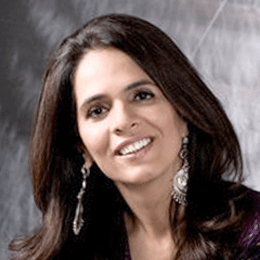
The Indian fashion retail industry is witnessing a massive transformation with the growth of organised retail and increasing fashion sensibilities of the Indian mass consumer. Taking a cue from the emerging trends in the Indian fashion industry, Anita Dongre, lifestyle and fashion designer has created a niche in this space on the back of a strong market segmentation strategy and a well-planned retail presence.
If you’ve got it, flaunt it
The upper and upper middle class of the consumer segment does look where it is investing its money, even in the small things like apparels, but also wants to carry a style statement for the same. Eyeing an opportunity in the growing mass apparel market, Anita Dongre is bringing high street fashion to the mass consumer.
“As more Indian women step out to active working lives, they are looking for styles that draw upon Indian design influences and sensibilities, but are fresh, with cuts and silhouettes that are convenient to wear,” says Devangshu Dutta, Chief Executive, Third Eyesight. He also adds that the apparel market in India is far from saturated and in spite of the entry of international brands, there is ample scope for growth of Indian brands. “However, the challenge for design-based businesses in India is to create an organised structure that allows the business to scale.” Dutta adds.
Currently, Dongre’s brands’ retail presence is strong with 75 exclusive brand outlets and over 250 Multi Brand Outlets. She plans to expand her presence beyond Indian borders and fully transform into a global lifestyle brand. “We are looking to expand demographically, looking to expand to different continents.” Dongre shares.
Market segment must in fashion industry
In principle, for any successful business or marketing plan it is imperative to have a market segmentation strategy in order to understand who exactly the consumer/market is; and the fashion industry is no exception to this rule. Hence in order to expand her brand’s reach to various potential TGs, Anita Dongre categorised three kinds of probable consumer sets. Dongre explains, “We actually started with mid premium and mass segment and are now moving to offering a premium brand. We wanted to target all the segments and product the best in each. Our labels cater to various tastes and requirements and internally, we treat each brand as a separate unit when it comes to design, marketing and strategy.”
Her brand portfolio consists of high street Western wear label AND, Indo-Western fusion labels like Global Desi and IInterpret, Timeless bridal wear, Grassroot that caters to ethnic fashion and organic wear, and AD Man, which is her foray into menswear. Most of her brands have strategically occupied the shop in shop format in various lifestyle chains like Shoppers Stop and Pantaloons.
Though multi brand outlets sport many such designer brands which do create awareness for these products but also are not able to compete with mainstream brands such as Levis, Pepe, UCB and USI etc. Hence, Third Eyesight’s Dutta feels that the strongest brand is one that stands out as distinctive in a department store environment and also has the ability to support a stand-alone exclusive store. For that, the product range has to be both wide and deep, and the ‘handwriting’ of the brand must be distinct from its competitors, season after season. Dongre has hence kept the emerging fashion consciousness among men consumers and started an apparel line catering to the same. She adds, “We have also started small with Timeless and AD Man and are looking to take these two all over India.”
Explaining the fashion industry structure at apparel design segment, V Rajesh, retail subject matter expert says that there are three levels the top end, that have players like Rohit Bal who cater to specific targets and extremely niche category, at the next level there are these top end designers who have their own line of clothing and boutiques like Ritu Beri, and at the bottom there are those who are from the merchandising background and design for major retail outlets like Shoppers Stop and Lifestyle. Dongre fits all the three.
Hence, he adds that apparel is more a functional product with the change of trends and time the role of the designer who has a more hands on job also changes accordingly. “In addition, these affordable designers have a plus point, they have a craving to be unique and stand out. That is why they look for clothes that are affordable as well as have a signature design. The only minus point in that in India nobody has respect for intellectual property rights,” he adds. Thus, there is a lurking threat of imitation in the apparel market in India.
Affordable designer tag
Nevertheless, the retail expert thinks that today the mass segment obviously cannot afford apparel showcased in Lakme or Wills fashion week. Thus, if they get a chance of getting apparels by the same designer at a much affordable rate, it is a good proposition for both the consumer and the marketer.
Thus, the budding apparel entrepreneur has consciously kept the prices of her more popular brands AND and Global Desi between Rs 1,500 and Rs 4,000. Thus, the value for money proposition and a designer tag not only suit the pockets of her various TGs but also fills the aspirational need of the consumer.
In addition, according to brand expert and columnist Santosh Desai, Indians are bent up on value for money, they look at the price point and from that perspective there are many different designers to look at in today’s market. The Indians look at affordable apparels that have got the signature tags of these designers. “Therefore we see a balance being created between the seriousness of the designers and the price tag that comes with their signature apparels,” he adds.
Desai strongly feels that there is an overall need in the market today and there is a good opportunity for designer brands to flourish. As Indians look for originality that distinguishes them from the mainstream, these designer brands are changing their view from being on the top end of the pyramid to catering to the masses at the bottom too. “In the case of Anita Dongre, she has originality and distinguished design that attracts the market, also she has many brands running under one umbrella and a more than one line of apparel,” Desai sums up.
admin
June 6, 2012
Priyanka
Golikeri , Daily News & Analysis (DNA)
Bangalore,
6 June 2012
 For
IT professional Meena Sarma, living in Mysore no longer implies
a small-town existence. The historical city has everything, from
corporate parks and hotels to dazzling malls.
For
IT professional Meena Sarma, living in Mysore no longer implies
a small-town existence. The historical city has everything, from
corporate parks and hotels to dazzling malls.
Being a shopaholic, she is glad that from salad dressings and Dutch cheese to the latest apparel and footwear brands, everything is available within reach, the precincts of her neighbourhood or office complex, just like in any other megalopolis.
A welcome change, says Sarma, as this was not the scenario some
years ago. Earlier, we could shop only at neighbourhood mandis
and local stores, she says. “As there were hardly any supermarkets
and hypermarkets within easy reach,” she adds.
This meant stocking up on her favourite food and clothing brands during every visit to Bangalore. Nowadays, the 28-year old, who earns Rs. 35,000 monthly, prefers buying groceries and perishables from any of the organised outlets dotting her street.
At least thrice a week, she ends up making a trip to the supermarket,
spending an average Rs. 200-300 per visit. In contrast, her visits
to the local kiranas have come down to a trickle.
“Unless it’s a sudden realisation of oil or flour getting
over at home, I don’t visit the provision store next door.”
Sarma likes the air-conditioned ambience, the discounts on MRP given on certain products, not to forget the spread of international savoury and dairy food.
Tier II towners like Sarma, who breeze into retail outlets twice or thrice a week, are a chief reason behind the surge in growth in modern trade in non-metros. Data by Nielsen show that tier II markets like Surat, Indore, Jaipur, Vizag and the like are witnessing rapid growth in modern trade (see table). Not only are these places registering strong double-digit numbers, but are often clocking more growth than established markets like Mumbai, Chennai and Kolkata.
Like the metropolitan shopper, tier II and III town shoppers also display the same purchasing power and willingness to buy a wider category of brands, say experts. Jamshed Daboo, CEO, Trent Hypermarkets, says there is a distinct trend towards shopping in a modern environment that offers a variety of local and international products. Trent has 15 hypermarkets measuring 35,000-80,000 sq ft, including those in small towns like Aurangabad, Surat and Kolhapur.
Others like Spar have outlets in towns like Coimbatore, Vijaywada and Mangalore spread across 35,000-40,000 sq ft.
Likewise, the Bharti Walmart joint venture also has a presence in tier III towns like Ludhiana, Guntur, Meerut, Agra, Amravati and the like. It operates 17 wholesale cash-and-carry stores spread across 50,000-100,000 sq ft in such places. “Often, breakfast cereals, canned food, jams and salad dressing are hot favourites with customers,” says Daboo, adding that all the stores stock products by British retailer Tesco – with which Trent has an agreement – and other international goods priced between `30-500 per unit.
Devangshu Dutta, CEO of consulting firm Third Eyesight, says tier II towns have done well for retailers primarily because rentals and other associated costs are lower while competition from modern trade is limited.
“But the challenge is to ensure there is repeat purchase and basket sizes are gradually upgraded with people buying more rather than splitting their baskets across stores,’’ says Amitabh Mall, partner and director, Boston Consulting Group.
The consumer basket is often split between stores as people still prefer to go to traditional stores for certain products. “Like buying rice from mandis or fruits and vegetables from the local sabziwalla,” says Mall.
Also, though stores in small towns exude optimism, at times the productivity is just marginally below those in metros, according to experts. General outlets in metroes spread between 80,000-1 lakh sq ft witness monthly footfalls exceeding 6-10 lakh. But in small towns, the picture is slightly different, as stores are smaller in size and population less.
Dutta says a small town may not be able to support a store more than 15,000-25,000 sq ft, even with a similar “one-stop-shop” offer.
Says Viney Singh, MD, Max Hypermarket India, “Our stores in small towns have an average footfall of 150,000 per month and this is growing at about 5%.’’
