
admin
September 30, 2015
Raghavendra Kamath, Business Standard
Mumbai, 30 September 2015
 It might not exactly be a battle zone, but the historic south
Mumbai neighbourhood of Fort recently witnessed a quiet retail
war. Not very far from the Bombay High Court runs a busy street
that leads to US coffee chain Starbucks’ first Mumbai store.
Situated near Horniman Circle, a stone’s throw from the Bombay
Stock Exchange, the store experienced quite a crowd when it first
opened. Along the usually crowded street leading up to it are
a dozen other shops that jostle for attention, among which is
a store that has shut down and whose signboard reads ‘The
Lounge’.
It might not exactly be a battle zone, but the historic south
Mumbai neighbourhood of Fort recently witnessed a quiet retail
war. Not very far from the Bombay High Court runs a busy street
that leads to US coffee chain Starbucks’ first Mumbai store.
Situated near Horniman Circle, a stone’s throw from the Bombay
Stock Exchange, the store experienced quite a crowd when it first
opened. Along the usually crowded street leading up to it are
a dozen other shops that jostle for attention, among which is
a store that has shut down and whose signboard reads ‘The
Lounge’.
It’s not unusual to see a shut store in Mumbai’s many
alleys and bylanes, but what’s interesting about this closed
outlet is that it used to be run by one of India’s oldest
and largest coffee chains — Café Coffee Day (CCD).
The story goes back to October 2012, when Tata Starbucks, an equal-stake
joint venture between Tata Global Beverages and Starbucks Corporation,
opened its first store in India in the aforementioned locality.
CCD, owned by VG Siddhartha, wanted to take the fight to the enemy
camp. The Lounge was one such format aimed at countering the sophisticated
look and feel of Starbucks.
The nearly 2,000 sq ft outlet clearly was no match for the global
coffee giant’s maiden store. While business picked up for
the new store, customers deserted CCD’s The Lounge, eventually
leading to its closure sometime in mid-2014. Although Starbucks
is a relative newbie on the Indian café circuit, its brand
recall and growing presence — over 75 outlets in two years
— is giving customers who grew up with CCD a chance to switch
loyalties.
Take Ratnesh Jain, 18, a college student who keeps track of every
penny he spends. Depending on how much time he has on his hands
and the location that is most convenient to him, Jain picks either
a CCD or Starbucks outlet to meet-up, although he says he clearly
prefers Starbucks, a departure from his choice in the past. “It’s
difficult to match the service and ambience of Starbucks. Not
just that, Starbucks delivers value for money in terms of a better
menu with larger and more delicious helpings, as compared with
CCD,” reveals Jain while sitting at a CCD store in upmarket
Colaba.
Jain goes on to explain, “For a very small portion of a
Dark Fantasy cake, CCD charges about Rs. 100, plus extra for toppings,
taking the entire bill to about Rs. 200. Starbucks, on the other
hand, charges around Rs. 200 for a similar dessert and offers
a much larger portion, complete with toppings.” Jain doesn’t
mind that CCD doesn’t offer him free Wi-Fi, although he feels
the pinch of the coffee and food not matching his palate. Many
others like Jain have developed a newfound loyalty for Starbucks,
where they say they find better service and ambience. “You
don’t mind paying more in return for better ambience, lively
atmosphere and an eclectic menu. CCD got lucky as it had a first-mover
advantage and customers did not have much choice back then,”
points out 20-year-old student Ketaki Sharma. She is a regular
at Starbucks and spends hours working on college projects there,
along with her classmates and friends.
Yet another Starbucks patron — 20-year-old Damini Kane —
says there is a clear difference between the service standards
of Starbucks and the rest of the café chains in India.
“CCD should certainly focus on improving its menu, becoming
more customer-friendly and, importantly, make its cafes more inviting,”
says Kane. At a Starbucks outlet, you might find everyone from
office-goers to students, tourists and the like making full use
of the uninterrupted free Wi-Fi.
In response, CCD tried to field the same proposition to draw
in customers and not all loyalists switched camps. Youngsters
like Pakhee Malhotra are clearly not buying into Starbuck’s
phoren halo. “Starbucks doesn’t sell good coffee. It
sells overpriced coffee. To pop about Rs. 200 for a Grande Caramel
Macchiato you must have a really rich dad. Hats off to you for
drinking away money like that,” writes Malhotra in an article
on iDiva. Though this counterpoint seems to favour CCD, in an
age of growing competition and fickle brand loyalty, it needs
to look at ways to fire up its brand pull and improve customer
satisfaction. While the café chain has its task cut out
when it comes to creating a great consumer experience, the 55-year-old
Siddhartha deserves accolades for the manner in which he built
— and, more importantly, ran profitably — an enviable
coffee business for the past two decades.
Freshly ground
The idea of setting up cafés was not even on the agenda for Siddhartha, the son of a coffee plantation owner who is married to the daughter of SM Krishna, the former chief minister of Karnataka. “Getting into the coffee business was incidental. We started off exporting coffee and realised two years later that it would not take us too far,” says the reclusive billionaire as he makes himself comfortable at the Lounge outlet at Nariman Point, the central business district of Mumbai. It was in 1994 that he came across an article on a German company called Tchibo, which started off as a 10×10 store in 1949 to finally emerge as a chain of coffee retailers and cafes.
“I was inspired by that and started with 20 stores in south
India selling coffee powder. In 1995, we decided to take the café
route, since there was a bigger opportunity for value addition
there. In the coffee powder business, the mark-up is 100%, while
in the café business it is as much as 800-900%,” points
out Siddhartha. Taking inspiration from how other international
brands went about building their businesses, Siddhartha and his
team started putting the company together.
While exports continue to be a part of the business, the coffee
arm today comprises a café network, which includes the
value format of CCD, The Lounge for trendy and affluent customers
and The Square for coffee connoisseurs. While Lounges (between
1,000 sq ft and 1,300 sq ft) and Squares (between 2,500 sq ft
and 3,000 sq ft) are located at expensive locations that attract
more affluent clientele, the CCD outlets are at more affordable
locations.
Besides, the company also sells vending machines to institutional
and individual clients, sets up kiosks and is selling brewed coffee
powder through Fresh & Ground branded outlets. (See: A distinct
flavour) When CCD entered Mumbai 14 years back, it opted for smaller
stores as the team wasn’t confident that the market was ready,
apart from the fact that rentals were too high even back then.
“Had we opened 1,500-sq ft stores in Mumbai at that time,
we would have gone bankrupt. Our key competitor at that time was
paying 70% of revenue only towards rent,” points out Siddhartha.
Interestingly, CCD did not opt for expanding through the franchisee
route and instead chose to spend its own capital. However, to
counter high rentals, it entered into revenue-sharing agreements
with corporates as well as fuel stations. At present, 25% of its
outlets are run on a revenue-share model.
“We have five to seven corporate relationships where we
only have revenue-sharing agreements. For them, CCD becomes a
complementary service,” mentions Siddhartha. Highlighting
the ownership approach, the company’s draft prospectus mentions
that complete ownership allows it to control all the operational
aspects of its café operations, thereby, ensuring that
it is able to deliver a consistent experience to its customers.
From a one-store-one-outlet (Coffee Day Cyber Café) format
in Bengaluru to around 1,500 stores, CCD today has a stranglehold
over the café market. Over the past two decades, quite
a few players have come in and set up shop, but none could match
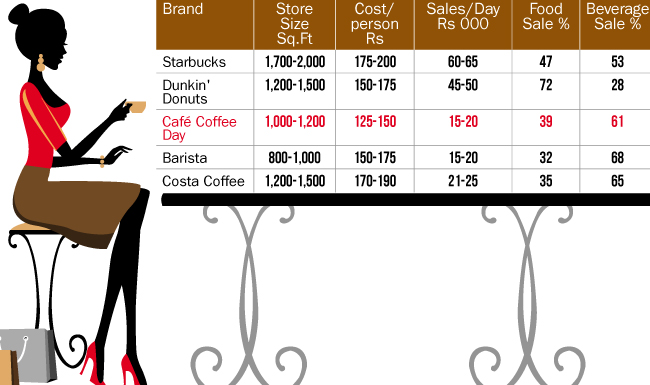
the speed and scale at which CCD grew. Barista, which set up shop
in 2000, is a distant second with 169 outlets, followed by Costa
Coffee with 89 outlets.
Although Barista initially started operations with premium pricing, it rejigged its strategy mid-way, making its menu more affordable. But that has not worked for the coffee chain, which has already changed hands twice. The other fringe players in the café business include the California-based The Coffee Bean and Tea Leaf and home-grown Mocha. Australia’s Di Bella Coffee, which had a troubled presence in the country after exiting a JV in 2013, is now re-entering the market with a new licensee, Electel.
Putting CCD’s growth in perspective, Saloni Nangia, president,
market research, Technopak Advisors, says, “Café Coffee
Day had a very aggressive expansion strategy and it looked at
smaller cities, too. It did not limit itself and adapted formats
depending on the size of the location, thus, ending up in all
sorts of nooks and corners.”
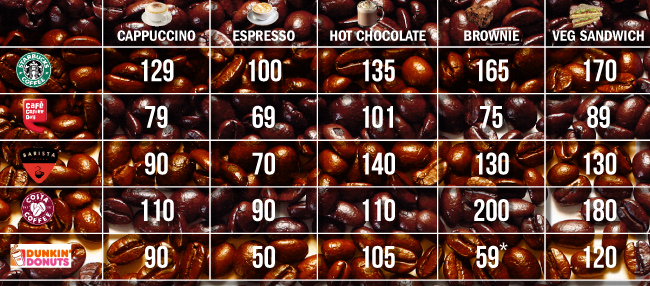 Pricing is another aspect that CCD built its plank on. For a
little perspective, a small portion of cappuccino at Starbucks
is priced at about Rs. 129, while it comes for Rs. 79 at a Café
Coffee Day outlet. A sandwich at Starbucks, however, costs no
less than Rs. 170, while at Café Coffee Day one can have
it for Rs. 89. Today, unlike Starbucks, the café network
has four different price points.
Pricing is another aspect that CCD built its plank on. For a
little perspective, a small portion of cappuccino at Starbucks
is priced at about Rs. 129, while it comes for Rs. 79 at a Café
Coffee Day outlet. A sandwich at Starbucks, however, costs no
less than Rs. 170, while at Café Coffee Day one can have
it for Rs. 89. Today, unlike Starbucks, the café network
has four different price points.
For instance, what it charges at an uptown Mumbai outlet will
be very different from what it charges in Navi Mumbai, a Greater
Mumbai Metropolitan suburb. On average, however, CCD is still
the cheapest among the café and quick service restaurant
(QSR) chains. “We are 57% cheaper than the competition. Will
they reduce prices by 40% and still be able to pay their rentals?”
quips Siddhartha. While he does have the upper hand over his rivals,
CCD has its own share of problems.
Storm in a coffee cup
Over the past four years, the vertically integrated CCD has had to shut over 300 stores, even as it opened close to 700 stores over the same period. A record 175 outlets were closed in the nine months of FY15 alone . The company’s draft prospectus mentions that in 2014, it undertook a strategic review of its café network and decided to close certain cafés due to their smaller size, lower levels of performance and higher rentals on renewal of leases.
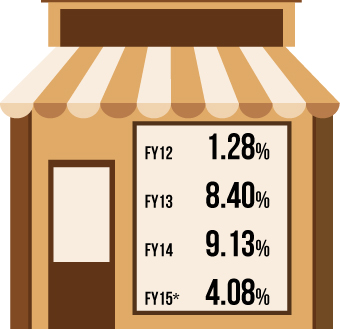
Putting the development in context, Siddhartha explains, “In Mumbai, 10-12 years ago, we took on lease 400 sq ft stores, which does not make much sense in today’s day and age. Also, ahead of the listing, we wanted to do a one-time clean-up.” Incidentally, amid the closures, CCD’s average sales per day (ASPD) per café grew by 3.9% from FY12 to FY13 and by 11% from FY13 to FY14, further increasing by 13% to Rs. 13,505 for the nine months of FY15.
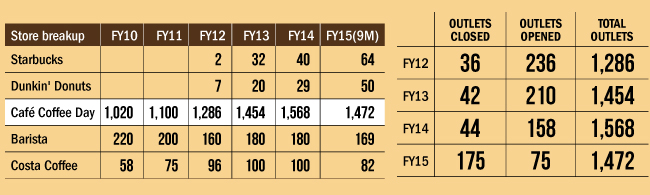 With an average store size of 1,700-2,000 sq ft and average spend
per person of Rs. 175-200, Starbucks delivers ASPD in the range
of rs. 60,000-65,000, nearly four times that of CCD and Barista
(See: Far from hot). Industry observers believe the spurt in CCD’s
average customer spend could partly be because of the high level
of closures in FY15 and the fact that it has opened just 79 outlets
in the nine months of FY15 against 158 for the whole of FY14.
With an average store size of 1,700-2,000 sq ft and average spend
per person of Rs. 175-200, Starbucks delivers ASPD in the range
of rs. 60,000-65,000, nearly four times that of CCD and Barista
(See: Far from hot). Industry observers believe the spurt in CCD’s
average customer spend could partly be because of the high level
of closures in FY15 and the fact that it has opened just 79 outlets
in the nine months of FY15 against 158 for the whole of FY14.
Siddhartha, however, is not giving up on his expansion plan.
The company plans to spend Rs. 88 crore from the proposed IPO proceeds
to set up 216 outlets and 105 kiosks by FY17. “The way I
see it, India can have thousands of stores on the highways at
our price point. On the Kanyakumari-Madurai highway, we have two
stores; between Goa and Mangaluru, we have three. That is a very
small number. We have sold 1.3 billion cups of coffee and tea
this year. Over the past five years, we have grown 30% in that
business. This is only the beginning of our growth story,”
he avers.
However, after getting aggressive with the Lounge and Square formats to take on Starbucks, Siddhartha had to scale back his plans as he found the move unviable. According to sources, around 2011, Siddhartha wanted to have 25% of CCD’s total outlets under the Lounge and Square formats. But by 2013, realising that the capex involved for both the formats was twice that of a regular CCD outlet, Siddhartha decided to change tack.
 As a result, the Lounge format is restricted to 42 stores currently
and the Square format to just seven stores. Though Siddhartha
is a prudent competitor, what is helping him is that other café
players are happy playing second fiddle to CCD. “It is a
typical expansion curve. First, you aim for scale and brand recognition
and then focus on quality of profits as the model stabilises.
Our expansion is now value-based and profitability-centred. It
also has to do with market conditions and spending sentiment as
a whole,” says Virag Joshi, president and CEO, Devyani International,
which runs the Costa Coffee chain.
As a result, the Lounge format is restricted to 42 stores currently
and the Square format to just seven stores. Though Siddhartha
is a prudent competitor, what is helping him is that other café
players are happy playing second fiddle to CCD. “It is a
typical expansion curve. First, you aim for scale and brand recognition
and then focus on quality of profits as the model stabilises.
Our expansion is now value-based and profitability-centred. It
also has to do with market conditions and spending sentiment as
a whole,” says Virag Joshi, president and CEO, Devyani International,
which runs the Costa Coffee chain.
CCD, however, will have to counter competition that is slowly
building up from QSR players such as Dunkin’ Donuts and McDonald’s’
McCafe. Dunkin’ Donuts has opened 50 stores since its entry
in 2012. In case of McDonald’s, which introduced the McCafe
brand three years ago, the economics work out even better, as
the new brand is run from within the existing McDonald’s
outlet, thus saving on rentals.
Amit Jatia, vice-chairman, Westlife Development, the master franchisee
of McDonald’s in west and south India, says, “What works
for us is that we already have about 210 restaurants at prime
locations in the west and south markets, with about 50-odd McCafes
within them. What this format does is bring incremental revenue
for us without any extra real estate costs. We already have accessibility,
so what we are doing is introducing our customers to coffee and
subsequently ramping the business up.” McDonald’s plans
to take up the McCafe count to 70 by the end of FY16 and nearly
double that number in another two years.
Jatia acknowledges that the coffee business in India is nascent
but growing. What he’s betting on, however, is the potential
that the category promises. “The real café chain story
will unfold over the next two to three years. The market could
get polarised. McCafe is not just about coffee but doubles up
as a beverages platform for us as well, and we have to ramp it
up quickly,” he adds.
Just like McDonald’s, Jubilant Foodworks, which introduced
the Dunkin’ Donuts brand in India, sees the brand serving
the dual purpose of a QSR and a café chain. Dev Amritesh,
president and CEO, Dunkin’ Donuts, says, “We are in
a sweet spot between a QSR and a café. This kind of positioning
is very nascent and the opportunity to create an interesting experience
is immense. Donuts differentiate us from the rest — the product
has a strong novelty and pull factor. It complements the category,
which is important to the overall business.”
Gimme more
While no one can beat CCD in terms of its scale, with Starbucks, Dunkin’ Donuts and McCafe entering the picture, industry benchmarks have moved up significantly when it comes to customer experience. In other words, even as it has one eye on profits, Coffee Day Enterprises will have to ensure a greater consumer pull.
“It has scale but still needs to work on experience management, wherein similar customer experience is delivered across the chain. It remains to be seen how CCD will fare wherever it has multiple coffee and QSR chain brands around it,” feels Nangia.
Concurring with the view is Devangshu Dutta, chief executive, Third Eyesight, a retail consultancy. “A significant threat to older café chains lies within their own business. The biggest challenge in this sector is making sure that brand desirability, ubiquity and product-service consistency are balanced. Indian chains run the risk of becoming less desirable as compared with international brands, or may deteriorate in their product-service consistency with rapid growth.”
And while Starbucks with its limited presence may not be a challenge
for now, what it has done to the detriment of CCD is that it has
spoilt the consumer, especially the youth segment.
“Starbucks has made our customers more demanding. They want the experience of Starbucks at CCD prices. Today, 60% of CCD’s business is generated by repeat customers and 40% by new customers. The big challenge is getting the share of the 40% without losing the existing 60%,” says an ex-CCD employee. The challenge for Siddhartha in creating a greater consumer experience is multi-pronged, as it involves staff, the right menu mix and investing in a better ambience. Point to staff-related issues and Siddhartha says, “We have 13,500 people working for the brand. Yes, we have attrition, although employees at above-the-store level have stayed with us. At the top level, we have 700 people with an attrition of not more than 5-6%.” But the issue is with the front end, which deals with customers. “We interview 100 and shortlist 30, but at the end just 15 join us, and they, too, do not last for more than a year,” says an insider.
Siddhartha does not refute the observation. “For someone
earning Rs. 10,000 per month in Mumbai and having to travel two hours
to work, the quality of work is always a tricky issue. However,
training can make things better.” Initially, the staff was
trained for just six days, but over the past year-and-a-half,
the company has adopted a policy of retraining recruits a month
later, for another 10 days.
“We have a school in Bengaluru where 500 people are trained
each year. If we increase our training programme from six days
to three months, the quality will improve tremendously,”
opines Siddhartha.
When it comes to creating a good ambience, Siddhartha says that
in Mumbai alone, CCD has opened 20 stores of over 1,000 sq ft
each. “These stores have a better ambience and are as good
as any international cafés.”
Realising that existing cafés, too, would need sprucing
up, the chain is looking to spend Rs. 60 crore on refurbishment
of existing outlets, besides improving vending machines. The other
critical challenge that the chain needs to work on is the inconsistency
in the quality of its beverages and its limited food menu. In
the cafe´ market, beverages primarily dominate the stock
keeping unit and sales mix, given the nature of the coffee retail
space.
For CCD, beverages contribute 61% and the rest comes from food.
Starbucks, on the other hand, has an average beverage sales contribution
of 53% and the rest is food. In an earlier interaction with Outlook
Business, Avani Davda, CEO, Tata Starbucks, had mentioned, “Food
will definitely be a key part of our business here and it is something
we will focus on.” In fact, Taj Sats has helped the chain
develop a menu that keeps in mind local preferences. So, there’s
a cardamom-flavoured mawa croissant that Davda says has “done
quite well”, besides tandoori paneer roll, murgh kathi wrap
and chatpata paratha wrap, among others.
In the case of CCD, till two years back, food was sourced from 210 vendors and today, that number is down to just four. Siddhartha is clear about the revenue mix that he is comfortable with. “Food is complementary and we will do things like serving a cookie with a cappuccino. We want to keep that 60% intact. Food will never exceed 40% of our revenue.” Coming to inconsistency in terms of coffee taste, Siddhartha points that CCD sources handcrafted coffee, which makes the taste inconsistent. “A lot of companies have the technology for mechanised brewing. We, too, can manufacture our own machines and that can be done when we think we need to.”
If CCD has to increase its same-store sales growth and profitability, it will have to look at ways to offer consumers more menu options, especially at a time when expansion will eat into profits on account of depreciation. “Fundamentally, CCD will have to work on improving its billing value,” says Nangia.
Given that the company reports profitability for the entire coffee segment, it’s not clear if the café business is profitable on a standalone basis. “Typically, 30% of CCD outlets bleed, 40% barely break even and the remaining 30% drive the business,” says a company source. In fact, profit from coffee and related businesses for FY14 was Rs. 25 crore, a decline of 19% from the same period a year ago, although it bounced back to Rs. 30 crore in the nine months of FY15.
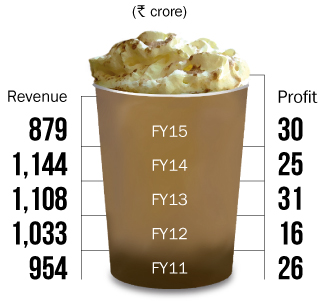
Though coffee and allied businesses account for over 50% of revenue and are profitable, on a consolidated basis, the entity has been loss-making for the past three financial years — all through FY14 and in the subsequent nine months of FY15, with a consolidated debt of over Rs. 2,800 crore. Of this, the debt in the coffee retail business accounts for only Rs. 300 crore, of which the promoter plans to repay Rs. 125 crore.
The company, which counts KKR and Rakesh Jhunjhunwala among its
investors, aims to utilise Rs. 633 crore — about 55% of the
issue proceeds — towards partial repayment of loans availed
by the company and its subsidiaries and invest the balance towards
expansion of its coffee business. Jatia believes that the IPO
will help CCD keep its momentum going. “CCD has been a front-runner
for coffee in India. Once it has additional funds, it will be
able to reinvent itself,” he feels.
Clearly, Siddhartha realises that the café market might just be hitting escape velocity and he does not want to let go of the opportunity. “I would be kidding myself if I say I have got it 100% right. We realise we have made mistakes and will rectify that, although you must also look at great American brands and how they were placed when they were 20 years old,” smiles Siddhartha, as he eyes customers who have just made themselves comfortable at The Lounge.
(Published in Outlook Business.)
admin
September 27, 2015
 Kaushikibrata
Banerjee and Utsav Basu, Millennium Post
Kaushikibrata
Banerjee and Utsav Basu, Millennium Post
New
Delhi, 27 September 2015
 Creative
cafes, restaurants and delivery joints are slowly but steadily
creating a whole new culture in the Capital.
Creative
cafes, restaurants and delivery joints are slowly but steadily
creating a whole new culture in the Capital.
A food capital as it already is, Delhi is a labyrinth of connections that interlinks one neighbourhood to another and most importantly, migration has been a steady theme in this city giving rise to an array of preferences and predilections. So, do we consider it to be a fortunate adventure? Give in to the indulgence and find out for yourself.
These days, professionals are either working through the night or are awake watching movies, TV shows or partying hard. Since they are up at odd hours, they often feel hungry much after restaurants close – like midnight snacks and beverages or are in need of other essentials like medicines as well.
There are a number of outlets indulging in this business these
days. But what is interesting is the fact that these outlets are
not evenly spaced out all over the national Capital. Enviably
so, these 24×7 outlets are concentrated in particular areas like
Gurgaon and South Delhi respectively. Some of the most popular
midnight delivery services are Batman Delivers, Midnight Munchies,
The Night Shift, Cravebusters, Midnight Cravings, Captain Grub
and the like.
You can order the best of biryanis, kathi rolls, salads, sandwiches, pastas, pizzas and even paranthas from Batman Delivers, apart from party items and medical essentials, cigarettes, tissue papers and disposable plates/cups. They deliver in Gurgaon and South Delhi but you have to pay a delivery charge of Rs 50 with an approximate delivery time of 40 minutes.
Midnight Munchies operates in South Delhi and offers delicious vegetarian and non-vegetarian meals like pizzas, noodles, wedges, nuggets and chicken bomber sandwiches, along with soft drinks, juice and packaged water. They do not have any delivery charges but the minimum order has to be upto Rs 350. Cravebusters is a popular late night delivery service, operating in 130 localities in Delhi NCR and promises hot and delicious food every time. Known for their unbeatable burgers, Captain Grub functions in South Delhi and Gurgaon only. Midnight Cravings is located at Vikas Marg and delivers around East Delhi.
These are just a few examples which show the concentration of 24×7 food outlets only in Gurgaon and South Delhi. Keeping this in mind, it has become very important to understand the reason why they are spaced out the way they are and what business orientations the owners have that have encouraged them to open such outlets in these respective areas only.
Sangeeta Singh, Head of Street Food Programmes, National Association of Street Vendors of India (NASVI), explains: “As far as I understand, South Delhi is considered to be a very posh area and has a history of its own. Most people residing there are bureaucrats and businessmen who have a very rich background. East Delhi or the Trans Yamuna as it is called was never a good choice in the 1970s and 1980s for residential purposes.”
Elaborating on how the different strata of society are spaced out in the national Capital, she goes on to say: “Delhi being the capital attracts people across India for a better future. The city has very good mix of working class, educated and un-educated business class, landlords comprising the local Gujjars and Jats, migrant workers (unorganised sector). The social strata of Delhi have unique characteristics as compared to other Metros or big cities in India. Old Delhi is dominated by the local business class, South Delhi by locals as well as educated business class and bureaucrats; North mostly by the Punjabis, East Delhi is dominated by migrants from Bihar and Uttar Pradesh while West is again a mix of Punjabis and migrants.
Prof J S Rajput, Former Director of NCERT, elaborates on how important social profiling is to run a business. He goes on to say: “Who has not seen young people in their executive suits and ties, sweating on roadside stalls, grabbing a plate of noodles working through long hours trying to crack a deal. In business, it is all about profiling. It is all about making an impression which will help them start and run a business successfully. Everything else is secondary.”
Highlighting on why there are a lesser number of 24×7 food joints or essential outlets in East Delhi compared to South Delhi and Gurgaon, Sangeeta Mittal, Associate Professor, Department of English in Maharaja Agrasen College, says: “There are lesser number of 24×7 outlets, I think, due to law and order constraints and lifestyle of lowerandmiddle middle-class in the area. People who work during the night or require to access groceries or drugstores after midnight are very few.” She tries to reason out the cause behind the concentration of such food joints in South Delhi and says: “I think the elite class refers to the high income groups. While some people are those who have been living in South Delhi since Independence and Partition in what began as refugee settlements making it big later in life, the rest are those who shifted after Independence to cash in on the developing political and professional opportunities in Delhi. Diplomats, NRIs, MNC workers, government servants and many more today stay there due to proximity to their workplaces.”
Mittal further adds: “Delhi has a cyclical demography. People prefer to live nearby to where they work. They also live where they are able to afford rent or to purchase property. But more well-to-do then shift to places with more spacious and luxurious houses, more sophisticated and safe urban housing options and locations with more facilities and better urban planning, if these locations are in peri-urban spaces like Gurgaon, Noida or farmhouses in what has today become Delhi NCR. The spaces vacated by them are occupied by the upwardly mobile aspiring migrants who continue to flock to Delhi for educational or professional reasons.”
Devangshu Dutta, head of retail research group, Third Eyesight says in a report: “There is an emerging consumer segment that works longer hours, especially among the workforce in the country’s outsourcing and technology industry. There has to be something catering to them.”
Technology and new-age entrepreneurship have changed the face of food ordering business in India. Today, you can order ingredients for a Greek salad or have biryani flown from Hyderabad to any city through apps on your mobile phone or at the click of a mouse. But in hindsight, it is a developing business and though several areas need to be incorporated within its ambit, the craze is growing slowly but steadily. And with that, the need for more 24×7 essential outlets is increasing by the day.
So, leave alone the physical component of a midnight craving and stop being overwhelmed by the need. Here’s your lip-smacking delight at 3 am, waiting for you to dig in. Now, whether up for an exam or watching matches till late night, bored at work or feeling low and stressed out at the crack of dawn, no need to introspect for inner peace. Just pick up the phone and order your favourite meal, for the night is still young!
"There are lesser number of 24×7 outlets, I think, due to law and order constraints and lifestyle of lower and middle-middle-class in the area. People who work during the night or require to access groceries or drugstores after midnight are very few- Sangeeta Mittal, Associate Professor, English Department, Maharaja Agrasen College
"South Delhi is considered to be a very posh area and has a history of its own. Most people residing there are bureaucrats and businessmen who have a rich background. East Delhi or Trans Yamuna as it is called was never a good choice in the 1970s and 1980s for residential purposes – Sangeeta Singh, Head of Street Food Programmes, National Association of Street Vendors
(Published in Millennium Post.)
admin
September 25, 2015
Sapna
Agarwal, MINT
Mumbai,
25 September 2015
 With brands like Zara and Forever 21 gaining acceptance and rapidly
growing their businesses in India, Kishore Biyani-led Future Lifestyle
Fashions Ltd has set up a design studio in London to tap into
the vibrant fast fashion market. The studio will launch its first
fast fashion brand with global design sensibilities in spring-summer
2016
With brands like Zara and Forever 21 gaining acceptance and rapidly
growing their businesses in India, Kishore Biyani-led Future Lifestyle
Fashions Ltd has set up a design studio in London to tap into
the vibrant fast fashion market. The studio will launch its first
fast fashion brand with global design sensibilities in spring-summer
2016
Located in Victoria, London, Future Style Lab houses an international
team of designers and merchandising experts. It will infuse the
brands Future Lifestyle sells such as Lee Cooper, Indigo Nation,
Scullers, Urbana, John Miller, Jealous 21, UMM and RIG with a
global design ethic, besides curating the new fast fashion brand.
“Indian fashion is evolving at a rapid pace and incorporating
global trends and sensibilities. Women in India today shop for
fresh fashion 8-10 times a year. Our design studio in London will
develop a fast fashion brand that responds to these needs and
infuses our brands with global sensibilities and innovation in
design and sourcing,” said Kishore Biyani, managing director,
Future Lifestyle Fashions.
London’s Victoria district has emerged as the new fashion
hub. While the likes of designer Tom Ford and luxury label Burberry
have their headquarters in the neighbourhood, offices of lingerie
brand Victoria’s Secret, fashion label Dolce and Gabbana,
luxury behemoth Richemont and shoemaker Jimmy Choo are in close
proximity.
The company has hired Manjula Tiwari from fashion and lifestyle e-tailer Jabong to lead Future Style Lab. Tiwari has over two decades’ experience in the fashion industry and was invol-ved in introducing global brands such as Espirit and United Colors of Benetton in India.
The design team will be led by Ainsley Dart, who has directed large design teams of multi-product, fast fashion brands and worked with textile suppliers such as Courtalds and Dewhirst.
Biyani’s plan to launch a fast fashion brand comes at a time when Swedish fashion retailer Hennes and Mauritz AB (H&M) is ready to launch its first store in India in October. UK-based Arcadia Group’s fashion brands Topshop and Topman made their debut in the Indian market with fashion e-tailer Jabong in the past week. Topshop has about 400 new styles hitting its 300 stores in the UK every week. These are then available at all its global stores and geographies within a week of launch.
“The plan is to make these available in India as well,” said Jacqui Markham, global design director, Topshop.
Moreover, existing global retailers like Zara, Forever 21 and Gap are also expanding in India. Since its launch five years ago, Spanish fast-fashion brand Zara, which has 16 stores in the country, has clocked revenue of Rs.721 crore for the financial year ended 2015—a growth of 24% over the year ago period.
Los Angeles-based Forever 21 has nine stores in India and plans to add five to six every year. “On average, each Forever 21 store does Rs.35 crore of business per year,” said Deepak Agarwal, CEO, DLF Brands Ltd, the brand’s joint venture partner in India in an earlier interview.
Likewise, US-based Gap Inc., which launched its first store in May in a franchise agreement with Arvind Brands, will have nine stores by the end of the fiscal, said J. Suresh, CEO, Arvind Brands.
The fast fashion business model is different from that of department stores or traditional retailers. It takes global fashion trends and makes them available within a very short time span—which could be a week or so—in stores. It involves continuous refreshes that keeps interest levels high among consumers who are fashion conscious.
Analysts believe Biyani will benefit by making the transition. “For Future Group, the fact that it is entrepreneurial and has its manufacturing base located here will allow it to do the continuous refreshes in good speed. It could work to its advantage,” said Devangshu Dutta, CEO at consulting company Third Eyesight.
(Published in Mint.)
admin
September 16, 2015
Varun Jain, The Economic Times
New Delhi, 16 September 2015
 Flipkart’s
‘Big Billion Days’ sale has yet again run into glitches this year,
and this time the ecommerce giant is tendering apologies to its
sellers in Agra whose products have been removed from the site
for almost two days now due to delivery issues.
Flipkart’s
‘Big Billion Days’ sale has yet again run into glitches this year,
and this time the ecommerce giant is tendering apologies to its
sellers in Agra whose products have been removed from the site
for almost two days now due to delivery issues.
Various vendors in the city ET spoke to complained that Flipkart
has blocked their products to be sold on its ecommerce site amid
a rush of consumers. They said the listings of their products
were not visible on the company’s website since the second day
of the mega sale event after they saw major traction on Tuesday,
the first day of sale.
"We were waiting for the Big Billion Days sale and have
kept ourselves adequately stocked to meet the consumer demands.
We got six times more order than what we usually get, on the first
day of the event. But on the second day we were surprised to see
our orders fell to zero. This is when we realised that something
is wrong," said an Agra-based vendor who sells artificial
jewellery on Flipkart.
One footwear vendor who received around 120 orders on day one said he has not been able to dispatch the whole order even on the third day because Flipkart’s logistics partner is only collecting partial orders, saying they have been asked only to collect certain orders owing to huge demand.
Experts said this reveals gaps in Flipkart’s logistics as the company has failed to cope with the huge amount of business the Big Billion Days is generating this year as well. The mega sale event had run into glitches last year when thousands of customers complained about products being sold out on the website even before they can hit buy button. There were complains of company intentionally increasing the prices of some products to make the discount look even bigger and the website also crashed several time. Eventually Flipkart’s co-founders Sachin Bansal and Binny Bansal had to apologize to the customers after the event.
Manish Maheshwari, vice president and head of sellers’ ecosystem at Flipkart, said consumer demand is around 40% more than the 3-4 times increase the company had expected "and there are implications of that".
"Being a marketplace, everything that is ordered by the consumer has to be supplied by the seller. And we have limited capacity in terms of how many people we have and how many collections we can do in a day," said Maheshwari. "So, it might be true that for a day we might have switched off the pick up from the Agra hub and therefore sellers in this region would have been impacted," he said.
"But they might have received enough demand on day one. This is a temporary block and we switch them back again once the backlog is cleared up," Maheshwari added.
According to the Agra vendors, they got an automated message from Flipkart on their seller account: "To ensure customers receive their orders on time and have a great experience buying your products, we have to temporarily restrict the order flow for sellers in your area. We will be reverting to normal order flow by tomorrow morning or as soon as the situation eases up. We apologise for the inconvenience and thank you for the continued support."
However, many vendors in Agra region said the services were not restored as of Thursday afternoon.
Some of the vendors said their listings were showing on Flipkart site/app, but consumers could not place order because either ‘Add to Cart’ option was disabled or they would be repeatedly greeted by ‘The item is currently unavailable in your pin-code’.
Devangshu Dutta, chief executive of retail consultancy Third Eyesight, said the peak capacity that Flipkart planned for Agra region might have reached and "now they were not able to pick any more orders to deliver".
"There is a very clear indication of the infrastructure gap," Dutta said. "If you are looking at rapid ramp up of business it cannot happen without the requisite infrastructure because all such infrastructure capacity planning has to be done on the basis of peak demand and if every time you are building up demand only to find it blocked by lack of capacity then obviously it is a problem," he said.
Another industry expert who did not wish to be named said it is a clear disappointment for vendors who are losing out on business, which they know is theirs as consumer orders were coming on day one. "There must be an investment made from the vendors’ side for one of the biggest sales in the ecommerce industry. That investment has essentially gone down the drain," the person said.
Maheshwari of Flipkart said that while it needs to add more capacities to meet the ever-growing demand, it is already following a scientific process to keep all stakeholders happy.
He said that when certain hubs starts getting more order than expected, the company switches off the collection hub of that particular region and the demand then gets diverted to the region where it is low. During this period, all the vendors linked to that collection centre will not be able to generate new orders. The company switches on the hub again once all the backlog has been cleared, Maheshwari said.
(Published in The Economic Times.)
admin
September 16, 2015
Ashish K Tiwari, DNA (Daily News & Analysis)
Mumbai, 16 September 2015
 "Quickest
delivery! Ordered an AC frm @snapdeal #electronicsmonday ystrdy
& zoom!its thr4 me today", reads a tweet by Sonali Jagwani,
a Delhi-based HR professional, summing up the mood at the ongoing
festive mega sale of e-commerce firms.
"Quickest
delivery! Ordered an AC frm @snapdeal #electronicsmonday ystrdy
& zoom!its thr4 me today", reads a tweet by Sonali Jagwani,
a Delhi-based HR professional, summing up the mood at the ongoing
festive mega sale of e-commerce firms.
As the sale by Amazon, Flipkart and Snapdeal entered fourth day
today, the online world was mostly praises.
@Flipkart MY #Wished_FullFilled after only 1 day wait, Flipkart
amazing" Thanks #BigBillionDays more to come, a tweet by
one of the shoppers was shared by Flipkart co-founder Binny Bansal.
This is in contrast with the last year, when e-marketplaces had
to face barrage of criticism on social media from consumers over
delayed, wrong deliveries, server crashes and pricing issues.
E-marketplace players too seem to happy with claims of millions of products sold, particularly in mobiles and consumer consumer electronics.
While Flipkart claimed to have sold half a-million mobile handsets in 10 hours, Snapdeal in its Diwali Dil Ki Deal campaign shipped five million orders so far. Amazon’s The Great Indian Festive Sale claimed categories like appliances, television, health and personal care and movies witnessed sales growth in the multiples of 3-7 times times over its previous biggest sale (The Great Indian Freedom Sale).
Calling it a blockbuster beginning for their mobile category sale, Mukesh Bansal, head of commerce platform, Flilpkart, said, "The Indian mobile revolution has truly come of age and the half a million mobile handsets sale record is truly a testament to the growing demand for smartphones in India."
P Sanjeev, director sales – Huawei & Honor Consumer products, tweeted that 1,000 units of their latest mobile handset Honor7 got sold out in less than an hour on Flipkart.
Flipkart had claimed sale of 1 million products in the first 10 hours of the sale with 25 items sold every second.
Flipkart, which is conducting the sale only on its mobile-app, said over 1.6 million mobile apps were downloaded two days prior to the sale.
SoftBank-backed Snapdeal, which saw five million app downloads on the Day One of sale, said it has set new benchmarks this time around: About 98.9% orders were dispatched within 24 hours of order placement, achieving 98.6% on-time delivery.
Jayant Sood, chief customer experience officer, Snapdeal, said the significant ramp-up in supply chain and technology capabilities has translated into superior customer value proposition. "There is a 350% increase in first-time customers and over 70,000 units of large-sized products like furniture, beds, TVs, and sofas have been shipped in just three days. The electronics sale has seen the highest demand for mobile phone with Rs 500 crore worth of phones sold on Snapdeal that day."
In view of the continuing strong demand Rs 200 crore worth phones are available today, he said.
While attractive discounts and pricing played their part, strategies like exchange offers and additional discount offers from banks YES bank, Standard Chartered and Citi Bank too help lure consumers. According to Flipkart, about 50% of customers availed the bank offers.
Commenting on the smooth execution by e-marketplaces for their respective festive sale offerings, Devangshu Dutta, chief executive, Third Eyesight – a retail consulting firm, said that e-marketplace operators have learnt their lesson from last year’s debacle. "They have been able to manage high traffic better this time around by scaling up efficiently on the server side. This has ensured a glitch-free shopping experience for customers. Having said that, I still think that challenges pertaining to physical infrastructure continues to be an issue and e-marketplaces need to address it properly and invest in," said Dutta.
But still consumers stayed sceptical.
"At Rs 675/- the price is unbelievable. Hope the material is good," read a comment below a description of an apparel posted on an e-commerce website.
(Published in DNA.)
